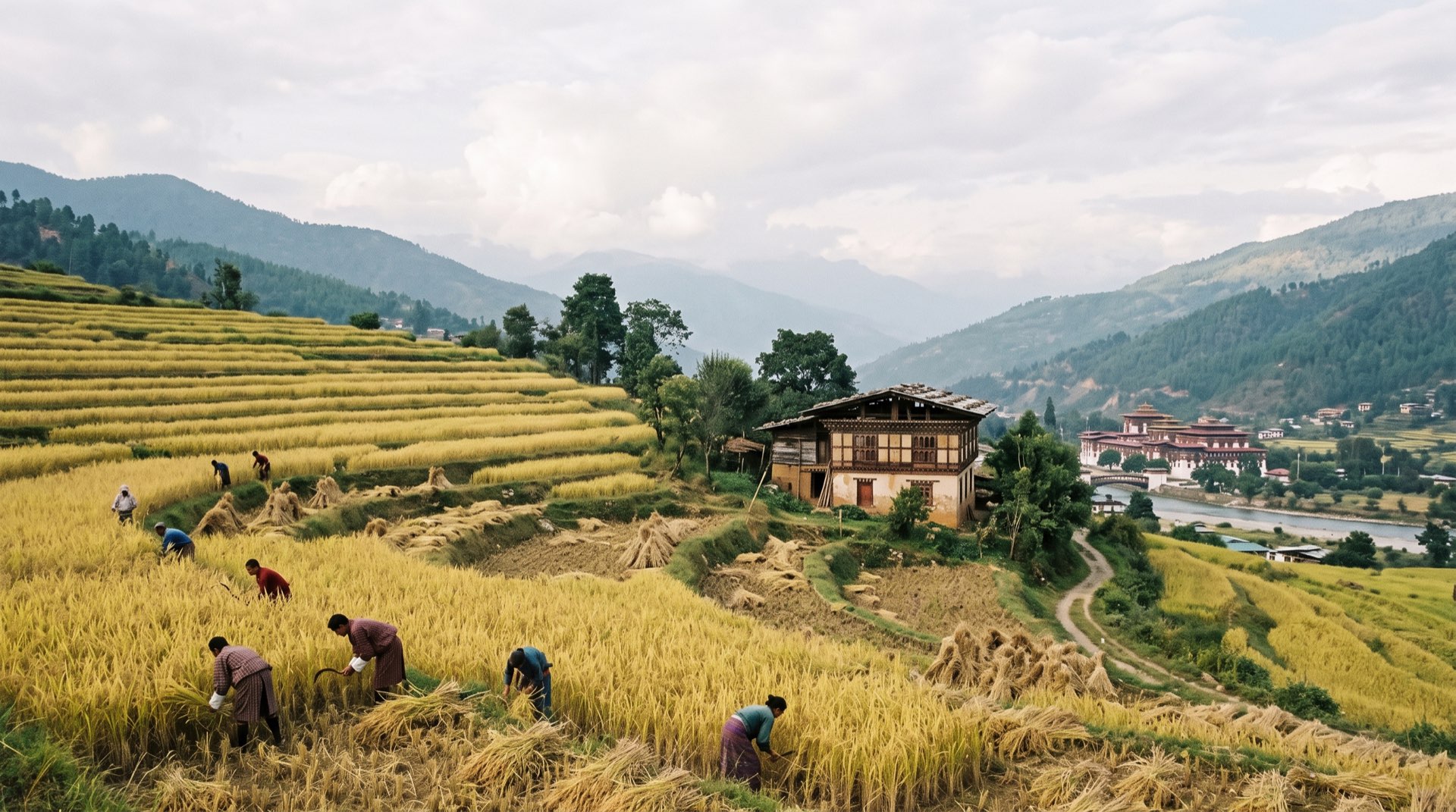
Ask anyone in our Thimphu office when you should come to Bhutan and you’ll get a different answer from each of us, every one delivered with total conviction.
One of us will describe an October dawn at the Dochula pass, the high Himalaya laid out white along the horizon. Another will talk about January in Punakha, where the sun warms the old fortress walls while Thimphu reaches for its down jacket. Someone will mention July: the smell of wet pine, and rice terraces so green they look lit from inside.
Underneath the question we usually hear a quieter worry. What if I pick the wrong month? Here is the reassuring part. There isn’t one. There is only the Bhutan you’d like to meet, and the weeks that suit it best.
| At a glance | Detail | Source |
|---|---|---|
| Rainy season | June to September, bringing about 73% of the year’s rain | NCHM Climate Atlas |
| Clearest views | October and November, then crisp winter days | Bhutan Luxury Travel, 2026 |
| Cold nights | In 2025 Paro fell to 0 °C or below on 96 nights; Punakha on none | NCHM, State of the Climate 2025 |
| Big spring festival | Paro Tshechu, 29 March–2 April 2026 (tentative) | Tentative festival list, on the Department of Tourism’s website |
| Cranes in Phobjikha | Late October to mid-February | Wangduephodrang district |
| Busiest months | October and November, with April close behind | Bhutan Luxury Travel, 2026 |
| Checked | 27 September 2026 |
What is the best time to visit Bhutan?
The best time to visit Bhutan is the season that matches what you want to feel, and each one gives you something the others can’t.
If it’s your first visit and you picture snow peaks above prayer flags, aim for October or November. If you love flowers and don’t mind a little haze, come in spring. If you want the great dzongs (the fortress-monasteries that anchor every valley) almost to yourself, with black-necked cranes feeding in the fields of Phobjikha, choose winter. And if you like green, quiet and the sound of rain on a lodge roof, the monsoon months are yours.
What changes through the year isn’t whether Bhutan is beautiful, but which kind of beautiful: sharp and clear, soft and blooming, cold and still, or wet and glowing. The practical things change too. Drive times after heavy rain, how early the lodges fill, whether a festival is on in the valley you’re visiting.
So rather than one answer, here is how the year really unfolds, from people who work through every month of it.
What is Bhutan like in spring, March to May?
Spring is warm, blooming and lively, with festivals near its start and a gentle haze that can soften the mountain views. Days warm quickly from March, and the rhododendrons flower on the higher passes. On a still morning near Dochula the forest glows red through the mist.
It’s festival season in the west, too. The tentative 2026 festival list on the Department of Tourism’s website put Paro Tshechu (the valley’s great festival of sacred masked dances) on 29 March–2 April, and the neighbouring district held its Haa Spring Festival on 7–9 April 2026, a celebration of highland life that has taken the place of Haa’s old summer festival. Together they gave you one grand dzong festival and one celebration of highland village life within a fortnight. Our guide to Bhutan’s festivals helps you choose between them, and Bhutan’s smaller festivals are worth a detour too.
The honest downside: by late April and May, haze and dust often hide the high peaks, and afternoon showers begin to creep in. Come for the colour and the celebrations rather than for guaranteed Himalayan panoramas. Our guide to Bhutan in spring goes deeper into the season.
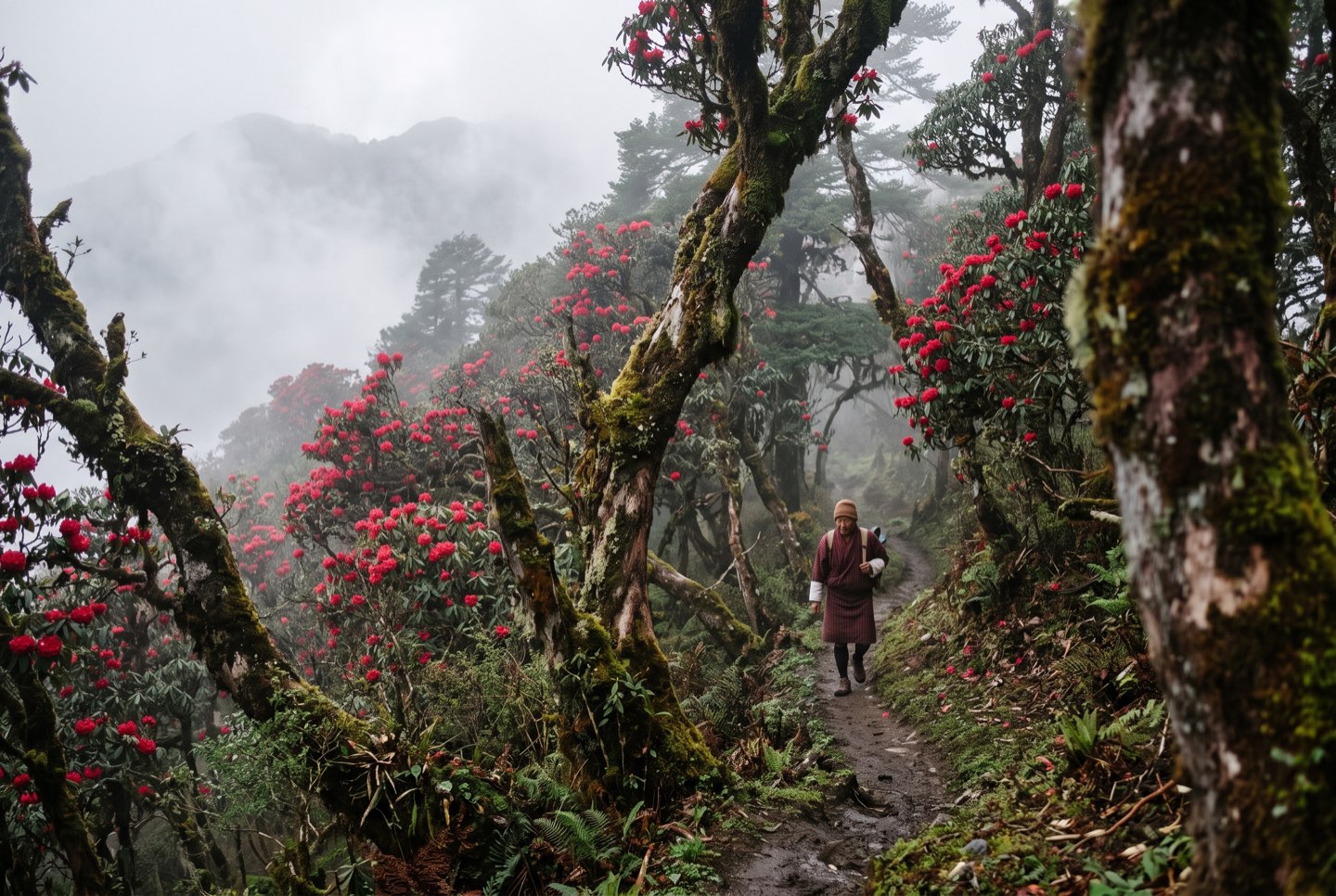 Rhododendrons in flower on a misty ridge near Dochula, among moss-covered trunks.
What is summer like, June to August?
Summer is Bhutan’s green season: warm, wet, quiet and, for the right traveller, quietly wonderful. The summer monsoon runs from June to September and brings about 73% of the year’s rainfall, according to the National Centre for Hydrology and Meteorology’s climate atlas.
That sounds grim until you see it. Rain often comes in bursts, and many mornings are bright. Clouds drift through the valleys, the rice goes into the fields and then grows tall, and the hillsides turn a green no photograph quite catches. The famous sites are at their calmest all year.
What’s hard: the high peaks usually hide behind cloud, trails turn muddy, and heavy rain can slow the roads, so we plan generous drive times and keep afternoons loose. It’s a season for slow days, long lunches and farmhouse visits rather than high passes and long treks. If that sounds like you, our guide to Bhutan’s green season goes deeper.
Why is autumn, September to November, so popular?
Autumn is popular because it delivers the Bhutan of the postcards all at once: clear skies, crisp air, harvest gold and big festivals. The rains ease through September, and October and November usually bring the clearest mountain views of the year.
The festival calendar is full, too. The 2026 tentative list gave Thimphu Tshechu on 21–23 September, and still to come are Jakar Tshechu in Bumthang on 18–21 October and Jambay Lhakhang Drup, at one of the valley’s oldest temples, on 26–29 October. In the Phobjikha valley the black-necked cranes start arriving in late October and stay until mid-February, and the valley welcomes them with a festival every 11 November, according to the Wangduephodrang district administration. Our guide to the cranes of Phobjikha has the rest of that story.
The catch is that everyone else knows this too. October is peak season, the best-known lodges fill first, and the famous sites have their busy hours. It is still wonderful. It simply rewards planning ahead, and an early alarm.
Is winter, December to February, a good time to go?
Yes, if you like cold, clear and calm. Winter days are often sunny under deep-blue skies, the nights are properly cold, and you share the great sites with far fewer people.
How cold? The national weather service’s State of the Climate 2025 counted 96 days last year when Paro’s overnight low reached freezing or below, and 77 at Babesa in Thimphu. Punakha, lower and warmer, had none. That is why we often base winter journeys in Punakha’s mild valley and climb into the cold for the views. Snow on the high passes occasionally rearranges a day’s plans.
Winter has festivals of its own. The tentative list puts the Druk Wangyel Tshechu at Dochula on 13 December 2026 and Trongsa Tshechu on 17–21 December, while Punakha’s festivals ran from 24 February to 1 March in 2026. The cranes stay in Phobjikha until mid-February. Pack layers, then read our full guide to Bhutan in winter.
When is Bhutan busiest, month by month?
Bhutan is busiest in October and November, then in spring around Paro Tshechu and through April. It is quietest in winter and the monsoon. Here is how the year runs for us, lodge by lodge:
- January to February: quiet, apart from Punakha’s festivals in late February.
- March to May: busy around Paro Tshechu and through April. Book early.
- June to August: the calmest months for visitors.
- September: building towards peak season as the rain eases.
- October to November: peak season. The best-known lodges fill first.
- December: calm again, apart from festival days.
Numbers are rising overall. Visitor arrivals from January to May 2026 were about 26% higher than in the same months of 2025, BBS reported. Busy is relative here, but the famous places now have rush hours, and timing matters more than it used to. We look at where, when and how to avoid them in Bhutan’s crowds in 2026.
How do you choose your window? Three questions
Answer three questions, in this order, and your window usually picks itself, often down to the week.
- What do you most want to see? Mountain views point to October, November or winter. Blossom points to spring. Cranes mean late October to mid-February. Emerald valleys and near-empty dzongs mean summer.
- Is there a festival you’d love to catch? Festivals follow the lunar calendar, so their dates move every year and the published list is tentative, Bhutan’s festival dates for 2027 included. We check the list first, then build the route to put you in the right valley on the right day.
- How do you feel about company? If you want the famous sites quietly, skip the peak weeks, or let us time your days around the busy hours.
Then open our month-by-month explorer to see what each month feels like, and tell us your dates. We’ll say honestly what that particular week looks like on the ground.
Where to go next
Once you have a season in mind, these go deeper on the festivals that shape it.
- Bhutan’s festival dates for 2027: the full tentative list, for planning ahead.
- Paro Tshechu or Thimphu Tshechu: how to choose between the two big ones.
- Bhutan’s smaller festivals: the others worth a detour, beyond the big tshechus.
- Bhutan in spring: rhododendrons, blossom and festivals.
- Jambay Lhakhang Drup: Bumthang’s fire festival, explained.
Frequently asked questions
What is the rainiest month in Bhutan?
July, on average: NCHM’s climate atlas for 1996–2025 puts it at the top, in the heart of the monsoon. The southern foothills are far wetter than the western valleys where most journeys spend their time.
When are the mountain views clearest?
Usually from October into December, once the monsoon has rinsed the air, and on bright winter mornings after that. By late spring, haze tends to soften the horizon.
Which months are busiest?
October, then November and the spring festival weeks. If those are your only dates, don’t worry. Just confirm lodges well ahead, because the most sought-after ones fill first.
Is Bhutan cold in winter?
Yes, at night and at altitude, though winter days are often sunny and pleasant. Layers matter more than one heavy coat: a warm jacket for mornings and evenings, plus a hat and gloves for the passes.
Every month in Bhutan is somebody’s favourite. Tell us yours, and we’ll find the weeks that fit it.