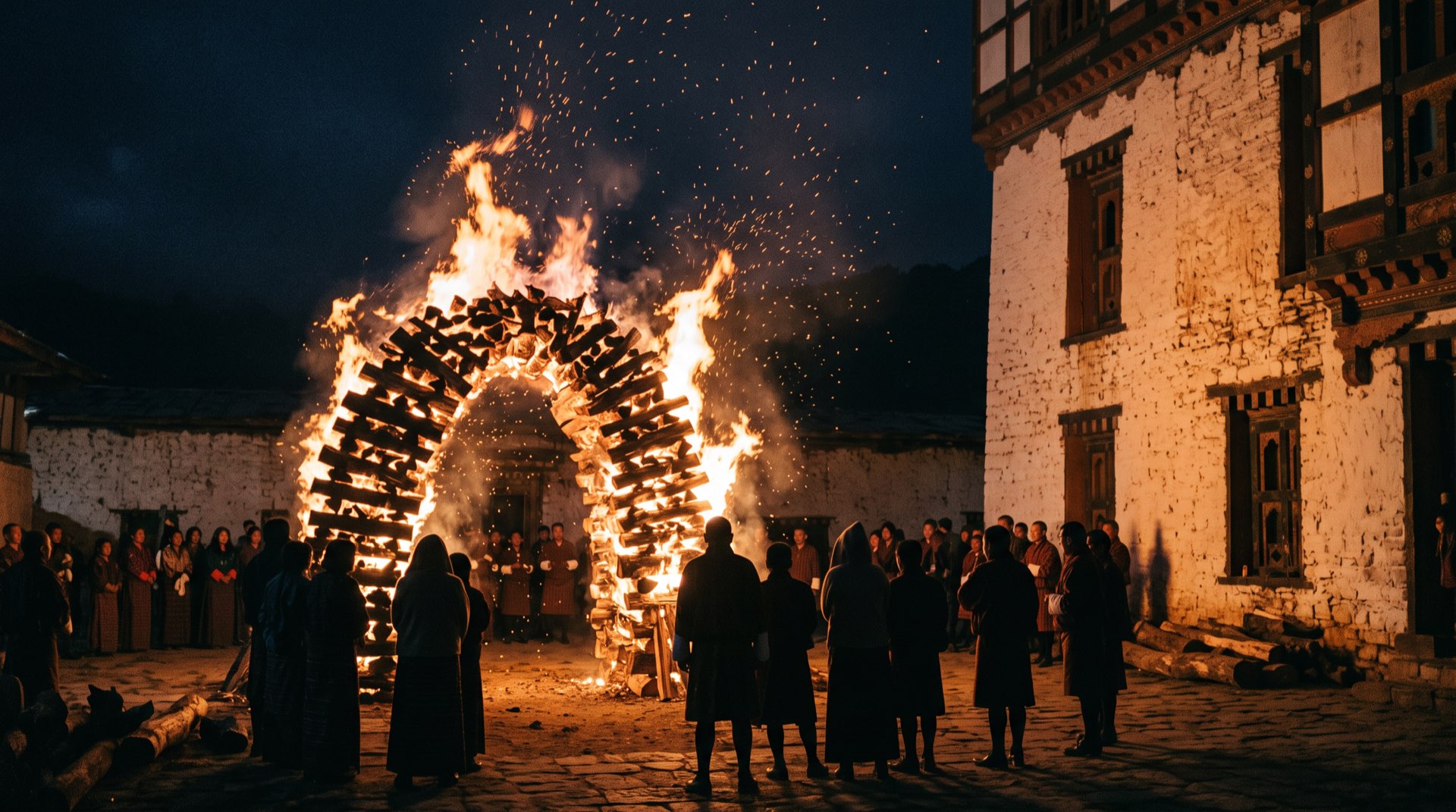
At the edge of a field near an old temple in Jakar, someone has built a gate out of leaves. Monks chant beside it. When it is lit, the cold night turns orange, and people from the crowd run through the flames.
You have probably met this festival already, under a headline that uses the word “naked” and not much else. That is a shame, and an unfair introduction. Jambay Lhakhang Drup is a temple’s consecration festival of dances, blessings and fire, and one of its dances is among the most reverent in the country. It takes a little care to attend well. Here is what the sources tell us, and where they disagree.
| At a glance | Detail | Source |
|---|---|---|
| The temple | Jambay Lhakhang (Temple of Maitreya), Jakar, Bumthang; said to be one of 108 temples built by King Songtsen Gampo in 659 CE | Bumthang Dzongkhag |
| The festival | Masked dances, a fire ritual and the Tercham; about 700 years old, instituted around the 14th century | BBS, 2022, BBS, 2017 |
| 2026 (tentative) | 26–29 October; Prakhar Duchhoed 27–29 October | 2026 list |
| 2027 (tentative) | 14–17 November; Prakhar Duchhoed 15–17 November | 2027 list |
| The Tercham | About 15 laymen from four villages, faces wrapped in white cloth, over three nights | BBS, 2022 |
| Cameras | BBS reported in 2017 that cameras and mobile phones were not allowed to film the dance | BBS, 2017 |
| Cold | Bumthang–Chamkhar station, 2,470 m: November averages about 16 °C by day and 1 °C at night | NCHM Climate Data Book |
| Checked | 30 September 2026 |
What is Jambay Lhakhang Drup?
It is the annual festival of Jambay Lhakhang in Jakar, one of the oldest temples in Bumthang, and it began as a ceremony to consecrate that temple. The district administration calls the temple the Temple of Maitreya and records the tradition that it is one of 108 that King Songtsen Gampo built in 659 CE, all on a single day, on the body of a demoness who was obstructing the spread of Buddhism.
The festival is younger than the temple. BBS says it was instituted around the 14th century by the master Dorji Lingpa, calls it a festival some 700 years old, and adds that four villages conduct it. Locals say skipping it would bring misfortune on the community. For two years it was performed behind closed doors because of Covid; in 2022 the public came back in record numbers. If masked dances and blessings are new to you, Bhutan’s beliefs, decoded is a gentle place to start.
What is the fire blessing (Mewang)?
The Mewang is a fire ritual held in a field near the temple. In 2017 BBS reported that mask dances were performed in the monastery grounds first, along with a ritual to purify the place and the spectators. Then a gate-like structure covered in leaves was set alight as monks began the ritual, and spectators ran through the burning gate, an act said to relieve them of their sins and evil.
BBS explains the Mewang, with other rituals of the festival, as performed for peace and harmony in the country, and its blessing as clearing the obstacles that hinder a person’s wellbeing. The lists also carry a Thangbi Mewang, at Thangbi Lhakhang in Bumthang, on 15–16 October 2027.
The fire is real, the ground is dark and the crowd is thick. Whether to run through is your choice, and nobody should feel they must; watching from the edge is a perfectly good way to receive it. Ask your guide on the night.
What is the Tercham, the so-called naked dance?
The Tercham is a sacred dance performed by local laymen, and the crowd treats it with reverence, not as a scandal. BBS calls it the biggest crowd-puller among the festival’s masked dances and “much-revered”, and notes that the mere mention of it draws giggles, though the dance has a deeper meaning and significance.
Around 15 laymen from four villages, Chawang, Norgang, Nashphel and Jambay Lhakhang, perform it over three nights, with their faces wrapped in white cloth but otherwise unclothed. BBS traces it to Guru Rinpoche, who is believed to have danced to draw away the spirits obstructing the building of Nabji Lhakhang in Trongsa, so that the work could go on. BBS reports that the dancers’ own relatives sit in the audience and stay where they are, for the wellbeing of dancers and spectators alike. Those it spoke to in 2022 had come for blessings.
On cameras, BBS reported in 2017 that none are allowed to film the dance, and that thousands gathered for it in the early hours of the morning. We have found no newer statement, so we treat that as the rule today: phones stay in pockets, and you watch rather than record.
When is it in 2026 and 2027?
The tentative lists on the Department of Tourism’s website give 26–29 October in 2026 and 14–17 November in 2027, nineteen days later as the lunar calendar moves on.
| Festival | 2026 (tentative) | 2027 (tentative) |
|---|---|---|
| Jakar Tshechu | 18–21 October | 6–9 November |
| Jambay Lhakhang Drup | 26–29 October | 14–17 November |
| Prakhar Duchhoed | 27–29 October | 15–17 November |
Our sources disagree on length. BBS called it a five-day festival in 2017 and a four-day one in 2022, and the lists give four days, which is what we follow. The lists also give only the span, so we cannot tell you which night carries the Mewang or the Tercham; we confirm the running order for your year. The 2027 list is dated 14 February 2025, so treat it as a strong guide, and see Bhutan's festival dates for 2027 for the whole list.
Can visitors attend, and what should you know?
Yes. It is a public festival, and BBS’s report on 2022, the first year the public was welcome after two closed-door years, includes a visitor from Switzerland in the record crowd. Both lists carry it.
What to know is mostly about manners and stamina. Treat it as you would a service in a place of worship, because for the villages it is one. Dress as you would for any temple, with long sleeves, covered legs and hats off, as our guide to dzong and temple etiquette explains. Sit at the edges, arrive early, expect thousands of people and a lot of standing in the cold, and ask before you photograph anyone. You are free to watch only the daytime dances. Nobody is counting.
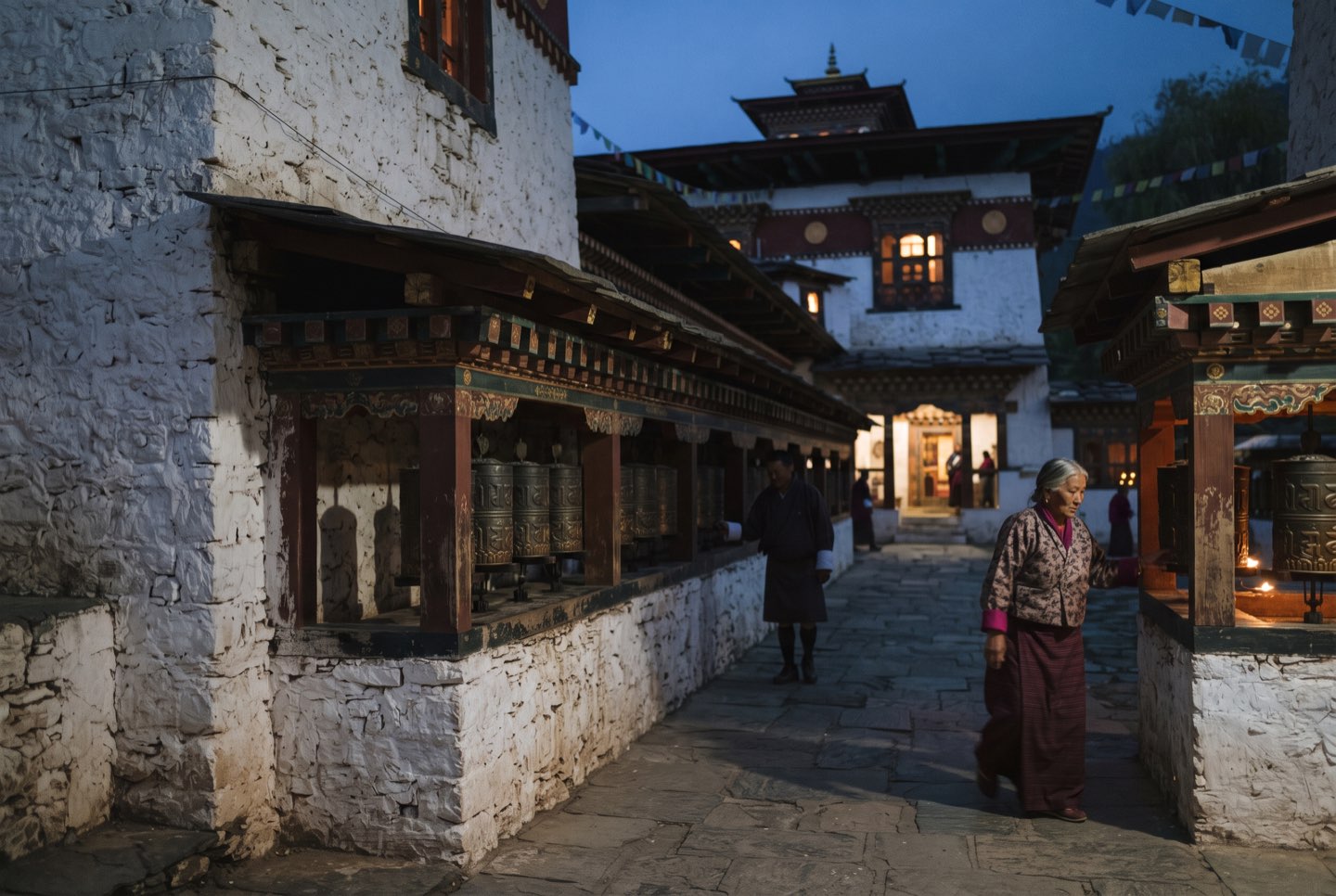 The whitewashed walls and prayer wheels of Jambay Lhakhang at dusk, a few pilgrims turning wheels.
What else is on in Bumthang that week?
In 2027, Jakar Tshechu (6–9 November) ends five days before Jambay Lhakhang Drup begins, and Prakhar Duchhoed (15–17 November) at Prakar Lhakhang in Chumi overlaps it. Three days before the fire festival, the Black-necked Crane Festival is held at Gangtey on 11 November. A month later come the Jambay Lhakhang Singye Cham and Nalakhar Tshechu, on 13 December. BBS counts 26 major festivals and 120 monasteries in Bumthang, so the district rewards a slow visit; our guide to travel beyond western Bhutan explains why, and our calendar of Bhutan’s festivals helps you fit the rest of the year around it.
Our Cranes & the Central Valleys journey spends three nights in Bumthang, after a road day of 188 km from Gangtey. In November 2027 that could carry you from the crane festival to the fire festival.
Where do you stay, and what do you wear for the cold?
Ask us where we would put you: we confirm lodges year by year, and the most sought-after fill first. For the cold, plan for real winter at night. At the Chamkhar weather station in Bumthang, at 2,470 m, the National Centre for Hydrology and Meteorology’s records for 1996–2017 average out, by our reckoning, at about 16 °C by day and 1 °C at night in November, against 19 °C and 7 °C in October. The 2027 dates fall in the colder month.
So bring thermal layers, a warm jacket, a hat and gloves (the hat comes off inside temples), thick socks for the shoes you will keep removing, sturdy footwear for a dark field, and a torch.
Frequently asked questions
Is it too late to go in 2026?
The tentative dates are 26–29 October, under four weeks after our check. That is short notice for a road trip east, but it is worth asking whether we can still make it work; if not, mid-November 2027 gives you a full year to plan.
Is photography allowed?
From the edge of the courtyard, without flash and without stepping onto the dance ground, usually yes for the daytime dances, as at any festival; never inside temples. For the Tercham, no filming, as above. When in doubt, ask your guide and keep the phone away.
How cold does it get?
Cold enough to plan for. In four of the 22 Novembers in the Chamkhar records the average night-time low was below freezing, and single nights fell as low as −10 °C.
Is it suitable for children?
That is a family decision. The daytime masked dances suit children who can sit for a while, as at any tshechu, but the fire ritual and the Tercham mean crowds, cold and late hours, and the Tercham involves nudity that some parents will want to talk through beforehand.
Come as a guest to someone else’s prayer, stand in the cold with everyone else, and let the fire do its work.