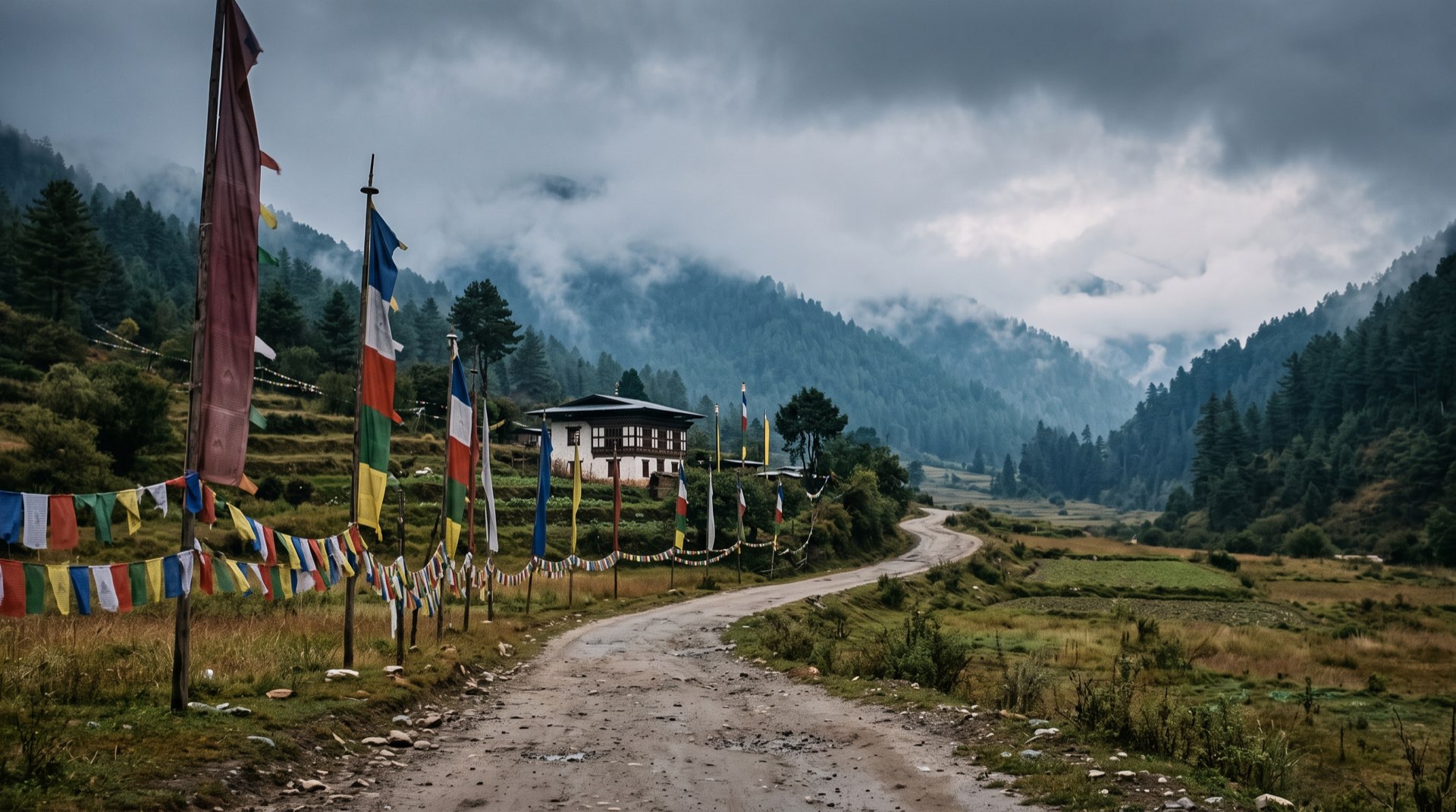
The worry usually arrives as a photograph. Someone you know went to Bhutan, and there, among their Tiger’s Nest pictures, is a line of people on the steps. Is this still the quiet kingdom you’ve been imagining, or has everyone else found it too?
We understand the question, because we watch the numbers as closely as you do. Here is what we see from Thimphu. On an early morning in the Haa valley, the only traffic is often a few cows and whoever is walking them, and the loudest sound is the river. Later that same morning, the little car park below the Tiger’s Nest may be full. Both are Bhutan in 2026. The difference is mostly where you are, and when.
| At a glance | Detail | Source |
|---|---|---|
| Visitors in 2025 | 209,376, up about 44% on 2024; around 62% from India | The Bhutanese |
| Early 2026 | More than 102,000 fee-paying visitors from January to May, about 26% more than a year earlier | BBS |
| Before the pandemic | More than 300,000 visitors in 2019 | BBS |
| Nepal, for comparison | 1,158,459 foreign visitors in 2025 | The Himalayan Times |
| Busiest times | October and November, the spring festival weeks, and mid-morning at the famous sites | Bhutan Luxury Travel, 2026 |
| Checked | 27 September 2026 |
Is Bhutan crowded in 2026?
No, not by the standards of most places you’ve been, but it is busier than it was, and a handful of famous places now have rush hours.
The numbers are honest about it. Bhutan welcomed 209,376 visitors in 2025, up about 44% on 2024, and around 62% of them came from India, according to government figures reported by The Bhutanese. Early 2026 was busier again: more than 102,000 visitors paying Bhutan’s Sustainable Development Fee between January and May, about 26% more than a year before, BBS reported.
Now some perspective. Before the pandemic, more than 300,000 visitors came in 2019, according to BBS, so today’s totals are still well below that. They are also spread across a country that keeps most of its land under forest, not funnelled into one old town.
What has changed is concentration. The same BBS report puts the average stay at about four nights for visitors from India and five for everyone else. Short trips mean most people see the same few western highlights, on the same few days, at the same hours.
Where does Bhutan feel busy, and when?
Bhutan feels busy in a few predictable places at predictable hours: the Tiger’s Nest in the morning, the big western dzongs (fortress-monasteries) in the middle of the day, and the courtyards of the major festivals.
The Tiger’s Nest is the clearest example. At the trailhead, the parking area holds only around 15 vehicles, and BBS reported in May 2026 that with tourist cars, buses and taxis arriving every day, many are forced to park along the narrow approach road. On the trail itself, people bunch up on the steps below the monastery.
Punakha Dzong and the Dochula pass tend to fill from mid-morning, when most vehicles on the Thimphu–Punakha road reach them. Paro and Thimphu feel lively in the peak weeks of October and November and around the spring festival.
Then there are the festivals. At Punakha’s festival in 2025, more than 3,300 visitors joined the local crowds, three times as many as the year before, according to BBS. Beautiful, yes. Quiet, no.
Where does Bhutan never feel busy?
Almost everywhere else, and that is the part the photographs leave out. Step beyond the Paro–Thimphu–Punakha triangle, or simply off its main road, and Bhutan empties quickly.
The Haa valley, over the Chele La pass from Paro, is our favourite example: farmhouses, Lhakhang Karpo (the White Temple), yaks on the high pastures, and roads where a passing car is an event. Phobjikha is wide and calm on most days outside its crane festival. The valleys of Bumthang, the country’s spiritual heartland, lie a long day’s drive east of Punakha and hold temples you may have to yourself. Further east still, villages see very few visitors at all. Our guide to travelling beyond western Bhutan explains why the drive is worth it.
Even in the west, quiet is never far away. A farmhouse lunch, a morning walk to a hillside temple, a monastery on a ridge above Thimphu: these rarely feel crowded, even in October. The crowd follows the famous names. You don’t have to.
What is the hour-by-hour trick?
Go early, go late, and do something else at the busy hour. It is almost embarrassingly simple, and it works.
- Early morning: start the Tiger’s Nest soon after breakfast, or reach Punakha Dzong while the river mist is still lifting. Soft light, cool air, nearly empty courtyards.
- Mid-morning to early afternoon: the famous places are at their busiest, so this is when we drive, walk a village trail, visit a farmhouse or sit down to a long lunch.
- Late afternoon: many day visitors have moved on, the light turns gold, and the dzongs grow quiet again before they close.
- Festival days: arrive before dawn on the final morning for the thongdrel, the giant sacred image unveiled once a year, or choose a middle day when the crowd is thinner.
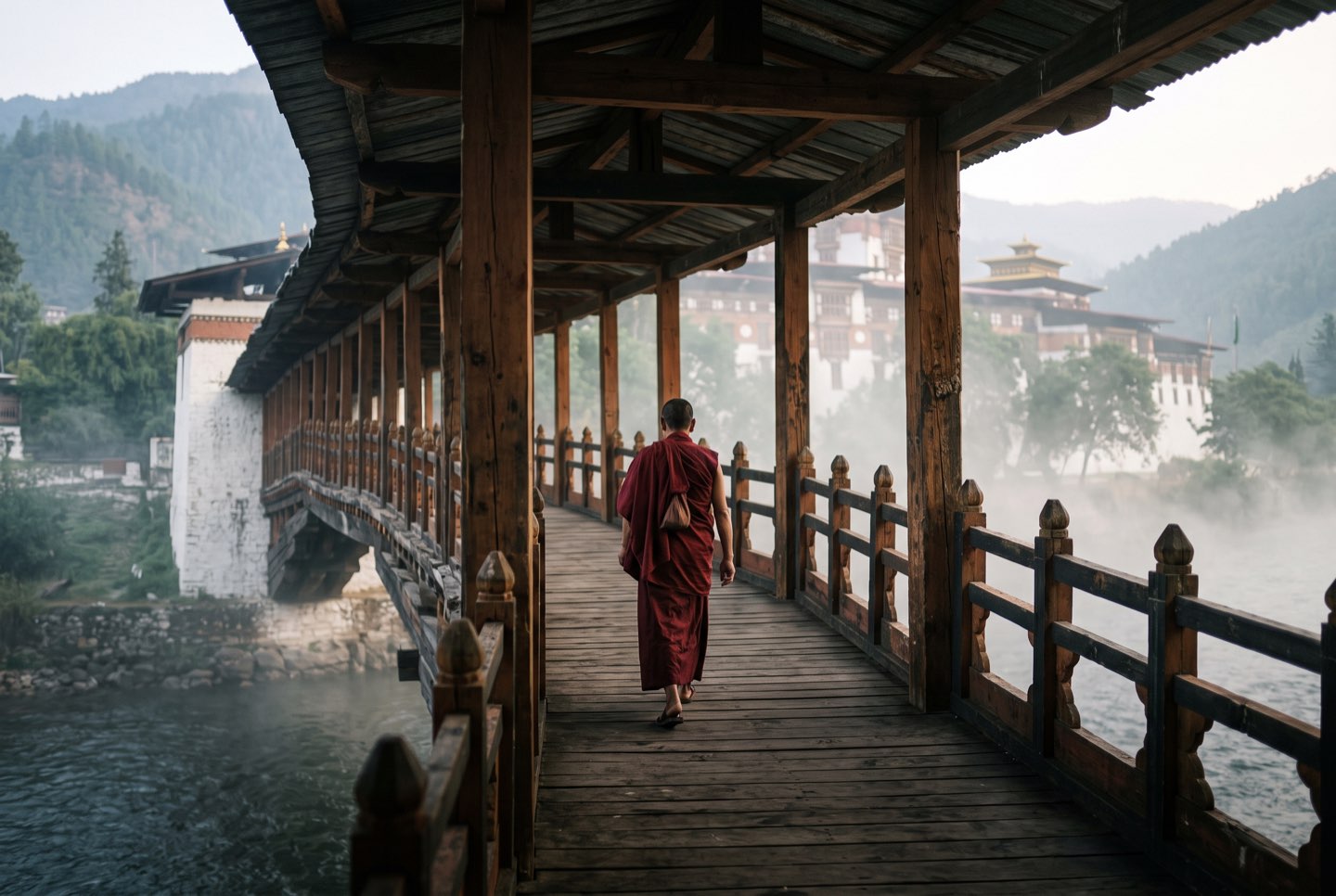 A monk crosses the covered bridge to Punakha Dzong in the early morning mist.
None of this needs rushing. It needs a guide and driver who know the rhythm of each place, and a plan flexible enough to swap two mornings when the weather or the crowd suggests it.
Which months have room to breathe?
December to February and June to August are the quietest months, and the edges of the autumn peak can be a sweet spot.
Winter is cold, clear and calm, with the cranes in Phobjikha and the great sites at their most peaceful; our guide to Bhutan in winter goes through it. The monsoon months trade mountain views for green valleys, soft rain and near-empty temples. Early September, as the rains ease, is calmer than the October peak, and the first weeks of December often bring clear days with fewer people.
The busiest stretches are October and November and the spring weeks around Paro Tshechu, the valley’s great festival. If those are the only dates you have, don’t worry: they are busy for good reasons, and the timing tricks above still work. Just plan earlier, because the most sought-after lodges fill first. For the whole year at a glance, see our guide to when to visit Bhutan.
How do we keep a journey quiet?
We design for quiet from the first draft rather than hoping for it. That starts with the route. We balance the famous western sites with at least one valley most visitors never reach, whether that’s Haa, Phobjikha or Bumthang, and we avoid stacking two big-name sites on the same morning.
Then comes the order of the days. We place the Tiger’s Nest after a few nights in the country, on a morning that suits the weather, and we visit the busiest dzongs early or late. If a festival is on your list, we choose the day, and the spot in the courtyard, with the crowd in mind. Our guide to Bhutan’s festivals explains how.
Travelling privately helps, too. With your own guide and vehicle there is no group to wait for and no fixed timetable, so we can change the plan the moment a quieter hour appears. Quiet, it turns out, is mostly patience, good timing and a little faith in early mornings.
Frequently asked questions
Is the Tiger’s Nest crowded?
It can be busy, especially at the trailhead and on the steps below the monastery in peak season. An early start and a patient pace make a real difference; our guide to the Tiger’s Nest hike covers the rest.
Which valleys are quietest?
Haa is the quietest close to Paro, an easy detour over the Chele La pass. For more distance from the crowds, Bumthang and the east ask for more driving and repay every hour of it.
Are festivals too busy?
The biggest ones are busy, especially the final dawn at Paro, but that crowd is part of the experience: families in their finest, gathered for a blessing. If you’d rather have room, choose a village festival or a middle day.
Is Bhutan more crowded than Nepal?
No. Nepal received 1,158,459 foreign visitors in 2025, according to Nepal Tourism Board figures reported by The Himalayan Times, more than five times Bhutan’s total that year.
Bhutan is still a place where you can hear the river. You just need to know which morning to listen.