Open the Department of Tourism’s events calendar and something unexpected happens. You go looking for the tshechus, and they are there, most of them marked “dates change” because the lunar calendar will not hold still. But between them, in the same tidy rows, sit a mushroom festival, a bathing carnival, a bird festival, a rhododendron week and a show of yaks and mastiffs at 4,000 metres.
The worry shifts. It is no longer “which big festival?” but “is this real, can I actually get there, and will it exist next year?” Some of these events are easy, some are hard, and a few are so young that nobody can say. This is our reading of that two-page PDF.
| At a glance | Detail | Source |
|---|---|---|
| Royal Highland Festival, Laya | 23–24 October, held every year; grounds at about 4,000 m, reached by road-end plus a 4–5 hour walk | Department of Tourism |
| Haa Spring Festival | 7–9 April 2026; Haa says it is held annually in April | Haa Dzongkhag |
| Rhododendron Week, Sheytemi (Merak) | 3–9 April 2026, at about 2,900 m; the second edition | Trashigang Dzongkhag |
| Lamperi rhododendron festival | 13–14 April 2026; 22–23 April 2027 (tentative) | Events calendar, 2027 list |
| Matsutake festivals | Genekha 15–16 August and Ura 23–24 August 2026 | Events calendar |
| Autumn events, 2026 | Black Mountain Festival, Trongsa, 5–6 Oct; Bathing Carnival, Nganglam, 1–3 Nov; Bird Festival, Tingtibi, 13–14 Nov | Events calendar |
| Checked | 30 September 2026 |
What festivals does Bhutan have besides the tshechus?
Quite a few. Around two dozen entries in the Department of Tourism’s National Tourism Events Calendar carry fixed dates, and most of them are not tshechus. A tshechu is a religious festival that follows the lunar calendar, which is why most of those entries simply say “dates change”. Our guide to Bhutan’s festivals covers them.
The fixed-date events are the ones few travellers hear about. In the 2026 edition they include April’s rhododendron events, the Haa Spring Festival, two matsutake mushroom festivals in August, the Royal Highland Festival in October, and then a Black Mountain Festival at Trongsa, a Bathing Carnival at Nganglam and a Bird Festival at Tingtibi. Several are organised by district administrations, sometimes with the Department of Tourism, as Trashigang says of its rhododendron week.
They are civic, cultural and seasonal, closer to a village fair than to a monastery courtyard, though faith is never far away. Their dates are set by organisers rather than by the moon, which is a small luxury for planners, although organisers, as we will see, do change their minds.
What is the Royal Highland Festival, and how hard is it to reach?
It is a two-day gathering of highland herders at Laya, about 4,000 m up, held on 23–24 October every year, and it is hard to reach: when the road ends, you walk. The Department of Tourism describes competitions for yaks, horses and mastiffs, songs, dances and poetry from the Layaps (the people of Laya), and stalls of yak cheese and highland produce.
The catch is the approach. The department’s sample itinerary drives 132 km from Thimphu to Gasa, switches to a pickup truck for 20 km of unpaved road, then walks four to five hours to Laya, gently at first and steeply near the village, and you sleep in a homestay. The page’s introduction gives a slightly shorter version and its sample dates belong to an earlier year, so treat every timing as approximate.
This year’s festival is just over three weeks away, so for most readers the real target is 2027. It is a high-altitude walk, not an excursion. Read our notes on altitude and health first, and if long days on foot are new to you, start with walking in Bhutan. We design Laya journeys on request and confirm the approach for your dates.
When are the mushroom (matsutake) festivals?
In August. The 2026 calendar put the Genekha festival on 15–16 August and Ura’s on 23–24 August, so this year’s have passed. The Department of Tourism places Genekha, 45 minutes from Thimphu, in the second week of August and Ura, in Bumthang, in the third or fourth. Their stated aim is awareness of sustainable harvesting and the pleasure of local flavours, with picking excursions, tastings, performances by locals and school children, and village sports.
The star is the matsutake, called sangay shamu, or Buddha’s mushroom. The same page says it grows in clusters at the base of pine trees, cannot be cultivated and is becoming rarer, and that its season begins in July and runs through August and September. That puts the festivals squarely in the wet months. The rain, in other words, is the point, and if it does not put you off, our guide to Bhutan’s green season explains why summer can be lovely.
Neither festival appears on the tentative 2027 list yet, so we would confirm dates with you.
What are the spring festivals: rhododendrons and Haa?
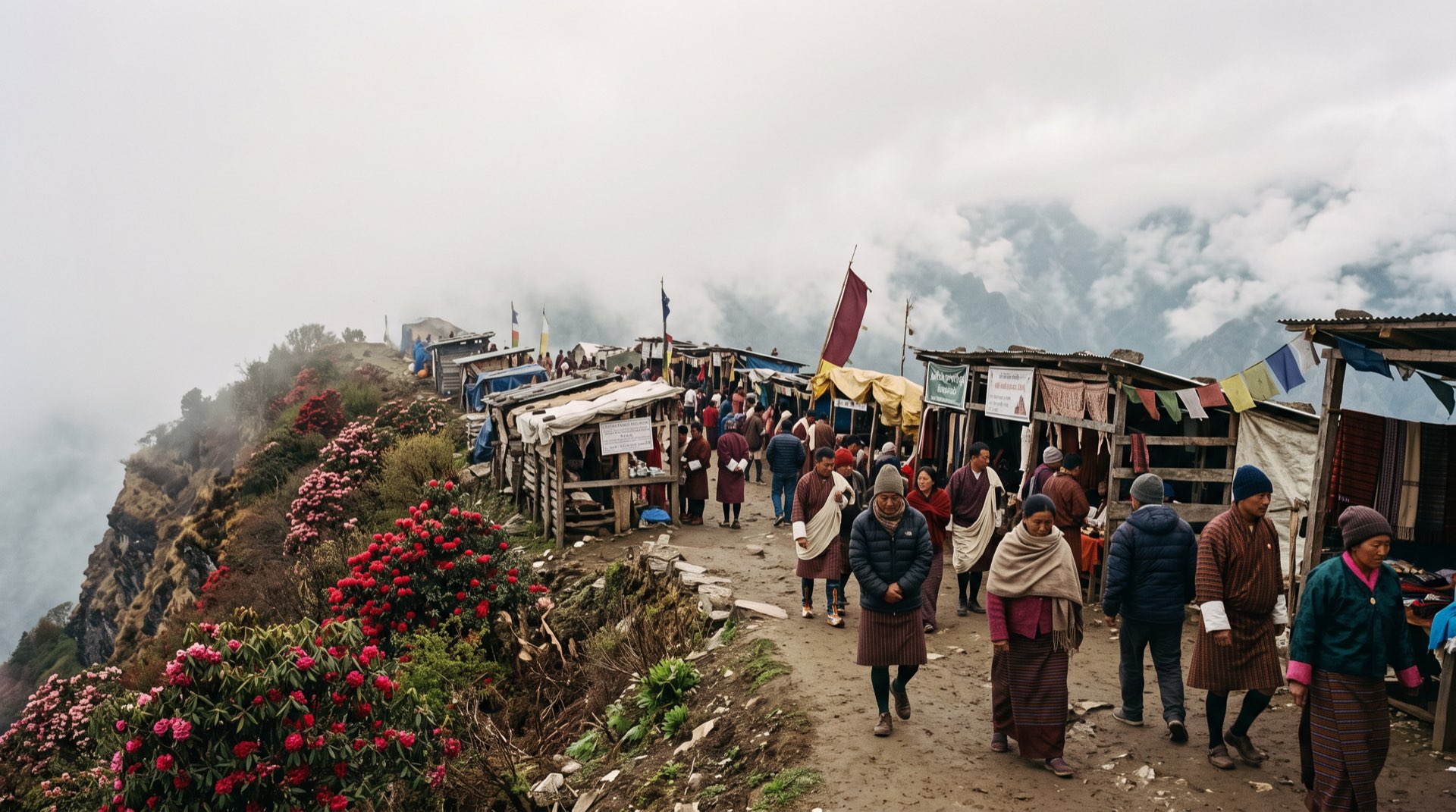
Three events share the first half of April: a rhododendron week in the east, the Haa Spring Festival and a rhododendron festival at Lamperi. Rhododendron Week at Sheytemi, in Merak, ran on 3–9 April 2026 at about 2,900 m. Trashigang’s administration reported over 8,000 people, with traditional dance, singing and games, and put Bhutan at about 46 rhododendron species, 41 of them in the highlands of Merak and Sakteng.
The Haa Spring Festival ran 7–9 April at Yangthang ground. Haa describes three days of mask dances, archery, craft demonstrations and yak-herding traditions, held annually in April.
Here is the catch: a festival date is not a bloom date. The flowers do not read the calendar, and we found no official bloom calendar, so we never promise a week. Our guide to Bhutan in spring explains what to expect instead.
Which events are new, and which might not repeat?
The youngest events are the ones to reconfirm. Sheytemi’s week was only the second edition in 2026, and Haa describes its festival as a reimagined spring version of an older event, whose summer story is in our green season guide.
Then check the paperwork. The tentative 2027 list, updated in February 2025, includes Rhododendron Week (3–9 April), Lamperi’s festival (22–23 April), the Jomolhari Mountain Festival (14–15 October), a mountain-bike race and the Black-necked Crane Festival. It has no Haa Spring Festival, matsutake festivals, Royal Highland Festival, Black Mountain Festival, Bird Festival or Bathing Carnival. That is not a cancellation, since the list is mostly tshechus, but it is a reason to reconfirm.
Even the dates wander between years. Lamperi’s is 13–14 April in the 2026 calendar and 22–23 April on the 2027 list, and the two documents place its venue in different districts, so we will not print one.
Which ones fit easily into a journey?
The western ones, and only a few of those. The Haa Spring Festival sits over the Chele La pass from Paro, and Genekha’s mushroom festival is a 45-minute drive from Thimphu, so both slot into a western journey with little extra travel.
Everything else needs room. Ura, in Bumthang, is a long day’s drive east of Punakha. Sheytemi is further east still, in Trashigang district, and our guide to travelling beyond western Bhutan explains the distances plainly. If Merak’s highland villages appeal, read Sakteng, Merak and the yeti for the wider picture.
Laya asks for the most. The department’s shortest sample itinerary takes four days from Thimphu, with a walk each way.
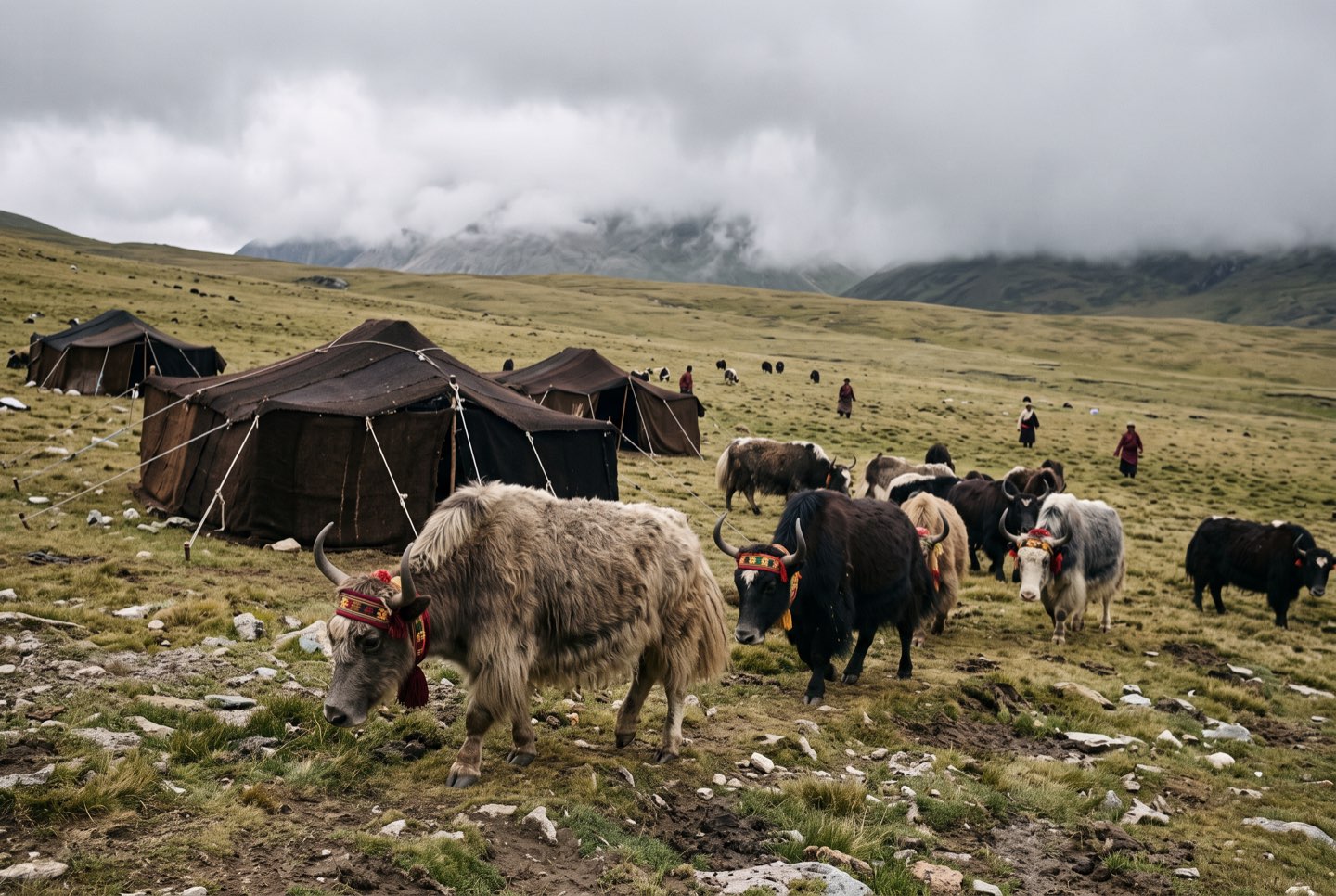 Yaks with woven headbands grazing beside black yak-hair tents on a high pasture in low cloud.
How do you choose between them?
Choose by asking three questions, in this order, and the calendar usually narrows itself.
- How do you feel about walking at altitude? If the answer is “not much”, skip Laya this time. Haa, Genekha and Lamperi all need far less effort.
- Are you happy to gamble on flowers? If you are, the April events are lovely, but flowers can be early, late or sparse. If you are not, choose food or highland culture instead.
- Which season do you want? April brings the flower events and warmer days, August brings green and mushrooms, and October brings clear skies and Laya. Our guide to when to visit Bhutan goes month by month.
Then tell us. We reconfirm dates as your journey nears, and we will tell you plainly how much of the road each event asks you to walk.
Frequently asked questions
Are these festivals religious?
Mostly they are cultural and seasonal, but faith is part of the picture. The Laya programme includes blessings by local monks, and Haa lists mask dances. Dress neatly, ask before photographing anyone and read our guide to dzong and temple etiquette.
Do they happen every year?
The Royal Highland Festival, the matsutake festivals and the Haa Spring Festival are described as annual. The newer ones are less certain, and dates can move, so we reconfirm each one before we build a journey around it.
Can I reach Laya without trekking?
Not by road, as the Department of Tourism describes the approach. Its page mentions a helicopter option with limited seats, but we cannot promise one for a given year, so ask us about your dates.
Which is best for a first-timer?
The easiest fit is the Haa Spring Festival if your dates fall in April, or the Genekha mushroom festival in August. Both are close to the west’s usual roads. Pair either with one of the big tshechus if the calendar allows.
Come for the tshechus, by all means. Then leave a few days for the rest of the calendar, where herders, foragers and flower-watchers keep festivals of their own.