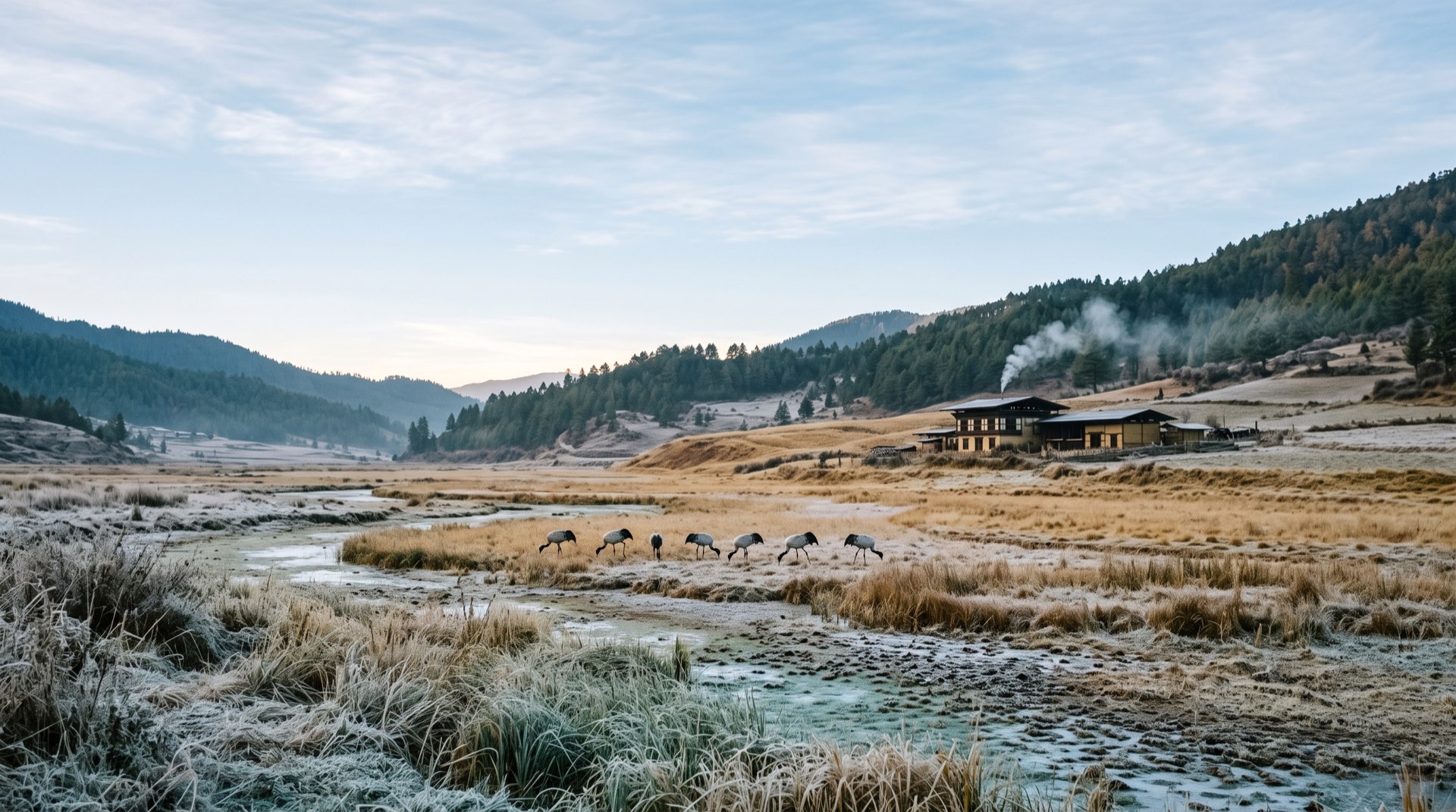
The first thing you notice on a winter morning in Paro is your own breath. Frost silvers the harvested rice fields, a farmhouse chimney sends up a thin line of wood smoke, and the sun takes its time climbing over the ridge. Then it arrives, and the whole valley seems to exhale. By mid-morning you’ve unzipped your jacket. By lunch you may well be eating in the sun.
Most people who ask us about winter have one worry, and it’s a fair one: won’t it be too cold? The nights are cold, and we won’t pretend otherwise. But the days are often bright and still, the air is clear, and the great dzongs (fortress-monasteries) feel wonderfully unhurried.
Winter is the season we recommend in a slightly lowered voice, as if sharing a secret. This is why.
| At a glance | Detail | Source |
|---|---|---|
| Winter season | December to February, the driest months, with about 1% of the year’s rainfall | NCHM Climate Atlas |
| Frosty nights in 2025 | Punakha none; Thimphu (Babesa) 77; Paro 96; Haa 141 | NCHM State of the Climate 2025 |
| Valley altitudes | Punakha about 1,200 m; Paro 2,200 m; Thimphu 2,300 m; Phobjikha 2,900 m | Bhutan Luxury Travel, 2026 |
| Cranes | Winter visitors between October and March; about 700 counted in 2024–25 | RSPN |
| Winter festivals | Dochula Druk Wangyel Tshechu 13 December 2026; Punakha festivals 24 February–1 March 2026 | Department of Tourism |
| Checked | 27 September 2026 |
Why is winter in Bhutan so underrated?
Because most people picture snow and shivering, when the reality is mostly sunshine. Bhutan’s winter runs from December to February, and it is the driest part of the year: the National Centre for Hydrology and Meteorology’s climate atlas finds that winter brings only about 1% of the country’s annual rainfall. Dry air means clear air, and on many mornings the ridges look sharp enough to touch.
It is also a more local season. The Central Monastic Body has moved between Thimphu in summer and Punakha in winter for nearly 400 years, Kuensel reports, so the courtyards of Punakha Dzong, where two rivers meet, are alive with monks going about their day.
Add the cranes in Phobjikha, festivals at either end of the season and fewer visitors on the road, and winter looks less like a compromise and more like a secret. If you’re weighing up the whole year, our guide to when to visit Bhutan sets winter beside the other seasons.
How cold is Bhutan in winter, valley by valley?
Cold at night, mild to pleasant by day, and very different from one valley to the next. Altitude does most of the work. Bhutan’s weather service calculates that temperatures fall by roughly 5 °C for every 1,000 m you climb, so Punakha, at about 1,200 m, lives in a different climate from Paro at 2,200 m.
The station records bear this out. In 2025, according to NCHM’s State of the Climate report, Punakha’s weather station didn’t record a single night at or below freezing, and its coldest was 3.5 °C in December. Thimphu’s Babesa station counted 77 frosty nights, with a low of −7 °C. Paro counted 96, with a low of −6 °C. Haa, at about 2,700 m, logged 141.
Phobjikha, at about 2,900 m, has no station in that table, but it is the highest valley on our winter routes, so we treat it as the coldest night of the trip.
One honest footnote: the same report found 2025 to be Bhutan’s warmest year on record. Pack for the numbers above, and then a little more.
When can you see the cranes in Phobjikha?
From late October until around February, when the black-necked cranes spend the winter in the wide, marshy valley of Phobjikha. The Royal Society for Protection of Nature, which has worked to protect them since the mid-1980s, counted about 700 cranes in Bhutan in the 2024–25 winter, and Phobjikha receives more of them than anywhere else in the country.
Winter is when the valley is most itself. You wake to frost on the grass and the cranes’ calls carrying across the marsh. Later they feed in the fields in loose family groups, grey bodies and black necks against the pale grass. We watch from the edge of the wetland, give them room, and let the valley set the pace.
Phobjikha is the heart of our Cranes & the Central Valleys journey, which carries on east over the Pele La (la means “pass”) to Bumthang. For the whole story of these birds, the legends around them and how the valley protects them, read our guide to the cranes of Phobjikha.
Which festivals fall in winter?
Two stand out: the Dochula Druk Wangyel Tshechu in December and Punakha’s festivals at the end of February. A tshechu is a festival of sacred masked dances, and winter ones feel especially intimate, with the crowd wrapped in scarves and the sun warming the courtyard.
The Dochula festival is held on 13 December at the pass between Thimphu and Punakha, among 108 chortens (Buddhist stupas). The Department of Culture explains that the chortens honour Bhutanese soldiers who died in a 2003 military operation, and that the festival’s dances are performed by the Royal Bhutan Army rather than monks. On clear days, it adds, the pass opens onto a panorama of the Himalaya.
The Department of Tourism’s tentative calendar also lists the Trongsa and Lhuentse tshechus on 17–21 December 2026. At the other end of winter, the Punakha Drubchen (listed as the Punakha Dromchoe) ran from 24 to 26 February 2026, followed by the Punakha Tshechu until 1 March. The 2027 dates follow the lunar calendar and weren’t published when we checked, so talk to us before you book flights. Our guide to Bhutan’s festivals covers the whole year.
What makes a Bhutanese winter so cosy?
The stove, mostly. Many homes and lodges warm their rooms with a bukhari, a simple wood-burning stove, and there are few better winter sounds than one ticking as it heats up. Evenings come early, so afternoons stretch out: a cup of suja (salty butter tea), a bowl of ema datshi (chillies stewed in melted cheese), the book you’ve been meaning to finish.
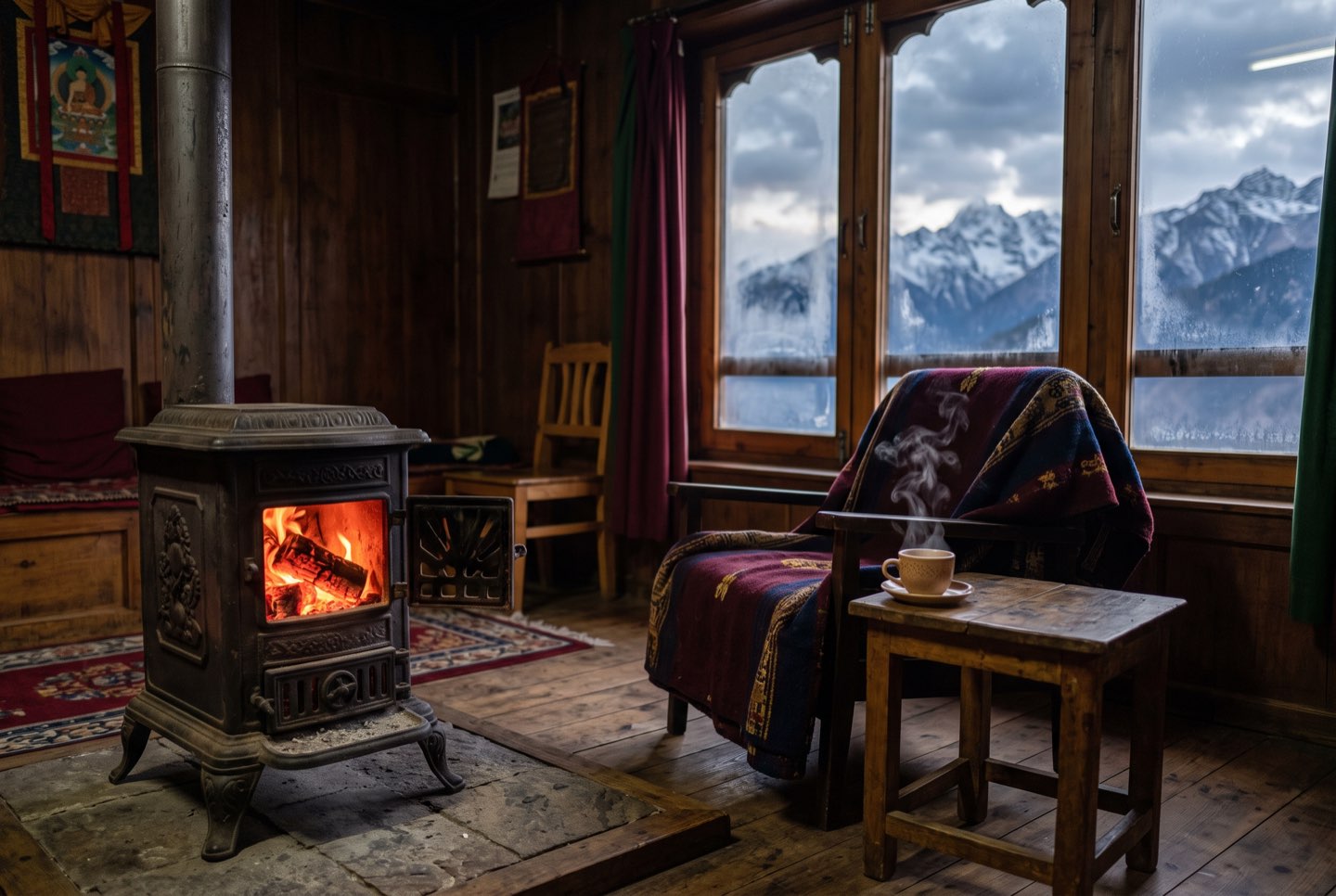 A bukhari glowing in a lodge room, with tea, a wool blanket and frosty mountains at the window.
Then there is the dotsho, the traditional hot-stone bath: a wooden tub of water warmed by river stones heated in a fire. Sinking into one on a frosty evening, steam rising into the dark, is the kind of cold-weather cure nobody warns you you’ll miss at home. Our guide to Bhutan’s wellness traditions explains how it works.
Mornings move at winter’s pace, too. The sun takes a while to reach the valley floors, so we rarely rush out at dawn… unless the cranes are calling, in which case we’ll hand you a flask of tea and a very warm hat.
What should you pack for Bhutan in winter?
Layers, above all, because you’ll go from a frosty morning to warm sunshine in the same day. Think thermal base layers, a fleece or wool mid-layer and a proper down or insulated jacket, plus a warm hat, gloves and a scarf for the evenings and the passes.
A few things people forget:
- Warm socks, several pairs. You take your shoes off at temple doors, and stone floors in January have opinions.
- Lip balm, moisturiser and sunscreen. The air is dry and the sun is strong at altitude.
- Sunglasses, for bright days and any snow on the passes.
- Walking shoes with good grip, for frosty paths and shaded steps.
- Smart layers for dzong visits. Long sleeves and covered legs are expected; a warm coat over them is fine.
You don’t need expedition gear. You do need to be comfortable standing still in a cold courtyard for an hour watching dancers, which is harder than it sounds.
Who is winter not for?
Winter isn’t for everyone, and we’d rather say so now. If you dislike being cold, even briefly, the mornings and evenings will test you. If you dream of high-altitude treks or rhododendrons in bloom, spring and autumn are your seasons. And if one particular mountain view is the whole point of your trip, remember that no season can promise a clear sky on a given morning.
It isn’t the season for tight, rigid itineraries either. Snow can slow the roads over the passes now and then, so we build a little slack into winter routes and keep the longest drives flexible.
But if you like quiet mornings, bright days, early nights by the fire and a country going about its winter life, this may be the season you didn’t know you wanted.
Frequently asked questions
Does it snow in Paro?
Sometimes, but not often, and it rarely settles for long on the valley floor. Snow is more likely on the high passes and in the higher valleys, and a light dusting on the temple roofs is a gift for photographers.
Are the passes open in winter?
Yes. The main road passes, including Dochula and Pele La, stay open through the winter. After heavy snow one can close for a few hours, occasionally longer, while road crews clear it, so we set off once the road is clear and keep a spare half-day on routes that cross them.
Is winter good for photography?
Very. Dry air gives crisp, clear light, the low sun keeps shadows long and soft, and frost, smoke and morning mist add texture. Bring spare batteries, because the cold drains them faster.
Are lodges open all year?
Generally, yes. Winter is a working season in Bhutan, not a closed one, but a property may occasionally shut for maintenance, so we check every lodge’s dates as we plan. Our guide to choosing Bhutan’s luxury lodges helps you pick between them.
Come in winter for the light, stay for the stove, and let Bhutan’s quiet season surprise you.