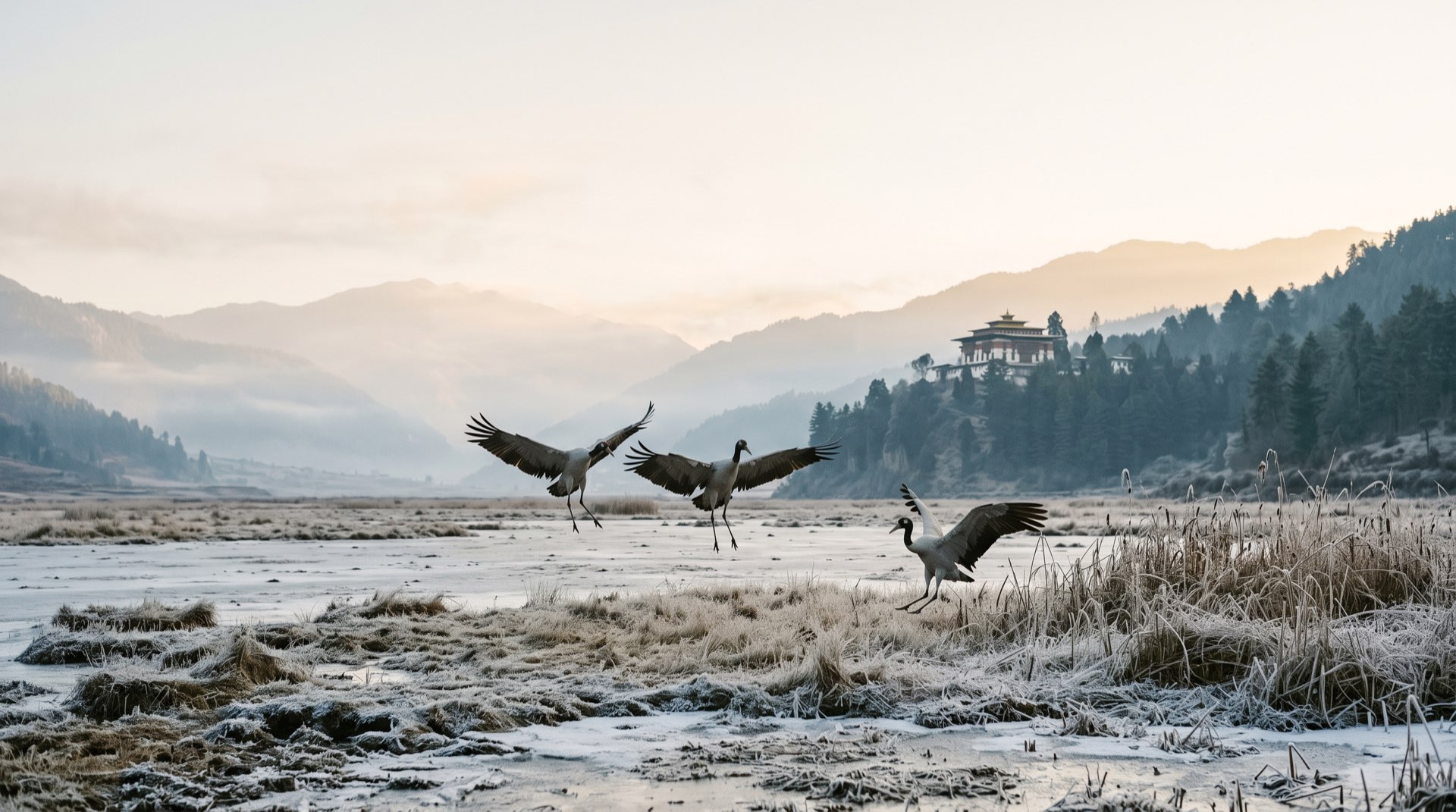
It begins before there is anything to see. You stand at the edge of the marsh in the blue half-light, frost crunching underfoot, breath hanging in the air. Then a call carries across the valley, a long, bugling note, answered from somewhere in the mist. By the time the sun reaches the ridge, the cranes are lifting off the roost in twos and threes, legs trailing, heading out to feed.
People ask us three things about this moment. Will the cranes be there? Will it be cold? And will we disturb them? Very likely, in season. Yes, properly. And no, not if we do it right.
Doing it right is most of the art, and it is simpler than it sounds.
| At a glance | Detail | Source |
|---|---|---|
| Season | Late October to mid-February; sightings are never guaranteed | Wangdue Phodrang Dzongkhag |
| National count | A record 709 cranes in winter 2024–25, up from 370 in 1987 | RSPN |
| Phobjikha | Around 640–650 of them, by far the largest flock in Bhutan | BBS |
| Festival | Black-necked Crane Festival, Gangtey Goenpa, 11 November 2026 | RSPN |
| Watching | From a distance, quietly, at dawn or dusk; no drones | RSPN, BCAA |
| Checked | 27 September 2026 |
When do the black-necked cranes arrive in Bhutan, and when do they leave?
They reach Phobjikha in late October and leave by mid-February, according to the Wangdue Phodrang district administration. They come from their summer breeding grounds on the Tibetan plateau and spend the winter in a handful of Bhutanese valleys, with Phobjikha by far the busiest.
The numbers tell a quiet conservation story. Bhutan’s count has nearly doubled since the first survey in 1987, from 370 birds to a record 709 in winter 2024–25, as the Royal Society for Protection of Nature (RSPN) records. Phobjikha alone held around 640–650 of them: the national broadcaster BBS put the valley’s count at 650, up 41 on the winter before.
The cranes don’t arrive on a timetable, and they have never once consulted ours. If you are set on seeing them, aim for the heart of the season rather than its very edges. And if a winter journey appeals, our guide to Bhutan in winter covers the clear skies and cold nights that come with it.
Why does Phobjikha matter so much?
Because it is the cranes’ main winter home, and the RSPN describes it as Bhutan’s largest high-altitude natural wetland. The birds roost at night in shallow water and spend their days foraging in the marsh and the harvested fields, picking up leftover grain.
The valley has been a Conservation Area since 1999, and the protection shows if you know where to look. Its power lines run underground, a choice made so that wires would not cut across the cranes’ flight paths.
The cranes matter to people too. In Bhutan they are revered as holy birds and messengers from heaven, and they fly through folk songs and stories. A story told in the valley says that when they arrive, they circle Gangtey Goenpa, the monastery on the ridge, three times. Watch them glide past the monastery at dusk and you begin to understand why.
The species is still listed as Near Threatened, and the RSPN notes pressure on the valley from new building and tourism. That is why how we visit matters as much as when.
What happens at the Black-Necked Crane Festival?
On 11 November 2026, the valley gathers in the courtyard of Gangtey Goenpa to welcome the cranes back. The festival falls on 11 November every year and was first held in 1998, according to the RSPN’s history of the festival.
The highlight is the crane dance, choreographed locally and performed by schoolchildren. Around it come folk songs, songs about the environment and masked dances, performed by local people, schoolchildren and monks. A local environment committee organises the day, and it feels like it: this is the valley’s own celebration, a chance to renew its promise to the cranes, with visitors warmly welcome.
It is a single day, outdoors, in November, at around 3,000 m. Dress warmly and respectfully, since this is a monastery courtyard, and arrive early for a good view of the dancing. If you would like to plan around other celebrations too, our calendar of Bhutan’s festivals has the year’s dates.
How do you watch the cranes without disturbing them?
From a distance, quietly, at dawn or dusk, and never with a drone. The cranes are wild, wary and getting through a hard winter; every time they take off in alarm, they burn energy they need.
- Keep your distance. The RSPN built its bird hide about 100 m from the roost, and on its own dawn watch the team kept noise and torches low so as not to disturb the birds. We do the same, and use binoculars and spotting scopes rather than stepping closer.
- Stay on paths and field edges. The marsh is the cranes’ home, and the fields belong to farming families.
- Leave the drone at home. Bhutan’s Civil Aviation Authority issues drone import permits only to government agencies, and drones brought in without approval are seized at the point of entry.
- Let the birds set the distance. If they stop feeding and start watching you, step back.
Dawn and dusk, when the cranes leave and return to the roost, are the magic hours. A crane has no interest in how long your lens is. Patience works better.
How does community tourism protect the valley, and what is our part?
By making sure the cranes bring a living to the families who share the valley with them. That is the thinking behind the community-based sustainable tourism the RSPN supports in Phobjikha, alongside its work on waste and local skills. Homestays and the festival itself put visitors’ spending straight into village hands.
We are part of that effort. As we describe in how we give back, we work with the Bhutan Ecological Society on community-based eco-tourism in the villages of Phobjikha.
The warmest way to take part is a meal or a night in a farmhouse. You sit by the clay stove while butter tea (suja) keeps arriving, strings of dried radish hang from the beams, and a family’s winter routine carries on around you, unhurried and warm.
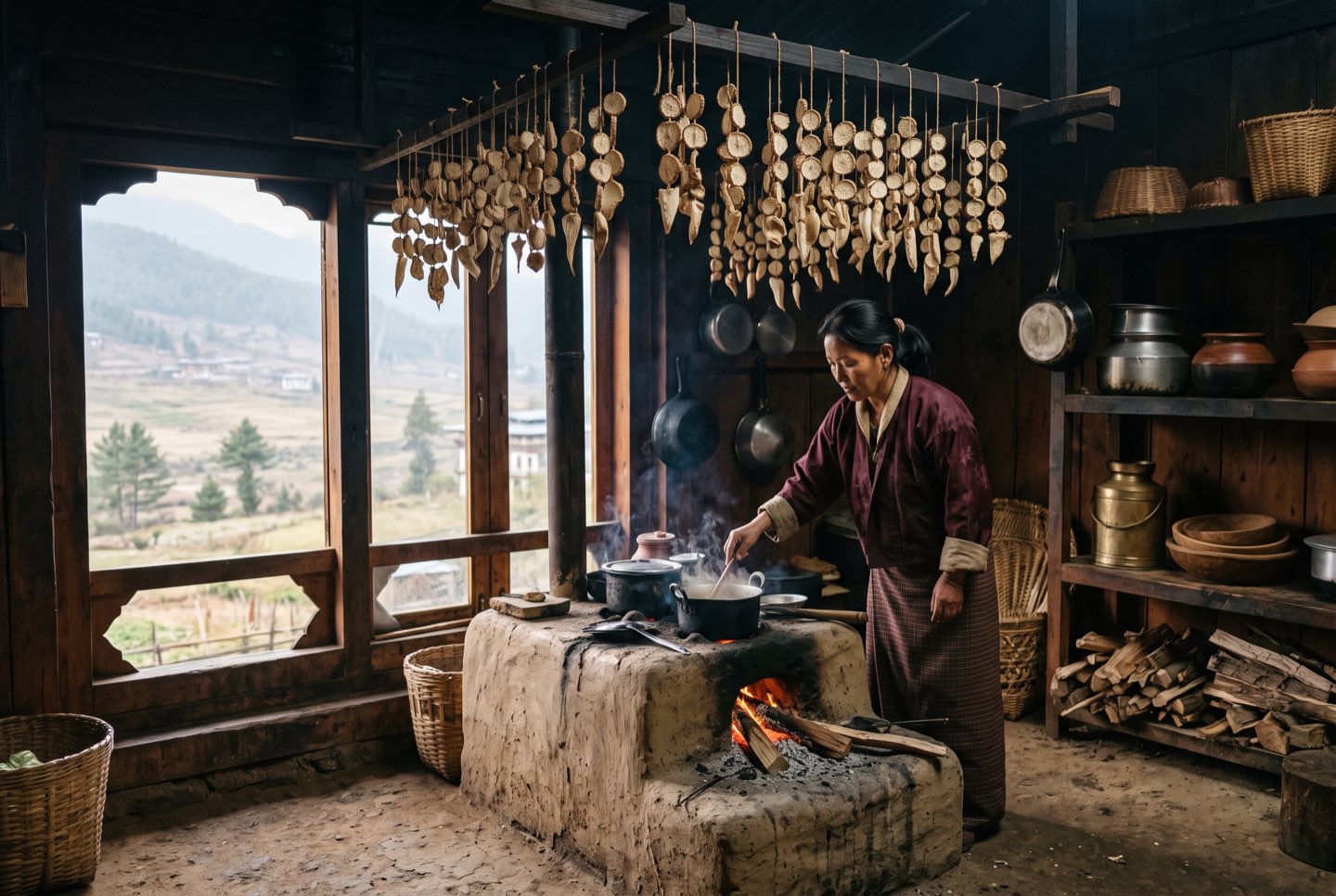 A farmhouse kitchen in Phobjikha: clay stove, dried radish and the valley in the morning window.
Where should you stay in Phobjikha?
In a lodge above the valley with a view of the marsh, or, for a night, in a farmhouse. Both keep you close to the roost at dawn.
For comfort, our Cranes & the Central Valleys journey stays at Gangtey Lodge, all glass and firelight above the crane valley, with Amankora Gangtey as the alternative. Waking to crane calls with the fire already lit is a very civilised way to do winter. Our guide to choosing Bhutan’s luxury lodges compares the options.
For connection, a farmhouse night is hard to beat, though simpler, with the kitchen stove at the heart of the house. A happy middle way is dinner with a family, then back to the lodge fire.
However you stay, give the valley at least two nights: one full day, and a spare dawn in case the first is lost to mist.
What else is there beyond the cranes?
Plenty, and the cranes spend much of the day feeding, which leaves you free. Phobjikha is a wide, open valley made for slow walking.
The Gangtey nature trail takes about an hour across the valley, and longer walks lead out to the villages beyond. Climb to Gangtey Goenpa on its ridge for the view back over the marsh, and time it for the late afternoon light. On a clear winter day the whole valley glows, and some of our favourite hours here are spent doing very little in it. For more walks like these, see our guide to walking in Bhutan. For the rest of Bhutan’s wildlife, from forest birds to the animals of the national parks, read a naturalist’s Bhutan, and for what you can realistically hope to see, wildlife in Bhutan.
When it is time to leave, the road runs east over the Pele pass to Trongsa and on into Bumthang, Bhutan’s spiritual heartland. The cranes, as it turns out, are only the beginning of the journey.
Frequently asked questions
Are the cranes guaranteed?
No. They are wild birds with their own plans. In the heart of the season, with hundreds wintering in the valley, your chances are very good, but the birds and the weather always have the final say.
How cold is Phobjikha?
Properly cold. The valley sits at around 3,000 m and winter dawns are below freezing, often with frost and a sharp wind. Lodges are warm; the marsh at dawn is not, so bring a down jacket, hat and gloves.
Can I visit the crane centre?
Yes. The RSPN’s Black-necked Crane Education Center at Gangtey explains the birds, the wetland and the valley’s eco-tourism programmes. It makes a good first stop on arrival, and we check its hours on the day.
Is the festival crowded?
Busy for a village, calm for a festival. The RSPN’s history of the festival mentions close to 250 visitors at the 2014 festival, alongside a big gathering from the valley itself, so arriving early still finds you a spot.
Come in winter, stand quietly at the edge of the marsh, and let the cranes arrive in their own time.