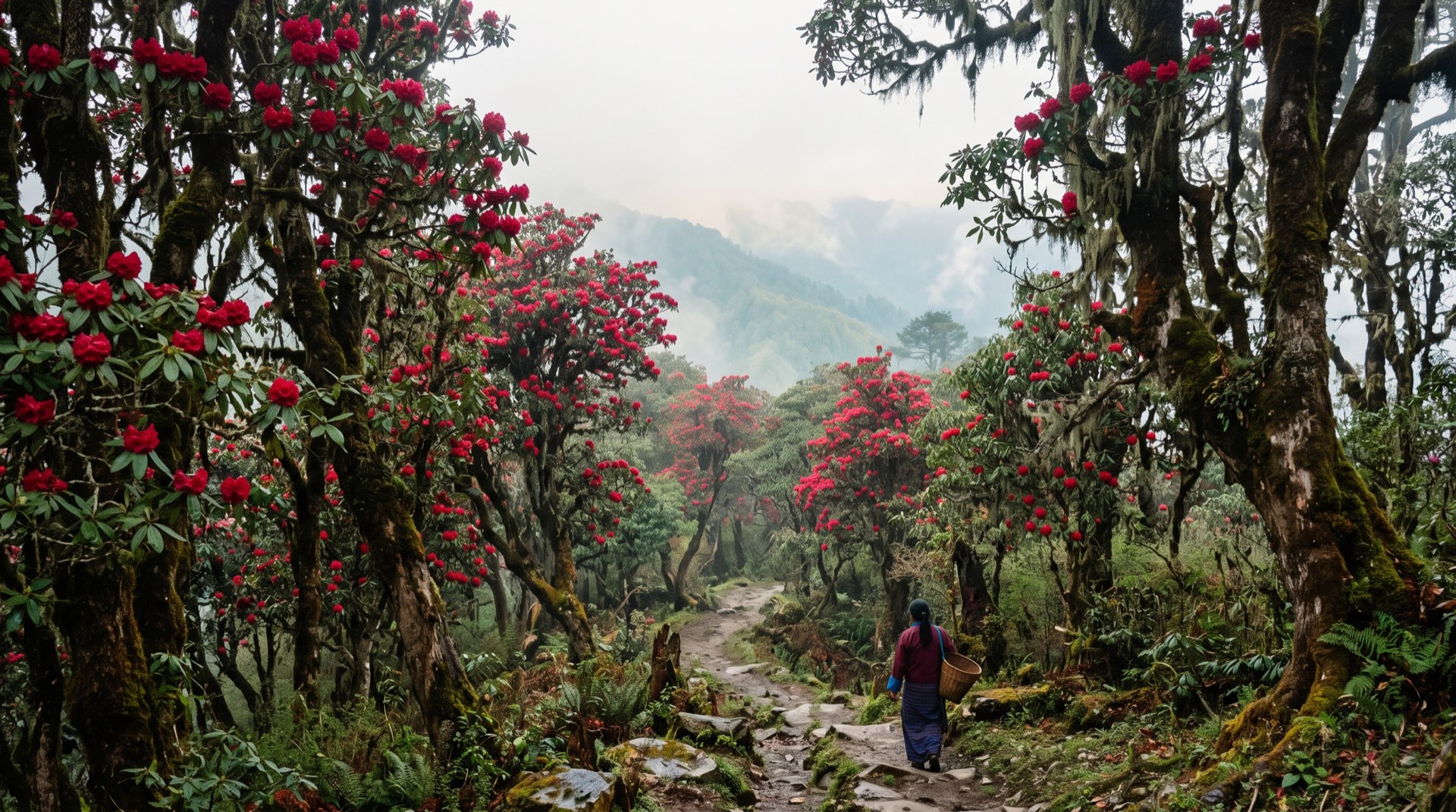
Six o’clock, and the valley is still blue with shadow. The air smells of wet moss and last night’s woodsmoke, and the forest is already talking: a clear whistle from the oaks, a busy chatter somewhere in the bamboo, a knocking high in the pines that might be a woodpecker or might be your imagination.
Perhaps this is where you hesitate. You aren’t a “birder”. You can’t tell a warbler from a wren, and you suspect a nature day means hours of squinting at leaves while someone else gets excited.
Here is the good news. Bhutan doesn’t ask you to be an expert. It asks you to get up early and look up. Our naturalists will do the naming. All you have to do is the wondering.
| At a glance | Detail | Source |
|---|---|---|
| Bird species | Around 736 recorded, 30 of them globally threatened | National Biodiversity Centre |
| White-bellied heron | 31 counted in Bhutan in 2026; fewer than 60 worldwide | RSPN |
| Rhododendrons | 46 species described in the Flora of Bhutan, 45 of them found here | Bhutan Biodiversity Clearing-House |
| Blue poppy | The national flower, Meconopsis gakyidiana, grows at about 3,700–4,300 m | National Biodiversity Centre |
| Bhutan Bird Festival | 13–14 November 2026, in Zhemgang | Department of Tourism |
| Tigers | About 131 estimated in 2021–22, up from 103 in 2014–15 | Bhutan for Life |
| Checked | 27 September 2026 |
Why is Bhutan so good for birds and wildlife?
Because so much of it is still forest, and that forest runs from warm subtropical valleys to the edge of the snow in a remarkably short distance.
Bhutan’s constitution requires at least 60% of the country to stay under forest. In a single day’s drive you can climb from broadleaf valleys, through oak and rhododendron, to the fir forests of the high passes, and each band has its own birds, flowers and particular silence.
The numbers are remarkable for a country this size. According to the National Biodiversity Centre, around 736 bird species have been recorded in Bhutan, 30 of them globally threatened. Add more than 5,600 species of seed plants, 129 mammals and around 750 butterflies, and you see why our naturalists never run out of things to point at.
The honest caveat: none of it performs on cue. Forests are dense, birds are busy, and no sighting is ever guaranteed. What you can count on is the feeling of walking through a place that still, very clearly, belongs to them.
What will you see in each season?
Something in every month, though the cast changes: song and blossom in spring, clear skies in autumn, cranes in winter and a green, dripping forest in summer.
Spring (roughly March to May). The forests are at their loudest. Birds are singing and nesting, and the rhododendrons are out. This is the peak of the birding year.
Autumn (September to November). Settled weather and comfortable walking. The annual Bhutan Bird Festival takes place in Zhemgang on 13–14 November 2026, with a birdathon run with the Bhutan Birdlife Society, according to the Department of Tourism, which counts 357 bird species in that region alone.
Winter (December to February). Crisp, quiet and clear. Black-necked cranes winter in Phobjikha from late October to mid-February; read about the cranes of Phobjikha before you choose your dates.
Summer (June to August). The monsoon: lush, misty and wet. Birding is harder under cloud, but the forest has never smelled better.
Our guide to when to visit Bhutan weighs up every month.
Can you see the white-bellied heron?
Possibly, with patience and a little luck. This heron is critically endangered, with fewer than 60 left in the world, and Bhutan is one of its last strongholds.
The Royal Society for Protection of Nature (RSPN) recorded 31 in Bhutan in 2026, living along forested rivers in the Punatsangchhu, Mangdechhu and Wangchhu basins, between about 100 and 1,800 m. The Punatsangchhu flows south from Punakha, so a dawn by its banks is where many heron hopes begin.
It is a tall, dark grey bird with a white belly, and it stands very still at the water’s edge for a long time. So, you will find, do the people looking for it.
We never promise one. RSPN notes that the species needs undisturbed rivers, so we keep our distance and our voices low. If you see it, you will have seen something very few people ever will. If you don’t, you will still have spent a dawn beside a Himalayan river, which is not a bad consolation prize.
When do Bhutan’s rhododendrons flower?
In spring, starting on the lower slopes and climbing with the warmth, so exactly when depends on how high you go.
The Flora of Bhutan describes 46 rhododendron species, 45 of them known in the country, according to Bhutan’s biodiversity clearing-house. The same report tells of one, Rhododendron pogonophyllum, found again in 2021 after 84 years unseen. Botanists are still meeting surprises here.
These are not the polite shrubs of a suburban garden. Some grow low and cushion-like on the high ridges; others are full trees, and walking beneath a canopy of red flowers on a misty spring morning is one of the great quiet pleasures of Bhutan. Look down as well as up: fallen petals turn the path pink.
Lower down, in the warmer broadleaf forests, the tree trunks carry orchids. Bhutan has recorded hundreds of orchid species, many of them tiny, and our naturalists have a knack for spotting the one clinging to a branch above your head.
What makes Bhutan’s blue poppy so special?
It is the national flower, it grows only high in the mountains, and it turned out to be a species of its own.
Until recently, Bhutan’s blue poppy was classed as a subspecies of a Himalayan cousin, Meconopsis grandis. Then research by the National Biodiversity Centre and the Blue Poppy Society of Japan showed it was distinct, and in 2016 it received its own name, Meconopsis gakyidiana, inspired by Gross National Happiness (gakyid means happiness in Dzongkha, the national language). The same work described new blue poppies too, bringing Bhutan’s total to 15 species at the time, three of them found nowhere else.
It grows at about 3,700–4,300 m, among high shrubs and at forest edges, so it isn’t a roadside flower. Seeing one means a proper walk at altitude, and flowering varies with the year and the height.
If the blue poppy is your reason for coming, tell us early. We would rather plan the walk around it than promise it on the way to lunch.
What is a walk with our naturalists like?
Slow, early and surprisingly sociable: more standing and listening than walking, with someone beside you who can put a name to almost every call.
Our team includes our naturalists, among them a botany specialist, and they can join any journey. An outing starts at first light, when birds are busiest, and rarely covers much distance. Binoculars up, binoculars down. A pause to listen. A leaf turned over to show the rust-coloured underside that tells two rhododendrons apart. A notebook for the list, if you like lists.
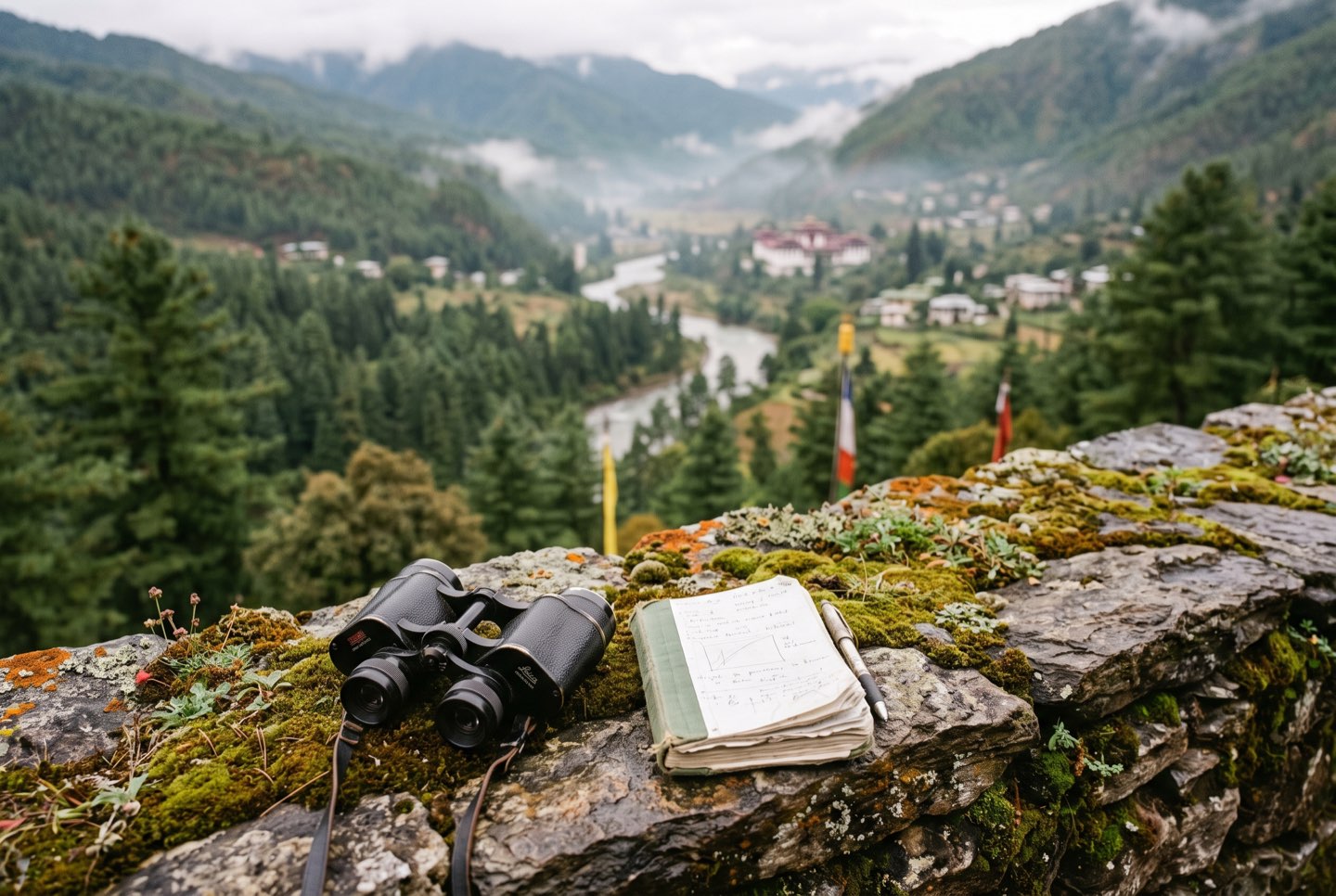 Binoculars and a field notebook on a mossy wall above the valley, in the first light of morning.
You don’t need to be fit or knowledgeable. The paths are usually gentle, the pace is slow, and questions are the whole point. Children often turn out to be the sharpest spotters in the group.
The hardest part is the alarm clock. Birds keep early hours, and they don’t negotiate. For longer days on foot, our guide to walking in Bhutan suggests where to start.
How do you watch wildlife well in Bhutan?
Quietly, patiently and from a respectful distance, with your expectations set by the forest rather than by a safari programme.
Bhutan is not a savannah. Most of its mammals live in thick forest and keep to themselves, so birds are the everyday wildlife and a mammal is a bonus. The pleasure is in the whole scene: the light, the sounds, the tracks in the mud.
A few habits make all the difference:
- Wear muted colours and keep your voice low.
- Give animals space. If a bird changes what it is doing because of you, you are too close.
- Never chase a bird or an animal for a photograph. Let it come, or let it go.
- Stay on the path in protected areas, and never feed wildlife.
- Carry your rubbish out with you.
Do these, and something lovely happens. After a while of standing still, the forest seems to forget you are there, and the birds come a little closer on their own.
Frequently asked questions
When is the best birding season?
Spring gives the greatest variety. If autumn suits you better, mid-November is a happy compromise: in 2026 the Black-necked Crane Festival in Phobjikha falls on 11 November, and the Bird Festival two days later.
Where can I see the blue poppy?
Only on foot, and only high up in eastern Bhutan, where it is recorded. The Merak and Sakteng region even has a blue poppy species whose typical form is known only there; our guide to going beyond western Bhutan explains the journey.
Do I need binoculars?
Yes, and a pair you know well beats a better pair you have never used. Light 8x or 10x binoculars you are happy to wear all day are ideal.
Are there tigers in Bhutan?
Yes. A national survey estimated 131 in 2021–22, up from 103 in 2014–15, with hotspots in parks such as Royal Manas, reports Bhutan for Life. They are shy and range widely, and camera traps see far more of them than people do.
In Bhutan the forest does most of the talking. Come early, walk slowly and let it tell you who lives there.