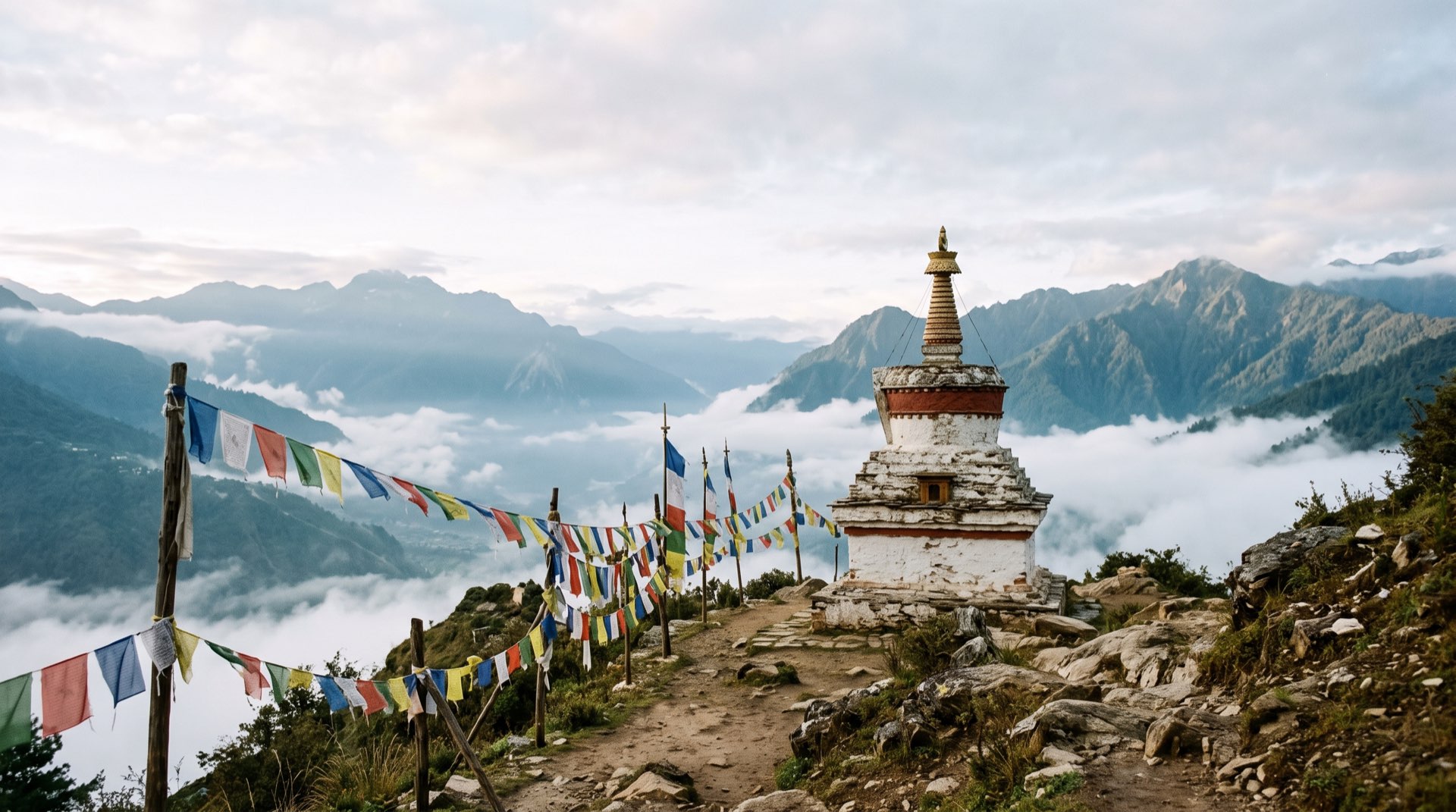
The valley floor is still in shadow, the daypack is by the door, and the day’s real question is which hill to walk up. The Tiger’s Nest gets the photographs, so it is easy to believe it is the only trail in Bhutan. It isn’t, and it is not the only one worth your knees.
The worry is usually practical rather than romantic. Which walks are gentle and which are not? What can you do on your second day, when the hotel stairs already leave you breathless? And how many can you fit in before your legs file a complaint?
The Department of Tourism publishes a list of 13 day hikes with a duration for each and very little else. We have sorted it by valley and by effort, and added what a few government pages tell us about the walks they describe.
| At a glance | Detail | Source |
|---|---|---|
| Hikes on the official list | 13 day hikes, from 1 hour to a full day | Department of Tourism |
| Our grades | Easy: up to about 2 hours; step up: 2–4 hours with a climb; big day: 5 hours or more | Our grouping of the Department’s times |
| Guide | A licensed guide accompanies tourists at all times, including at monuments | DoT notification, 8 April 2026 |
| Altitude rule | Risk from a sleeping altitude of 2,450 m; above 3,000 m, raise it by no more than 500 m a night (advice the CDC relays) | CDC |
| One altitude we can source | Phajoding, about 3,600 m | Thimphu district administration |
| Checked | 30 September 2026 |
What are the best day hikes in Bhutan besides the Tiger’s Nest?
Twelve of the Department’s thirteen make a sensible planner, and the table below sorts them by effort. The Department gives times and no grades, so the grades are ours. It gives no altitudes either, so where a government page supplies one we say so, and where none does we leave a gap rather than guess. Treat each time as walking time, then add tea, photographs and an hour at the temple at the top.
| Grade | Valley | Walk | Department’s time |
|---|---|---|---|
| Easy | Phobjikha | Gangtey Nature Hike | 1 hour |
| Easy | Bumthang | Bumthang Cultural Hike | 2 hours |
| Easy | Thimphu | Changangkha to Buddha Point | 1.5–2 hours |
| Step up | Thimphu | Tango Monastery | 2 hours |
| Step up | Dochula pass | Dochula to Lungchutse Lhakhang | 2–3 hours |
| Step up | Punakha | Khamsum Yulley Namgyal Chorten | no clear time listed |
| Step up | Phobjikha | Gangtey to Longtey village | 4 hours |
| Big day | Paro | Bumdra | 5 hours |
| Big day | Paro | Zuri Goenpa | 5–6 hours |
| Big day | Paro | Paro Taktsang (Tiger’s Nest) | 5–6 hours |
| Big day | Thimphu | Phajoding | 6 hours |
| Big day | Bumthang | Ngang Lhakhang to Tahung | 6 hours |
The thirteenth entry, a day near the Chele La pass, is tied to a funerary site. A place where families say goodbye is not a sight, so we have left it off.
Which walks are easy?
Three, and all take two hours or less: the Gangtey Nature Hike, the Bumthang Cultural Hike and Changangkha to Buddha Point. The Department calls the Buddha Point trail fairly easy, without much steep climbing, and says it opens onto a view of the Thimphu valley. The other two are valley-floor walks of the sort described in our guide to walking in Bhutan.
“Easy” describes the path, not the air. Phobjikha lies at around 3,000 m, so a one-hour stroll there is best saved for your fourth or fifth day. Bumthang is the natural home of the cultural walk, and our guide to going beyond western Bhutan explains how to reach it.
These are the walks with nothing to prove. Take them at conversation pace, on your first afternoon or the morning after a big day, and use them as your fallback when the weather says no to a climb. A spare easy walk is always worth having in your pocket.
Which walks are a step up, and which are big days?
A step up is a climb of a couple of hours to a temple; a big day is most of the day. The step-ups include Tango (2 hours) and Dochula to Lungchutse (2–3 hours). Punakha’s district administration describes the Khamsum path as leading from the roadside over a bridge on the Mo Chhu, then climbing steeply to the chorten, and suggests going in the cool of the morning. The Gangtey to Longtey walk, at 4 hours, is the longest of the group.
The big days start at 5 hours: Bumdra, Zuri Goenpa, Ngang Lhakhang to Tahung and the Tiger’s Nest, which our guide to the Tiger’s Nest hike covers in full. Phajoding is the one to read twice. The Department lists 6 hours, while Thimphu’s district administration says 3–4 hours each way to a monastery at about 3,600 m, and calls it moderately challenging. Plan a full day, with lunch and a lie-down.
Which walks suit your first two days at altitude?
The short, low-effort ones, and the CDC explains why. It says an unacclimatised traveller going to a sleeping altitude of 2,450 m or higher is at risk of altitude illness, and, relaying Wilderness Medical Society advice, that above 3,000 m you should raise your sleeping altitude by no more than 500 m a night. It also says fitness does not change the risk.
So on days one and two, the good choice is Changangkha to Buddha Point, or a stroll, and a long lunch. Punakha lies far lower than Paro or Thimphu, so its steep chorten climb comes with thicker air. Keep Phajoding, Bumdra, the Tiger’s Nest and Phobjikha for later. Our guide to altitude and health in Bhutan has the altitudes for the places you will sleep.
Which walks work in the monsoon, winter or spring?
Most work in most seasons, with the low and short ones easiest in the wet. The National Centre for Hydrology and Meteorology says the summer monsoon, June to September, brings 73% of Bhutan’s rain, and winter, December to February, only 1%.
In the monsoon, choose morning walks in the lower valleys and expect mud and cloud over the ridges; rain often comes in bursts, and many mornings are bright. Winter is dry, so Punakha’s low valley is pleasant on foot, while Paro’s mornings and the high ridges are cold and the Tiger’s Nest and Phajoding deserve a warm layer and an early start. Spring and autumn suit everything, including the big days. Our guide to when to visit Bhutan goes month by month.
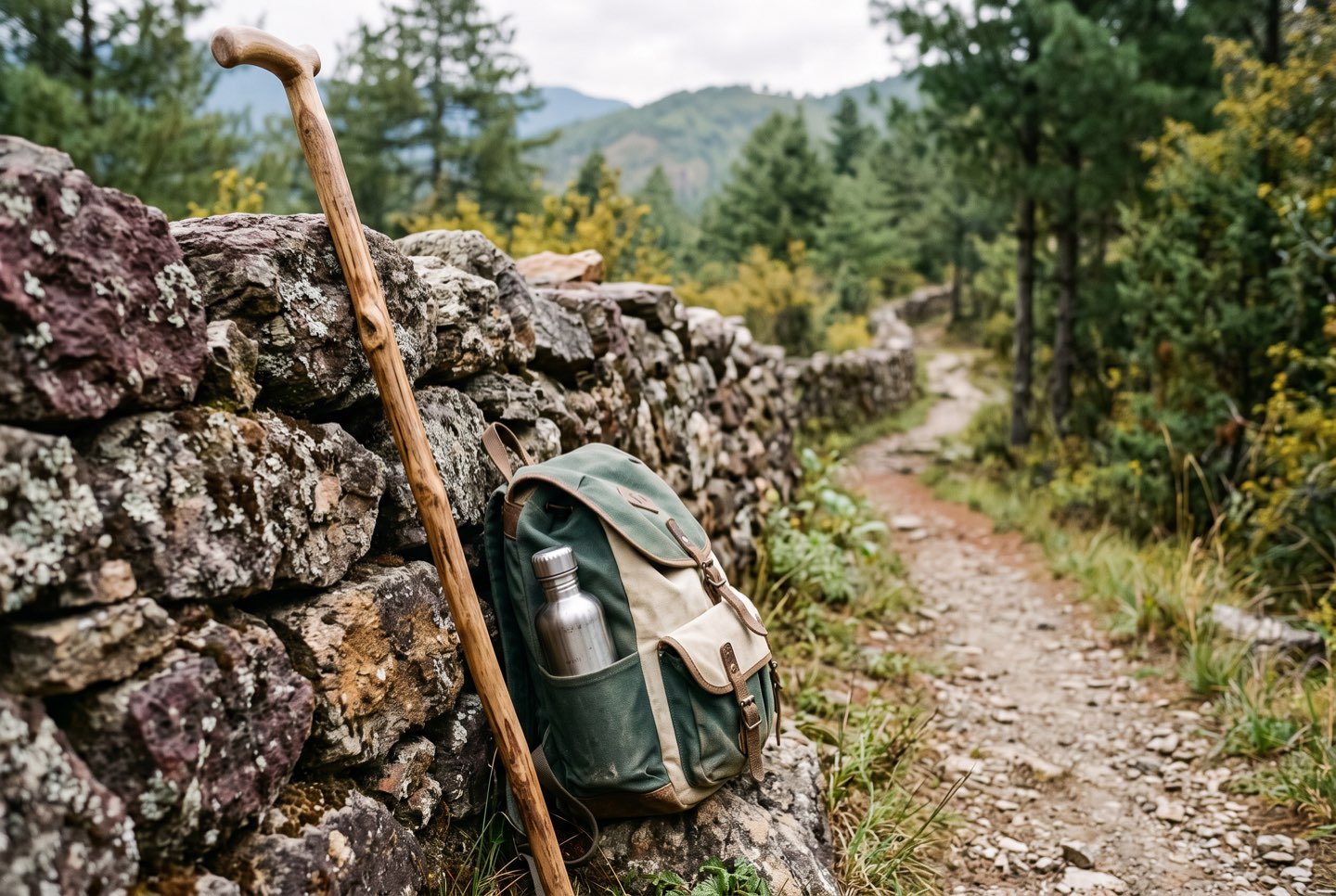 A wooden walking stick and a small daypack with a steel water bottle, leaning against a stone wall beside the trail.
What should you carry for a half-day walk?
Less than you think, plus one thing you will not think of. We carry water and snacks for you, and day-hike refreshments are part of our journeys, so your daypack can stay light. If an item does not earn its weight by the first switchback, leave it at the hotel.
- A waterproof shell, even on a bright morning, because the weather turns quickly on a ridge.
- A warm layer for the top, where it is usually windier than the trail.
- Sun cover, because the sun is stronger at altitude than it feels.
- A hat you don’t mind removing, since hats come off at temple doors. Our guide to dzong and temple etiquette explains the rest.
- Your own medicines and a spare pair of socks.
How do you fit walks into a journey?
Easy first, step-ups in the middle, big days once your body has had a week of Bhutan, and a lighter day after each. That is the shape we aim for, and we confirm the order for your dates. On The Soul of Western Bhutan, for example, the Tiger’s Nest comes with an easy day before it and a slow one after.
Then we choose by valley: a gentle walk in Thimphu early, the chorten climb when you reach Punakha, the nature walk in Phobjikha once you are used to the height, and a temple walk in Bumthang. Dochula to Lungchutse fits neatly on the day you drive from Thimphu to Punakha, because you go high for the walk and sleep low that night. If day hikes leave you wanting more, Bhutan’s treks compared is the next step, and the Tiger’s Nest is never the finish line.
Frequently asked questions
Do I need a guide for day hikes?
Yes. The Department’s April 2026 notification requires a licensed guide with tourists at all times, and that includes the gentlest walk on the list. It also means someone else is holding the map.
Can a car meet me at the end?
Often, yes. The car can meet you at the far end, which is why many of our walks go one way, and we confirm the pick-up point for each walk when we plan your days.
Which hike is best for families?
Start with the easy three. The Gangtey Nature Hike takes an hour, and we set the goal by the smallest walker, with a snack at the turning point.
Are there toilets on the trail?
Rarely on the trail itself. We plan a stop before the start and after the finish, and you only need to tell your guide when you want a pause.
A country this steep repays a short walk as generously as a long one. Start small, and let your legs vote.