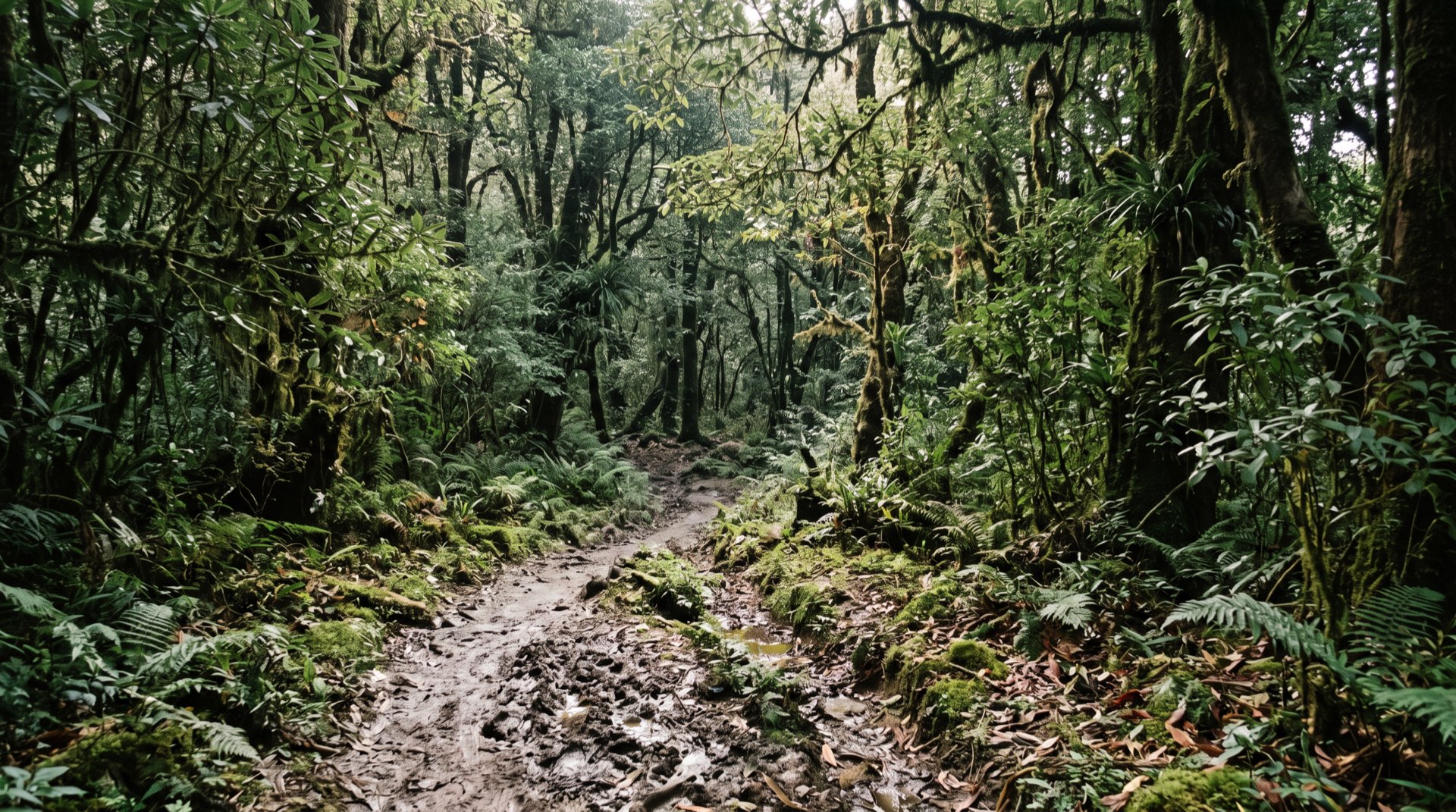
The track is soft with last night’s rain, and every few steps it tells you something. A scuff in the leaf litter. A dent that might be a hoof. Somewhere in the firs above, a bird repeats two notes as if it had lost the rest of the tune. You slow down without deciding to, and your eyes start doing what they haven’t done since childhood: searching every shadow for a shape.
Then comes the arithmetic everyone does. A country famous for tigers and snow leopards; a journey of a week or two. What are the chances?
It is a fair question, and most “you might see” lists dodge it. So we start with the surveys, then sort what a lodge-and-valley journey can show from what needs boots, a tent and a great deal of luck.
| At a glance | Detail | Source |
|---|---|---|
| Tigers | 131 in 2021–22, up from 103 in 2014–15 (+27%) | Bhutan for Life |
| Snow leopards | 134 confirmed in 2022–23, up from 96 in 2016 | Department of Forests and Park Services |
| Mammals | 129 species recorded, 26 of them globally threatened | National Biodiversity Centre |
| Birds | 754 species (Department of Tourism) or around 736 (National Biodiversity Centre): two official figures that differ | Department of Tourism |
| Protected land | Almost 42% of the country: five national parks, four wildlife sanctuaries and a strict nature reserve | Department of Tourism |
| In the wild | Hunting and fishing illegal in most of Bhutan; no venturing into the wild without an accredited guide | Department of Tourism |
| Sighting rates | No official statistics for visitors that we could find | Our own search, 30 September 2026 |
| Checked | 30 September 2026 |
What wildlife does Bhutan have?
A great deal, and most of it stays out of sight. The National Biodiversity Centre records 129 mammal species, 26 of them globally threatened, and says Bhutan harbours 11 of the world’s 36 wild cat species. Birds are trickier: the Department of Tourism says 754 species, while the Centre’s own page says around 736. Both are official, they don’t agree, and we quote each rather than crown a winner.
The reason is habitat and space. Bhutan climbs from warm subtropical forest in the south to glaciers in the north, and the Department of Tourism says almost 42% of the country lies inside protected areas joined by biological corridors, so animals can move between them. Its list of residents reads like a dare: tigers, snow leopards, red pandas, Himalayan black bears, takins, blue sheep, clouded leopards, golden langurs, musk deer, elephants and Tibetan wolves. That protection grows from the same thinking as Gross National Happiness, which counts a healthy environment as part of a good life.
How many tigers and snow leopards are there?
131 tigers and 134 snow leopards, according to Bhutan’s latest national surveys, and both counts have grown. Bhutan for Life reports that tigers rose from 103 in 2014–15 to 131 in 2021–22, using camera traps and field surveys. The forest department says its 2022–23 survey confirmed 134 snow leopards, up from 96 in 2016, which it calls a modest increase, with 310 camera stations across about 9,000 km² of alpine habitat.
Now the part that matters for your holiday. Averaged over the 32,800 km² sampled, tiger density is 0.23 per 100 km², roughly one tiger for every 430 km² (our arithmetic). A female’s home range averages 155 km², a male’s 498 km². The survey found tigers thickest, at more than two per 100 km², in the Royal Manas, Jigme Singye Wangchuck, Jigme Dorji and Phibsoo protected areas and in the Bumthang, Dagana and Zhemgang divisions. Snow leopards were denser in the west than in the centre or east.
Cheering numbers for conservation, modest ones for an itinerary. The tigers have not read yours.
What can you realistically see on a normal journey?
Birds almost everywhere, cranes in winter and the signs of bigger animals; a large mammal is a bonus, never a plan. We know of no published sighting rates for visitors, so this ladder comes from habitat: where each animal lives, set against where a lodge-and-valley journey actually goes.
Rung one: likely. Birds. They turn up in every kind of habitat here, and the Department of Tourism names March to May as the peak birding months; a naturalist’s Bhutan walks through the seasons. In winter come the cranes of Phobjikha, the valley our Cranes & the Central Valleys journey is built around.
Rung two: a good bet, with an asterisk. Thimphu’s district administration describes the Motithang Takin Preserve as a semi-wild sanctuary where visitors can watch takins, Bhutan’s national animal, roaming freely. It is a dependable way to meet a large mammal, and it is a preserve, not the wild. Ask us if it fits your day.
Rung three: signs, not sightings. The surveys list Bumthang among the tiger hotspots, caught snow leopards on camera in Thimphu’s forest division and recorded a white-lipped deer, new to the country’s records, in Paro. You travel through their country, but your routes are roads and valley floors, and these animals favour ridges and darkness. Expect a track, a story from your guide and, if you are like us, a vivid imagination.
What needs a trek or a specialist trip?
Anything that lives in the far south or above the tree line: elephants and golden langurs in one direction, blue sheep, red pandas and snow leopards in the other.
Rung four: the south. The Department of Tourism lists elephants in Phibsoo and Jomotsangkha wildlife sanctuaries, with tigers, gaur and golden langurs at Phibsoo, and describes Royal Manas National Park as recently opened to the public. This is a different journey from the western circuit, with its own roads and its own planning. Tell us if it is your dream and we’ll say what is possible.
Rung five: the high country. Blue sheep and takins are listed in Jigme Dorji National Park, where Mount Jomolhari stands, and takins and Tibetan wolves in Wangchuck Centennial. Reaching the high ground usually means several days on foot with a trek crew, which is where walking in Bhutan turns into expedition planning. Snow leopards live in the northern alpine landscape the survey covered, and even there a density of 1.34 per 100 km² is no promise: the animal is famously good at not being looked at. The far east, covered in beyond western Bhutan, adds its own sanctuary, told in Sakteng, Merak and the yeti.
Where are the national parks?
Ten protected areas, together almost 42% of the country, each with a different cast. This is the Department of Tourism’s list, with areas as it gives them:
- Jigme Dorji National Park (4,349 km²): the largest, from warm broadleaf forest to permanent ice; black bear, blue sheep, takin.
- Wangchuck Centennial National Park (4,149 km²): takin, black bear, Tibetan wolf.
- Jigme Singye Wangchuck National Park (1,300 km²): musk deer, golden langur, red panda, tiger.
- Thrumshingla National Park (768 km²): where a survey team photographed a tiger at 3,000 m.
- Bumdeling Wildlife Sanctuary (1,545 km²): snow leopard, tiger, red panda, and a winter home for black-necked cranes.
- Phibsoo (278 km²) and Jomotsangkha (273 km²) wildlife sanctuaries: elephants, gaur; golden langurs at Phibsoo.
- Jigme Khesar Strict Nature Reserve: the only strict reserve, from Haa to Samtse; clouded leopard, red panda.
- Royal Manas National Park in the south, and Sakteng Wildlife Sanctuary in the far east, home of the Brokpa herders.
Why do you need a guide in the forest?
Because the rules say so, and because the forest has no fence. The Department of Tourism tells visitors not to venture into the wild without an accredited guide, adding that encounters with wild predators, although increasingly rare, are not unheard of even a short hike from the cities. Hunting and fishing are illegal in most of Bhutan.
Hold that against the surveys and it stops sounding alarming and starts sounding sensible. The animals are real, the numbers are healthy and the country would like you to meet them on their terms. A guide reads the path, keeps you on it and knows which valley is quiet this week. Nobody is asking you to be brave.
How do you watch wildlife well?
Quietly, early and from a distance, with hopes set by the forest rather than by a safari brochure. Muted colours, low voices and binoculars you already know how to use beat any amount of enthusiasm. Stay on the path, never feed anything, never chase a photograph.
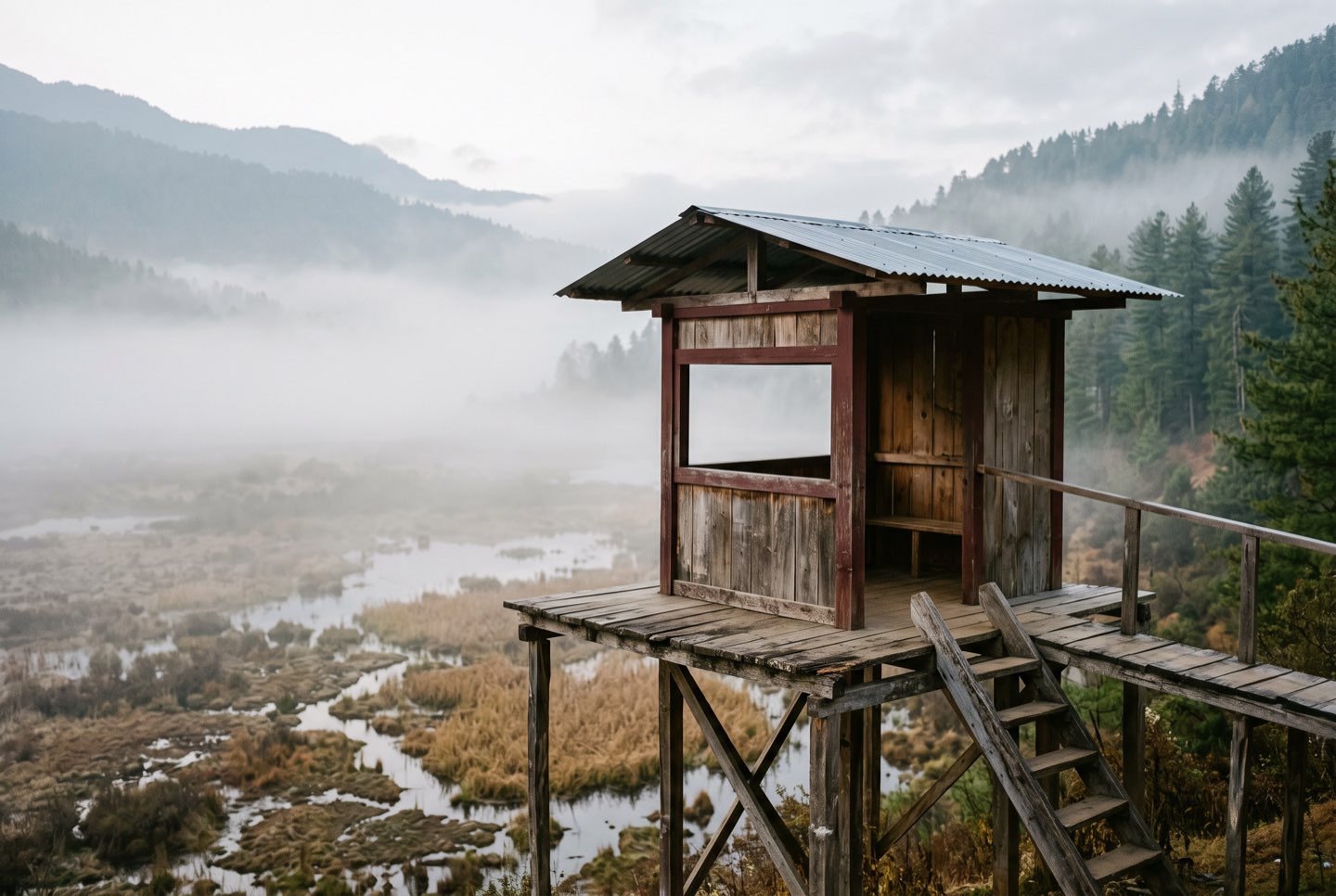 A small wooden lookout above a misty marsh clearing at dawn, empty and cold.
The Department of Tourism asks visitors to enjoy Bhutan’s natural abundance and leave the wild undisturbed. In practice, that means stillness, and it means counting the small wins. A woodpecker’s knock, a set of prints, a rustle that turns out to be a bird the size of a teacup. The tiger, if it comes, was always going to be a gift.
Frequently asked questions
Can I see a tiger?
Very unlikely on any journey, and we won’t pretend otherwise. The camera traps that counted them record far more than people ever do. If it is a dream, tell us early so we can say plainly what is possible.
Is it safe to walk with wildlife around?
On the usual trails, with your guide, yes. Keep to the path and to your guide’s pace, never approach or feed an animal, and mention any worry before you set out rather than halfway up a slope.
What is Bhutan’s national animal?
The takin. The Department of Tourism places wild takins in Jigme Dorji and Wangchuck Centennial National Parks, while Thimphu keeps a semi-wild sanctuary for them at Motithang.
Are there elephants?
Yes, in the warm south. The Department of Tourism lists elephants in the Phibsoo and Jomotsangkha wildlife sanctuaries, well away from the usual western circuit.
In Bhutan the forest keeps its own timetable. Come for the birds, hope for the tracks, and be glad of every animal that doesn’t need you to see it.