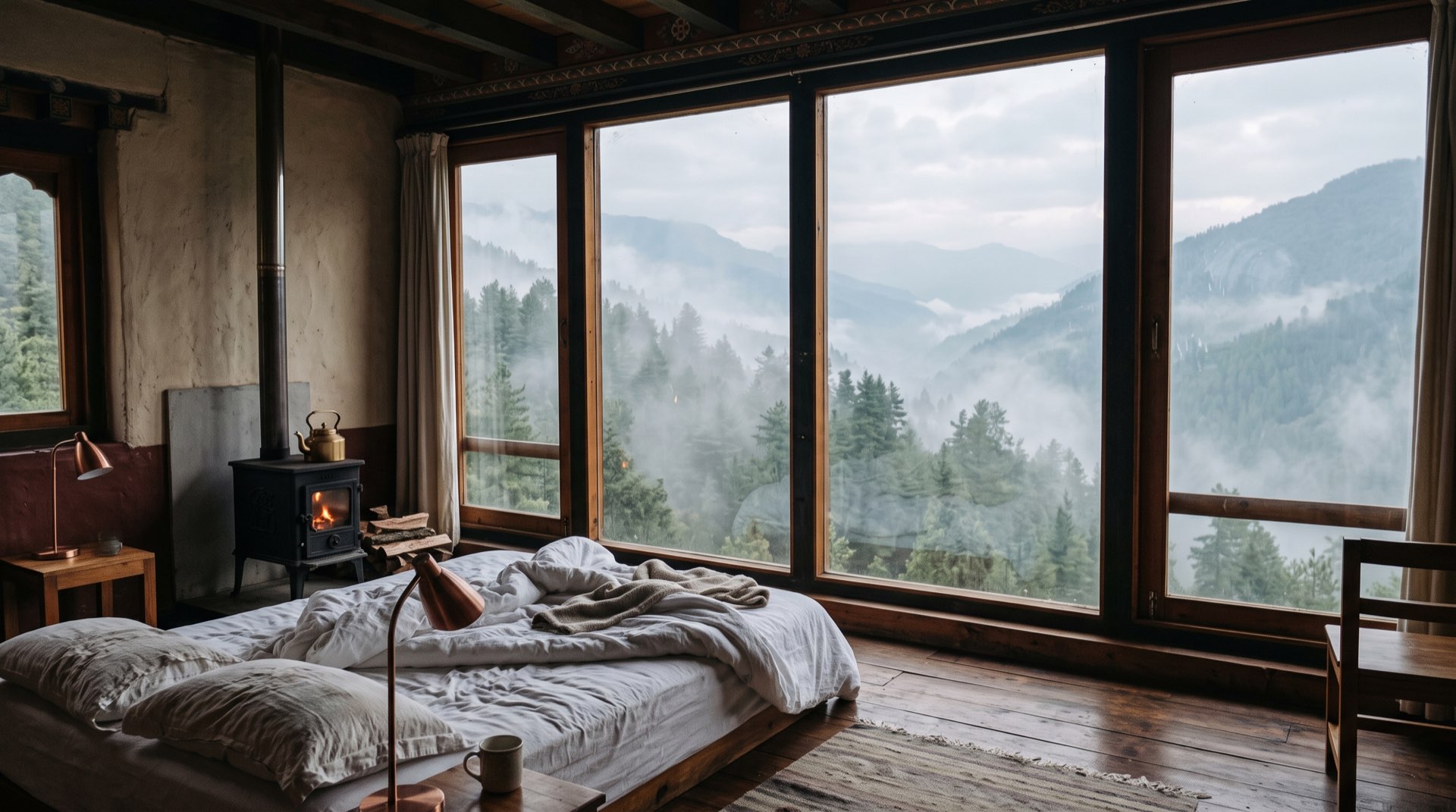
The bukhari, a traditional wood-burning stove, still holds a little of last night’s warmth. Outside the window, pine forest falls away into a valley full of mist, and somewhere below, a dog and a rooster are settling an argument that started well before dawn. You haven’t moved from the bed yet. You don’t need to.
That is what a good lodge in Bhutan gives you. The hard part is choosing, and not just once: on most journeys you move between three or four valleys, and every lodge website looks lovely. Amankora, Six Senses, COMO Uma, Pemako… the names start to blur by the second browser tab. So let’s slow down and think about it the way we do when we plan a journey: valley by valley, and guest by guest.
| At a glance | Detail | Source |
|---|---|---|
| Amankora | Five lodges: Paro (24 suites), Thimphu (16), Punakha (8), Gangtey (8), Bumthang (16) | Aman |
| Six Senses Bhutan | Five lodges: Thimphu, Punakha, Paro, Gangtey, Bumthang | Six Senses |
| COMO Uma | Two lodges: Paro and Punakha | COMO |
| Pemako | Thimphu (66 rooms and suites) and Punakha | Pemako |
| Where visitors may stay | Only in accommodation approved by the Department of Tourism | Department of Tourism |
| Checked | 27 September 2026 |
How do you choose a luxury lodge in Bhutan?
Choose by valley first, then mix. Bhutan’s lodge brands aren’t lined up side by side in a resort town; they are spread through the valleys you will travel. Amankora is a series of five lodges across the central and western valleys, and Six Senses Bhutan also has five, each designed to reflect a different side of Bhutanese life. COMO Uma has two, and Pemako has hotels in Thimphu and Punakha.
So the useful question isn’t “Aman or Six Senses?” It’s “Where do I want to wake up in Punakha?” Answer that for each valley and a journey tends to assemble itself, often with two or three brands in it.
We compare lodges by setting, style, pace and who they suit, and we don’t rank them. The right lodge for a honeymoon can be the wrong one for three generations. For the bigger picture of how we travel, start with slow luxury in Bhutan; for budgets, our guide to what a luxury Bhutan journey costs sets out how the pieces fit together.
Where should you stay in Paro?
Choose for your arrival and for the Tiger’s Nest, because most journeys begin and end here. Amankora Paro sits among pine forest, with 24 suites and a two-storey spa within easy reach of the Tiger’s Nest, according to Aman. It is secluded and serene: the place to go quiet after the flight.
COMO Uma Paro sits on a tree-clad hill overlooking the town, about a ten-minute drive from the airport, with COMO Shambhala wellness facilities including an indoor pool and a gym. Much of its kitchen’s produce comes from an organic garden kept with local farmers. It suits travellers who like morning yoga, a view over the town and a short hop to the airport on the last day.
Six Senses Paro is known as the Stone Ruins, and yes, you dine among them. Six Senses describes it as a convenient base for an early start up to the Tiger’s Nest.
On our own journeys, we usually pair Amankora Paro with COMO Uma Paro as the alternative. Tell us whether you want silence or a little life around you, and the choice tends to make itself.
Thimphu: hillside retreat or the heart of town?
That depends on whether you want to look at the capital or step into it. Six Senses Thimphu is perched on a hillside among apple orchards and pine forest, looking over the lights of the city, and Six Senses calls it its Palace in the Sky. It is where all three of our published journeys spend their first nights.
Amankora Thimphu has 16 suites set in a quiet forest above the capital, yet close to the city’s sights. It suits travellers who want Thimphu on their doorstep without hearing it.
Pemako Thimphu is the other way round. It sits in the heart of the capital, with 66 rooms and suites designed to evoke a medieval fortress, and a spa, Lotus Realm, inspired by Sowa Rigpa, Bhutan’s traditional medicine. It is larger than the forest lodges, with more going on, and it suits travellers who like to wander out after dinner or meet the city on foot.
If you can’t decide, split your nights. Thimphu rewards two, and we have yet to hear anyone complain about seeing it from both a hillside and a high street.
Which lodge suits Punakha?
Punakha is lower and warmer than Paro or Thimphu, and this is where lodge styles differ most. COMO Uma Punakha, COMO’s smallest Uma lodge, sits on a small hill at the western end of the valley above the Mo Chhu river, and every room looks out over the river winding through rice fields and orchards. It is a place for people who like a view they’ll struggle to leave.
Amankora Punakha has just eight suites, set in a 300-year-old farmhouse near Punakha Dzong, with views over the rice paddies below. Intimate, historic and quiet.
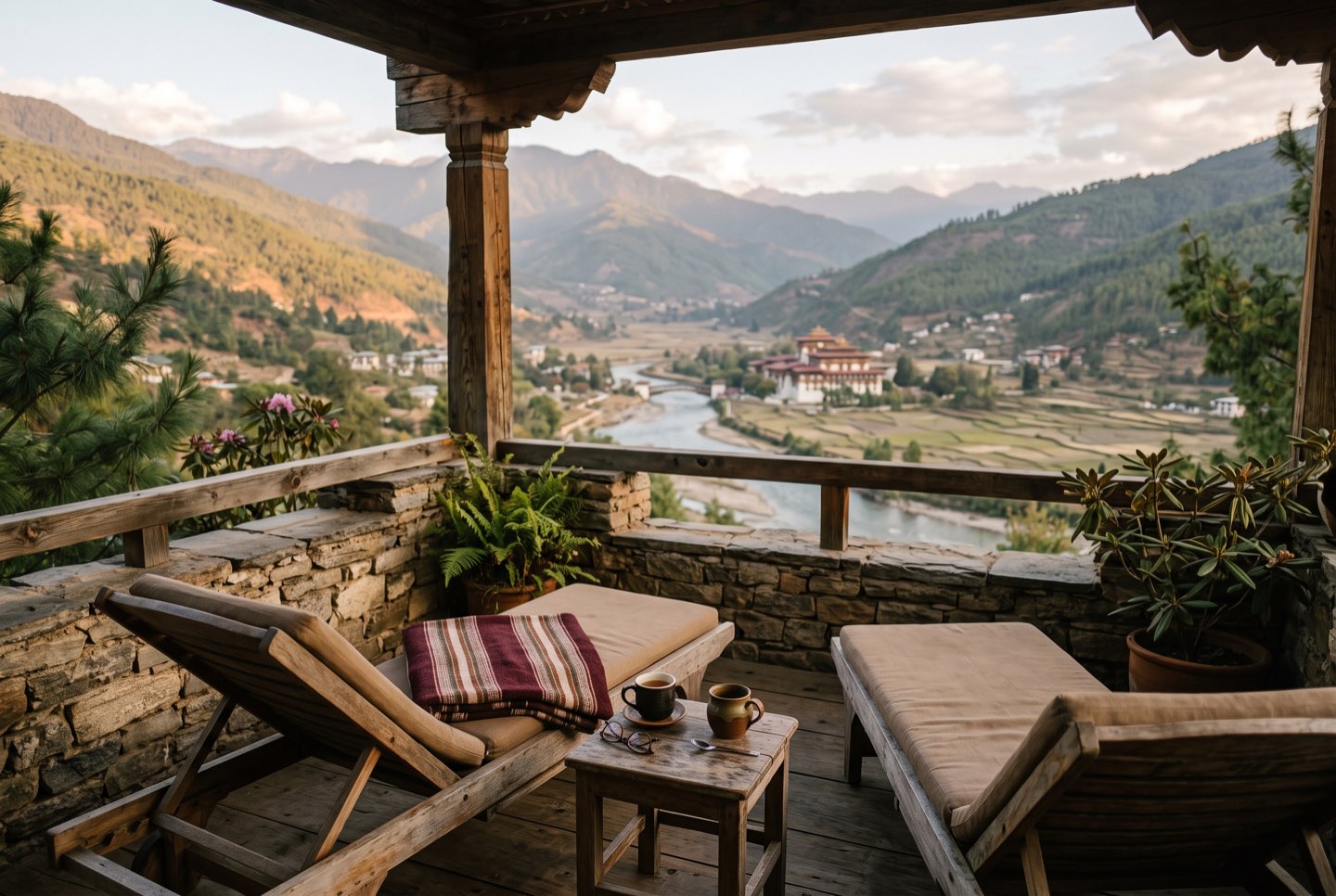 Two chairs, a folded blanket and two cups, facing the Punakha valley at golden hour.
Six Senses Punakha, which it calls the Flying Farmhouse, has a rustic feel, a choice of suites and villas, a pool, and yoga and meditation huts. Its larger villas make it an easy fit for multi-generation journeys in Bhutan, where grandparents want a door to close and children want somewhere to run.
Pemako Punakha offers tented villas close to the river, for travellers who like canvas walls with their comforts.
What about Gangtey and Bumthang?
Go further east and the lodges get smaller and the silences longer. In the Phobjikha valley around Gangtey, Amankora Gangtey has eight secluded suites overlooking the Gangtey Goemba monastery. Six Senses Gangtey sits just above the valley’s crane visitor centre, which is why it is known as the Birdwatching Bridge. And Gangtey Lodge, a separate property from Amankora’s lodge of the same name, which our Cranes & the Central Valleys journey uses, is perched high above the valley’s nature reserve. The black-necked cranes winter here from late October to mid-February; read about the cranes of Phobjikha before you choose your window seat.
Bumthang, the spiritual heartland, is a long and beautiful drive further east. Amankora Bumthang has 16 suites beside the royal Wangdicholing Palace. Six Senses Bumthang is built as a forest within a forest, and each suite wraps around a courtyard with its own tree.
Both valleys are high and cold in winter, so the stove in your room earns its keep.
How far ahead should you book?
For October, November and the spring festival weeks, as early as you can. Many of these lodges are small: Amankora’s Punakha and Gangtey lodges have eight suites each, so a family taking two suites fills a quarter of the lodge. When the autumn skies are clear and the festivals are on, those rooms go first.
The 2027 festival dates haven’t been published yet, so tell us your window and we’ll watch for them. Summer and winter are quieter, with more choice of rooms. The Department of Tourism notes that the monsoon, from June to September, can affect transport and services, while winter brings crisp, clear days and cold nights.
The practical advice is simple. Send us your dates, even roughly, and we’ll check the smaller lodges first, then build the route around what’s free. It is much easier to fall in love with a lodge that still has a room.
What doesn’t luxury mean here?
Here, luxury isn’t about gilded lobbies or nightlife. The Department of Tourism describes accommodation ranging from five-star hotels to village homestays, and visitors may stay only in places it has approved. What the lodges we use share instead is setting and scale: local stone and timber, wood stoves, and a view you’ll plan your day around.
It doesn’t mean sealing yourself off, either. These lodges are a way into the valley, not a wall around it, with butter lamp ceremonies, archery lessons or a walk that starts at the door.
And it doesn’t mean perfect connectivity. Most hotels have Wi-Fi, but in the far valleys it may gently remind you why you came.
Finally, it doesn’t mean one brand is right for everyone. Browse the lodges we work with, then tell us how you like to stay.
Frequently asked questions
Which lodge is best for honeymooners?
There isn’t one answer. Couples who want privacy often love the smallest lodges, such as COMO Uma Punakha or Amankora’s eight-suite lodges, while those who want a plunge pool of their own look at the one-bedroom villas at Six Senses Punakha. COMO Uma Punakha also offers a traditional anniversary blessing with white scarves.
Can I stay at one brand throughout?
Yes. Amankora and Six Senses each have lodges in five valleys, and both describe journeys that link them. We are happy to do the same, though mixing brands often gives you a closer match in each valley.
Are lodges open all year?
Bhutan is a year-round destination, and the lodges we use welcome guests through the seasons. Openings can change from year to year, though, so we confirm every lodge for your exact dates before we build a route around it.
Do lodges have spas?
Yes. Amankora Paro has a two-storey spa, both COMO Uma lodges have COMO Shambhala, Six Senses has spas across its lodges, and Pemako’s is called Lotus Realm. We can also arrange a traditional hot-stone bath; read more about Bhutan’s wellness traditions.
Choose the valley, then the view. The rest is simply a matter of staying long enough to enjoy it.