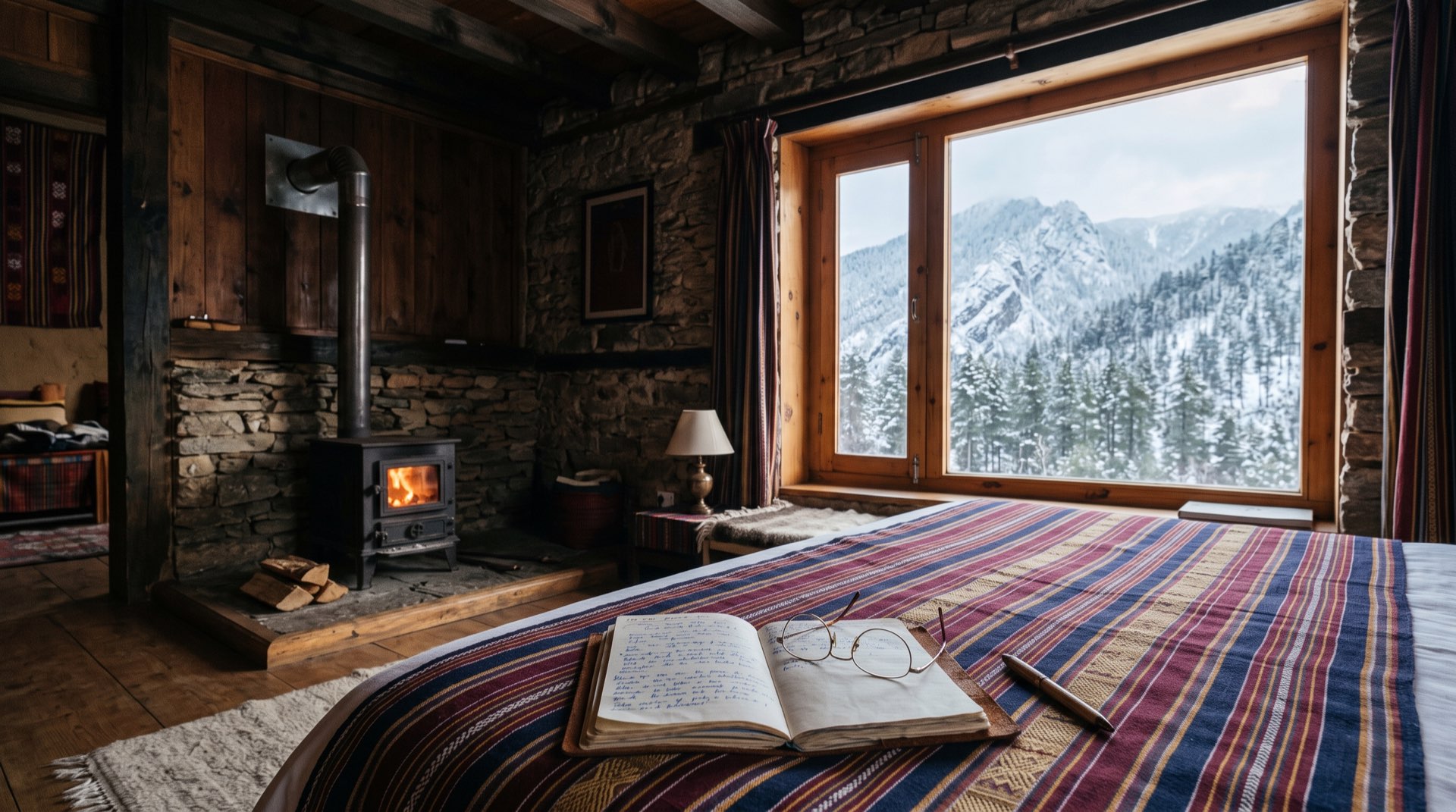
Late afternoon in a timber lodge, somewhere above a Bhutanese valley in winter. The bukhari, a cast-iron wood stove, ticks as it warms. Outside the window, the ridge has turned pink under new snow. It is the kind of scene people picture when they first dream about Bhutan, and very often it is also the moment they start to wonder, quietly, what all this costs.
So they search, and find everything from suspiciously precise figures to polite silence. We understand. Most of us would rather ask about a trip’s price in a whisper, if at all.
Let’s talk about it openly instead. We won’t give you one number, and we will explain why. What we can give you is the six things that decide it: the same six we weigh every time we write a proposal.
| At a glance | Detail | Source |
|---|---|---|
| Fixed by government | SDF: US$100 per adult per night; US$50 for ages 6–11; nothing for under-6s | Department of Tourism |
| Fixed by government | Visa: US$40 per traveller, paid once | Department of Tourism |
| Set by your choices | Lodges, length, route, party size and private experiences | Bhutan Luxury Travel, 2026 |
| Set by the calendar | Season and festival dates | Bhutan Luxury Travel, 2026 |
| Set by the airlines | Flights into Paro, and any domestic flights | Drukair |
| Included with us | Visa and SDF, private guide and driver, entrance fees, taxes and service charges | Bhutan Luxury Travel, 2026 |
| Checked | 27 September 2026 |
Why won’t we quote you one number?
Because a single figure would be wrong for almost everyone who read it. A private journey in Bhutan is built from choices, and six of them decide nearly all of the cost:
- The government fees: the SDF and the visa
- Your lodges
- The length of your journey and its route
- Your party size and the private experiences you choose
- The season
- Your flights into Paro
Only the first is fixed. The other five can move the total a long way, in both directions, and they interact: festival week in a small lodge is a very different proposition from the same lodge in a quiet January.
So instead of a headline figure, we send an itemised proposal. It sets out the SDF and visa for each traveller, your lodges, your guide, driver and vehicle, entrance fees, any domestic flights, and the private experiences you’ve asked for. Change one line, say a different lodge or one more night in Punakha, and you can see exactly what moves. We think that is far more useful than a “from” price.
Which costs are fixed?
Only the government’s: the Sustainable Development Fee and the visa. For most international travellers the SDF is US$100 per adult per night. Children aged 6 to 11 pay US$50, and children under 6 pay nothing, according to the Department of Tourism. The visa is a one-off US$40 per traveller.
Both are the same whoever you travel with, and with us both are included and shown on their own lines. Our guide to Bhutan’s Sustainable Development Fee has a worked example you can copy.
Two things are worth knowing. First, the SDF counts nights, so every night you add adds the fee for each paying traveller, which is a good reason to make each night count rather than simply adding more. Second, the current rate is set until 31 August 2027, and BBS reported in September 2026 that nothing has yet been announced beyond that date.
Taxes, meanwhile, are already inside our journeys, including Bhutan’s new Goods and Services Tax, which came into force in January 2026.
How much do your lodges decide?
More than anything else you choose. The lodge is where you spend most of your hours, and in Bhutan the range runs from heritage farmhouses and small boutique hotels to the lodge circuits of Amankora, Six Senses and COMO.
Many of the finest lodges are also small. Amankora’s lodges in Punakha and Gangtey have just eight suites each. Small means peaceful, and it also means those suites fill early in the popular months and are priced to match. The room matters too: a suite looking across to a dzong is a different line from a room facing the garden.
Mixing is normal, and often wise. Spend where you will linger, such as a valley where you have two or three nights and a view you’ll want to wake up to. Save where you will mostly sleep before an early start. Our guide to choosing Bhutan’s luxury lodges compares them valley by valley, so you can decide where the extra is worth it to you.
How do length and route change it?
Every extra night adds a night of everything: lodge, guide, driver, vehicle and the SDF for each of you. That is why we would rather design a journey where each night earns its place than simply make it longer.
Route matters as much as length. Paro, Thimphu and Punakha fit comfortably into a week by road; our signature journeys range from six days in the west to eleven reaching Bumthang. Going east changes the maths, because Bhutan’s mountain roads are slow: Punakha to Gangtey alone is the best part of three hours, and Bumthang lies further on, over the high passes.
There is another way. Drukair flies from Paro to Bumthang in central Bhutan and Yonphula in the far east, as well as Gelephu in the south, so one leg can become a short flight instead of a long road day. Flying adds a fare but can save a night or two on the road, and those nights have costs of their own. Driving adds nights, but it gives you the passes, roadside tea and the views you only get from a slow mountain road. We are happy to show you both.
Does travelling as a family or group change the cost?
Yes, because some costs are shared and some are per person. The SDF and visa are per person. Your guide, driver and vehicle are per journey, so a family of four sharing them spends less per head than a couple, while a solo traveller carries them alone. Lodges sit in between, priced by the room, so a family sharing a villa spends differently from friends who each want their own door to close.
Children help the arithmetic, as under-6s pay no SDF and 6- to 11-year-olds pay half.
Then there are the private experiences, which are often what guests remember longest: a picnic laid out above a river, a traditional hot-stone bath, an hour with a thangka painter (an artist of Buddhist scroll paintings), tea with a family in a farmhouse. Each one appears as its own line, some modest and some less so, so you can decide which are worth it to you. There is no wrong answer, although we have yet to meet anyone who regretted the picnic.
How much do the season and your flights matter?
A great deal, and they tend to move together. Autumn and spring are Bhutan’s busiest seasons, with the clearest skies, the big tshechus (festivals of masked dances) and the most demand for rooms, guides and seats. Lodges generally set their rates by season, and in October or festival weeks the smallest can be full months ahead, so we suggest getting in touch three to six months before.
Winter and the summer monsoon are quieter, often better value, and to our eyes just as beautiful. Winter mornings are cold and clear, the cranes are back in Phobjikha, and the stove in your room becomes the centre of the evening. Read more about Bhutan in winter.
Flights follow the same rhythm. Some routes into Paro are thin: Drukair lists Bangkok, Delhi and Kathmandu as daily but Singapore and Dhaka as twice-weekly. Fares depend on where you start and how early you book, so international flights sit outside the journey price. Our guide to flying into Paro has the details.
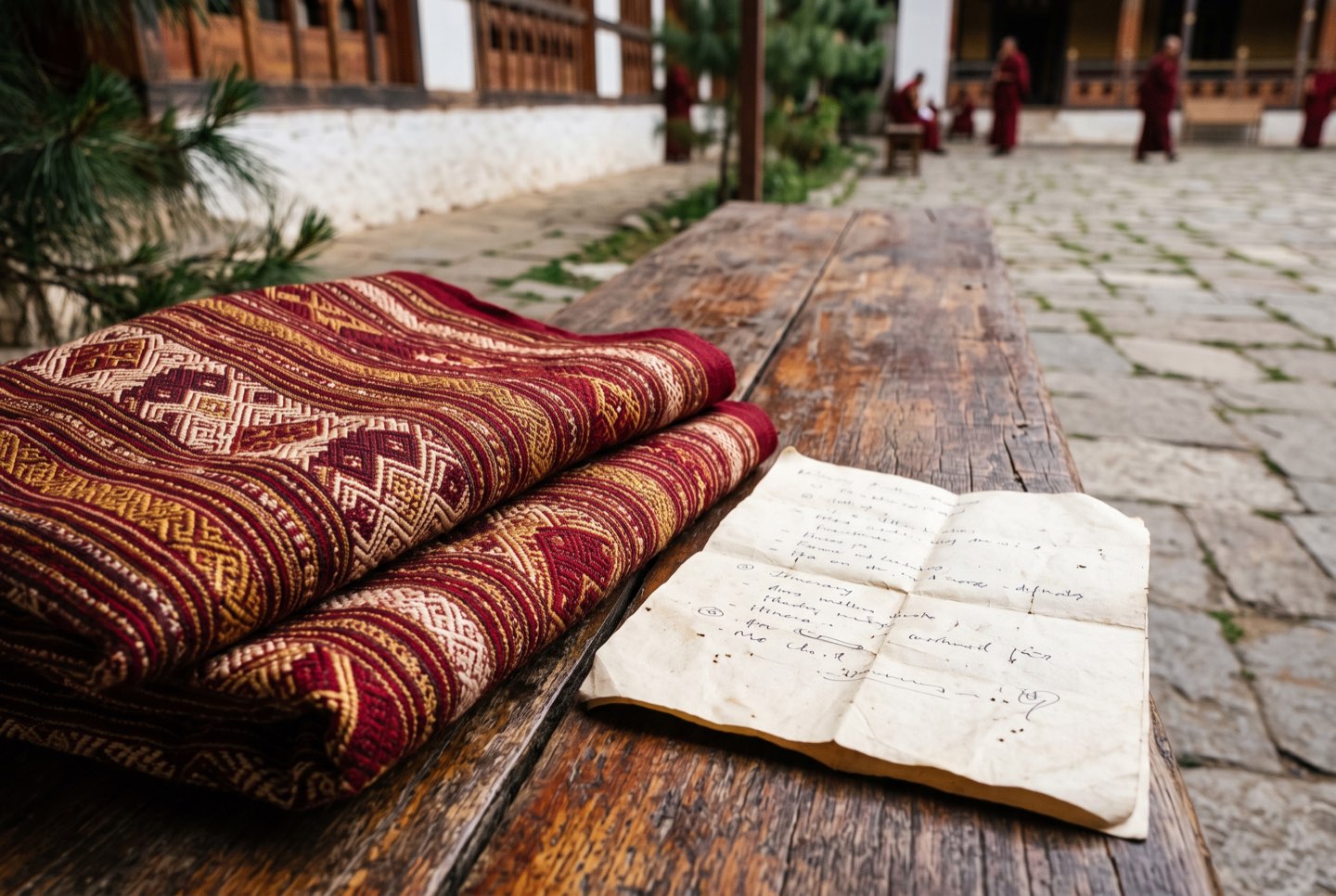 Hand-woven kira cloth in madder red and gold, beside a folded, handwritten itinerary.
Where does your money quietly go further?
In the things you would otherwise pay for piecemeal, and in the ones you can’t buy anywhere else. With us, your visa and SDF, private guide, driver and vehicle, entrance fees, permits, taxes and 24-hour support are all included. There are no surprise tickets at the dzong door, and on a day hike the tea and snacks are part of the plan.
Some of the best value lies in how a journey is shaped. A quieter month. Two nights in a place instead of one, so you unpack once and actually see the valley. A farmhouse lunch rather than a formal one. A slow morning at the lodge you chose with care, instead of a dash to one more viewpoint.
And some of it goes further than your journey. Every night of SDF helps fund schools, healthcare and forests in the valleys you pass through. It is the one line on the proposal that keeps working long after you have flown home.
New to all this? Start with planning your first trip to Bhutan.
Frequently asked questions
Are tips included?
No. Tipping your guide and driver is a personal thank-you, never an obligation, so it isn’t built into the proposal. If you would like a sense of what is customary, just ask us before you travel.
Is there a minimum spend?
The only fixed nightly charge is the SDF; everything else follows your choices. What we don’t trim is the private guide and driver, because that is how travel in Bhutan works and how we like to look after people.
Do children cost less?
Usually, yes. Children under 6 pay no SDF and those aged 6 to 11 pay half, and a family sharing one guide, driver and vehicle brings the cost per person down.
Can I mix luxury lodges with simpler hotels?
Yes, and many of our guests do. Spending more where you linger and less where you simply sleep is one of the easiest ways to shape the cost.
The right journey isn’t the one with the biggest number or the smallest. It’s the one where every line on the page is something you’ll remember.