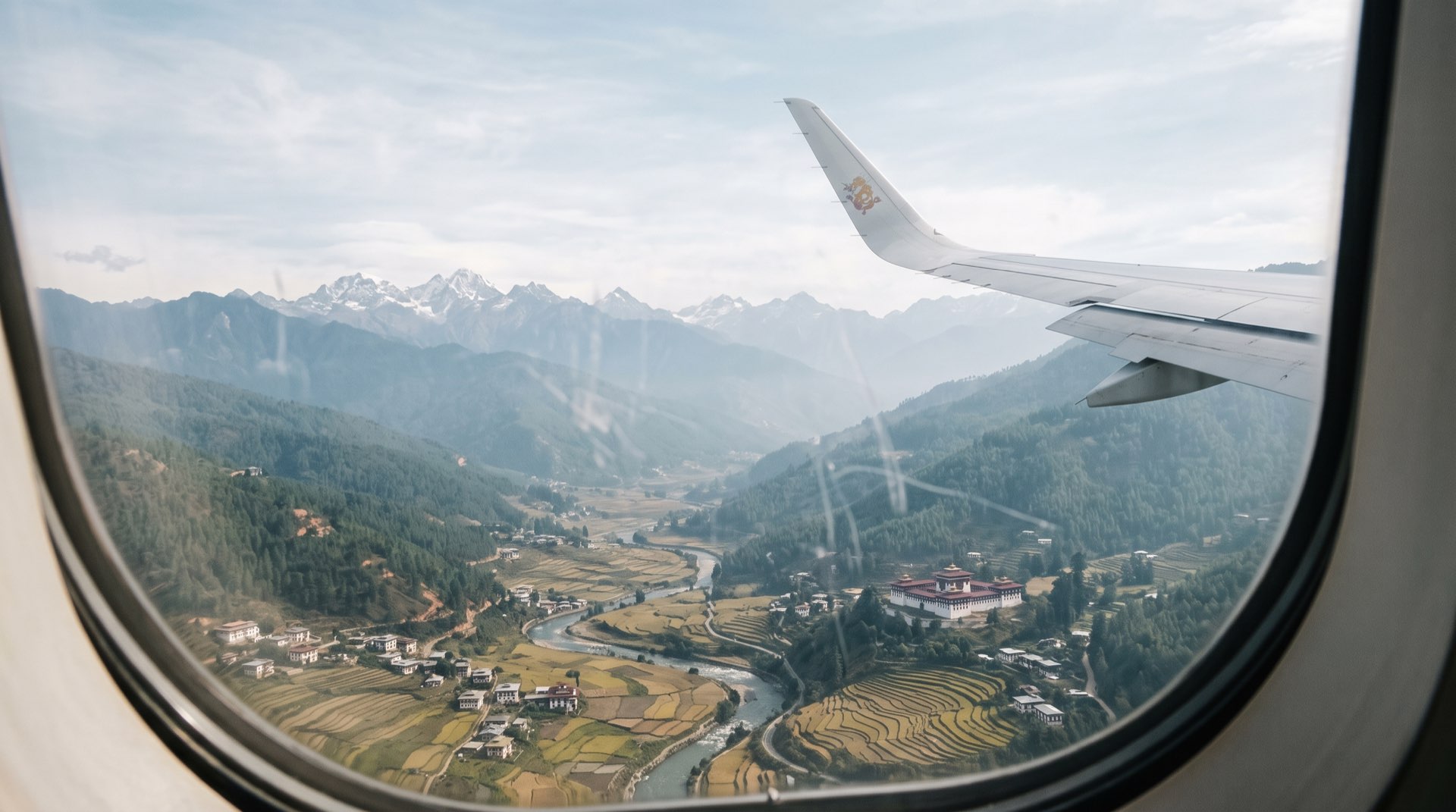
Somewhere over the foothills, the cabin goes quiet. Conversations trail off, phones come out, and heads turn towards the windows. The aircraft banks, then banks again, following a river through a valley so steep that the forest seems close enough to touch. A farmhouse slides past, prayer flags fluttering on the ridge above it. Then, quite suddenly, there is a runway.
If you have read about the Paro landing, you may have seen the word “dangerous” somewhere near it. It’s a fair worry, and we’d rather talk about it openly. The same goes for the practical questions: which hub to fly through, where to sit, and what happens when the weather has other plans.
We plan around these flights for a living, so let’s start with the landing and work backwards.
| At a glance | Detail | Source |
|---|---|---|
| Airlines | Drukair and Bhutan Airlines, the country’s two national carriers | Department of Tourism |
| Main hubs, at the time of writing | Bangkok, Delhi, Kathmandu and Kolkata on both airlines; Drukair also flies from Singapore, Dubai, Dhaka, Guwahati and Bagdogra | Drukair, Bhutan Airlines |
| Flying hours at Paro | Sunrise to sunset only, in visual conditions | Department of Air Transport |
| Runway | A single runway of 1,964 m | Department of Air Transport |
| Drukair economy baggage, international | 30 kg checked, 5 kg cabin bag | Drukair |
| Our buffer | At least 24 hours between your Paro flight and any onward connection | Bhutan Luxury Travel, 2026 |
| Checked | 27 September 2026 |
How do you actually get to Bhutan?
You fly into Paro from a regional hub, on one of Bhutan’s two national airlines. According to the Department of Tourism, direct flights link Paro with Bangladesh, India, Nepal, Singapore and Thailand, and Drukair adds Dubai to that list.
At the time of writing, Drukair’s destinations page lists daily flights from Bangkok, Delhi and Kathmandu, with services on selected days from Singapore, Dubai, Kolkata, Dhaka, Guwahati and Bagdogra. Bhutan Airlines flies to Bangkok, Delhi, Kathmandu and Kolkata. Schedules shift with the seasons, so treat any timetable as a starting point rather than a promise.
Which hub suits you depends on where you begin. Singapore and Bangkok are natural stepping stones from Australia and East Asia; Delhi and Dubai sit neatly on many routes from Europe. Drukair also flies domestic hops from Paro to Bumthang, Gelephu and Yonphula, handy on longer journeys east.
If you’re still at the dreaming stage, our guide to planning your first trip to Bhutan puts the flights into the wider picture.
Which side of the plane should you sit on?
If you’re flying east from Kathmandu or Delhi, sit on the left. Look at a map and the logic is simple: the route runs along the southern edge of the Himalaya, so the left-hand windows face the high peaks and the right-hand ones face the plains.
On a clear day that view is worth planning for. On a cloudy one, the left side offers exactly the same cotton wool as the right. Clouds, sadly, don’t take seat requests.
With Drukair, its FAQs explain that you can choose a seat only through web check-in, which opens 72 hours before departure and closes four hours before. Set a reminder; that window has a habit of opening while you’re packing.
Whichever side you get, keep your camera close for the final descent. The approach follows the valley itself, so both sides have their moment: forested ridges, terraced fields, white farmhouses and prayer flags, all closer than you are used to seeing from a plane.
Why is the Paro landing famous, and should you worry?
It’s famous because the approach is flown by sight through a deep mountain valley to a runway of modest length. And no, it isn’t something to lose sleep over. Those conditions are exactly why the rules at Paro are so strict.
According to Bhutan’s Department of Air Transport, flights to and from Paro may operate in visual conditions alone, between sunrise and sunset, and landing there is reserved for a select group of specially certified pilots. The single runway is 1,964 m long, laid along the banks of the Pa Chhu (chhu means river).
What you’ll feel is a steady descent and a few banking turns as the aircraft follows the valley. What you’ll see is the part people talk about afterwards: ridges sliding by, paddy fields spreading out below, and the valley opening up as if it had been expecting you.
If you are a nervous flyer, tell us before you travel. We can’t fly the plane (and you really wouldn’t want us to), but we can make sure the first faces you see on the ground are calm, friendly ones.
What happens in your first hour on the ground?
You walk across the apron in cool, clean mountain air, clear immigration in a terminal dressed in traditional painted woodwork, and meet your guide just outside. It is a refreshingly gentle arrival.
The terminal building was designed to give visitors their first glimpse of Bhutan’s architectural heritage, and it does. Carved window frames, painted beams, a sense that you have arrived somewhere with its own way of doing things. At immigration you show the visa clearance letter you travelled with, and your visa is issued on arrival. We arrange that letter for you; our Plan Your Journey page explains how.
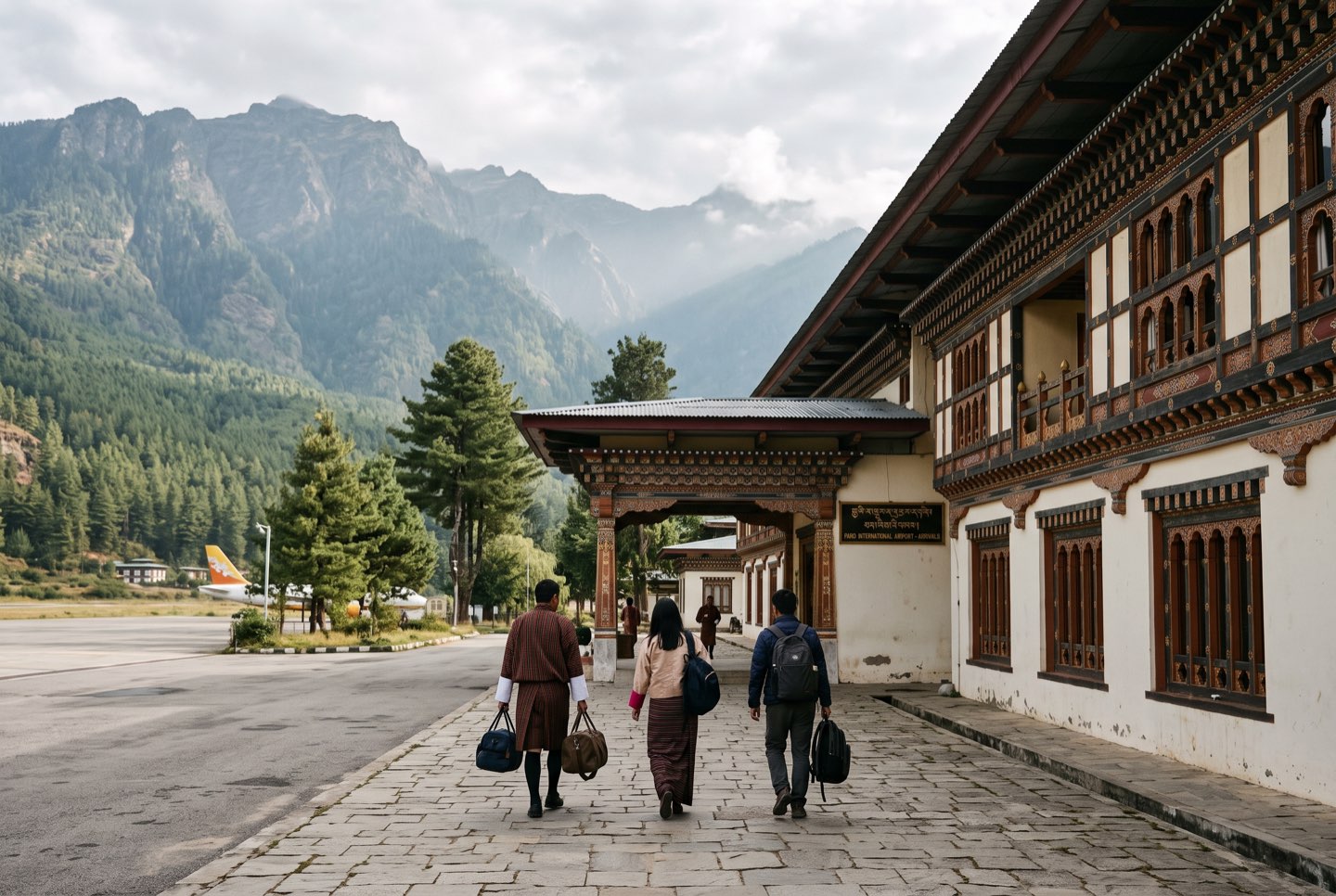 A short walk across the apron to Paro’s painted terminal, forested hills behind.
Once your bags appear, your guide and driver are waiting, and Paro town is a few kilometres down the road. You land at about 2,200 m, so we keep the first afternoon easy: a short walk, a cup of tea, perhaps a first look at the valley. Our guide to altitude and health in Bhutan explains why a slow first day is never wasted.
Why do daylight-only flights shape your plans?
Because nothing flies in or out of Paro after dark, your whole journey has to fit around the sun. That affects both ends of the trip.
On the way in, long-haul flights reach the hubs at all hours, but Paro departures run only in daylight. It often makes sense to spend a night in Bangkok, Delhi or Singapore and fly on fresh the next day. Your first day in Bhutan starts better for it, and so do you.
On the way out, we ask for at least 24 hours between your flight from Paro and any onward connection. Think of it as our buffer for the mountains. If weather holds your flight for a few hours, that gap means a long lunch in your hub instead of a missed connection… which is a very different afternoon.
When you’re working out how many days in Bhutan you need, count these travel days honestly. They are part of the journey, not time lost from it.
What if the weather delays your flight?
You wait a little, and we rearrange a little. Because Paro flights need good visibility, low cloud or bad weather can hold a departure, and Bhutan’s Department of Tourism is candid that the country’s landscape occasionally makes departure dates unreliable.
The good news is that a private journey bends. If you land late, we move the first afternoon’s visit to another day or swap it for a quiet walk in Paro. If you land much later, we look at the whole route again and protect the moments that matter most to you. Our team is on hand 24 hours a day while you’re in Bhutan, so you never have to sort it out alone.
Two small habits help. Reconfirm your flights at least 72 hours before departure, as Drukair advises, and choose travel insurance that covers delays and missed connections.
The mountains don’t reschedule. We do.
What should go in your hand luggage?
Anything you would hate to be without for a day, packed within the cabin limits. According to Drukair’s baggage page, economy passengers on international flights may check 30 kg and carry a cabin bag of up to 5 kg (7 kg in business), with its three dimensions adding up to no more than 100 cm. Bhutan Airlines allows 30 kg checked in economy and a 7 kg cabin bag. Always check your own ticket, since allowances can differ by route.
Five kilograms is the moment many travellers discover exactly how much their camera weighs.
In your cabin bag, we’d pack your passport and visa clearance letter, any medicines you take (in their original packaging), a warm layer for the cooler mountain air, and a charger. If you’re flying on to Bumthang, note that Drukair’s domestic allowance is lower, at 20 kg checked in economy. Wear your bulkiest jacket on board; it saves weight in the bag, and you’ll be glad of it on a crisp Paro morning.
Frequently asked questions
Can I fly to Bhutan directly from Europe or the US?
Not at the time of writing. Every international route into Paro starts in Asia or the Gulf, so you’ll connect through a hub such as Bangkok, Delhi, Singapore or Dubai.
Is the landing dangerous?
It asks a lot of pilots, and the whole system is built around that. When conditions aren’t right, flights simply wait, which is frustrating on the day and reassuring every other day.
Will I see Everest?
On a clear day, you might. Flying east from Kathmandu, the route passes south of the high Himalaya, Everest included, so the left-hand windows are the ones to ask for. Cloud has the final word.
Do I need a return ticket to board?
Check with your airline, as rules can vary. In practice it rarely comes up: your visa application asks for your arrival and departure dates, and we coordinate both flights with your journey. The document that really matters at boarding is your visa clearance letter, which Drukair requires of all visitors except Indian, Bangladeshi and Maldivian nationals.
Leave a little room for the mountains, and the flight into Paro becomes the first memory of your journey, not the first worry.