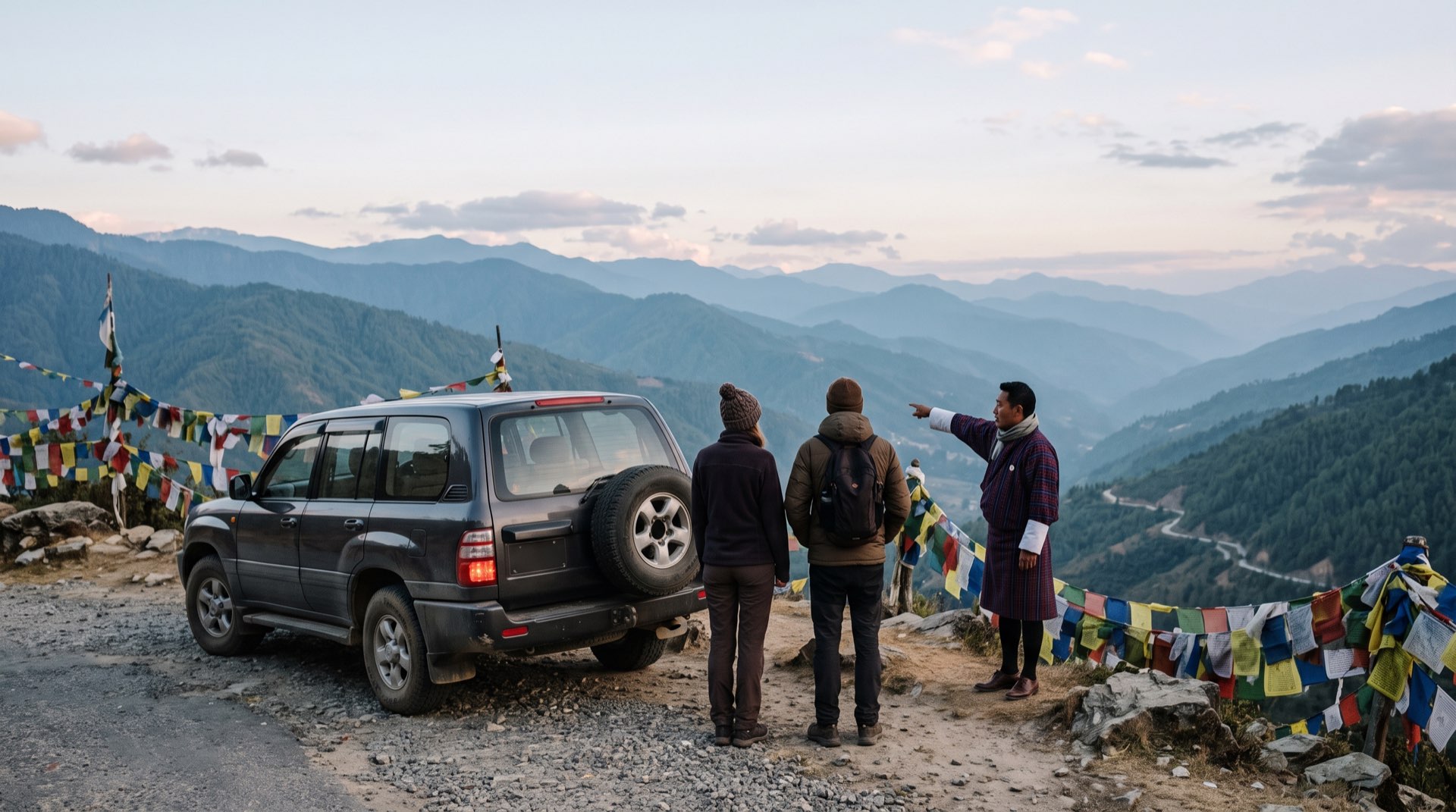
There is a moment, somewhere on the road down from the Dochula pass, when the prayer flags fall behind you and the Punakha valley opens below in terraces of rice. The car tends to go quiet. And quite often, someone starts counting the days they have left.
That is the real worry behind this question. Not whether Bhutan is worth it, but whether your days will disappear into a car seat, or whether you’ll leave feeling you had only just arrived. Flights are limited, the roads wind, and every day here is a day away from somewhere else.
So let’s do the arithmetic together: what six, eight and eleven days really give you, and where the time goes.
| At a glance | Detail | Source |
|---|---|---|
| 6 days · Rivers, Dzongs & Bliss | Paro, Thimphu, Punakha; easy walking; Tiger’s Nest optional on a long day; spring and autumn | Bhutan Luxury Travel, 2026 |
| 8 days · The Soul of Western Bhutan | The same valleys, plus a rest day and a free day; easy to moderate; spring and autumn | Bhutan Luxury Travel, 2026 |
| 11 days · Cranes & the Central Valleys | Adds Gangtey and Bumthang; easy to moderate; autumn and winter for the cranes | Bhutan Luxury Travel, 2026 |
| Paro flights | Sunrise to sunset only, in visual weather conditions | Department of Air Transport |
| Onward connections | Leave at least 24 hours after your Paro departure | Bhutan Luxury Travel, 2026 |
| Checked | 27 September 2026 |
So, how many days do you need in Bhutan?
For a first visit, plan on seven to nine days; eight is where we would start most travellers. That’s enough for Paro, Thimphu and Punakha at a gentle pace, the Tiger’s Nest on rested legs, and at least one afternoon with nothing in it.
Five or six days work if time is short. You’ll see the same western valleys, with a brisker rhythm and one long day. Ten days or more open the road east, over high passes to the crane valley of Phobjikha and the old temples of Bumthang. Two weeks or longer reach the far east.
Why does length matter so much? Not because of the number of sights, but because of the shape of the country. Most moves mean a winding mountain road, often over a pass, so each one takes a morning and sometimes more. The more nights you spend in each place, the less of your trip happens through a windscreen. That is the whole idea behind slow luxury in Bhutan: fewer moves, longer stays.
What fits into 6 days, and what doesn’t?
Six days give you the essential west: Paro, the capital Thimphu and the warm Punakha valley, with the Tiger’s Nest as an option at the end. It is the shape of our Rivers, Dzongs & Bliss journey.
Day one is mostly arrival, then a drive of about an hour to an hour and a half to Thimphu. A full day in the capital follows. On day three you cross the Dochula pass to Punakha, roughly two and a half to three hours, and day four belongs to the dzong where two rivers meet.
What doesn’t fit comfortably is the Tiger’s Nest. The drive back from Punakha to Paro takes about four to four and a half hours, and the full return walk takes about 5–6 hours on top. You can do both in one day, energy and daylight permitting, but it is a long one. A single extra night in Paro, with the walk the next morning, changes the whole feel of the trip.
What doesn’t fit at all: the Haa valley, Phobjikha and Bumthang. They will keep for next time.
Why is 8 days the classic first journey?
Because it takes the same western loop and gives it room to breathe. The Soul of Western Bhutan, our eight-day journey, follows the same roads as the six-day trip, but its two extra days go exactly where a shorter trip feels the squeeze.
The drive back to Paro gets an easy day of its own, broken by a farmhouse lunch with a local family, with the afternoon free. The Tiger’s Nest then has a whole morning to itself, walked at your own pace, with the cafeteria viewpoint halfway up as a perfectly honourable place to stop. Our guide to the Tiger’s Nest hike will help you decide how far to go.
Then comes an open day. You might spend it slowly in Paro, with artisans or simply at the lodge, or take the longer drive over the Chele La pass to the Haa valley.
Walking stays easy to moderate throughout, and spring and autumn bring the clearest views. The two extra days aren’t padding. They are the difference between seeing Bhutan and settling into it.
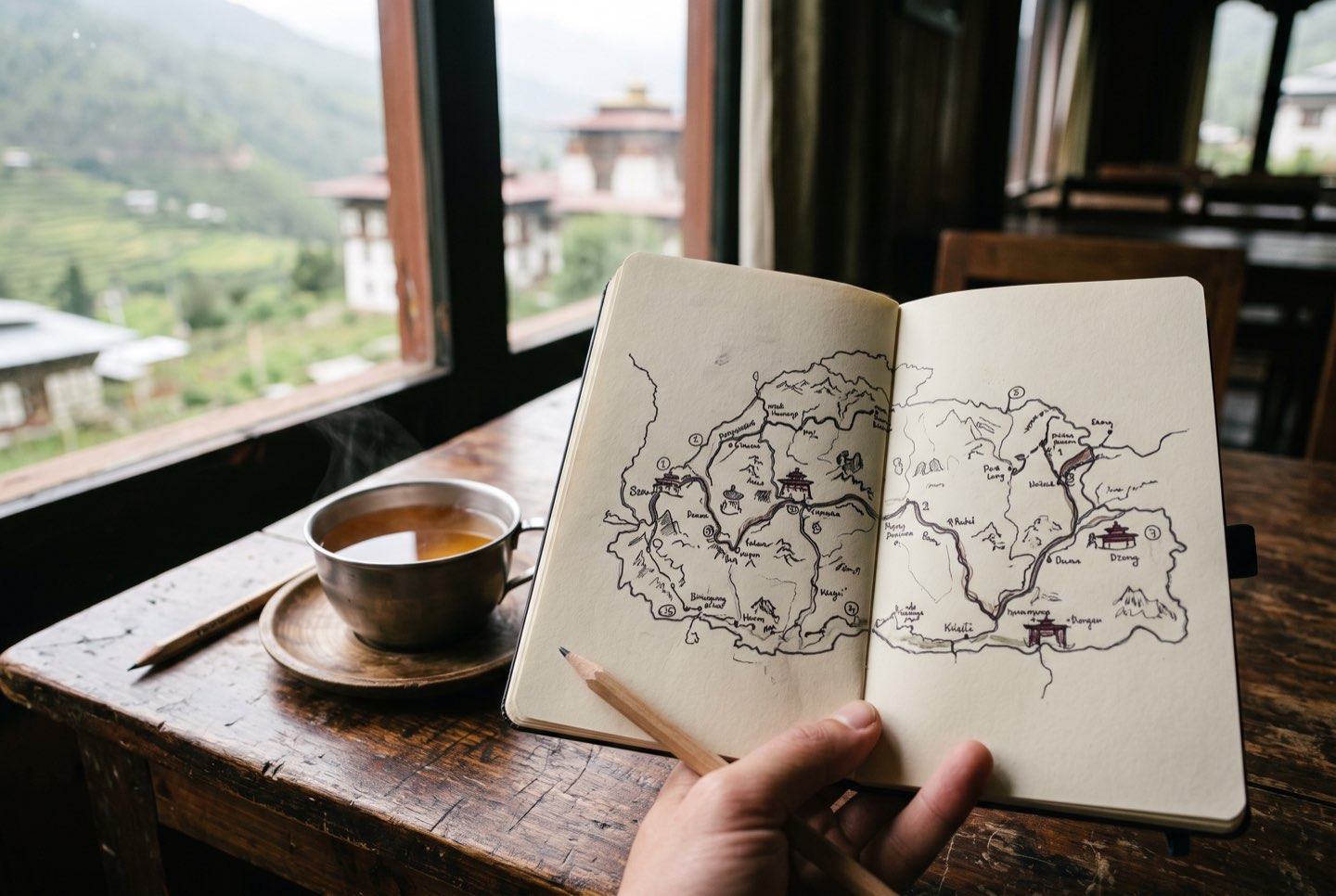 A route sketched day by day in a notebook, with a pencil and a cup of tea on the lodge desk.
What do 11 days add?
Central Bhutan, which feels like another country again. Our Cranes & the Central Valleys journey begins with Thimphu and Punakha, then turns east.
From Punakha it is about two and a half to three hours to Gangtey and the wide glacial valley of Phobjikha, where you spend two nights. From late October into February, black-necked cranes winter on its wetlands; our guide to the cranes of Phobjikha explains when and how to see them. Then comes the big road day, over the high Pele pass and past Trongsa Dzong: roughly four hours to Trongsa and about two and a half more to Bumthang, with plenty of stops.
Bumthang gets three nights, for its ancient temples, apple orchards and buckwheat fields, and a slow afternoon with a local family. Getting back west means either a full day on the road or a short domestic flight where one is scheduled; Drukair currently lists five flights a week between Paro and Bumthang. The Tiger’s Nest waits at the end, a fitting finale.
Are 14 days or more worth it?
Yes, if you want to go beyond western Bhutan into the far east, and you don’t mind trading polish for character. The lodges on our journeys end at Bumthang. Beyond it the roads grow longer, the stays simpler and the valleys quieter.
Two weeks let you carry on east from Bumthang instead of turning back, and give each long drive a rest day on either side. The logistics need care. The Department of Tourism notes that Yonphula airport in the east is given to unpredictable weather in summer, and that flights there are sometimes delayed or cancelled. The other way out is by road through Samdrup Jongkhar, one of four official road entry points from India, which means planning around India’s visa rules too.
If this is your first visit, we would usually say: start in the west, fall a little in love, and come back for the east. It will still be there.
How should you add extra days?
Add nights, not stops. The most valuable extra day is usually one with no drive in it.
Our favourites: a night in Paro before the Tiger’s Nest, so you walk it fresh; a second night in Punakha, where the valley sits low and warm, at about 1,200 m; and a slow first day, because Paro lies at around 2,200 m and your body appreciates the chance to adjust. Our guide to altitude and health in Bhutan explains why.
If a festival or the crane season is the reason for your trip, fix those dates first and build the days around them; our guide to when to visit Bhutan has the calendar.
And keep some slack. We plan drives to finish in daylight, as the UK government’s travel advice recommends avoiding travel at night where possible. It also warns that monsoon rains can cause landslides that cut off some roads for days. In summer, a spare day is not an indulgence. It is insurance with a view.
How do flights shape the maths?
Your first and last days are always partly flight days, and Paro’s rules shape them. According to the Department of Air Transport, flights to and from Paro operate only from sunrise to sunset, and only in visual weather conditions. You will never land after dark, and on a cloudy morning your flight may wait for the sky to clear.
The UK’s travel advice notes that weather regularly affects flights here, and Bhutan Airlines states plainly that its schedules can change without notice and that it cannot be held responsible for missed connections. So we recommend at least 24 hours between your Paro departure and any onward flight. A night in Delhi, Bangkok, Kathmandu or Singapore on the way home beats a sprint through a transit desk.
Not every route flies every day, either, so the day you can land may decide which journey fits. Our guide to flying into Paro explains the routes, and the landing itself.
Frequently asked questions
Is 5 days enough?
It’s enough for a real first taste of Paro, Thimphu and Punakha, if you accept a brisk pace and keep the Tiger’s Nest optional. Expect to leave with a list for next time.
Should I add a rest day?
Yes, if you can. A day without a drive is the simplest luxury in Bhutan: a slow breakfast, a short walk, perhaps one of Bhutan’s wellness traditions such as the hot-stone bath.
Can I combine Bhutan with Nepal?
Yes. Drukair lists daily flights between Kathmandu and Paro, and we can plan the Nepal leg as well, or add Sikkim or Northeast India instead. Leave a buffer day between the two countries.
Which is best for a first visit?
For most first-time travellers, The Soul of Western Bhutan at eight days. With six days, Rivers, Dzongs & Bliss covers the same valleys more briskly; if you are returning, or dreaming of cranes, choose Cranes & the Central Valleys.
However many days you have, come ready to slow down. Bhutan will do the rest, one valley at a time.