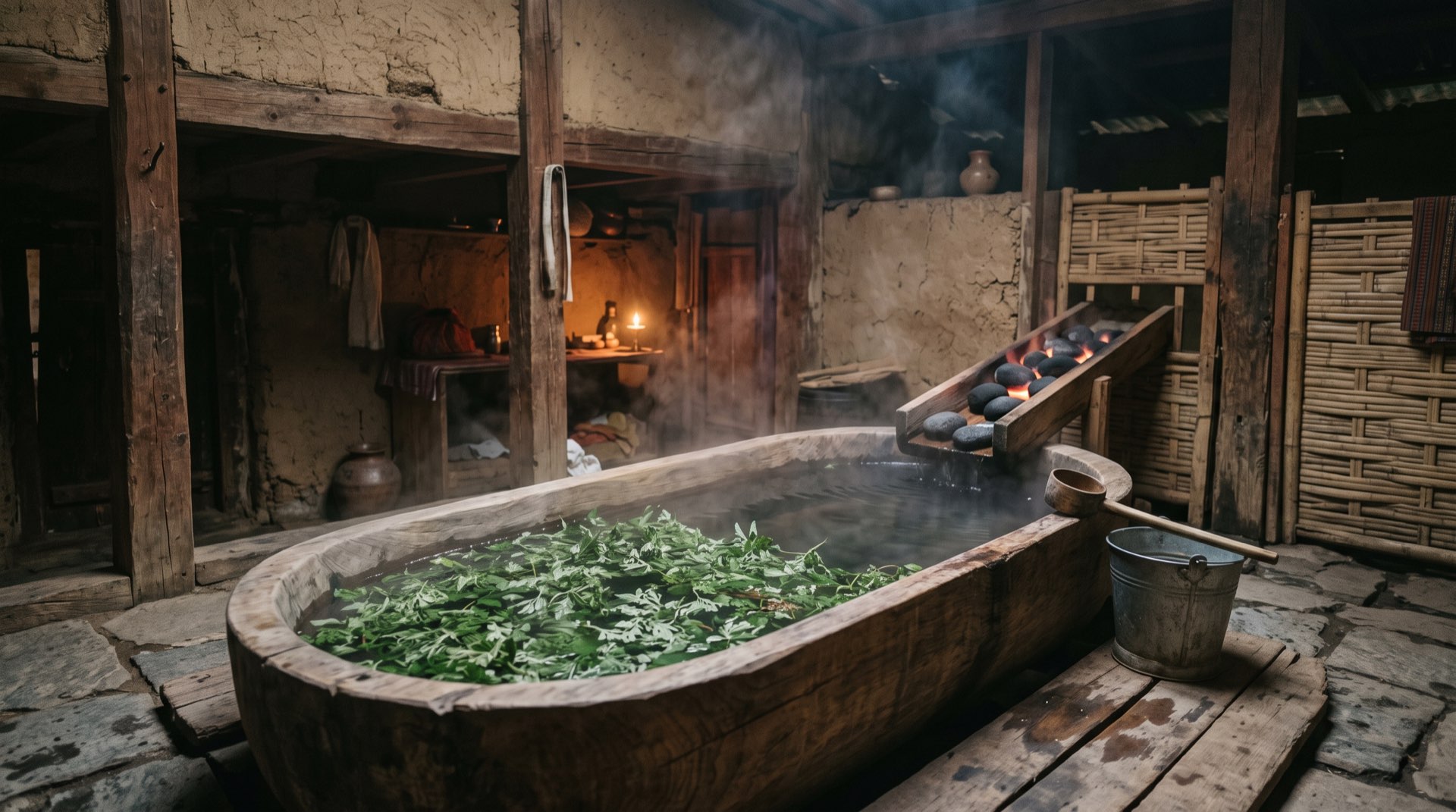
The first thing you notice is the sound. Somewhere behind a wooden wall, a river stone that has spent hours in a fire meets the water, and the whole bath answers with a long hiss and a crackle. Then the smell reaches you: wood smoke, and the green, faintly bitter scent of artemisia leaves drifting on the surface.
If part of you is wondering whether this is a real Bhutanese tradition or a spa treatment in national dress, you’re in good company. So are the two that most guests are too polite to ask. How hot is it, exactly? And what do I wear?
We’ll answer all three, and yes, we will get to the swimsuit question.
| At a glance | Detail | Source |
|---|---|---|
| The bath | A wooden tub (wa) of water and artemisia leaves, warmed with river stones roasted in an open fire | Department of Tourism |
| Local names | Dotsho (also spelt dotcho) or menchu, “medicinal water” | Department of Tourism |
| Traditional medicine | Sowa Rigpa, Bhutan’s official medical tradition, part of the national health system since 1967 | Ministry of Health |
| On our journeys | An optional hot-stone bath in Punakha on our western journeys; meditation or private yoga on request | Bhutan Luxury Travel, 2026 |
| Before you soak | If you’re pregnant, talk to a healthcare provider first; no alcohol before or during | CDC |
| Checked | 27 September 2026 |
What is a Bhutanese hot-stone bath?
It is a long soak in a wooden tub of herb-scented water, heated not by a boiler but by stones from the river. In Dzongkha it is called dotsho, and the water is menchu, “medicinal water”. Bhutan’s Department of Tourism describes the method: river stones are roasted in an open fire near the bath house, then added to a wooden tub, or wa, of water and fresh artemisia leaves. More hot stones go in while you soak.
The stones drop into a closed-off section at one end of the tub, so they never touch you. Each one spits and steams as it meets the water. Many bathhouses are lit only by candles, and it’s normal to wear a swimsuit, as the Department of Tourism points out, since someone will be adding stones while you’re in.
Traditionally the tub stood in a farmhouse garden or near a river, and families looked forward to it after a long day in the fields. Today you’ll find it everywhere from mountain villages to five-star lodges. The ritual is the same. Only the towels change.
What is Bhutan’s traditional medicine?
It is Sowa Rigpa, a medical tradition rooted in Buddhist principles. Bhutan’s Ministry of Health says it was recognised as the country’s official medical tradition and integrated into the health system in 1967, and since then Bhutanese have been free to choose between traditional and modern medicine. Tibetans, the ministry notes, long called Bhutan Lhomenjong, the valley of medicinal herbs, for the plants that grow here at altitudes from about 200 m to 7,800 m.
The idea at its heart is balance. The tradition sees the body as three elements, air, bile and phlegm, and illness as those elements falling out of balance. Treatment can mean changes in behaviour, herbal medicines, physiotherapy and spiritual healing.
What moves visitors is seeing an old tradition at work in a modern capital. The traditional medicine hospital stands at Kawajangsa in Thimphu, and the ministry’s National Centre for Traditional Medicine Services is charged with preserving and promoting herbal baths, hot-stone baths and traditional massage within the national health system. This isn’t folklore behind glass. It’s everyday healthcare.
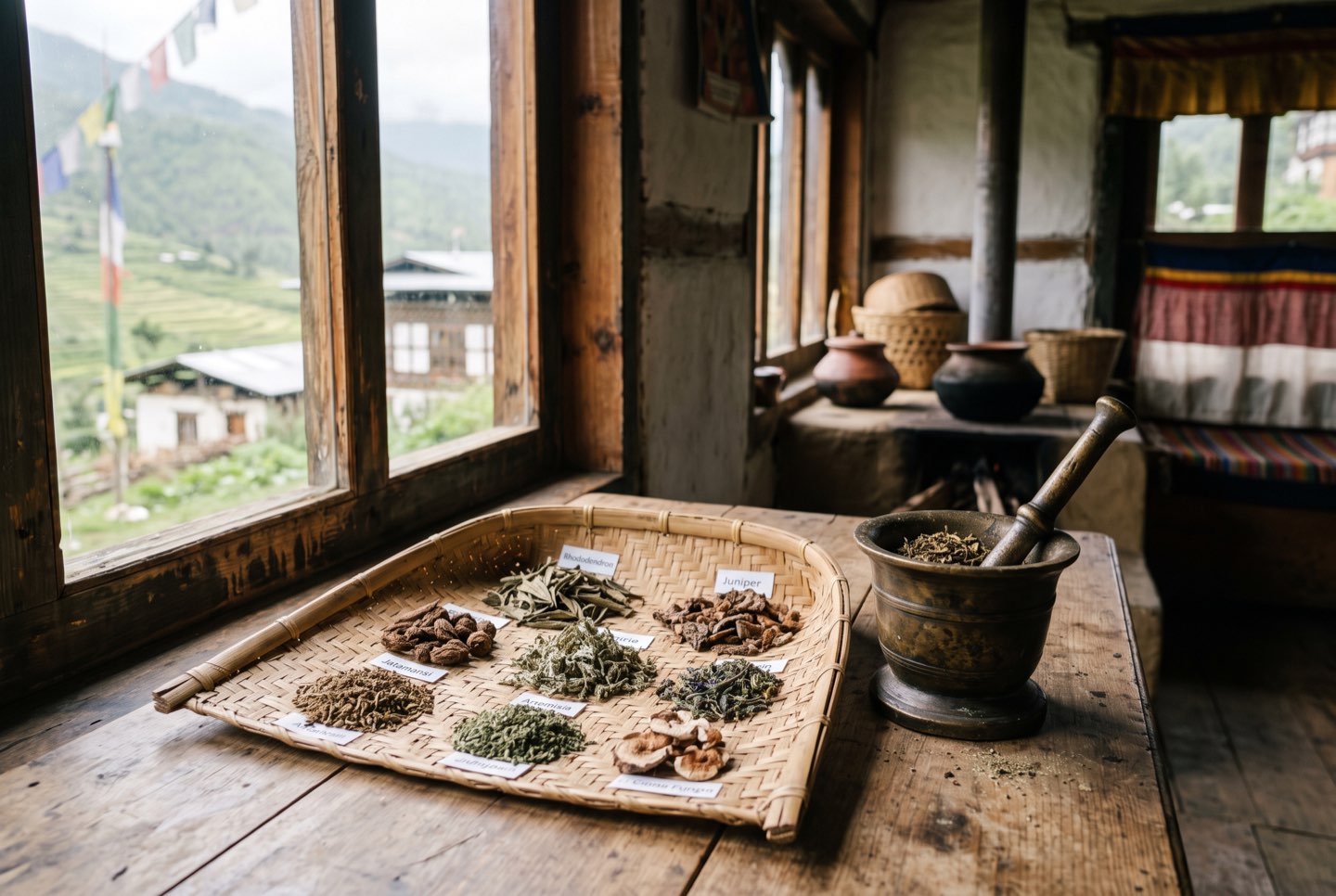 Dried medicinal herbs on a woven bamboo tray, beside a brass mortar in the window light.
Can you learn to meditate in Bhutan?
Yes, and you can start from nothing. Here meditation isn’t a wellness trend; it is part of life. The Department of Tourism notes that devout Buddhists meditate for months, even years, and that retreat centres are found all over the country. Nobody expects that of you.
What we arrange is gentler. A quiet session with a teacher, at your lodge or somewhere peaceful nearby, that begins with how to sit, how to breathe, and what to do with a mind that keeps planning tomorrow’s lunch. An hour is plenty for a first taste. You may be surprised how much of it stays with you afterwards, on a bench at the Dochula pass or in a monastery courtyard as the butter lamps are lit.
If you would like to go deeper, a longer stay with a daily practice is possible. Tell us before you travel, and we’ll talk honestly about what fits your dates and pace. Meditation works best when it isn’t squeezed between two long drives.
Lodge spa or farmhouse bath: which should you choose?
Choose the farmhouse for the tradition, and the lodge for the tradition with a robe waiting afterwards. Both are real. They simply feel different.
A farmhouse bath is an act of hospitality before it is a treatment. The Department of Tourism describes how the host takes care, and time, to stoke the fire and heat the stones for guests. The tub usually stands outside the house itself, facilities are simple, and we like to pair the evening with tea and conversation with the family. It is warm in every sense.
Lodge spas offer the same ritual with more polish: a private bathhouse, fresh towels, and often a massage to follow. At COMO Uma Punakha, one of the lodges on The Soul of Western Bhutan, the hot-stone bathhouse sits on the hillside above the lodge, and the bath ends with a massage.
Our honest view? If you only do it once, do it in a farmhouse. If you can do it twice, try both and see which one stays with you. For the lodges themselves, our guide to choosing Bhutan’s luxury lodges compares their settings and styles.
What does a wellness day look like on our journeys?
It looks like an ordinary travel day with the edges softened. On The Soul of Western Bhutan and Rivers, Dzongs & Bliss, day four in Punakha is the natural moment: a morning in the courtyards of the dzong where two rivers meet, a gentle walk, then an easy afternoon at the lodge with an optional hot-stone bath.
On Cranes & the Central Valleys, stillness is built into the route, with a full, gentle day in the Phobjikha valley and a butter-lamp offering in one of Bumthang’s centuries-old temples.
We like the bath best on the evening after a big walk, such as the Tiger’s Nest hike, when warm water feels like a reward. Beyond that, we can thread a morning meditation, a private yoga class or a long, slow lunch through any journey, or build one around rest.
Our case for slow luxury in Bhutan explains why doing less here so often feels like more. And if you are still deciding on length, our guide to how many days in Bhutan shows where an unscheduled day fits best.
Who should take care with a hot-stone bath?
Anyone who is pregnant, has a heart condition or high blood pressure, or takes medication for either should ask their doctor before booking a hot-stone bath. It is a hot soak, and the same common sense applies as to any hot tub. The CDC’s hot-tub advice is clear: if you’re pregnant, talk to a healthcare provider first, and don’t drink alcohol before or during your soak. Some bathhouses offer a glass of ara, the local spirit. Save it for later.
Bhutanese traditionally believe the bath restores the body, and many still turn to it when they feel unwell. For our guests it is a tradition and a pleasure, not a medical treatment, and it never replaces one.
A few house rules of our own. Keep your first soak short. Drink water before and after. Say so if it’s too hot, and nobody will add another stone. Stand up slowly at the end. And remember you are at altitude, especially in your first days; our guide to altitude and health in Bhutan explains how your body adjusts.
Frequently asked questions
Is the hot-stone bath safe?
For most healthy adults, yes. The heat builds one stone at a time, which gives you plenty of chances to say “that’s enough”, and someone is always just outside, tending the fire.
Can I visit the traditional medicine hospital?
Often, yes, as part of a day in Thimphu; the Department of Tourism itself suggests it. It is a working hospital for Bhutanese patients first, so we arrange any visit quietly and check what’s possible on your dates.
Do I need meditation experience?
None at all. A first session starts with posture and breathing, and a chair is perfectly acceptable if the floor and your hips disagree.
Is wellness available all year?
Yes. Winter is the classic season for a hot soak, and the menchu bath is traditionally thought especially welcome in the cold months; see our guide to Bhutan in winter. In Bhutan’s green season, a rainy afternoon and a warm tub are made for each other.
In Bhutan, even the bathwater takes its time. Let it, and you may find you have slowed down too.