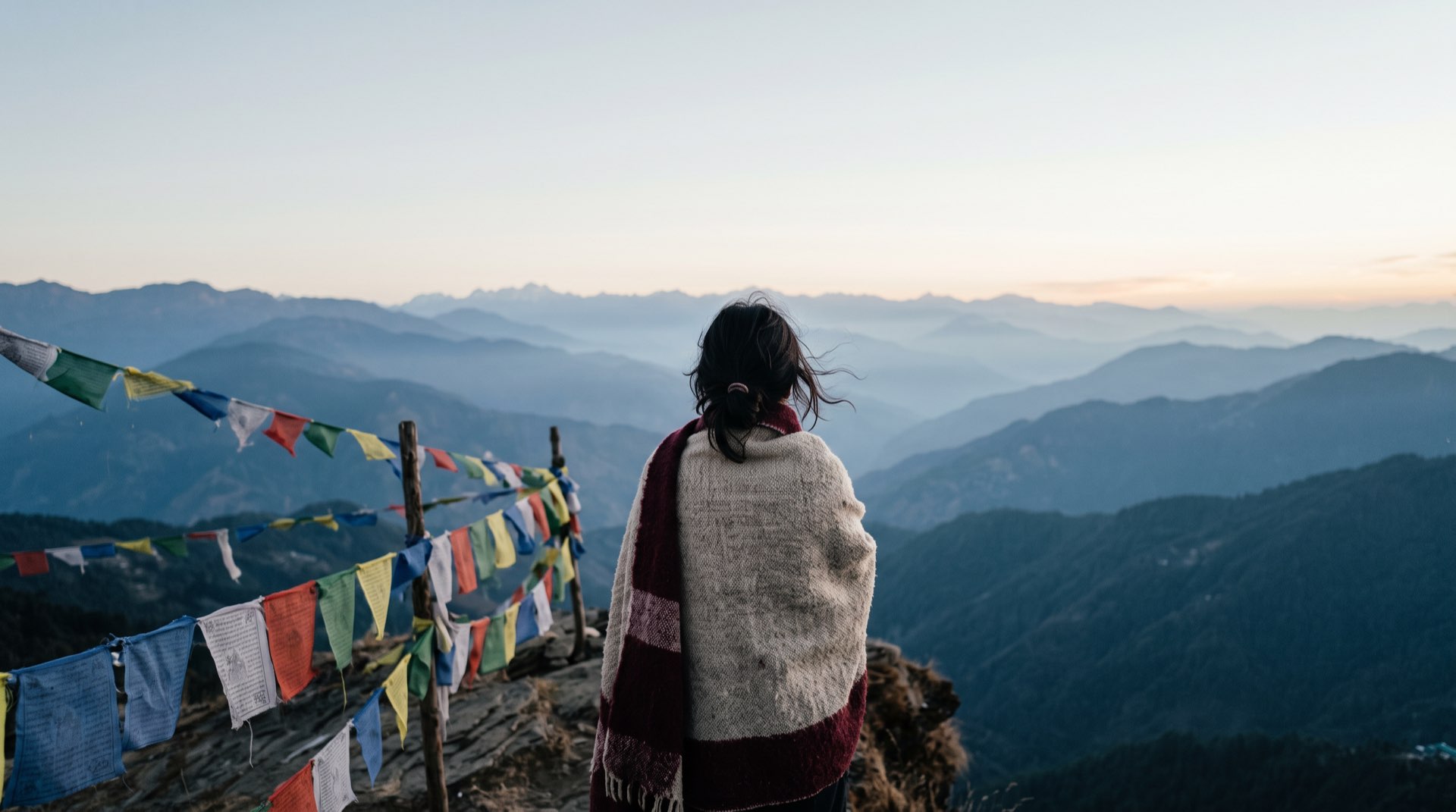
It is late, and you have three tabs open: a monastery on a cliff, a mountain range over a Kathmandu rooftop, a garden temple in the rain. Each is lovely. Each promises calm. And the spreadsheet you started an hour ago is beginning to look like a cry for help.
Mood pieces will not settle it, because they all praise their subject. So we will do what the spreadsheet person would do: start with numbers that governments and tourism boards actually published, add the rules you cannot avoid, and say plainly who Bhutan is not for. We are a Bhutan team, so we will read the figures for Nepal and Japan, not review those countries.
| At a glance | Detail | Source |
|---|---|---|
| Bhutan, 2025 | 209,376 tourists, up 44.33% on 2024; about 62% Indian | The Bhutanese |
| Nepal, 2025 | 1,158,459 foreign visitors, credited to Nepal Tourism Board figures | The Himalayan Times |
| Japan, 2025 | 42,683,600 visitors; a preliminary estimate | JNTO |
| Our arithmetic | Nepal about 5.5 times Bhutan; Japan about 204 times | Our calculation from the three rows above |
| Bhutan’s fixed rules | A guide at all times; Sustainable Development Fee of US$100 per adult per night (Indian nationals pay a separate rate); drones generally not permitted | Department of Tourism |
| Checked | 30 September 2026 |
Bhutan, Nepal or Japan: how do they compare?
They differ first in scale, then in how much is arranged for you. Bhutan welcomed 209,376 tourists in 2025, according to the annual tourism snapshot reported by The Bhutanese. Nepal received 1,158,459 foreign visitors, a figure The Himalayan Times credits to the Nepal Tourism Board. Japan received 42,683,600, which the Japan National Tourism Organization labels a preliminary estimate.
Read these as orders of magnitude, not a league table. The three agencies do not count identically. JNTO includes travellers in transit and expatriates re-entering Japan; Bhutan’s total includes Indian nationals, who are the majority. We could not find the Nepal Tourism Board’s own statistics page online, so Nepal’s figure reaches you second-hand.
How crowded is each, in real numbers?
Nepal received about 5.5 times as many visitors as Bhutan in 2025, and Japan about 204 times. The arithmetic is short: 1,158,459 ÷ 209,376 is 5.53, and 42,683,600 ÷ 209,376 is 203.9.
| Country | 2025 arrivals | Multiple of Bhutan | Average per day | Days to match Bhutan’s year |
|---|---|---|---|---|
| Bhutan | 209,376 | 1 | about 574 | 365 |
| Nepal | 1,158,459 | about 5.5 | about 3,174 | about 66 |
| Japan | 42,683,600 | about 204 | about 116,941 | about 1.8 |
Two more comparisons help. Against 2024, Bhutan grew 44.33%, Japan 15.8% and Nepal 0.95% (1,158,459 against 1,147,548). Against 2019, Bhutan is at about 66% of its pre-pandemic peak of 315,599, while Nepal is at about 97% of its record 1,197,191.
And a total is not a crowd. What you feel is concentration. Bhutan’s small numbers still gather at a few places and hours, and non-Indian visitors stayed an average of five nights, The Bhutanese reported, citing the November 2025 Tourism Monitor. Our note on Bhutan’s crowds in 2026 shows where and when.
What rules and costs can’t you avoid?
In Bhutan, three. First, a guide: the Department of Tourism says it is mandatory to be accompanied by a guide at all times. Second, the Sustainable Development Fee: US$100 per adult per night for every nationality except Indian, whose citizens pay a separate rate. Children aged 6 to under 12 pay US$50 and under-6s nothing. It is a daily levy that funds free healthcare, education and conservation, among other things; our guide to Bhutan’s Sustainable Development Fee explains it. Third, a visa with a one-off US$40 processing fee.
Smaller rules follow. Drones are generally not permitted, you may stay only in approved accommodation, and you cannot hire a self-drive car.
We will not list Nepal’s or Japan’s rules or fees, because we are not their authority and we would rather leave a gap than guess. What matters is the type of cost: Bhutan’s is a fixed, nightly government fee, which is why we do not compare prices here.
What is each one built for?
Bhutan is built for small numbers, on purpose. The Bhutanese describes “High Value and Low Volume” as the government’s stated policy, and the country measures progress through Gross National Happiness, not visitor totals. The result, on our journeys, is a private guide and driver and days with space in them; more on that in our guide to slow luxury in Bhutan.
Nepal and Japan are built at other scales. The numbers hint at their shapes without our overreaching: Nepal’s single largest market was India, with 292,438 visitors, about 25% of its total. Japan’s was South Korea, with 9,459,600, about 22%. Bhutan’s largest, again India, is about 62%. In all three, the biggest source of visitors is a neighbour.
For what to see and do in Nepal or Japan, ask their tourism boards or a specialist there. For Bhutan, ask us.
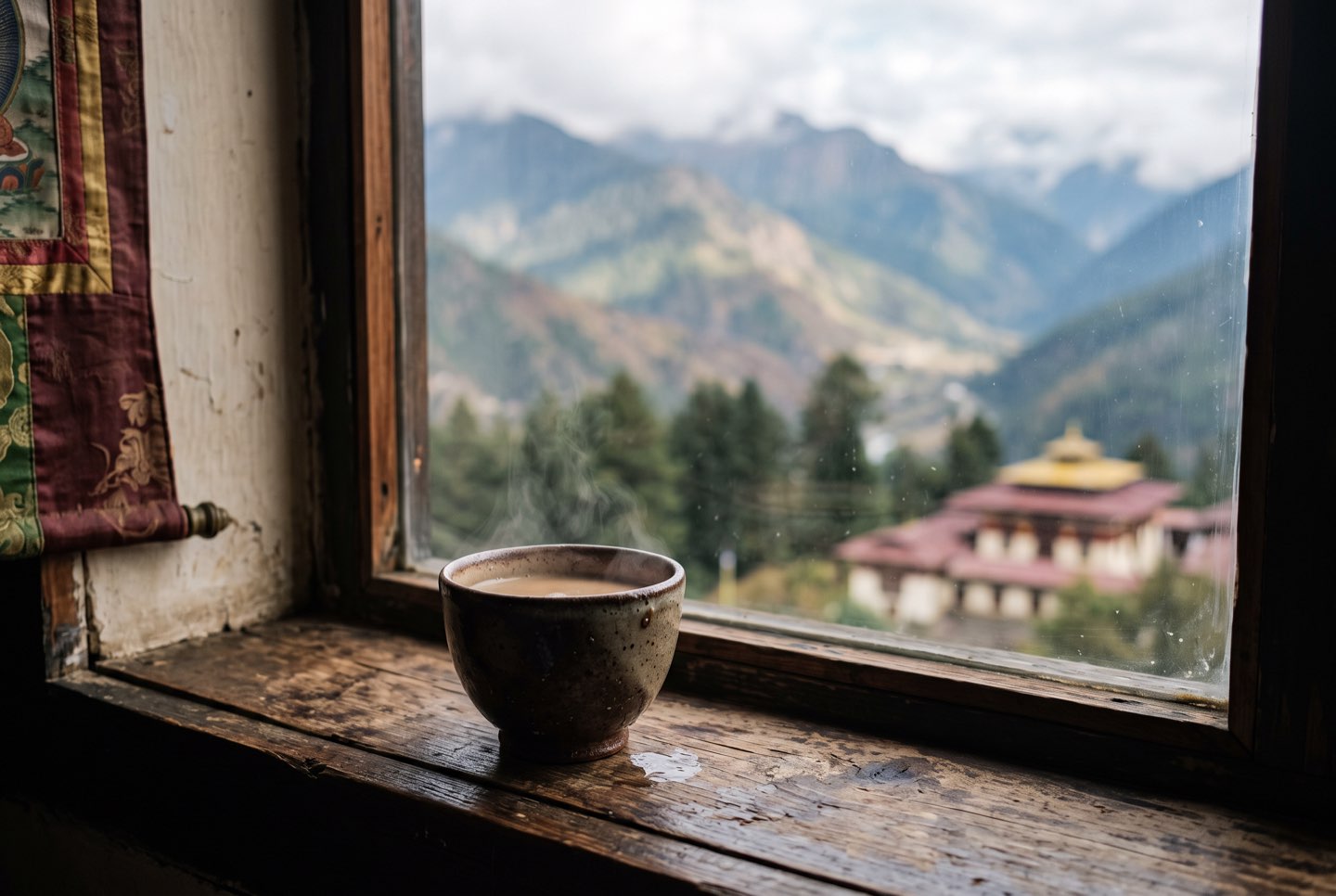 A single cup of steaming butter tea on a wooden windowsill, the mountains soft beyond the glass.
Where do the seasons overlap?
We can vouch only for Bhutan’s calendar, and it is uneven. October and November are the clearest and busiest months, the spring festival weeks are busy too, and December to February and the monsoon months are the quiet stretches. Our guide to when to visit Bhutan sets out the detail.
For the other two, use one month as a yardstick. In December 2025 Nepal received 98,190 foreign visitors, according to The Himalayan Times, and Japan received 3,617,700, JNTO says. Set beside Bhutan’s whole year, Nepal’s single December equals about 47% of it (98,190 ÷ 209,376), and Japan’s single December is about 17 times it (3,617,700 ÷ 209,376 is 17.3).
The point is not the precision. It is that the gap in scale holds in every month, so choose by the season you want to feel, not only by the country. If you are flexible on dates, the quieter Bhutan months leave you the most room. If you are not, book the smallest lodges first.
What does Bhutan not offer?
Plenty of things, and it is better you hear them from us. Bhutan is not for you if:
- You want to travel unguided. A guide is required at all times.
- You want to improvise. Plans here run on daylight-only Paro flights and mountain roads; our guide to flying into Paro explains why slack matters.
- You need advanced medical care within reach. The UK government’s travel advice says one hospital, in Thimphu, can provide surgery and emergency treatment, outside it hospitals generally offer basic care, and complex treatment means evacuation to India or Thailand. Good insurance matters.
- You want to fly a drone or drive yourself. Tourists are generally not permitted to bring drones, and self-drive cars cannot be hired.
- You want nightlife, shopping or a big city. Thimphu is a capital, not a metropolis.
- You want the lowest price. The nightly fee is fixed.
- You have a long weekend. Flights and roads eat the first and last days.
If you read that list and felt relief rather than disappointment, Bhutan is probably your country. If two or three items made you wince, be glad you found out now, and not in the third hotel of a trip that was never going to suit you.
How do you choose? A decision rule
Answer four questions, in this order.
- How much company do you want? If your answer is “as little as possible”, Bhutan’s numbers fit. If you like a busy, energetic scene, a larger destination may suit you better.
- How much do you want arranged? If you are happy with a guide and a driver, Bhutan works. If you want to wander without one, it does not.
- How many days can you give? Eight is our starting point; fewer makes Bhutan a sprint. Our guide to planning your first trip to Bhutan helps.
- Which month? Bhutan’s quiet months leave the most room, and its busy ones ask for earlier booking.
You do not have to choose only one. Combining Bhutan with Nepal, Sikkim or Bangkok is straightforward by air.
Frequently asked questions
Is Bhutan worth the cost?
Only you can say, and we will not put a price on it here. The question to ask is what you receive: small numbers, a guide who is with you throughout, and a nightly fee that, according to the Department of Tourism, funds free healthcare, education and conservation in the country you are visiting. If those things matter to you, the answer leans yes. If you would rather spend on variety, it leans no.
Why is Bhutan more expensive than Nepal?
We cannot verify Nepal’s prices, so we will not compare them. In our view, the differences are structural: a fixed nightly fee, a mandatory guide and a deliberately small volume. Smaller numbers spread fixed costs over fewer travellers, which is a reason to look at what you receive, not only what you pay.
Can I combine Bhutan and Nepal?
Yes. Both national airlines list daily Kathmandu flights in their autumn 2026 timetables; leave a day of slack before any onward flight.
Is Bhutan more crowded than Nepal?
No. Nepal received about 5.5 times as many visitors in 2025. Crowds are local, though, so choose your hours as carefully as your country.
Choose the country that lets you be the traveller you want to be.