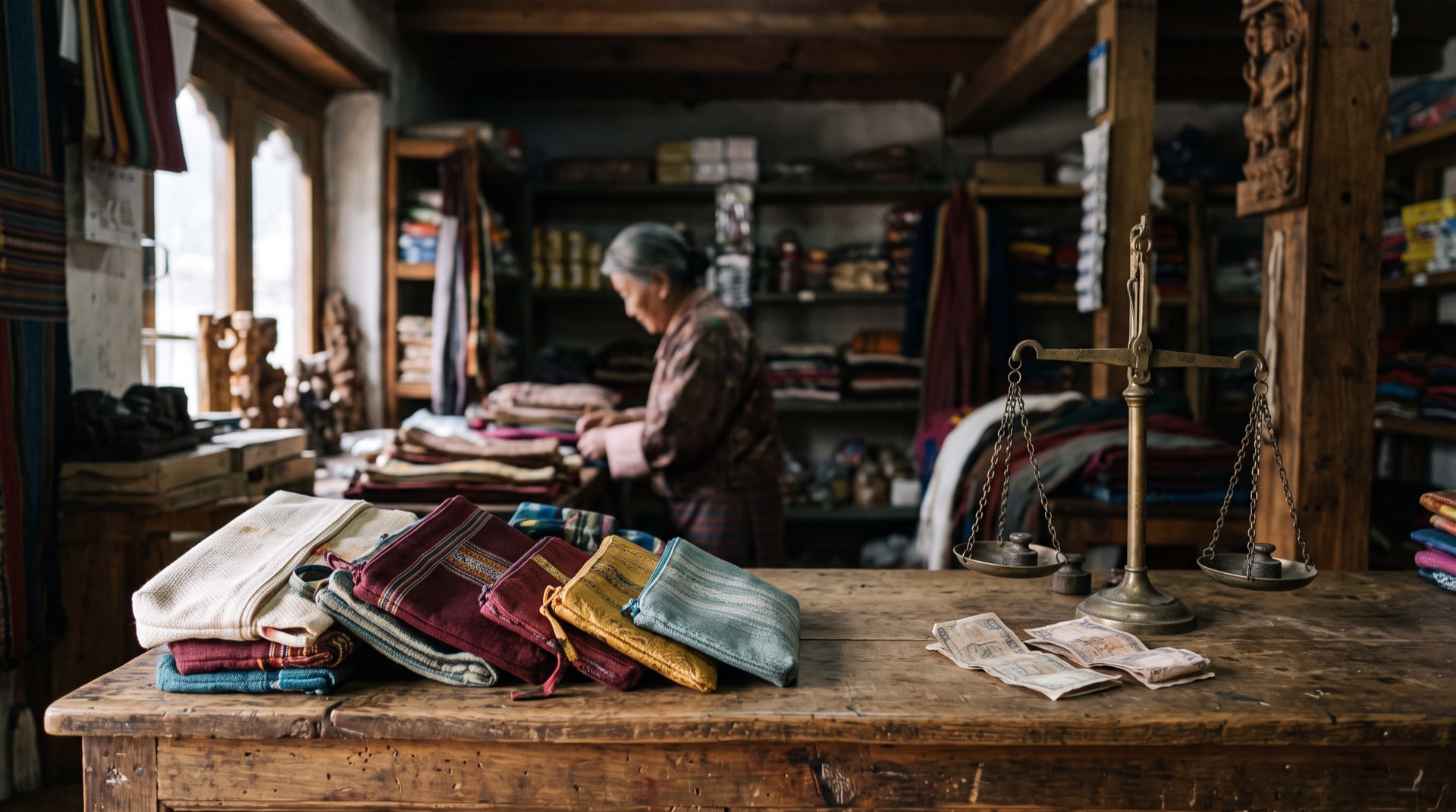
Picture a wooden counter in a village shop: woven purses in a row, a brass scale, and someone waiting kindly while you work out whether this is a card moment, a cash moment or a phone-app moment you did not prepare for. Later, in a lodge room with a lamp glowing, your phone is at four per cent and the charger in your hand has pins the wall socket declines to acknowledge.
None of it is hard — but small things can turn a calm arrival into a scramble. And, unusually for a practical guide, some official answers disagree with each other: cash limits, alcohol, tobacco. So we have kept what is confirmed apart from what is contested, with the source beside each.
| At a glance | Detail | Source |
|---|---|---|
| Currency and cards | Ngultrum (Nu), 1:1 with the Indian rupee; Visa and Mastercard widely used in towns, not everywhere | Department of Tourism |
| Ngultrum notes in or out (contested) | Nu 25,000 in the central bank’s January 2026 regulations; Nu 30,000 on the UK Foreign Office page | Royal Monetary Authority, UK Foreign Office |
| Foreign cash | Declare it above US$10,000 (wording varies slightly) | Royal Monetary Authority |
| Plugs and voltage | Types C, D and G; 230 V at 50 Hz | Department of Tourism, electricity regulator |
| SIM cards | Paro airport visitor information centre, Bhutan Telecom and TashiCell branches | Department of Tourism |
| Alcohol allowance (contested) | One litre on the airport page; up to two litres of spirit in the customs rules | Department of Air Transport, Revenue and Customs |
| Tipping | No official rule found; gratuities are not included on our journeys | Bhutan Luxury Travel, 2026 |
| Checked | 30 September 2026 |
What currency do you use, and can you pay by card?
The ngultrum (Nu), and yes, cards work in towns but not everywhere. According to the Department of Tourism, the ngultrum is 1:1 with the Indian rupee, ATMs and banks accept Visa and Mastercard, and international cards are widely used in urban areas, though the service may not reach the rest of the country. US dollars and Indian rupees are also widely accepted, and the department suggests bringing some cash in dollars, rupees or ngultrum.
You can change money at Paro airport, banks, larger hotels and authorised exchange businesses in Thimphu. The goBoB and MyPay wallet apps can be linked to international cards and used with a local SIM.
Our advice: tell your bank you are travelling, treat the card as your main tool and carry some cash for the places the machines don’t reach. On our journeys the visa, nightly Sustainable Development Fee, guide, driver, hotels, meals as listed and monument entrance fees are covered, so the cash you need is small.
How much cash can you bring?
Foreign currency is the easy half. Bhutan’s central bank, the Royal Monetary Authority (RMA), says in its Foreign Exchange Regulations 2026 that you may bring in foreign banknotes without limit, but you must declare them on arrival unless the total is US$10,000 or less. The Foreign Office and the airport’s customs page say much the same, though one writes “or more” and the other “more than”, so declare if you are near the line. The Department of Tourism’s FAQ says you may bring cash equivalent to US$10,000, which sounds like a ceiling; the RMA text treats it as the point where declaring begins.
Ngultrum notes are the contested half. The RMA’s regulations, dated 14 January 2026, allow up to Nu 25,000 in notes and coins in or out of Bhutan, a figure it may change, and say any excess without clearance or declaration is confiscated. The UK Foreign Office gives Nu 30,000. We can’t tell you which is current on your date, so plan around the lower figure. Since you can change money in Bhutan, you can simply arrive with none.
How do you get a SIM card or wifi?
Buy a local SIM on arrival, or rely on hotel wifi and accept the gaps. The Department of Tourism says most hotels have wifi but recommends a guest SIM for more convenient data and a more reliable connection, and it warns that mobile data can be expensive. SIMs are sold at the visitor information centre at Paro airport, at Bhutan Telecom and TashiCell branches, and by authorised agents in towns. The department also mentions a B Mobile SIM, sold in larger cities and topped up through the goBoB app.
Both operators publish tourist-SIM packages on their own websites, and Bhutan Telecom lists eSIM versions for phones that support them.
Our view, not an official one: in mountain country, treat a signal as a pleasant surprise, not a promise. If you need to be reachable, tell us. What wifi to expect at each lodge is something we confirm for your dates.
What plugs and voltage do you need?
Three plug types, all at 230 V. The Department of Tourism says Bhutan uses the British plug (three square pins, type G), the European plug (two round pins, type C) and the Indian plug (three thick round pins, type D), and suggests adaptors for all three. The electricity regulator’s 2022 Distribution Code declares the standard supply as 230 V and 50 Hz.
Check your chargers. If the label says 100–240 V, an adaptor is all you need, and most phone, camera and laptop chargers do. A hair dryer or razor from a 110 V country may not. If you rely on a medical device that needs steady power, tell us before you travel so we can check with your lodges.
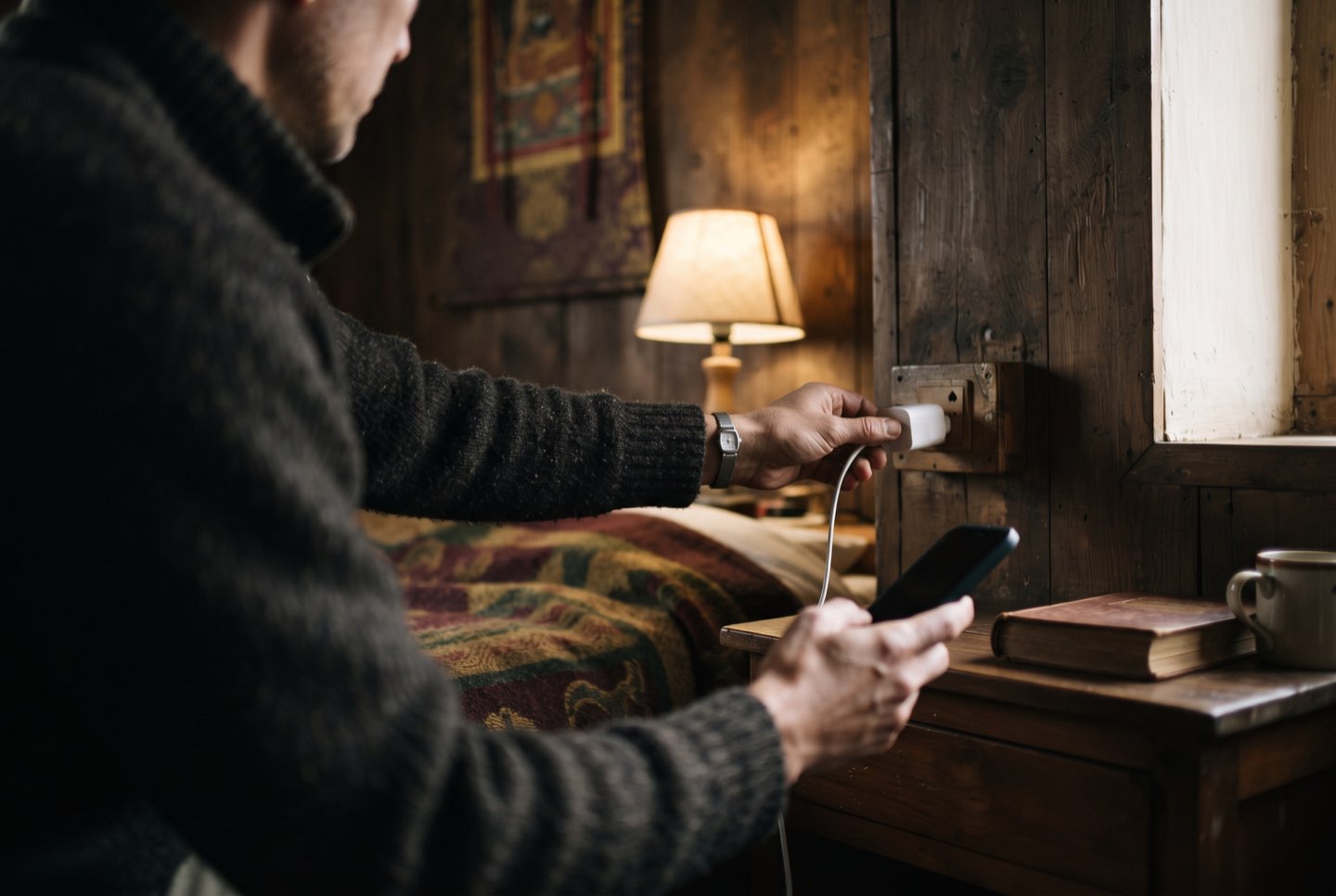 Hands plugging a phone charger into the wall beside a bed in a wood-panelled lodge room.
What can you bring into Bhutan?
Personal belongings, a modest allowance of gifts and a bottle, and a few firm limits. The airport’s customs page explains the two channels: green if you have nothing to declare, red if you have dutiable goods, with random checks. It lists narcotics, psychotropic drugs, pornographic material and antiques as prohibited, and it says items such as drugs and pharmaceutical products, plants and live animals need an import permit. Carry your own medicines in their original packaging with a copy of the prescription.
Two allowances are where sources disagree.
- Alcohol. The airport page lets a tourist bring one bottle of up to one litre free of duty. The customs rules published by the Department of Revenue and Customs allow spirit of up to two litres within a small allowance for gifts and souvenirs.
- Tobacco. The airport page permits 200 cigarettes or three 50-gram tins of pipe tobacco at 100% duty. The UK Foreign Office says only that a small supply for personal use is allowed, that you will pay tax and duty, and that you must be able to show proof of payment. The airport page shows no date, and its page data says March 2017, so treat its numbers as a starting point. Other guides quote other figures; we found no current official one.
What can’t you take out?
Antiques never leave, and other cultural objects need an export permit. The Foreign Office says it is illegal to take antiques out of Bhutan and that customs officials may inspect items that look like antiques. The Department of Tourism explains that a law sets out which artistic, historic, cultural and religious objects must stay, and that souvenirs may need an Export Permit for Non-Antique Artefacts. Our guide to what to buy in Bhutan shows how that works for textiles and crafts.
Two habits help. First, dutiable goods you declared on arrival are checked when you leave: the airport page says any declared item found missing attracts duty and taxes at prevailing rates, so keep your declaration form. Second, if something is old, or looks sacred, or is a bargain that seems too good, ask your guide before you buy, not at the departure gate.
What should you check before you fly?
Three things deserve a last check: cash limits, allowances and your phone plan. Because the sources above disagree, five minutes with your bank, your mobile provider and the customs pages beats a discussion at the red channel. The rest of the list is short.
- Bank and cards: tell your bank, and carry a backup card.
- Power: pack adaptors for types C, D and G, and check your chargers say 100–240 V.
- Phone: unlocked, or ready for an eSIM.
- Clothes for temples: long sleeves and covered legs; our guide to dzong and temple etiquette has the detail (a dzong is a fortress-monastery).
- Arrival: the Paro landing is daylight-only, so leave a day before any onward connection; see flying into Paro.
New to all of this? Planning your first trip to Bhutan puts the pieces in order.
Frequently asked questions
Are tips included, and do I tip?
Gratuities are not included on our journeys. We found no official rule or guideline on tipping in Bhutan, so we won’t invent one. A tip for your guide and driver is a personal thank-you, never an obligation. If you would like a sense of what is customary, ask us before you travel.
Can I bring a drone?
Tourists are generally not permitted to bring drones into Bhutan, says the Department of Tourism, and flying one, for fun or for work, needs a permit obtained in advance. Applications from official guests are reviewed case by case. We haven’t printed the FAQ’s permit contact address because we couldn’t confirm it is current.
Will my phone plan work, and where do I buy a SIM?
Whether your home plan roams in Bhutan is a question for your provider, whose agreements we can’t see. Ask what a day of roaming costs and compare it with a local SIM. Hotel wifi is the fallback.
How much cash should I carry?
Less than you fear, and more than nothing. With guide, driver, hotels, meals as listed, entrance fees, visa and fee covered, cash is for souvenirs, small extras and gratuities if you choose. We can’t name a fair number without knowing your habits, so tell us how you like to travel.
Sort the small things before you land, and the days can be as unhurried as you like.