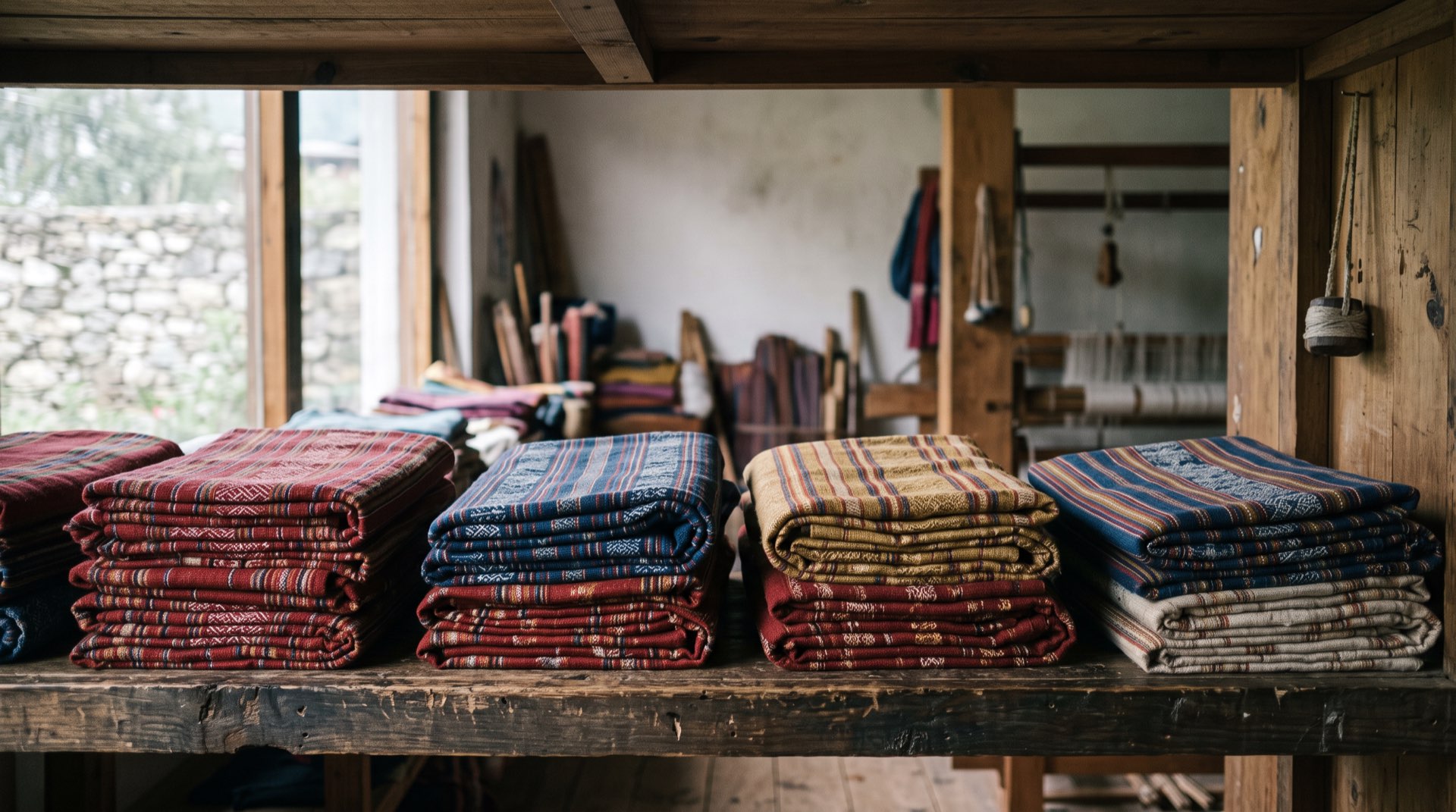
Somewhere in your first week, you will be holding a length of cloth up to a window. The light will slide through the weave, one colour will do something you can’t name, and a small internal accountant will start asking three questions at once. Is this really handwoven? Is it a fair thing to buy, from a fair place? And the one nobody mentions until the airport: will it be allowed to leave the country with me?
The rules turn out to be shorter than the worry, and Bhutan’s crafts are the kind you can watch being made. Read the section on what stays behind before you fall for something that can’t come.
| At a glance | Detail | Source |
|---|---|---|
| Over 100 years old | Objects of artistic, historic, cultural, religious, social, archaeological or technical interest may not be removed | Department of Tourism |
| Valuable objects of any age | Include ornaments and jewellery, objects made from animal parts, weapons and armour, archaeological material and fossils | Department of Tourism |
| Export permit | Online, from the Department of Culture; processed within two working days if photos and details are clear; valid 14 days | Department of Culture |
| Permit fee | Nu 100 per item at the time of writing, with a revision proposed | Department of Culture |
| See craftspeople | National Institute for Zorig Chusum, Thimphu: open to the public, trainee work on sale | Department of Tourism |
| Tourist GST refund | Goods only, claimed at the international airport, minimum Nu 50,000 per invoice including GST | GST Rules 2026 |
| Checked | 30 September 2026 |
What is worth buying in Bhutan?
Things made by hand, by someone whose name and village you can learn. That rule sorts most of the shelf, and it fits Bhutan’s living culture: crafts here are practised, not kept under glass.
Textiles come first. The Department of Tourism’s feature on Bhutanese fabric notes that not so long ago bolts of woven cloth were even used as towels, which should ease any worry about putting a handwoven cover on an actual sofa. Beyond cloth, the department’s guide to the traditional arts points to paper from the bark of the Daphne tree, now made into envelopes, calendars and books, plus wooden bowls and cups, and bamboo household objects woven especially in the east.
Then there are thangkas, painted scrolls of Buddhist deities and scenes. A new one from a trainee’s brush is a lovely thing to hang. An old one is another matter, and we’ll get to it.
Three questions cover nearly every purchase. Who made it? Where? How long did it take? If nobody can answer, you have learned something.
How can you tell a handwoven kira from a machine copy?
Not always at a glance. In October 2024 the national broadcaster BBS reported that machine-made copies of kushuthara, the intricately patterned silk kira (the woven wrap Bhutanese women wear) of the east, had reached the market and can look almost identical from a distance. A Thimphu textile business owner quoted there said the machine versions tend to be too bright. A stakeholder meeting recommended geographical-indication tags and quality standards to help buyers, but we haven’t found such a hallmark in force, so the checking is up to you.
Here is what we would do:
- Ask for the story. The Department of Tourism names Lhuentse’s silk-on-silk kushuthara and Radhi’s bura as regional specialities, with yak and sheep wool in the north and nettle, cotton, hemp and silk in the east and south. A story that doesn’t fit the fibre is a clue.
- Ask how long it took. The same feature describes a full-patterned silk kushuthara kira that took its weaver months. Months of work priced like an afternoon’s is a sum that doesn’t add up.
- Buy where weavers train or work. The Royal Textile Academy in Thimphu runs a weaving school, and its museum shows you the real thing before you shop.
- Ask for a receipt that names the piece. A named piece, a maker and a date are easy to describe if you later need to photograph and list it for a permit.
What are the thirteen traditional arts?
They are known together as Zorig Chusum, and the Department of Tourism lists them as painting, sculpting, paper-making, bronze casting, carpentry, masonry, carving, wood turning, blacksmithing, ornament making, bamboo work, embroidery and appliqué, and weaving.
Read as a shopping map, the list sorts itself. Carpentry and masonry shape houses and monasteries, and blacksmithing lies behind the chain-link bridges, so those come home as photographs. Paper, bowls, bamboo, embroidery and weaving fit in a suitcase. New paintings and sculpture can come too; the permit below is how you show that a piece is not an antique.
Where can you watch craftspeople at work?
At the schools where the next generation trains. The National Institute for Zorig Chusum in Thimphu, founded in 1971, is open to the public, according to the Department of Tourism: visitors may walk the halls, observe classes and talk to the students. Original work made on site is on sale, so you can buy something whose maker you may just have watched.
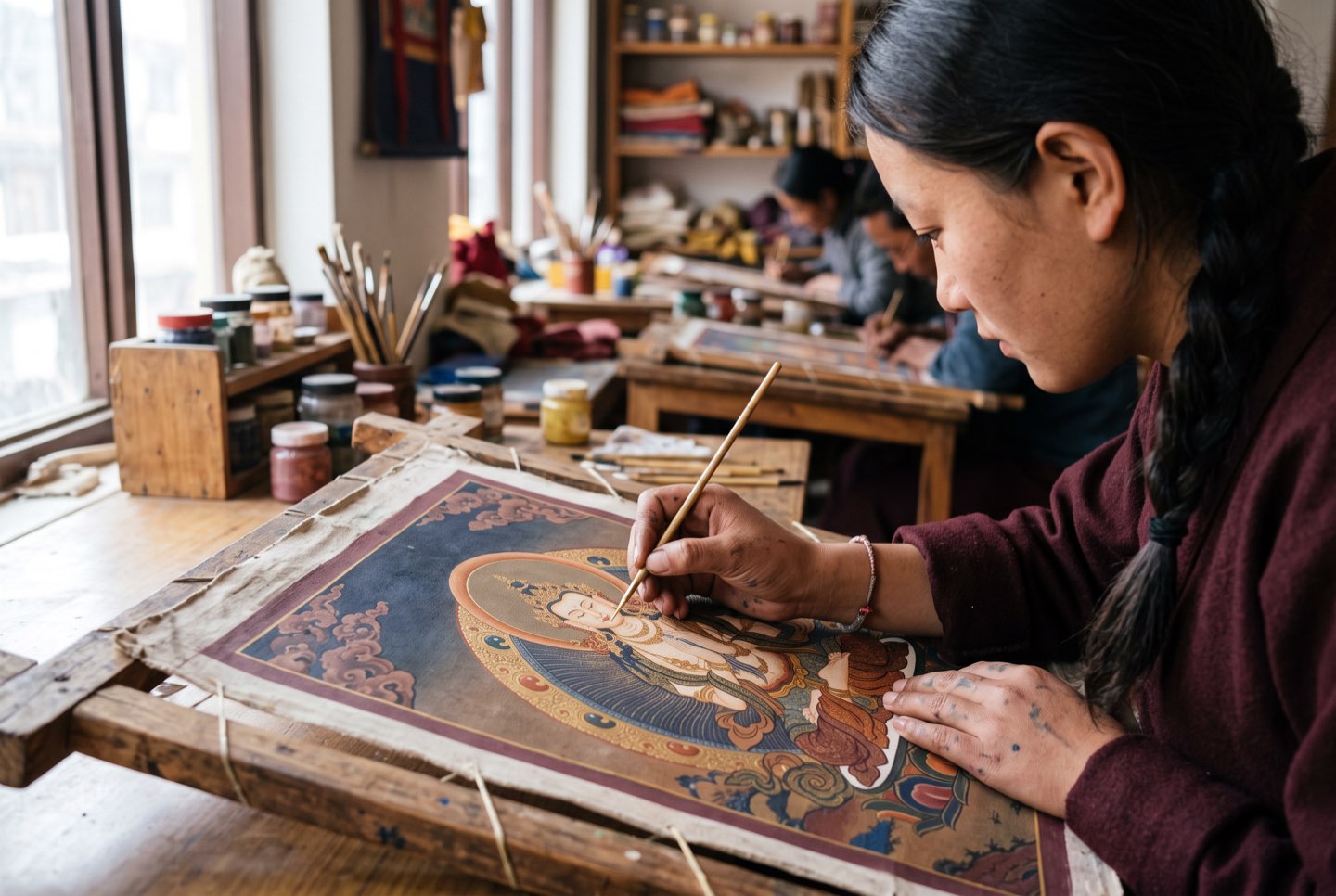 A student’s brush adding fine gold detail to a thangka, seen over the shoulder in a craft-school studio.
The Royal Textile Academy does the same for cloth: a training space for aspiring weavers, a conservation centre, and a two-floor museum with permanent displays above and changing exhibitions below. It is a good place to learn what to look for before you spend anything.
On our side, The Soul of Western Bhutan gives a full day to Thimphu, with time behind the scenes with artisans and a quiet audience with a master thangka painter at work, and lists textile weaving as an option in Paro. Opening times change, so we confirm them for your dates.
What can’t you take out of Bhutan?
Anything more than 100 years old that has artistic, historic, cultural, religious, social, archaeological or technical interest, plus certain valuable objects of any age. That is how the Department of Tourism’s page on the export permit for non-antique artefacts puts it, citing the Movable Cultural Property Act of Bhutan, 2005. The page was last updated in September 2022, so check with the department for changes.
Its examples for the over-100-year rule reward slow reading: images of buddhas, bodhisattvas and other deities; manuscripts and scriptures with their cloth wrappers, prayer flags and amulets; stupas; ritual objects; furniture, textiles and clothing; architectural salvage. Yes, an old prayer flag is on the list.
The second category ignores age: valuable ornaments and jewellery, objects made from animal parts, weapons and armour, archaeological material and fossils.
Why so strict? The department’s textile feature explains that years of enthusiastic collecting sent many national treasures abroad, and that any textile of possible significance must now be vetted by the Department of Culture before it can leave. If anyone offers you something described as an antique, the answer is simple: it can’t leave.
How do you get an export permit?
Online, through the Department of Culture’s non-antique export system, and it is quicker than you might fear. The system’s own FAQ says a permit is processed within two working days if the information is correct and the photographs are clear. Blurry photos and missing details are what get applications rejected, and if the department doubts a photo, the item must be inspected in person.
Timing matters. A permit is valid for 14 days from approval, extendable online by two weeks, so apply in the last days of your trip, not the first. Photograph each item in good light before it disappears into a suitcase. The FAQ lists a fee per item in ngultrum (Nu), with a revision proposed; the table has the figure at the time of writing.
None of this is hard, but it is fiddly. The first step of the online form asks for the applicant’s CID (Bhutanese citizen identity) number, and the FAQ says one applicant may apply on behalf of several people, so we would expect a Bhutanese host to file for a visitor. We haven’t confirmed how visitors are meant to use the form, so tell us before you buy anything sizeable and we will confirm the current steps for your dates.
How do you carry it home?
With the permit where you can find it. The same FAQ says you may keep the permit on your phone, but its QR code must be clearly visible so Customs can cross-check the items as you leave. You must also declare non-antiques to Customs on exit; if that is skipped, the system records it and it can cause trouble at your next application.
For the physical journey, roll a thangka in a tube and keep it in hand luggage, fold textiles in tissue and wrap bowls in soft clothes. Bhutanese Buddhists regard images of deities as sacred, so give yours a high, respectful shelf; our guide to dzong and temple etiquette explains the spirit.
For cards, cash and ngultrum, see our guide to money, SIM cards and plugs in Bhutan, and if the journey itself is still taking shape, start with planning your first trip to Bhutan.
Frequently asked questions
Can I take an old thangka home?
No, not if it is more than 100 years old; the law names images of buddhas, bodhisattvas and other deities. New thangkas are different, and the non-antique permit exists for exactly this. Ask us which pieces need one.
Do I need a permit for a new kira?
We haven’t found a rule that mentions ordinary new souvenirs either way, so we won’t guess. The permit exists to keep heritage in Bhutan, and significant textiles are vetted by the Department of Culture. A fine silk piece that took months to weave is exactly the kind to ask about first. Tell us and we will check before you pay.
Can I claim GST back?
Only in narrow cases. Under rules 147 to 153 of the GST Rules 2026, a tourist may claim only when leaving through an international airport, for goods worth at least Nu 50,000 including GST on one invoice, taken out within the period the immigration law allows and presented with the paperwork. A 5% administrative charge may be deducted, and GST on services is never refunded. Most souvenirs fall below that line.
What about jewellery and things made from animal parts?
The export page lists ornaments and jewellery, and objects made from animal parts, among the valuable objects covered whatever their age, but it doesn’t say what counts as valuable. Ornament-making is one of the thirteen arts, so new jewellery is plainly made and sold, and we haven’t found where the line falls. Ask before you buy, and check your own country’s rules for animal products, because customs at home may have their own.
Buy what you watched being made, keep the paperwork close, and leave the old things where they belong.