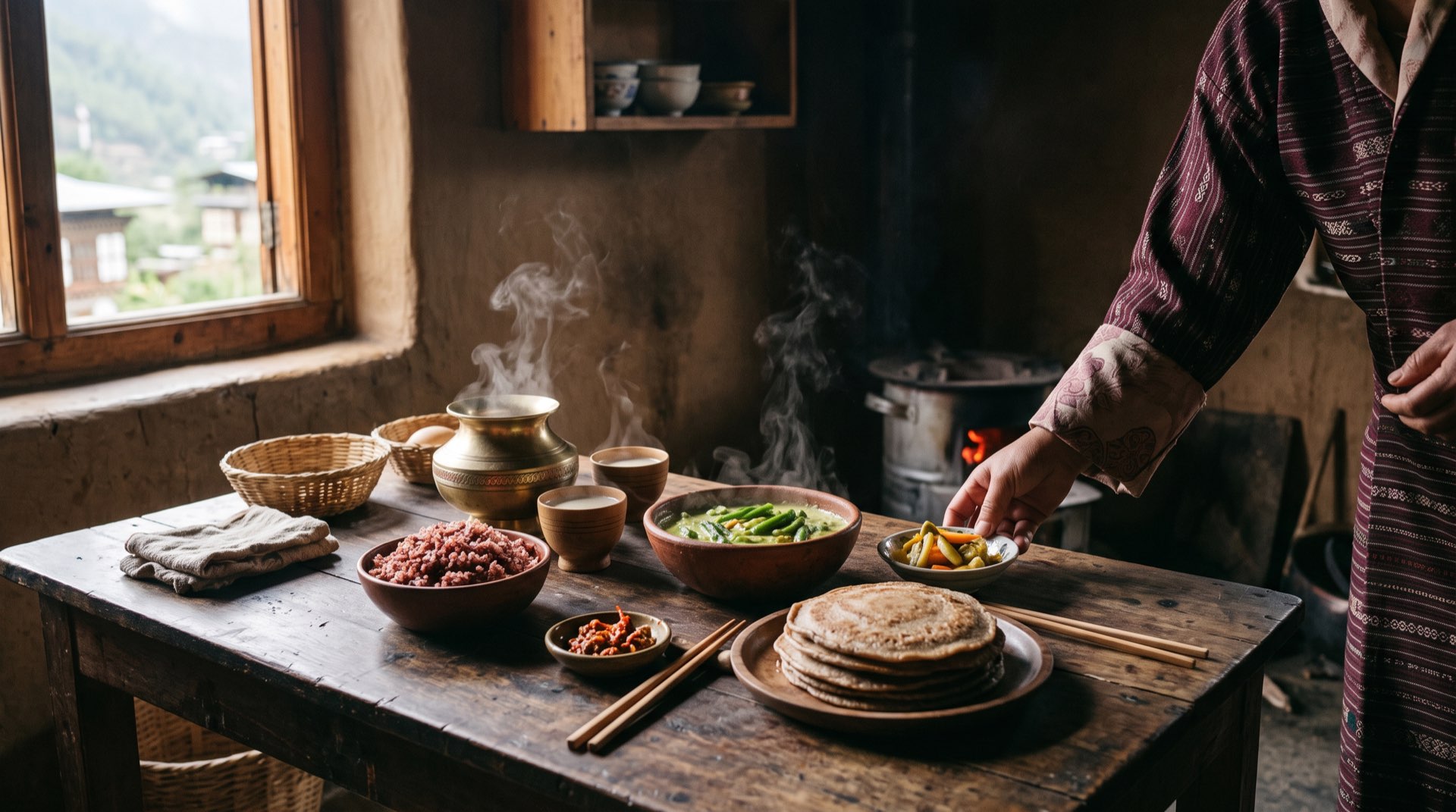
The lid comes off the pot and the steam reaches you first: green chilli, melting cheese, a little garlic. It’s ema datshi, Bhutan’s national dish, and it sits in the middle of a farmhouse table beside a mound of pinkish red rice and a pot of butter tea. Somebody’s eyes are already watering. Probably yours.
Food is one of the quiet pleasures of a journey here, and one of the quiet worries before it. Will everything be fiery? What if you’re vegetarian, vegan, coeliac or simply cautious? And what happens if you can’t finish what a kind host has put in front of you?
The short answers are: no, not everything; yes, easily; and nothing terrible. The longer ones follow, from a team that has looked after a great many curious, hungry and occasionally nervous eaters.
| At a glance | Detail | Source |
|---|---|---|
| Ema datshi | Chillies stewed with cheese, eaten with red rice. Heat: high | Department of Tourism |
| Kewa datshi | Potatoes in the same cheesy sauce. Heat: gentle | Department of Tourism |
| Jasha maru | Chicken stew with chillies, onion, tomato and coriander. Heat: medium to high | Department of Tourism |
| Puta | Buckwheat noodles, a speciality of Bumthang. Heat: usually mild | Department of Tourism |
| Suja | Butter tea, churned with butter and salt. Heat: none | Department of Tourism |
| Heat ratings | Our own, for home-style cooking; hotel kitchens cook milder | Bhutan Luxury Travel, 2026 |
| Checked | 27 September 2026 |
How spicy is Bhutanese food, really?
Very, if you eat the way Bhutanese families do, and far less if you don’t. In most kitchens here the chilli isn’t a seasoning. It’s the vegetable. Ema datshi literally means “chilli cheese”, and the chillies are the main event, not the garnish.
Bhutan’s Department of Tourism describes chillies as an essential part of nearly every dish, and they are eaten red, green, fresh, dried, powdered and pickled. Travel in autumn and you’ll see them drying almost everywhere: on rooftops, hanging from windows, spread out on the ground.
The good news is that the heat is adjustable. The same official guide notes that meals in homes and roadside eateries are usually eye-wateringly spicy, while hotels and restaurants cook milder for visitors. Ask for the chillies on the side and most kitchens can cook the stew gently and let you add the fire yourself.
Our advice? Try the real thing at least once, with a spoonful of rice ready and no audience. Then decide how brave the rest of the trip will be.
What else is on the table besides chillies?
Rice, above all, and whatever grows nearby. Bhutan’s staple crops are red and white rice, maize and buckwheat, and a meal is built around a generous mound of rice with one or two tsem, or stews, of vegetables, lentils, cheese or meat alongside.
Red rice is the one to look out for. It’s nutty, earthy and a little soft, and farmers in the western and central valleys have grown it for centuries. Cooked, it turns a gentle pink that makes even a simple plate look like a small celebration.
Climb higher and the menu changes with the altitude. If you travel beyond western Bhutan into Bumthang, buckwheat takes over: puta noodles and khurle, buckwheat pancakes. In Phobjikha, potatoes are the main crop, so a bowl of kewa datshi there tastes of the valley outside the window, especially in winter, when you come for the cranes of Phobjikha. Further east, corn dishes appear, and a pungent cheese called zoedoe that the Department of Tourism compares to blue cheese.
What does butter tea actually taste like?
Like a light, salty broth that happens to contain tea. Hold on to that thought and you’ll be fine.
Suja, butter tea, is churned from tea, butter and salt. If your brain is expecting a cup of English breakfast, it will lodge a formal complaint on the first sip. We’ve seen the expression many times: surprise, a pause, then a polite second sip. Tell yourself you’re drinking soup and it all makes sense.
It’s served in homes and offices alike, often with a small bowl of zaw, crunchy puffed rice, on the side. And it makes the most sense in the cold. On a high pass first thing in the morning, or in a farmhouse kitchen in winter, the butter and salt feel exactly right.
If it really isn’t for you, ask for ngaja, the sweet milk tea that is just as common. Nobody will mind in the slightest.
Our honest review of suja? Three stars on the first cup. Five on a frosty morning at the top of a pass.
What happens at a farmhouse lunch?
You sit, you’re served, and you’re served again. For many travellers a farmhouse lunch is the meal they talk about longest. The kitchen is warm from the wood stove, and meals were traditionally eaten sitting on the floor, with the rice and stews set in the middle for everyone to share.
A few customs help. Before eating or drinking, many Bhutanese toss a little food or drink into the air as an offering, as the Department of Tourism explains. Hosts usually serve themselves only after their guests have started, so when your plate arrives, begin. You’re not being greedy; you’re being polite.
Offering a guest something to drink is part of good manners, and refusing outright can feel rude. Accept the cup, even if you only take a sip. That includes ara, a traditional spirit made from grains such as rice, maize or barley. Sip slowly. It’s stronger than it looks.
And pace yourself. Hospitality here is generous, and second helpings have a way of arriving before you’ve finished the first. It’s one of the warmest windows into Bhutan’s living culture you’ll find.
Can vegetarians, vegans and gluten-free travellers eat well?
Yes, and vegetarians most easily of all. Vegetable dishes are everywhere, and meat-free eating is part of the culture: BBS reported in 2024 that meat shops across the country close for a whole month during Saga Dawa, a holy month in the Bhutanese calendar.
Vegans need more planning, because the local cheese goes into nearly all vegetarian dishes, as the Department of Tourism notes, and butter turns up in the tea. The staples themselves, though, are plant-based: chillies, potatoes, mushrooms, greens, lentils and red rice are all vegan until the cheese goes in, so kitchens can cook them with oil instead.
Gluten-free works well, because rice is the backbone of nearly every meal. Buckwheat, despite its name, isn’t a kind of wheat, but buckwheat products can still carry gluten, and dumpling wrappers are usually made with wheat flour.
For coeliac disease or a serious allergy, tell us when you first get in touch. We can arrange meals to suit and brief your guide, and we’ll be honest where a small village kitchen can’t promise a separate pan. Bring any medication you rely on.
Should you eat at your lodge or in local kitchens?
Both. The mix is what makes the trip. Lodge kitchens cook Bhutanese dishes alongside international ones, with the heat turned down for visitors, and after a long day a quiet dinner by the fire, with no decisions to make, is its own kind of luxury. Our guide to choosing Bhutan’s luxury lodges explains how each one feels.
Local kitchens give you everything else: a bowl of noodles in a Thimphu café, a picnic lunch by a river, a farmhouse meal cooked by the family whose fields you walked past that morning. This is where the food tastes most of the place.
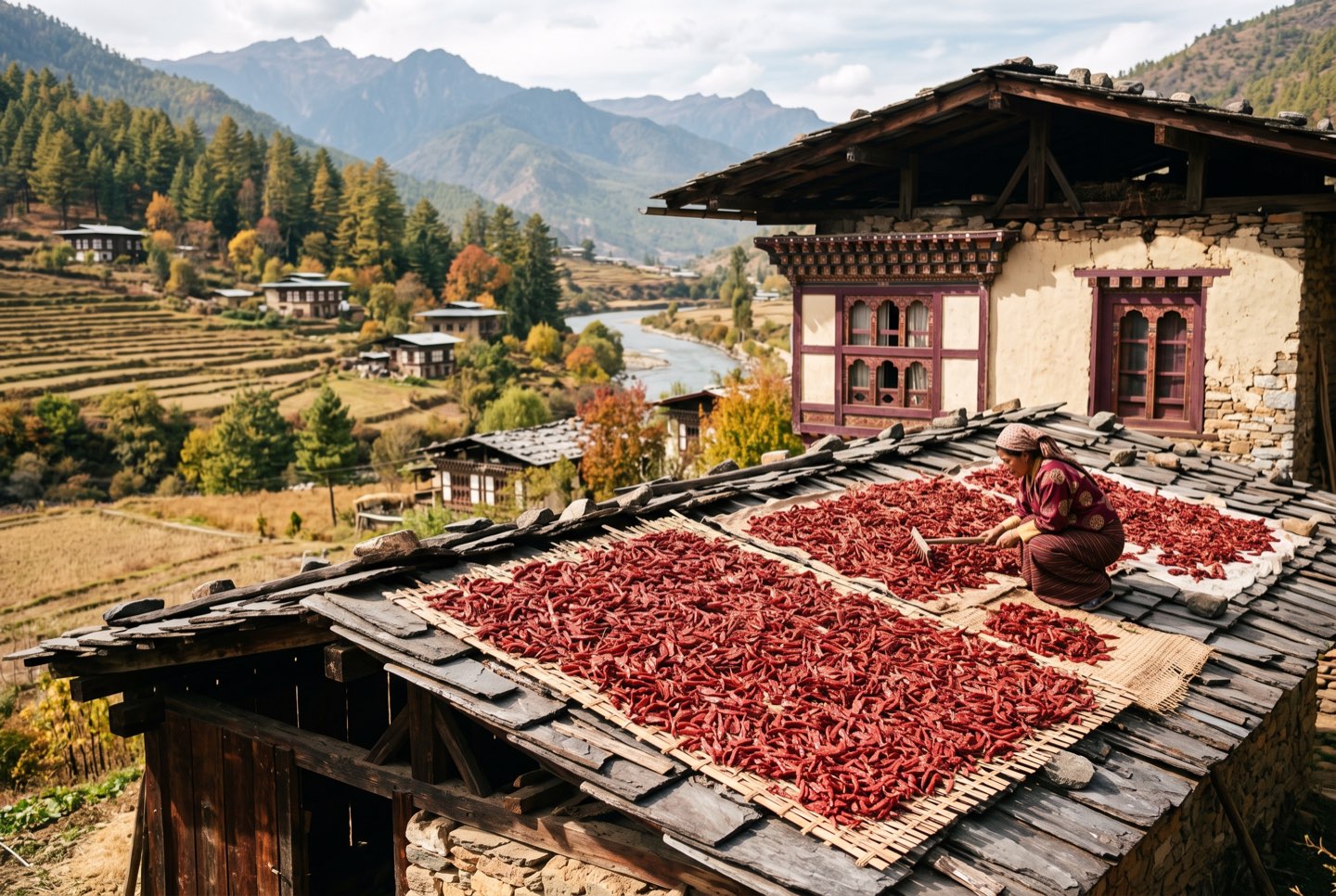 Chillies drying on a farmhouse roof in the autumn sun, the valley beyond.
Menus change with the season and the market, so we won’t promise you a particular dish at a particular lodge. What we do is share your preferences ahead of time and plan the balance with you: perhaps one meal a day out in the valleys and the rest at your lodge. That rhythm sits at the heart of slow luxury in Bhutan: time for a long lunch, and nowhere else you need to be.
Which words help you order?
A handful, and your guide will do the rest. Start with a simple pattern: datshi, the cheese, comes after the main ingredient. Once you know that, half the menu reads itself.
- Ema datshi: chillies and cheese. The national dish.
- Kewa datshi: potatoes and cheese. The gentle one.
- Shamu datshi: mushrooms and cheese. Wikipedia’s entry on ema datshi lists more variations.
- Suja and ngaja: butter tea and sweet milk tea.
- Zaw: puffed rice, served with tea.
- Ara: the traditional grain spirit.
- Kadrin chey la: thank you. Use it often.
And for everything else? Point at the chilli, smile and shake your head gently. In our experience, it works in every valley in the kingdom.
Frequently asked questions
Is Bhutanese food very spicy?
Home cooking often is, but you’re never obliged to eat it that way. When you need a rest, ask for kewa datshi or jaju, a mild soup, and keep a bowl of rice close by.
Can vegans eat well?
Yes, with notice. Tell us at the start and we’ll pass your needs to every kitchen on your route, so the cheese and butter stay out of the pot.
Is gluten-free possible?
Yes. Rice is at the heart of Bhutanese meals, so the main things to watch are dumplings, noodles and bread. We flag your needs to each kitchen and your guide checks at the table.
Is it safe to eat street food?
Follow the CDC’s general advice for travellers: food that is cooked and served hot is the safer choice, while raw foods and street stalls carry more risk. Our guide to altitude and health in Bhutan covers staying well more broadly.
Come hungry and curious. Leave room for a second helping, and for a third cup of tea you never expected to love.