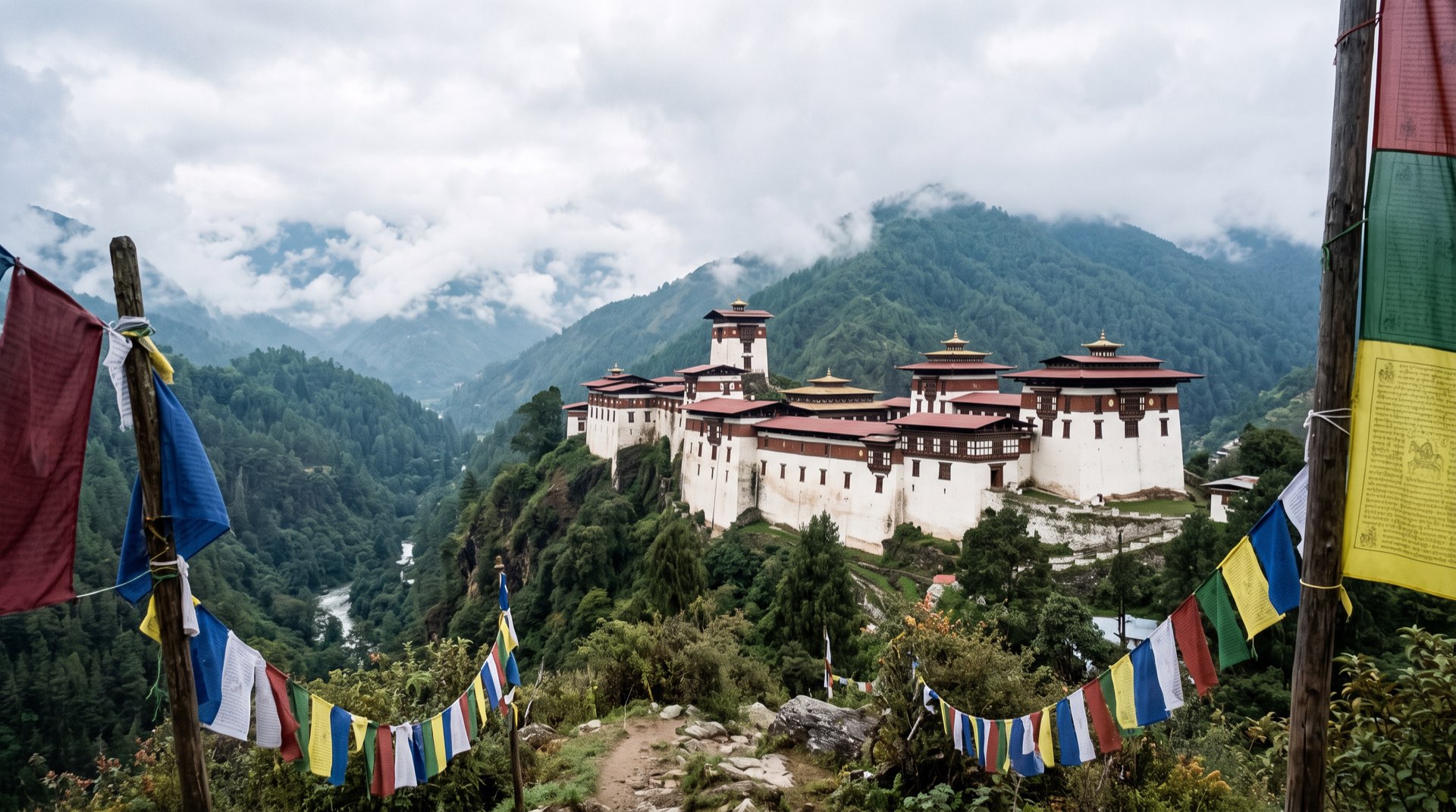
The road to Trongsa saves its view for the last bend. Across the gorge, whitewashed walls climb a ridge in layer after layer, and the cloud hangs at roof height as if it were waiting to be shown in. By now you have heard the word “Zhabdrung” six times today and “penlop” twice, and somewhere around the fourth you started nodding as though you knew both.
It is an easy thing to do, and nobody minds. Most of us did not learn Bhutan’s history at school, and its buildings assume we did. The good news is that you need only ten dates, each attached to a place you can stand in. We have kept the firm dates apart from the traditional ones, and told you whose word each comes from.
| At a glance | Detail | Source |
|---|---|---|
| Guru Rinpoche | 747 A.D. in the Royal Bhutanese Embassy’s account; the Department of Tourism says only “8th century” | Embassy, Department of Tourism |
| The Zhabdrung arrives | 1616 (Department of Tourism); “the 17th century” (embassy) | Department of Tourism |
| Punakha Dzong | Built 1637 (some sources say 1637–38); the First King’s enthronement in 1907 took place here | UNESCO Tentative List entry |
| Tashichho Dzong | Originally built 1641; present form largely from the 1960s | Thimphu Dzongkhag |
| Monarchy | Ugyen Wangchuck unanimously elected first hereditary monarch, 1907 | Embassy |
| Constitution | Adopted 18 July 2008; National Day is 17 December | Constitution of Bhutan |
| Elections | First parliamentary elections 2008; second 2013 | Embassy |
| Checked | 30 September 2026 |
How did Bhutan begin?
With scattered settlements and then, by tradition, with a visit. The Royal Bhutanese Embassy in New Delhi says archaeological finds point to settlements as far back as 2000 B.C., but that recorded history begins with the arrival of Buddhism in the 8th century. It names a year: 747 A.D., when the sage Padmasambhava, revered in Bhutan as Guru Rinpoche, visited and introduced Buddhism.
Treat 747 as one source’s wording. The Department of Tourism says only that Buddhism was first introduced by the 8th-century tantric master Guru Rinpoche, and we have found no official page that explains the year. Nor is it the only tradition: Bumthang’s district administration records Jambay Lhakhang as one of 108 temples that King Songtsen Gampo built in 659 CE, which our guide to Jambay Lhakhang Drup reports. Read all of these as tradition, not settled history. Tradition holds that he flew to the cliff at Paro Taktsang on the back of a tigress, and for most Bhutanese that story matters more than the calendar. Our guide to the Tiger’s Nest hike tells it, and Buddhism in Bhutan shows how the faith looks today.
Who was the Zhabdrung, and why does everyone mention him?
He is the leader who turned a country of valleys into one nation, and much of what you will visit was built by him or in his name. According to the Department of Tourism, Zhabdrung Ngawang Namgyal arrived from Tibet in 1616, brought several schools of Buddhism that flourished under his rule, and unified the country as a single nation-state with an identity of its own. The sources differ here: the embassy says only that he united the country in the 17th century. So 1616 is the Department’s date for his arrival (UNESCO’s entry gives it too), and we use it as that.
The Department adds that he first built dzongs, the fortress-monasteries, for security and administration, which is why they look like castles and work like town halls. That too is contested: Bhutan’s UNESCO Tentative List entry says dzongs began to be built in the 12th century by clergy of Tibetan schools, and credits the Zhabdrung with building several more as he unified the country. His name also keeps turning up in the present tense: the monk body’s yearly move between Punakha and Thimphu follows a tradition he instituted, as our Buddhism guide explains. For what these buildings are like when they are working, see Bhutan’s living culture.
What was the dual system of government?
Two heads at once: the Je Khenpo, the chief abbot, led the religious order, and the Deb Raja led the administration. That is the embassy’s description of the system the Zhabdrung set up. In its account, the country emerged from the 17th century with a distinct national and cultural identity and an unprecedented degree of political stability. From the second half of the 18th century the dual system began to weaken, as local chieftains asserted themselves and internal discord affected unity, and external threats in the latter half of the 19th century sharpened the need for strong national leadership.
You will also meet the penlops, regional governors. The Trongsa district administration says the Zhabdrung appointed the first Trongsa Penlop in 1647, and that on the Zhabdrung’s instruction he built the dzong. Keep the word in your pocket. You will need it again.
When did the monarchy begin?
In 1907, when Ugyen Wangchuck was unanimously elected the first hereditary monarch of the kingdom, according to the embassy. It describes the new monarchy as bringing a period of peace and stability, unifying the country under a central authority and starting a steady engagement with the outside world. The Constitution keeps the link alive: the title to the Golden Throne vests in the legitimate descendants of Druk Gyalpo Ugyen Wangchuck.
Two dzongs give the story a place. Bhutan’s UNESCO entry says Punakha Dzong was the birthplace of the monarchy, with the First King’s enthronement there in 1907, and the Trongsa district administration says that the Crown Prince’s formal investiture as Trongsa Penlop is still observed in Trongsa Dzong. Our Cranes & the Central Valleys journey passes the dzong on the way to Bumthang, and if you would like time inside, ask us. This page keeps to the dates official pages give; the reigns since have their own histories, best told standing in the courtyards.
How did democracy arrive in 2008?
Through preparation, in the embassy’s account: successive Kings, it says, “prepared for far reaching political changes”, and in 2008, a century after the monarchy began, Bhutan held its first parliamentary elections and had its first democratically elected government. A second election followed in 2013, further consolidating the new system.
The Constitution was adopted on 18 July 2008. Among much else, it asks the State to promote the conditions that enable the pursuit of Gross National Happiness, a phrase our guide takes apart. One caution: ten dates cannot hold the whole of the twentieth century, so we have kept to what official pages state plainly. Your guide can tell you more, and it is fine to ask.
Which place on your journey belongs to which date?
Four places carry most of the ten dates: Paro, Punakha, Trongsa and Thimphu. Paro, Punakha and Thimphu are on all three of our journeys, and Trongsa is on the route of our longest, Cranes & the Central Valleys.
| Date | What happened | Where to see it |
|---|---|---|
| 747 (embassy); “8th century” (Department of Tourism) | Guru Rinpoche introduces Buddhism, by tradition | Paro Taktsang, the Tiger’s Nest |
| 1616 (Department of Tourism) | The Zhabdrung arrives from Tibet | Any of his dzongs; sources differ on whether he built the first |
| 1637 (some sources: 1637–38) | Punakha Dzong is built | Punakha, beside two rivers |
| 1641 | Tashichho Dzong is first built | Thimphu |
| 1647 | First Trongsa Penlop appointed; on the Zhabdrung’s instruction he builds Trongsa Dzong | Trongsa |
| 1907 | Ugyen Wangchuck elected first hereditary monarch | Punakha Dzong, where UNESCO’s entry places the enthronement; at Trongsa Dzong the Crown Prince’s investiture as penlop is still observed |
| 1960s | Tashichho Dzong takes much of its present form | Thimphu again: the King’s throne room and offices and the Central Monastic Body share its walls |
| 2008 | Constitution adopted; first parliamentary elections | Punakha Dzong, named in the Constitution for the heir’s ceremony |
| 2013 | Second parliamentary election | Nowhere in particular, which is rather the point |
| 17 December | National Day, every year | Wherever you are that day |
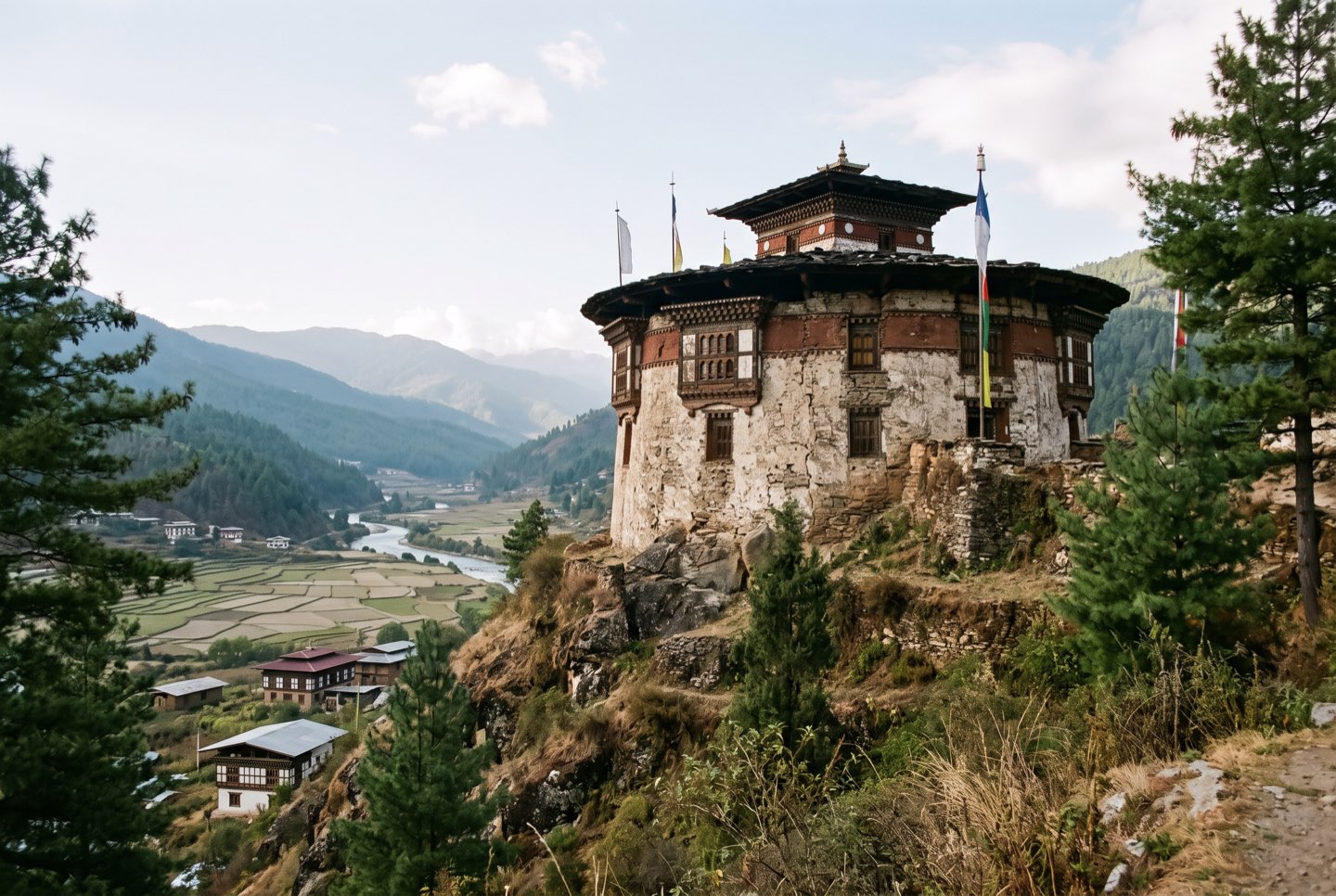 Ta Dzong, the old stone watchtower on the hill above Paro, in the morning light.
Look up from Paro town and you will see one more piece of the story, the stone watchtower of Ta Dzong, keeping its watch over the valley. One caution on the table: 1641 is the Thimphu district’s date for the original Tashichho Dzong, and we found no official page on anything older on the site.
Why does 17 December matter?
Because the Constitution names it National Day, and it is also the date written into the story of the throne. The Constitution sets National Day on 17 December each year. It also says that the title to the Golden Throne vests in Ugyen Wangchuck’s descendants as enshrined in “the inviolable and historic Gyenja” of a day it gives as 17 December 1907. The Constitution does not explain the choice, but the two dates are the same.
If December falls inside your plans, the tentative 2026 list on the Department of Tourism’s website has the Druk Wangyel Tshechu at Dochula on 13 December and the Trongsa Tshechu on 17–21 December, as our guide to Bhutan’s festivals sets out. Tentative dates can move with the lunar calendar, so we reconfirm them for you. Tell us the month and we will tell you which of these places you would be standing in.
Frequently asked questions
Why do sources give different dates?
Because much of the early record is tradition, and each official page decides how precisely to state it. The embassy gives a year for Guru Rinpoche; the Department of Tourism gives a century. When a guide names a date on the road, ask where it comes from. It makes good conversation.
Did the 2008 change end the monarchy?
No. The Constitution states that the form of government is a Democratic Constitutional Monarchy, that the Druk Gyalpo is head of state and symbol of unity, and that sovereign power belongs to the people of Bhutan.
Why does the Constitution mention Punakha Dzong?
Because it says the successor to the Throne shall receive dar, a ceremonial scarf, from the Machhen of Zhabdrung Ngawang Namgyal at Punakha Dzong, and be crowned on the Golden Throne. The Constitution’s own glossary defines the Machhen as the holy relic of the Zhabdrung, who unified Bhutan in the 17th century.
Why do Bhutanese dates come with animals?
Because the traditional calendar names years for an element and an animal, and its months follow the moon. The Constitution dates its own adoption to the fifteenth day of the fifth month of the Male Earth Rat year, corresponding to 18 July 2008, and the 1907 Gyenja to a day in the Earth Monkey year. It is also why festival dates shift every year.
Ten dates are enough to start with. Bring them to the courtyards, keep the rest for your guide, and let the walls do the remembering.