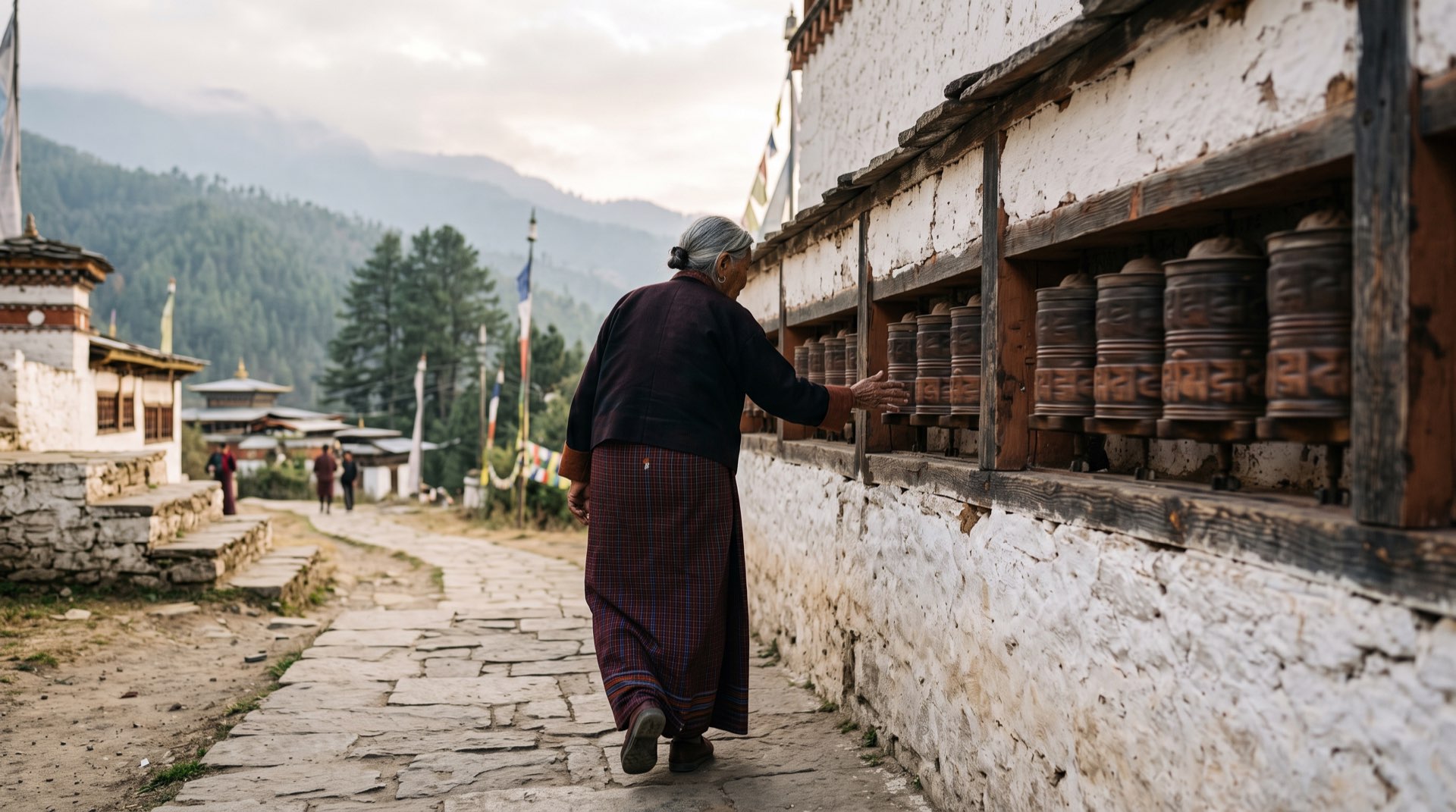
Stand at the National Memorial Chorten in Thimphu soon after sunrise and you’ll understand what we mean by living culture. Older women in woollen kiras, the ankle-length national dress, walk slow circles, prayer beads slipping through their fingers. Children in smart miniature versions squeeze in a quick round before school. A big prayer wheel creaks on its axle, and a bell rings each time it comes round.
Nobody is performing for you. That is the wonderful part, and also the slightly daunting one. You may worry that you’ll spend your journey surrounded by meaning you can’t read, or that you’ll walk the wrong way round something sacred. (Most people do, once, and we’ll gently turn you round.)
So think of this as the friend at your elbow, explaining in plain English what you’re looking at, and why it matters to the people around you.
| At a glance | Detail | Source |
|---|---|---|
| Dzong | Fortress-monastery; Paro’s houses the district’s monks and its government offices | Paro Dzongkhag Administration |
| Chorten | A stupa, walked around clockwise | Thimphu Dzongkhag Administration |
| Lungta | “Wind horse”: prayer flags whose prayers the wind is believed to carry | Department of Culture |
| Gho and kira | The national dress for men and women, worn every day | Department of Tourism |
| Zorig Chusum | The 13 traditional arts and crafts | Department of Tourism |
| Dzongkha | The national language | Constitution of Bhutan |
| Checked | 27 September 2026 |
Why does Bhutan’s culture feel lived rather than displayed?
Because almost all of it is still in daily use. The fortress you tour in the morning is someone’s office. The robe the man at the next table is wearing is what he put on at home. As Bhutan’s Department of Tourism puts it, faith here isn’t only a once-a-year festival: it’s the morning offering at the family altar, a glance at the newspaper for an auspicious day, and a few rounds of the local chorten in the evening.
Even the law treats culture as something alive. The Constitution asks the state to protect dzongs, temples, language and the arts, and in the same breath calls culture an evolving, dynamic force.
Think of this page as the map. When you want the detail, we’ve written companion guides to dzong and temple etiquette, to Bhutan’s beliefs, decoded (yes, including the painted phalluses), to eating well in Bhutan and to Gross National Happiness.
What is a dzong?
A dzong is a fortress, a monastery and a district office in one. The Department of Tourism notes that the Zhabdrung (more on him below) first built them for both security and administration, and they still do double duty. Paro’s Rinpung Dzong, whose name means “Fortress on a Heap of Jewels”, is home to the district’s monastic body and the government offices of Paro, according to the Paro Dzongkhag Administration.
You’ll learn to read them quickly. Tall whitewashed walls lean gently inwards. A central tower, the utse, rises from a stone courtyard where the great religious festivals are danced. A broad red band near the roofline marks the building as sacred.
What surprises first-timers is the traffic. Officials in gho hurry across the courtyard with folders, young monks cut past in maroon robes, and a low chant drifts down from somewhere above. Some rooms are closed to visitors because people are working or praying in them. Dress as you would for a place of worship that is also a government office; our etiquette guide covers the rest.
What do chortens, prayer flags and prayer wheels mean?
All three are everyday acts of devotion. Bhutanese believe that walking round a chorten, hanging a flag or turning a wheel brings merit (good karma) and sends blessings out to all living beings.
A chorten is a stupa, a whitewashed shrine. Thimphu’s Memorial Chorten, the Thimphu Dzongkhag Administration explains, represents the mind of the Buddha, and people walk around it clockwise, spinning its prayer wheels and praying.
Prayer flags are called lungta, “wind horse”. The Department of Culture describes them as printed with prayers and hung high so the wind can carry the blessings across the land, in five colours for the five elements. You’ll see them on passes, bridges and rooftops.
Prayer wheels are drums packed with written prayers. Bhutanese believe turning one brings the same benefit as reciting the prayers inside. Some turn by hand, others by streams or the wind.
The one rule is to go the way everyone else goes: clockwise, sacred thing on your right. If you notice a steady stream of smiling grandmothers coming towards you, you know what to do.
Who were Guru Rinpoche and the Zhabdrung?
They are the two names you’ll hear most often. Guru Rinpoche, also known as Padmasambhava, is the eighth-century tantric master whom Bhutanese tradition credits with bringing Buddhism to these valleys. The Zhabdrung, Ngawang Namgyal, arrived from Tibet in 1616 and unified the country as one nation, according to the Department of Tourism.
Guru Rinpoche’s story is written into the landscape. Tradition holds that he flew to the Tiger’s Nest cliff on the back of a tigress to meditate there (our guide to the Tiger’s Nest hike covers the practical side). The great tshechu festivals honour him with masked dances; tshechu means “tenth”, for the day of the lunar month that tradition links to him.
The Zhabdrung’s legacy is more political, and just as present. He built the first dzongs, and his sacred remains rest in Punakha Dzong. The Constitution still requires each new king to receive a ceremonial scarf there, from those remains, before he is crowned. Our guides tell both stories far better than a page can.
What are the 13 traditional arts?
They are the skills behind almost everything you’ll admire here, known together as Zorig Chusum, the thirteen arts and crafts. The Department of Tourism counts sculpture, carving and needlework among them; the rest are painting, wood turning, carpentry, masonry, paper-making, bronze casting, blacksmithing, gold and silver work, bamboo work and weaving.
These aren’t museum crafts. Young people still train in them at the National Institute for Zorig Chusum in Thimphu, and a royal decree of 1998 requires new buildings to follow traditional rules, so the painted beams and carved windows keep coming.
Weaving is the art you’ll meet most often. On a backstrap loom, the weaver sits with the warp strapped around her waist and leans back to keep it taut. The Department of Tourism singles out Lhuentse’s kushuthara, an intricate silk-on-silk kira fabric, and the Royal Textile Academy in Thimphu shows some of the finest pieces.
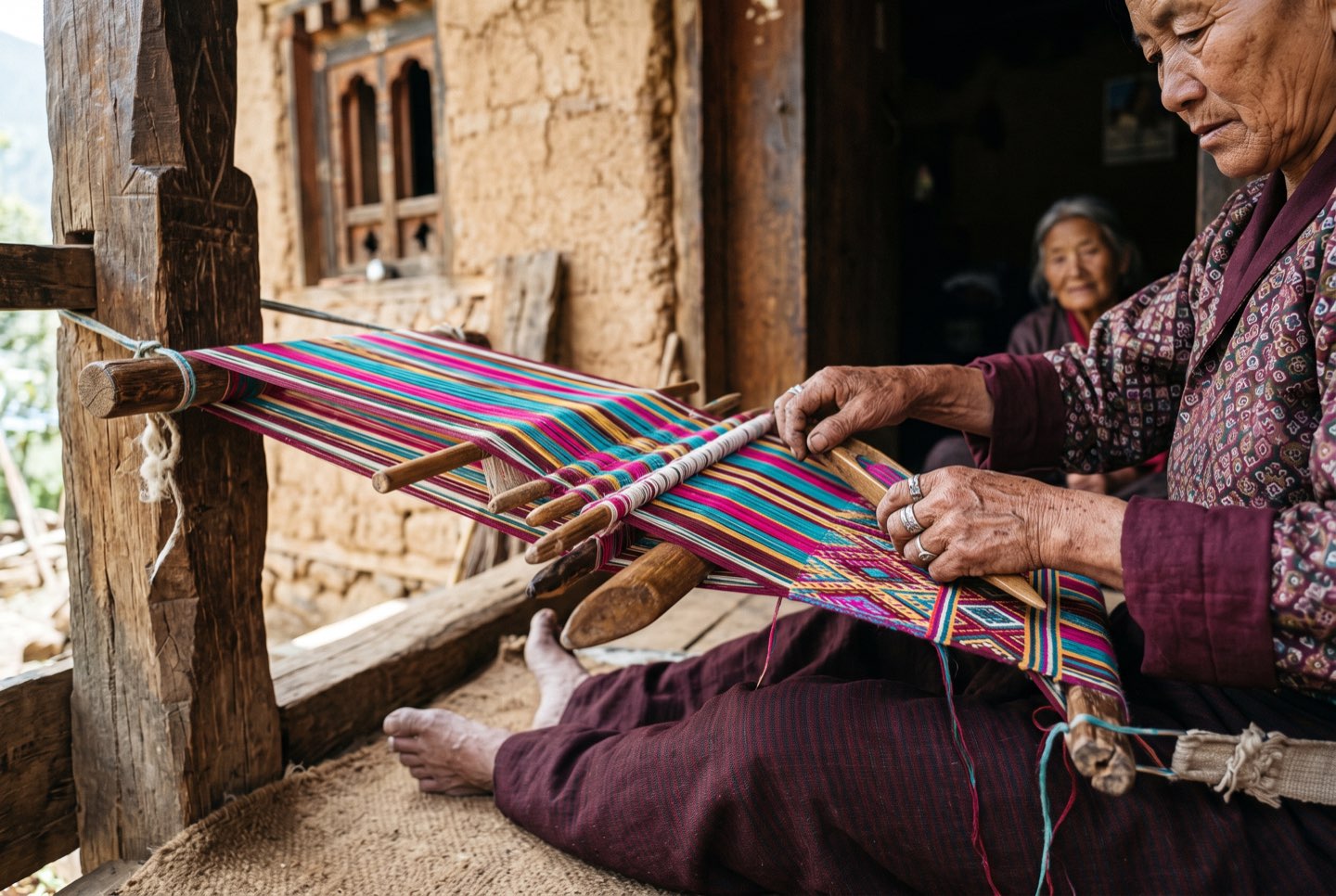 A weaver’s hands at her backstrap loom, bright kushuthara threads in a sunlit farmhouse doorway.
Watch a painter lay down a single, perfect line of gold and you may quietly shelve your plans to try it at home.
Why does almost everyone wear the gho and kira?
Because it is the national dress, and for most Bhutanese it is simply what you put on in the morning. Men wear the gho, a knee-length robe tied at the waist with a woven belt. Women wear the kira, an ankle-length woven wrap, with a short jacket over the top.
The Department of Tourism describes it as part of daily life, from schoolchildren on their way to class to professionals in meetings. The finest pieces come out for weddings and festivals, which is why a tshechu courtyard looks the way it does. When Bhutanese visit a dzong, they add a ceremonial scarf: the kabney for men and the rachu for women. Its colour reflects rank, and the saffron and orange ones belong to the most senior figures in the land.
First-time visitors sometimes wonder whether it’s all put on for tourists. The question lasts about as long as the drive from Paro airport. Should you wear one yourself? Our guide to dzong and temple etiquette answers that.
Where do Gross National Happiness and food fit in?
Both are culture too: GNH shapes how the country is run, and food is where you taste the culture three times a day.
The Department of Tourism traces GNH to His Majesty the Fourth King in the 1970s, and the Constitution directs the state to promote the conditions for pursuing it. It rests on four pillars: good governance, sustainable development, the preservation of culture and the protection of the environment, which is partly why so much of what you’ve read above is protected rather than packaged. Our guide to Gross National Happiness looks at where you’ll actually feel it, and where the picture is more complicated.
Food is the friendlier way in. The dish you’ll meet first is ema datshi, which simply means “chilli cheese”: chillies cooked in cheese, eaten with rice. Suja, butter tea churned with salt, follows close behind. In our kitchens chilli counts as a vegetable rather than a seasoning, so do say if you’d like yours gentle. Our guide to eating well in Bhutan covers the rest, dietary needs included.
Frequently asked questions
Can visitors enter dzongs?
Yes. Visitors can usually enter the courtyards and some of the temples, dressed modestly and with a guide. Hours shift around office work and ceremonies, so we plan each visit around what will be open that day.
Is Bhutan only Buddhist?
No. The constitution names Buddhism as Bhutan’s spiritual heritage, but it also makes the King the protector of all religions and guarantees freedom of religion. Hindu communities live mainly in the south, and major Buddhist and Hindu festivals are public holidays.
What language do people speak?
Dzongkha is the national language; you’ll also hear Tshangla in the east and Lhotshamkha, close to Nepali, in the south. English is widely spoken in towns and by everyone looking after you. Kuzu zangpo la (hello) and kadrin chey la (thank you) earn a smile anywhere.
Why do people walk clockwise?
Walking clockwise, with the sacred place on your right, is the traditional Buddhist way of honouring it. Bhutanese believe each round, like each turn of a prayer wheel, gathers merit, which is why many people fit in a few circuits whenever they pass.
You don’t need to understand everything you see in Bhutan. Arrive curious, walk clockwise, and let the country explain itself one kind question at a time.