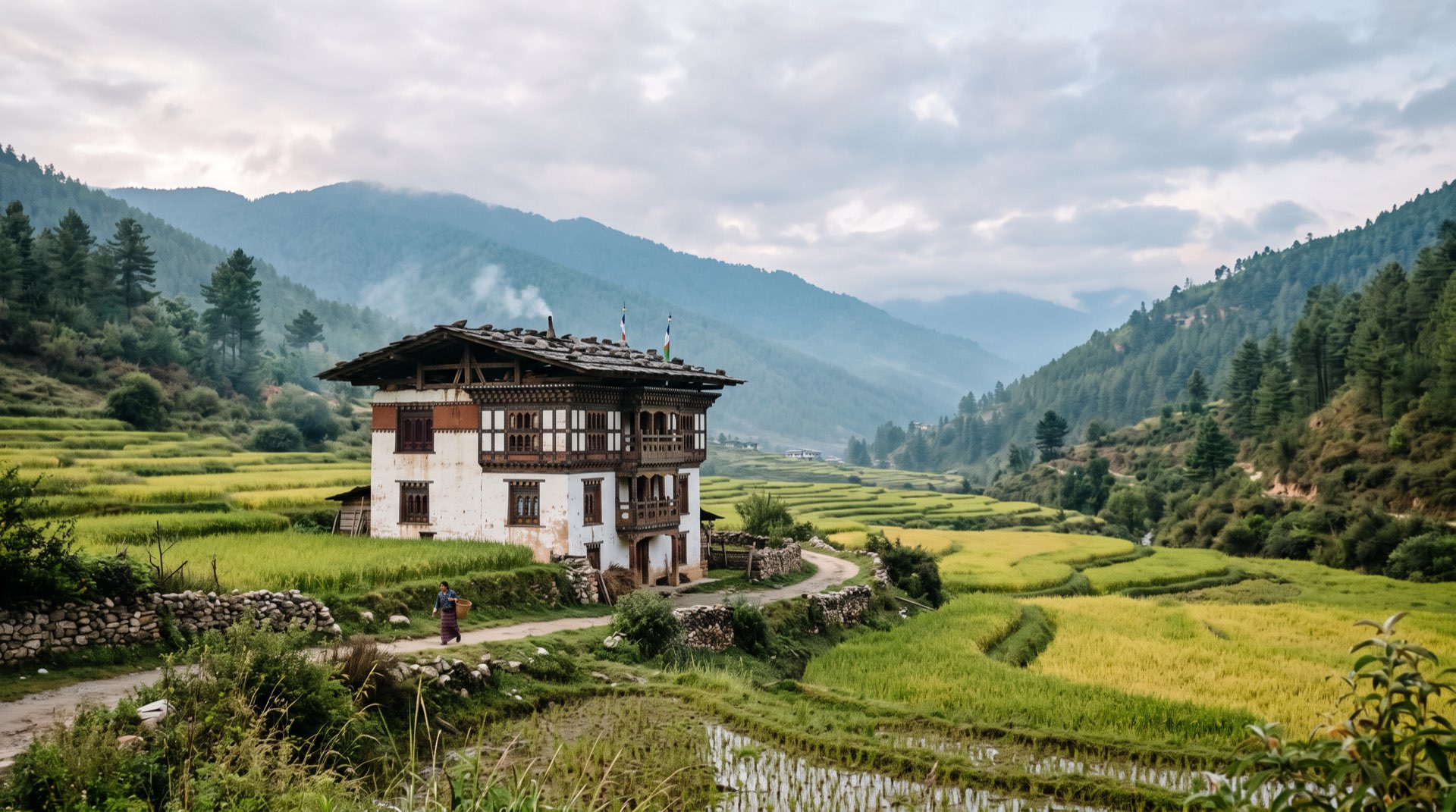
By the fifth farmhouse you have started a game. Whitewashed walls, three floors, wooden windows painted like party invitations, a low roof with stones sitting on it. Then another one, and another. Somewhere near the tenth you lean forward and ask your guide whether everybody in this valley hired the same architect.
Nobody did, and yet the sense of one hand is real. It comes from rules, from rank and from habit, and once you know the key the game changes: you stop asking “why do they all look alike?” and start asking “who lives in that one?”
Here is the key. Along the way we’ll test one famous claim, that dzongs were built without nails or plans.
| At a glance | Detail | Source |
|---|---|---|
| Dzong walls | Whitewashed stone and earth, sloping inwards; a central tower (utse); a red band marks a sacred, important building | Department of Tourism |
| Two faces | Massive battered stone walls outside; carved and painted wood on the inner facades | Bhutan’s UNESCO Tentative List entry |
| Farmhouse | Often three storeys: livestock below, storage and living space above, living quarters and a shrine on top | Traditional Architecture Guidelines |
| Rank | Roof features signified hierarchy and status | Traditional Architecture Guidelines |
| Painting | Traditional painting of features is mandatory; painted copies of carved features are not allowed | Traditional Architecture Guidelines |
| Law | A royal decree of 1998 requires buildings to follow some traditional rules | Department of Tourism |
| “No nails, no plans” | Both stated by the Department of Tourism. “No plans” has engineering support; “no nails” we could not confirm | Department of Tourism |
| Checked | 30 September 2026 |
Why do Bhutan’s buildings all look alike?
Partly by law and partly by hierarchy. The Department of Tourism says a royal decree of 1998 requires all Bhutanese buildings to follow some traditional rules during construction. Alongside the decree sits a rulebook, the Traditional Architecture Guidelines from the Department of Urban Development and Housing. Its foreword worries that modern materials and imported labour were eroding traditional building, and it sets out which features belong on which kind of building.
But “alike” hides variety. The same Department of Tourism page describes rammed-earth, mud and timber houses in the west, houses of thick stone slabs in the east and thatched bamboo houses in the warm south. Even inside one style the rules change with rank: a farmhouse and a dzong share a vocabulary, but not the same sentences.
That is the difference you will start to see, and it is one more way Bhutan’s living culture shows up in daily life rather than only at festivals.
How do you read a dzong?
From the outside in. A dzong is a fortress-monastery and government office in one, and Bhutan’s own UNESCO Tentative List entry describes the pattern. Rectangular ranges of rooms enclose a flat stone-paved courtyard, and a towering central structure, the utse, stands inside it, holding shrines of guardian deities and Buddhist masters. The dzong presents two faces: high, massive, inward-sloping stone walls outside, and an inner face of sophisticated timberwork with carving and painting.
The Department of Tourism adds a single large fortified door and whitewashed walls, and a red band along the top that marks the building as sacred. The guidelines call that band the kemar and say it is permitted only on dzongs and monasteries. Site matters too: UNESCO’s entry notes dzongs stand on hilltops or where rivers meet, for strategic reasons.
Tashichho Dzong lets you check all this by eye. The Thimphu Dzongkhag describes its whitewashed walls, golden roofs and painted wooden windows. Our guide to dzong and temple etiquette covers how to behave once inside.
What is inside a traditional farmhouse?
Animals below, people above and a shrine at the top. The guidelines describe family homes as frequently three storeyed: livestock on the ground floor, storage and sometimes living space on the second, living quarters and a shrine on the third. Above that sits an open space beneath the roof for storage. The guidelines say that space is usually kept open for storage, and the Department of Tourism mentions chillies and crops drying in the attic. (Our guide to eating well in Bhutan explains why they matter so much.)
The roof is simple and clever. The guidelines say boulders laid over lath hold the wooden shingles down, with traditional pitches of just 12 to 15 degrees. A mud-plastered panel over a bamboo mat, set between timber frames, is a traditional infill. And because the terrain is steep, houses usually stand scattered or in clusters rather than in rows. So when you sit down to tea or lunch in a farmhouse, remember the layout around you: animals underfoot, harvest overhead and the family’s shrine on top.
What do roofs, windows and painted symbols tell you?
Status, first. The guidelines say roof features signified rank in society. The highest is the jabzhi, a square lantern-like roof, reserved for dzongs, monasteries, temples and royal buildings; crowning it is the sertog, the highest ornament of all, allowed only on dzongs, monasteries and royal buildings. A second, raised roof over the main one was historically said to suit a senior official or someone of high social ranking.
Windows are the second clue. The guidelines reserve the grand window fronts with many openings for dzongs and monasteries, and they permit a plain narrow window without cornices only on stores and toilets, which tells you where the builders saved the decoration.
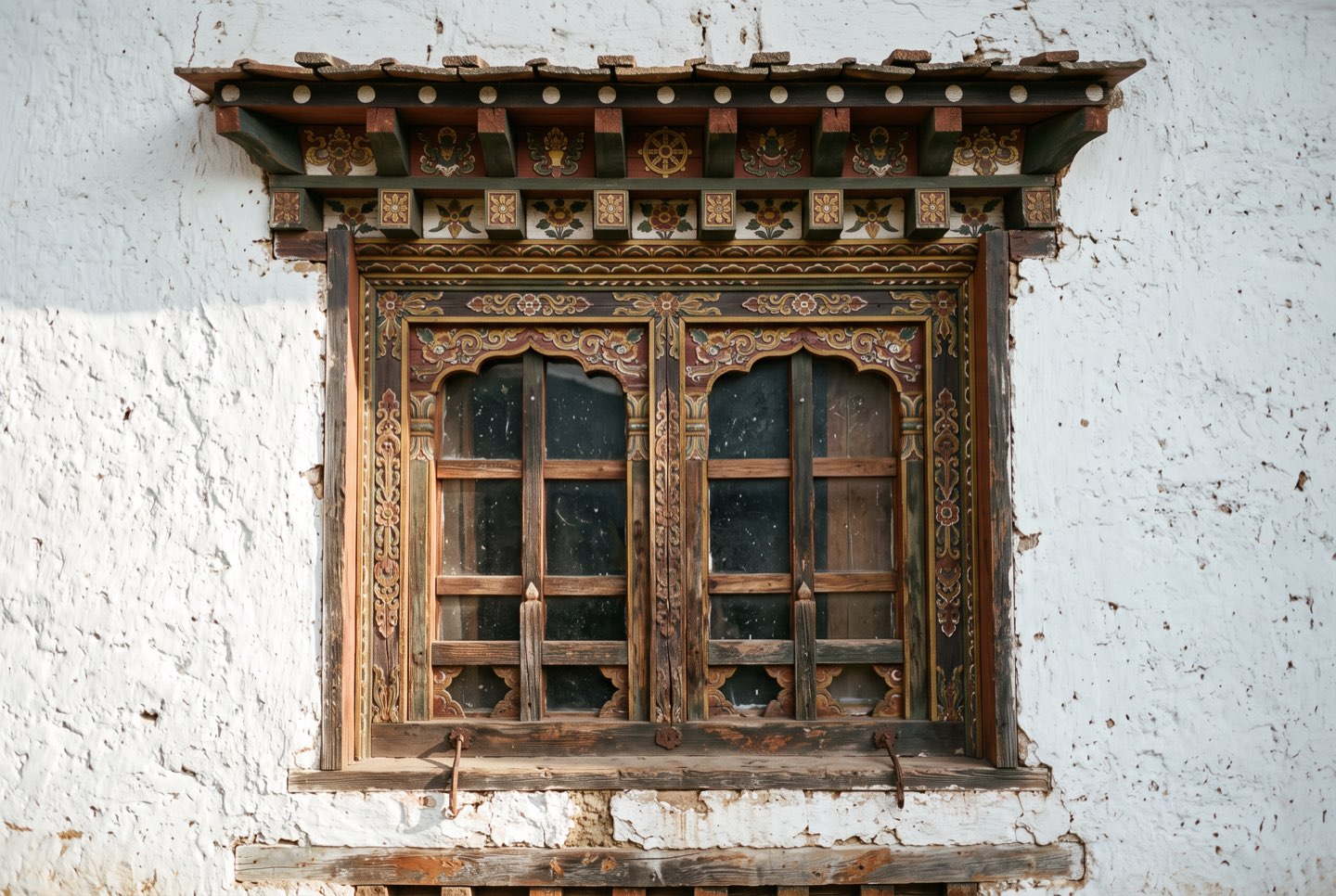 Painted wooden window frames beneath a carved cornice on a whitewashed wall, in raking side light.
Painting is the third. The guidelines make traditional painting of architectural features mandatory “as per entitlement”, and they rule out using paint to imitate features. In other words, decoration should decorate a real feature, not stand in for one. Painted figures on walls are another layer of meaning, and we’ve unpacked the best-known in Bhutan’s beliefs, decoded.
Are dzongs really built without nails or plans?
Half of it holds up, and half we could not confirm. The Department of Tourism’s culture page says Bhutanese architecture is made without nails or iron bars, and that most dzongs were made without any written plans or designs. Many travel pages repeat the line.
“No plans” is the sturdier half. A 2018 engineering paper from the Royal University of Bhutan’s College of Science and Technology says traditional buildings were raised by skilled craftsmen with no plans drawn on paper, the knowledge passed on through practice. The guidelines say much the same about building skills being learnt orally and on the job. That is not the same as having no design, only no drawings.
“No nails” is another matter. The guidelines don’t mention nails, and neither does Bhutan’s UNESCO entry or the engineering paper. Dzongs have also been rebuilt: the Department of Tourism says many were ravaged by fire, and UNESCO’s entry notes that renovation and expansion work is still traceable, so what stands today is not always the first timber. Treat “no nails” as a tradition about how the great builders worked, not as a rule, and ask your guide what they have heard. It may be a good conversation.
What do the official guidelines require today?
A code of rank and use, applied with some give. The guidelines set out “entitlements”, known as thopthang, which say which features a building may carry. A table lists which traditional details are permissible or required in contemporary buildings, and the conclusion concedes it may not be practical to enforce true entitlement on every new building, since buildings have grown from three storeys to five.
Two other points matter. Structural stability must count for as much as looks, because Bhutan lies in a sensitive seismic zone, and the book is meant to be used alongside the Bhutan Building Rules. And the copy on the ministry’s website carries no printed date: it refers to documentation published in 1993 and is dedicated to the Fourth King, and the file’s own properties say March 2012. Treat it as a long-standing baseline, not a current statute, and check the present rules before you rely on a detail.
Which buildings should you look at first?
Start with three. Tashichho Dzong in Thimphu shows a dzong’s public face, with its golden roofs and painted windows. Punakha Dzong stands where the Pho Chhu and Mo Chhu rivers meet, the kind of strategic site UNESCO’s entry describes; on The Soul of Western Bhutan you also cross the traditional cantilever bridge beside it, a design the Department of Tourism says has no vertical supports. Then choose a farmhouse, and go inside.
Bhutan put five dzongs on its UNESCO Tentative List in 2012: Punakha, Wangdue Phodrang, Paro, Trongsa and Dagana. The Zhabdrung, the religious leader who arrived from Tibet in 1616 and unified the country, founded them; our overview of a short history of Bhutan tells that story.
Frequently asked questions
Can I stay in a traditional farmhouse?
Possibly. The Department of Tourism’s FAQ says you may stay only in accommodation it has approved, and describes the range as running from five-star hotels to homestays in traditional village settings. Ask us what is possible on your dates; we don’t promise a specific farmhouse.
Why are there painted symbols on houses?
Many are protective or auspicious. The painted phalluses, the best known, are believed to guard a home from evil spirits and bless it with fertility. The story is in Bhutan’s beliefs, decoded. Treat them as blessings, not jokes.
Are the buildings earthquake-safe?
We can’t certify any building. The guidelines say structural stability must count for as much as looks because of the seismic zone, and the engineering paper above found cracks to be the most prominent defect in the seven rammed-earth houses it surveyed in Paro, calling for a proper code of practice. Ask us about a specific place.
May I photograph people’s houses?
A farmhouse is someone’s home, so ask first, as you would for a portrait. Our guide to dzong and temple etiquette covers the courtesy of asking before you photograph people. Your guide will tell you what is appropriate at the door and ask for you.
Learn six features of a dzong and one rule of a farmhouse, and Bhutan’s buildings stop looking alike and start telling you who lives inside.