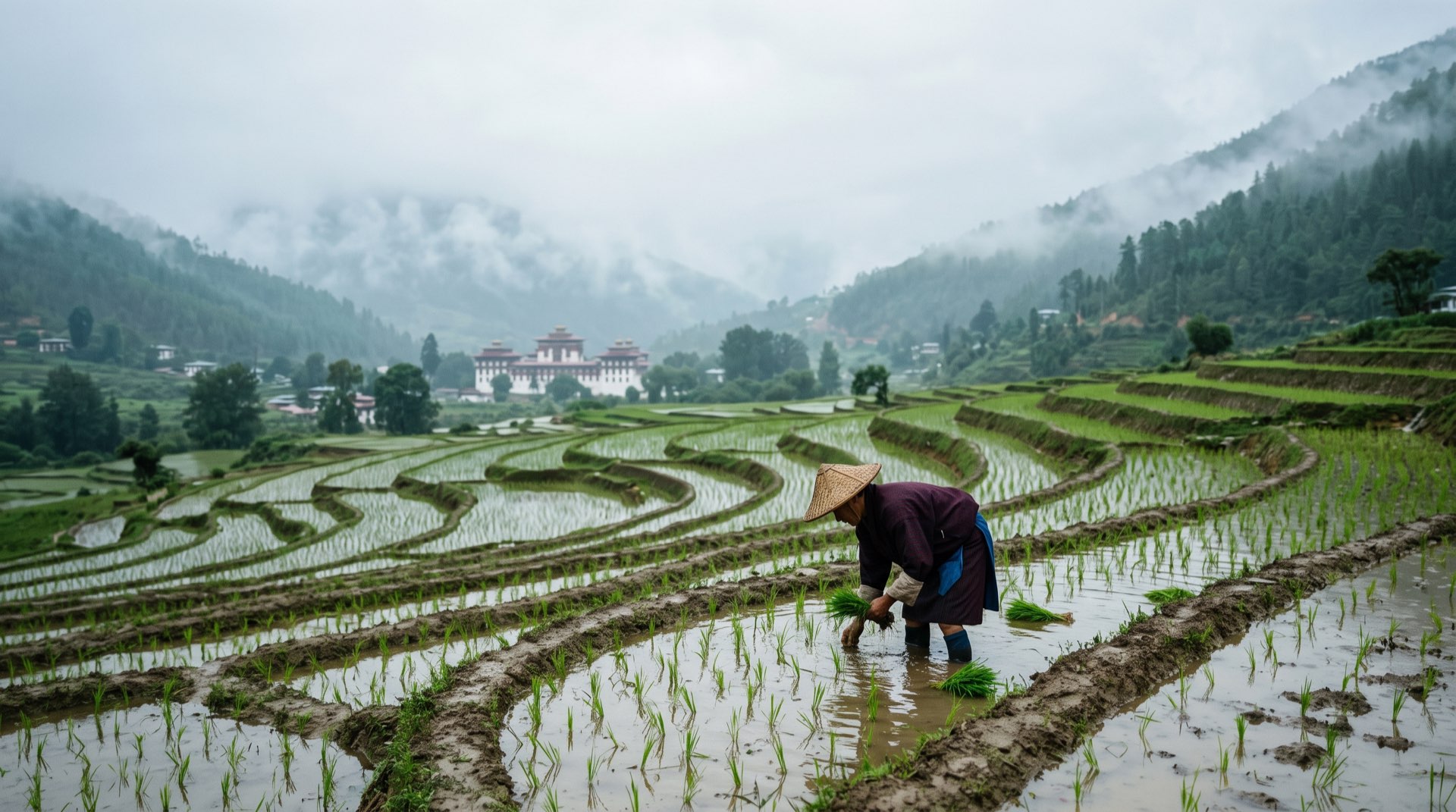
Somewhere above Punakha on a June morning, a cloud is resting on the hillside like a cat that has found a warm spot, and it has no intention of moving. Below it, the rice terraces are a green so bright they almost hum. Farmers are out in the flooded fields, bent over rows of seedlings, and the only sounds are running water and a temple bell further down the valley.
This is Bhutan’s green season, and it is the season people ask us about with the most hesitation. Won’t it rain the whole time? Are the roads safe? Will I see anything at all? Fair questions, every one.
We spend every monsoon on these roads ourselves, so let’s take them one at a time.
| At a glance | Detail | Source |
|---|---|---|
| Summer monsoon | June to September, bringing about 73% of Bhutan’s yearly rainfall | NCHM Climate Atlas |
| Wettest month | July, with a national average of about 460 mm | NCHM Climate Atlas |
| A typical day | Rain for a few hours, then warm days and cool nights | Department of Tourism |
| Roads | Monsoon landslides can cut off some roads for days | UK Foreign Office |
| Summer festivals | Nimalung Tshechu 22–24 June and Kurjey Tshechu 24 June 2026, both in Bumthang | Department of Tourism |
| Haa festival | Now held in spring: the Haa Spring Festival ran 7–9 April 2026 | The Bhutanese |
| Checked | 27 September 2026 |
Is the monsoon a good time to visit Bhutan?
It is, if you value green, quiet and atmosphere more than guaranteed mountain views. Bhutan’s summer monsoon runs from June to September, and according to the National Centre for Hydrology and Meteorology’s climate atlas, it brings about 73% of the country’s yearly rainfall, with July the wettest month. So yes, it rains. That’s the trade.
Here is what you get in return. The valleys turn a deep, glowing green. Rice goes into the terraces in June and grows tall through the summer. Waterfalls run full, the forests smell of wet moss and pine, and with fewer visitors at the dzongs (fortress-monasteries) and temples, the quiet moments come easily.
And here is what you give up. Cloud can hide the high peaks for days. Trails get muddy. Heavy rain can slow the roads and, now and then, a flight. None of this spoils a trip that is planned around it, but flexibility matters more now than in autumn.
Still deciding? Our guide to when to visit Bhutan puts all twelve months side by side.
What does a monsoon day really look like?
Often a bright or softly overcast morning, cloud building by midday and rain in the afternoon or evening. The Department of Tourism notes that summer rain usually falls for a few hours a day, followed by warm days and cool nights, and that matches much of what we see in the western valleys. Some days it barely rains. Some days it rains from breakfast to bedtime, and those are the days for a long lunch.
Our favourite part is the moment after. The rain stops, cloud lifts off the dzong roofs in slow ribbons, and the valley steams gently in the sun. Prayer flags hang heavy and bright. Every roadside stream seems to have something urgent to say.
So we walk and visit viewpoints in the mornings, and save the afternoons for temples, weaving houses, a farmhouse kitchen or a hot-stone bath. Paro and Thimphu feel warm rather than hot; Punakha, lower down, can be properly sticky. A light waterproof and shoes that don’t mind puddles will see you through.
What’s on in summer, and why did the Haa festival move to spring?
Summer is a quiet festival season, and that is part of its charm. The main events are in Bumthang, where the Department of Tourism’s calendar listed the Nimalung Tshechu on 22–24 June 2026 and the Kurjey Tshechu on 24 June. A tshechu is a festival of sacred masked dances, and both are held at temples in Bumthang’s valleys. The 2027 dates follow the lunar calendar and weren’t published when we checked.
You may have read about a Haa Summer Festival. It no longer happens in summer. The festival began in 2010 as a summer event, but The Bhutanese reported that the monsoon had affected access and visitor numbers, so it moved to spring, when the weather is clearer and the rhododendrons are out. The third Haa Spring Festival was held on 7–9 April 2026, celebrating the valley’s highland traditions. Our guide to Bhutan’s festivals covers the whole year.
The rest of summer’s calendar is written by the fields: planting, weeding, and rice growing greener by the week. Honestly, that is often the better show.
How worried should you be about landslides and rain?
Enough to plan for them, not enough to stay home. The UK Foreign Office warns that monsoon rains can cause landslides that cut off some roads for days, advises travellers to check their route before setting off, and suggests avoiding travel at night where possible. We take all of that seriously.
It also helps to know what a typical blockage looks like. Of the 363 roadblocks the Department of Surface Transport recorded in 2023–24, The Bhutanese reported that 306 were minor and typically cleared within 24 hours. Location matters too: the Thimphu regional office reported just 12, while the Sarpang office in the south reported 113.
In practice, that means a delay is far more likely than a drama. We keep long drives to daylight, check the forecast and road reports the evening before, and would always rather wait for a road to clear than push on.
As for umbrellas: we carry them for you, in the car, at every stop. Bhutan’s rain is warm, but it is thorough.
Who does the green season suit?
Travellers who love mist, green and quiet more than big views. In our experience that includes:
- Returning visitors who have seen the peaks and now want to see daily life, with farmers in the terraces and villages at work.
- Photographers who prefer mood to postcards: cloud on the ridges, reflections in flooded fields, wet prayer flags.
- Anyone coming to rest. Long lunches, meditation, hot-stone baths and days with nothing urgent in them are the essence of slow luxury in Bhutan, and summer suits them well.
- Families whose holidays fall in the summer months.
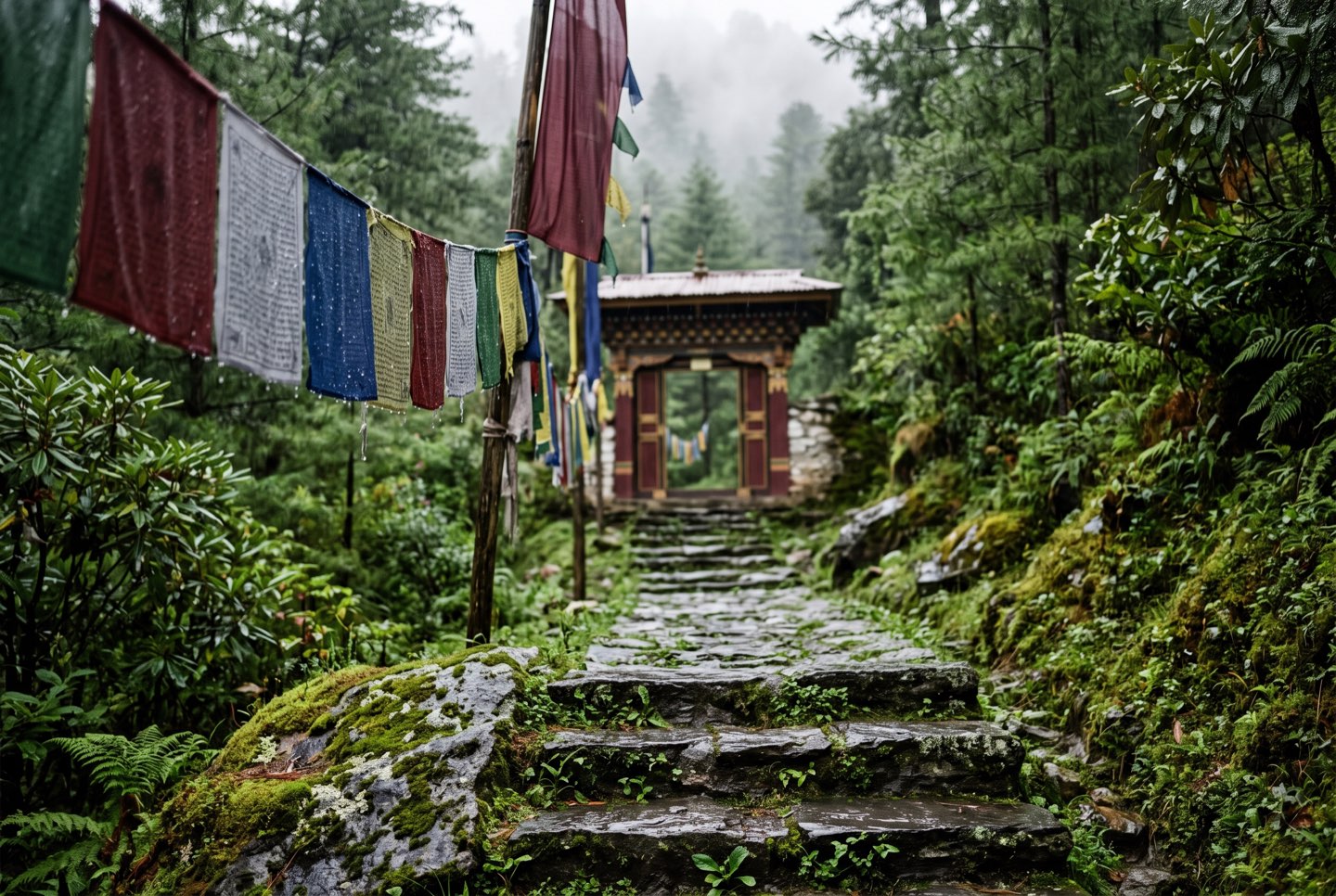 Rain-soaked prayer flags and a mossy stone path leading to a small temple gate.
It suits fewer people if this is your one chance to see the Himalaya from the Dochula pass, if your onward connections are tight, or if a wet day would spoil your holiday. If a rainy afternoon sounds like an excuse for a book and a pot of tea, though, you are exactly our kind of monsoon traveller.
How do we plan around the weather?
By giving every day a plan B and every journey a little slack. A summer itinerary with us usually follows a few simple habits:
- Mornings outdoors. Walks and viewpoints come first, while the paths are driest and the sky is often at its clearest.
- Shorter drives. We favour routes through the western valleys of Paro, Thimphu and Punakha, with less time on the road between stays, and keep longer journeys east flexible.
- Good plans for wet afternoons. Dzongs, craft workshops, a cooking session or a dotsho, the traditional hot-stone bath; our guide to Bhutan’s wellness traditions explains the ritual.
- A spare day at the end. We recommend at least 24 hours between your departure from Paro and any onward connection in every season, and in summer it matters most.
Our month-by-month explorer shows what June, July and August each tend to bring.
Frequently asked questions
Will flights be cancelled?
Sometimes. The UK Foreign Office notes that weather regularly affects flights, and Paro’s airport operates in daylight only, with pilots landing by sight, so low cloud can hold a flight until it lifts. That is what the spare day is for. Our guide to flying into Paro has more.
Can I still hike?
Yes. Lower and mid-level walks work well with an early start, a good waterproof and shoes with grip. Expect mud, slippery steps and, some mornings, a fine view of the inside of a cloud. Our guide to walking in Bhutan has more ideas.
Are there leeches?
Yes, on damp forest trails after rain, though not in towns or temple courtyards. Leech socks, trousers tucked into your socks and a quick check after a forest walk deal with most of them, and we’ll show you how on your first forest walk.
Is it cheaper in summer?
Not in the way people hope. Bhutan’s Sustainable Development Fee, the government’s daily visitor fee, is a flat rate whatever the month, so we’d rather you came for the green than for a bargain. Tell us your dates and we’ll give you a clear quote for them.
Come for the green, stay for the quiet, and let the rain set the pace for once.