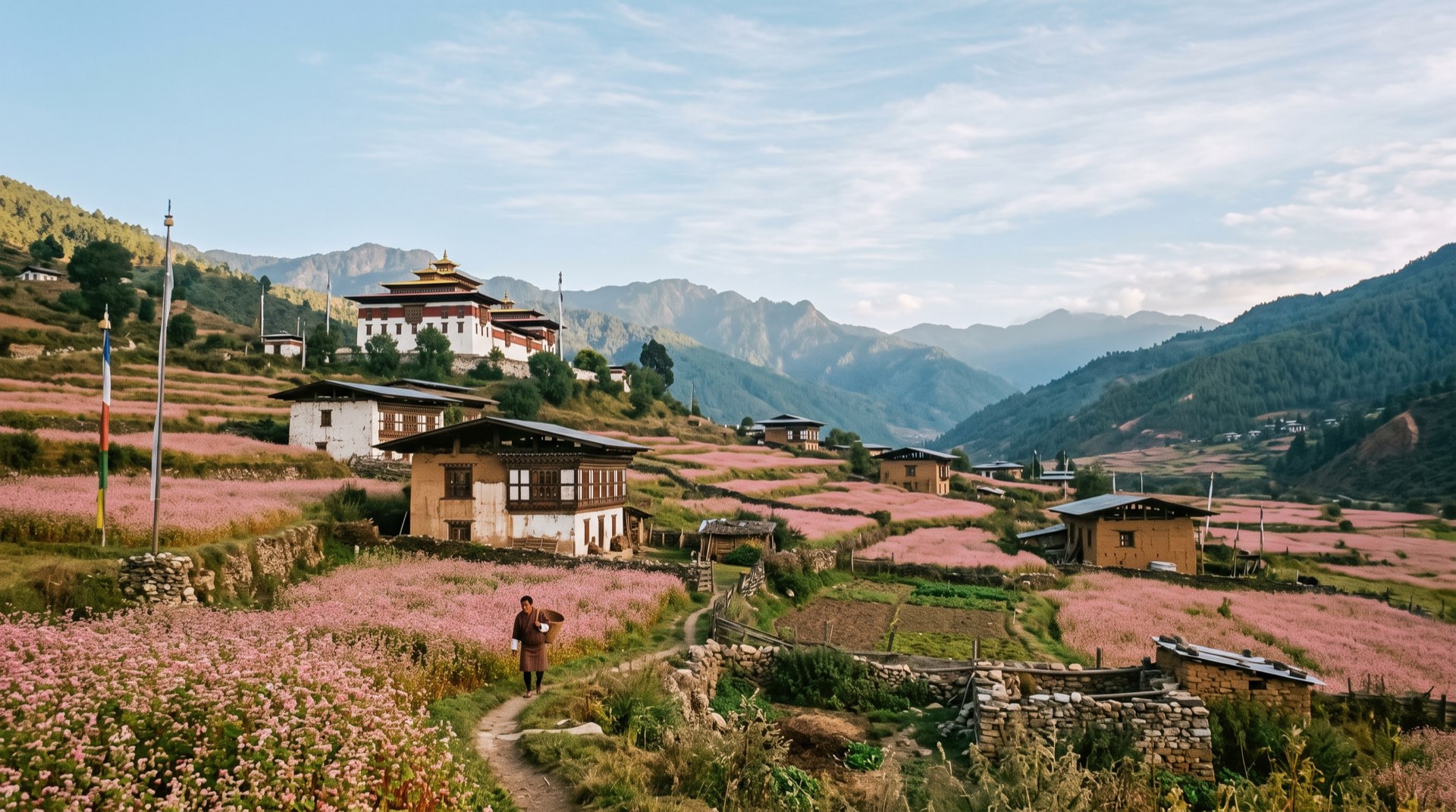
The road east from Bumthang climbs through fir forest hung with pale lichen, and the cloud closes in until the prayer flags on the high pass of Thrumshing La are the only colour in the world. Then the road begins to fall. It keeps falling for what feels like hours, through forest so deep and unbroken that a single farmhouse roof feels like news.
Perhaps you are wondering whether it’s worth it. Whether the long roads east are an adventure or just a lot of sitting. Whether “simpler lodging” is a polite way of saying uncomfortable.
We have been taking guests to Merak and Sakteng since 2009, and our answer hasn’t changed: for the right traveller, this is where Bhutan gets under your skin.
| At a glance | Detail | Source |
|---|---|---|
| Bumthang | Four valleys: Chokhor, Chumey, Tang and Ura | Bumthang Dzongkhag Administration |
| Flights | Paro–Bumthang about 35 minutes; Paro–Yonphula (Trashigang) about 45 minutes; several days a week, weather permitting | Drukair |
| Roads | Mountain roads; monsoon landslides can close some roads for days | UK FCDO |
| Sakteng Wildlife Sanctuary | 740.6 km² in the far east, home to around 4,000 people | Bhutan for Life |
| Drametse Ngacham | An eastern village’s masked drum dance, on UNESCO’s list since 2008 | UNESCO |
| Our first Merak–Sakteng trek | March 2009, on foot from Rangjung | Bhutan Luxury Travel, 2026 |
| Checked | 27 September 2026 |
Why go beyond western Bhutan?
Because beyond the western valleys, Bhutan becomes quieter, more rural and, for many travellers, more moving. You share temples with farmers and pilgrims rather than with other visitors, and the landscape opens out on a scale the west rarely shows you.
Paro, Thimphu and Punakha are the heart of most first journeys, and rightly so. But the country carries on well past them. Bumthang holds some of Bhutan’s oldest temples. Further east lie Mongar and Trashigang, their villages scattered across huge forested slopes. Twice a year, the village of Drametse holds a festival for its masked drum dance, the Drametse Ngacham, which UNESCO has listed as intangible cultural heritage since 2008: sixteen masked dancers, and ten musicians with cymbals, trumpets and drums.
If you have read about Bhutan’s crowds in 2026 and worried about sharing the famous sights, the East is a gentle antidote. It isn’t empty. It is simply lived in, rather than visited.
How long are the drives, and when should you fly?
Long enough to plan around: think in full days rather than hours, and assume the weather gets a vote. Flying one way spares you doing the long drive twice.
By road, journeys east go in stages. From Punakha, our Cranes & the Central Valleys journey stops in Gangtey, then crosses the Pele La (la means “pass”) and passes Trongsa Dzong, a great fortress-monastery, on the way into Bumthang. Beyond Bumthang, the road over Thrumshing La to Mongar is roughly a full day on its own, and Trashigang a shorter drive further. Weather and roadworks can stretch all of it.
The UK’s Foreign, Commonwealth & Development Office warns that monsoon rains can cause landslides that cut off some roads for days, and advises avoiding night driving. We plan road days to finish in daylight.
Or take to the air. Drukair’s published schedules for autumn 2026 show flights from Paro to Bumthang of about 35 minutes, and to Yonphula near Trashigang of about 45 minutes, several days a week. Schedules change and mountain flights depend on the weather, so we always keep a road plan in reserve.
Pack patience, a good playlist and something for motion sickness. The road supplies the views.
What is Bumthang like?
Bumthang is Bhutan’s spiritual heartland: four high valleys of temples, farms and buckwheat fields, and the natural first stop for anyone heading east.
Bumthang’s district administration calls it “the spiritual and eco-cultural heartland of Bhutan”, and it is made up of four valleys: Chokhor, Chumey, Tang and Ura. In Chokhor stands Jambay Lhakhang, a temple (lhakhang) that tradition dates to the seventh century. Nearby is Kurjey Lhakhang, named for the imprint of his body that Guru Rinpoche, the saint at the heart of so many of Bhutan’s sacred stories, is said to have left in the rock where he meditated. Bhutan’s first three kings rest there too.
Festivals bring the valleys to life. In 2026 the Jambay Lhakhang Drup falls on 26–29 October, and our calendar of Bhutan’s festivals has the rest.
Bumthang is, for now, as far east as Bhutan’s luxury lodges go, and our Cranes & the Central Valleys journey spends three nights here. The valley is also known for its honey, cheese and apples. After the drive in, you will have earned all three.
What is travel in the far east like?
Warm, rural and simpler: the welcome is generous, the lodging is comfortable rather than five-star, and the days on the road are long.
Beyond Bumthang, hotels are smaller and plainer. We choose rooms for warmth, hot water, cleanliness and a view, and we tell you honestly what to expect before you decide. What you give up in spa menus you gain elsewhere: tea in a farmhouse kitchen, a loom clacking on a veranda, a village festival where you may be among very few visitors. In 2026 the tshechus (annual temple festivals) of Mongar and Trashigang both fall in mid-November.
Expect simple menus and long lunches, often a picnic with a view. And expect the phone signal to have its own opinions on the mountain roads.
None of this is roughing it. The care behind each night is the same as in the west; the East simply asks you to trade a little polish for a great deal of character.
What are Merak and Sakteng like?
They are the highland villages of the Brokpa, a herding community of Bhutan’s far east, and for us they are where a very special part of our story began.
Both lie within Sakteng Wildlife Sanctuary, which Bhutan for Life describes as 740.6 km² in the far east, home to around 4,000 people who raise yaks, sheep and dzo (yak–cow hybrids). The Merak–Sakteng loop is the longest trekking route inside the sanctuary.
In March 2009, with special government approval, we led the first British trekking group officially allowed into Merak and Sakteng. Roads hadn’t reached them yet, so the journey began on foot from Rangjung in Trashigang. You can read more in our story.
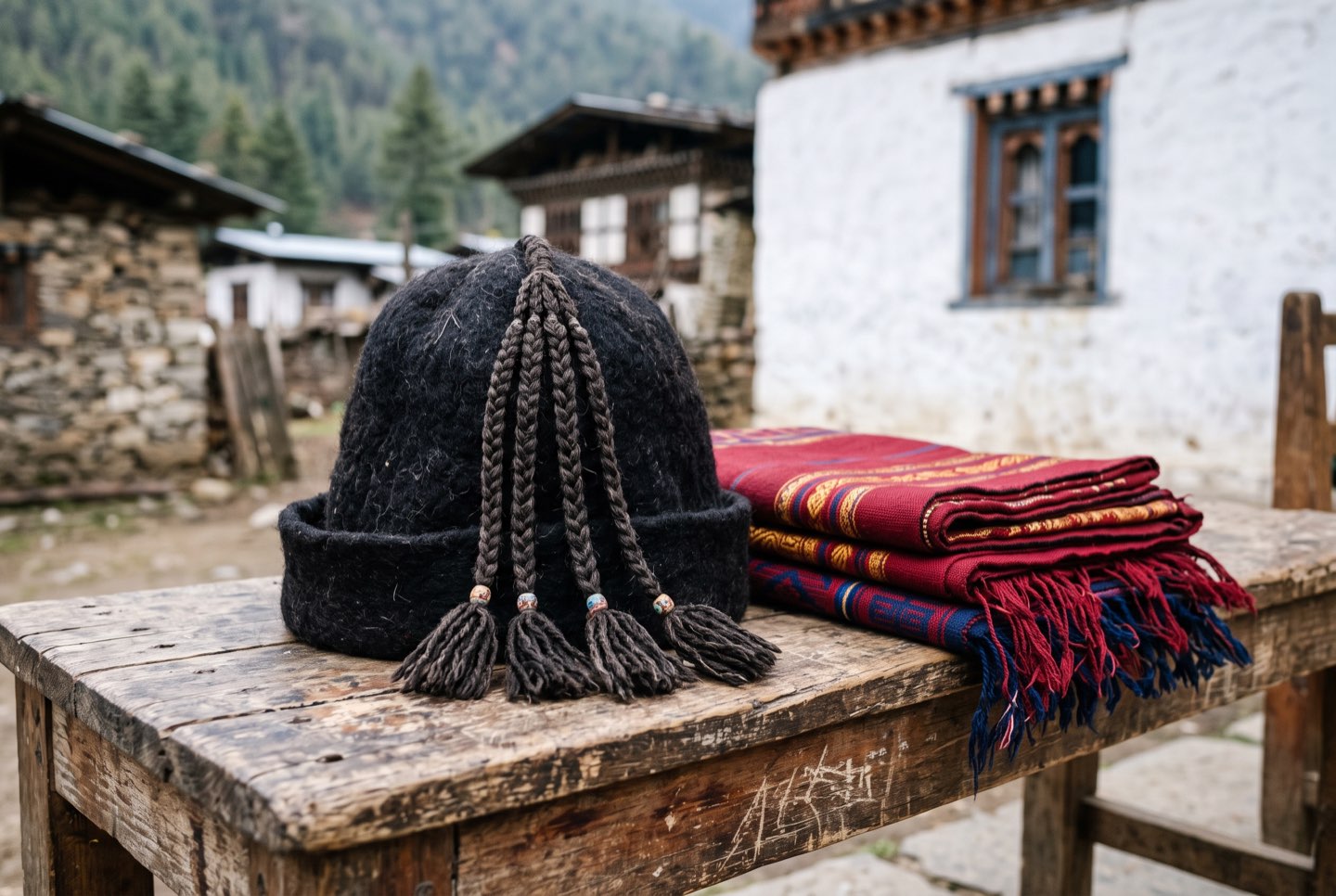 A Brokpa hat of felted yak hair, resting beside folded handwoven cloth in the cool highland light.
Roads have since arrived. Bhutan’s broadcaster BBS reported in December 2023 that the drive from Rangjung to Sakteng took almost four hours, with the last 17.5 km rough and bumpy. Walking between the villages is still the way we love to do it, through yak pastures and high forest. In its season you may even meet a blue poppy known only from this region, which we describe in a naturalist’s Bhutan.
Who is eastern Bhutan for?
Returning travellers, curious walkers and anyone who values people and landscape over thread counts.
It suits you if you have already seen the west, or if Bhutan is less a box to tick than a place you want to understand. It suits keen walkers, textile lovers, birders and photographers, and families with older children who like a little adventure. And it suits anyone whose idea of luxury is a view nobody else is photographing.
It is probably not for you on a first, short trip, or if long days in a vehicle make you miserable, or if a five-star room every night matters more than what lies outside it. That isn’t a judgement. It’s honest planning, and we would rather say so now than on day nine.
For gentle days on foot along the way, see our guide to walking in Bhutan.
How do you combine east and west?
Travel one way by road and the other by air, so you watch the country change without doing every bend twice.
The simplest version adds Bumthang to a western journey: drive east through Punakha and Gangtey, then fly back to Paro when the schedule allows. The fuller version keeps going, through Mongar to Trashigang and, if you wish, up to Merak and Sakteng, before flying back west from Yonphula.
Either way, we place the best-known western sights at the start or the end, keep a rest day after the longest drives, and leave slack for the weather. If a festival is the reason for your dates, we build the route backwards from it. More days and more road do change the shape of a budget, and our guide to what a luxury Bhutan journey costs explains the building blocks.
Frequently asked questions
Is eastern Bhutan safe?
Yes. The UK’s travel advice describes crime levels as low across Bhutan. The thing to respect is the terrain, and your guide and driver are with you every day.
Are there luxury hotels in the East?
Not in the five-star sense beyond Bumthang. Expect clean, comfortable local hotels, and simpler still on the Merak–Sakteng trail, where our trek crew makes the difference. Our guide to choosing Bhutan’s luxury lodges covers the lodges further west.
How long do I need?
For Bumthang, allow at least three nights on top of a western journey. For the far east, including Merak and Sakteng, think in terms of two weeks or more; our guide to how many days in Bhutan helps you decide.
Do I need extra permits?
Nothing for you to arrange. The Department of Tourism says visitors no longer need a route permit to travel around the country, as long as a certified guide is with them. If a trek needs anything extra, we arrange it with your itinerary, so the main thing is to settle your route early.
The East asks for a few more days and a little more patience. It gives back a Bhutan that feels entirely your own.