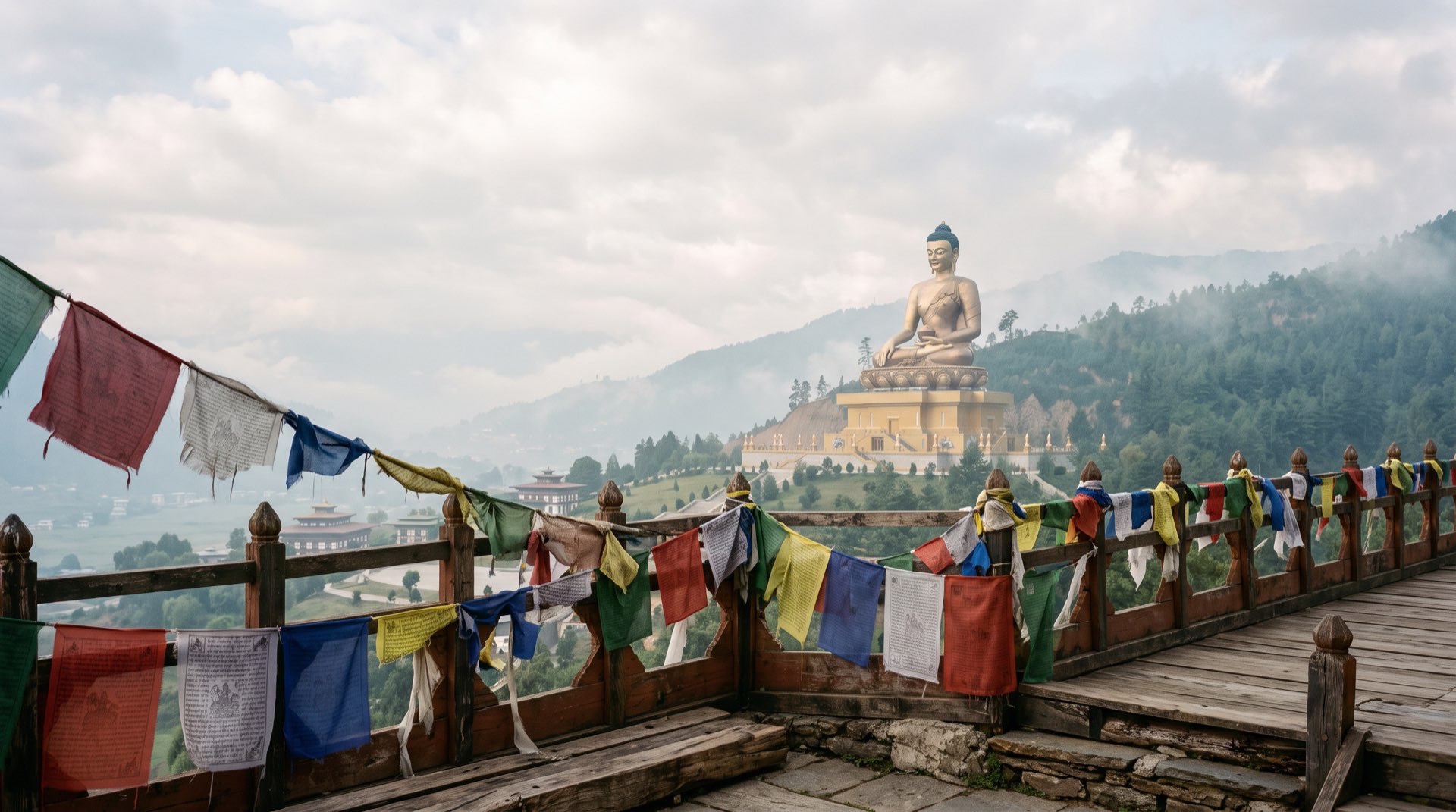
“Capital” is not usually the word that sells a trip. It suggests traffic, concrete and a hotel near a roundabout. Then someone mentions that Bhutan has no traffic lights at all, and you become curious and mildly suspicious in equal measure.
Thimphu is small, hilly and stubbornly unhurried. It is also the one place on most itineraries where old and new Bhutan share a pavement (our introduction to Bhutan’s living culture explains the old half): a gilded Buddha over the valley, a fortress-monastery where the King has his offices, and cafés where people in gho and kira, the national dress, check their phones. It rewards visitors who give it time and punishes anyone who tries to see it all before lunch, so here is how long to give it, what to see, and what to leave for another visit.
| At a glance | Detail | Source |
|---|---|---|
| From Paro airport | About 55 km on our itinerary (the Department of Air Transport gives 54 km), 1–1.5 hours by road | Bhutan Luxury Travel, 2026 |
| National Memorial Chorten | Built in 1974 in memory of the Third King | Thimphu Dzongkhag |
| Buddha Dordenma | 54 m tall, completed September 2015, holds more than 125,000 smaller Buddhas | Thimphu Dzongkhag |
| Tashichho Dzong | First built in 1641; the King’s offices; the monk body’s summer home | Thimphu Dzongkhag |
| Hours | Most monuments open 9 am–5 pm daily; we confirm each one | Department of Tourism |
| Guide | Required to enter monuments and dzongs | Department of Tourism |
| Entry fees | Revised more than once in recent years, so we quote none; monument fees are included on our journeys | Bhutan Luxury Travel, 2026 |
| Traffic lights | None anywhere in Bhutan | UK Foreign Office |
| Checked | 30 September 2026 |
Is Thimphu worth your time, and how many days?
Yes, and our default is one full day plus a soft landing. The capital is about 55 km from the airport, an hour to an hour and a half by road, so it is a natural first stop after flying into Paro. On The Soul of Western Bhutan, day one is the drive, a check-in and private tea overlooking the valley as the light softens. Day two is the city itself. Day three is the road over the Dochula pass to Punakha.
Add a second day if craft schools, museums or a longer walk appeal, so nothing has to be squeezed. Give Thimphu three days and you are probably here for a festival; Paro Tshechu or Thimphu Tshechu compares the two.
What you get in return is the country as it lives now. Fewer places, done properly, is the heart of slow luxury in Bhutan, and Thimphu rewards it.
What are the essential sights?
Three sights make nearly every list. Two are sacred landmarks, and the third, Tashichho Dzong, gets its own section below.
The National Memorial Chorten was built in 1974 in memory of the Third King, Jigme Dorji Wangchuck. The Thimphu Dzongkhag Administration says it holds sacred relics, texts and images rather than human remains, and that locals and visitors circle it clockwise, spinning its large prayer wheels. Go and simply walk the circle for a while. You will find the pace contagious.
The Buddha Dordenma stands 54 m (177 ft) tall on a hill in Kuenselphodrang Nature Park, gilded bronze looking down the valley. The Dzongkhag says it holds over 125,000 smaller Buddhas inside, was completed in September 2015, and was commissioned to mark the Fourth King’s 60th anniversary and to fulfil an ancient prophecy believed to bring peace and prosperity. If you would like the faith behind all this, start with Buddhism in Bhutan.
A word on tickets. The Department of Tourism’s FAQ says most monuments are free and some are chargeable, though the department’s own list of museums and monuments, linked from that FAQ, marks most of the Thimphu sites it names as chargeable. Which sites charge, and how much, has changed more than once: the national broadcaster BBS reported a rise in July 2022 and a partial reversal in March 2023. We would rather not print a number that may be out of date by the time you read it. On our journeys, monument fees are included.
When can you visit Tashichho Dzong, and why does the monk body’s calendar matter?
Later in the day than you might expect, and it pays to confirm the window, because the dzong is in daily use. It is a working seat of government: the Dzongkhag says it was first built in 1641 by the Zhabdrung, largely shaped into its present form by the Third King in the 1960s, and houses the King’s throne room and offices. It is also where the Central Monastic Body spends the summer, moving here from Punakha Dzong each year, and it hosts the Thimphu Tshechu festival.
That seasonal move is why the monks’ calendar matters. The Department of Tourism’s list of museums and monuments, linked from its FAQ and undated, gives the dzong a one-hour window, 5 pm to 6 pm, against 9 to 5 for most sites, plus a 9 to 5 entry marked “PH”, which we take to mean public holidays. How the monks’ stay and the office day combine is not spelled out on any official page we read, so we don’t guess. We confirm the arrangements for your date.
You will admire the whitewashed walls, golden roofs and painted windows more if you know how to read them; see Bhutanese architecture. Dress and photography rules are in our guide to dzong and temple etiquette.
Where can you see traditional arts and textiles?
At the two institutions that teach them. The National Institute for Zorig Chusum, founded in 1971, is open to the public, says the Department of Tourism: you can walk the halls, observe classes and talk to the trainees, and original work made on site is on sale. The Royal Textile Academy is both a training space for aspiring weavers and a conservation centre, with a two-floor museum of permanent and changing textile displays.
Both help you look at everything else more sharply. Day two of The Soul of Western Bhutan includes time behind the scenes with artisans and a quiet audience with a master thangka painter at work, and we confirm which workshops are open on your dates.
If you would like to buy something, our guide to what to buy in Bhutan explains how to check it is genuine and what the export rules stop you taking home.
What is the weekend market like?
A working market rather than a museum piece, and a good place to watch Thimphu shop. The weekend market is on our optional list for the Thimphu day, and the Department of Tourism’s FAQ names the Centenary Farmers’ Market among the places visitors enjoy shopping. Expect the produce of the valleys: vegetables, chillies by the basketful and cheese, the ingredients of Bhutan’s national dish (our guide to eating well in Bhutan has the full story).
Here is the catch. We could not confirm market days or hours on a government page, and travel sites disagree, so we will not print any. We check them for the days you are in Thimphu and build the visit around them.
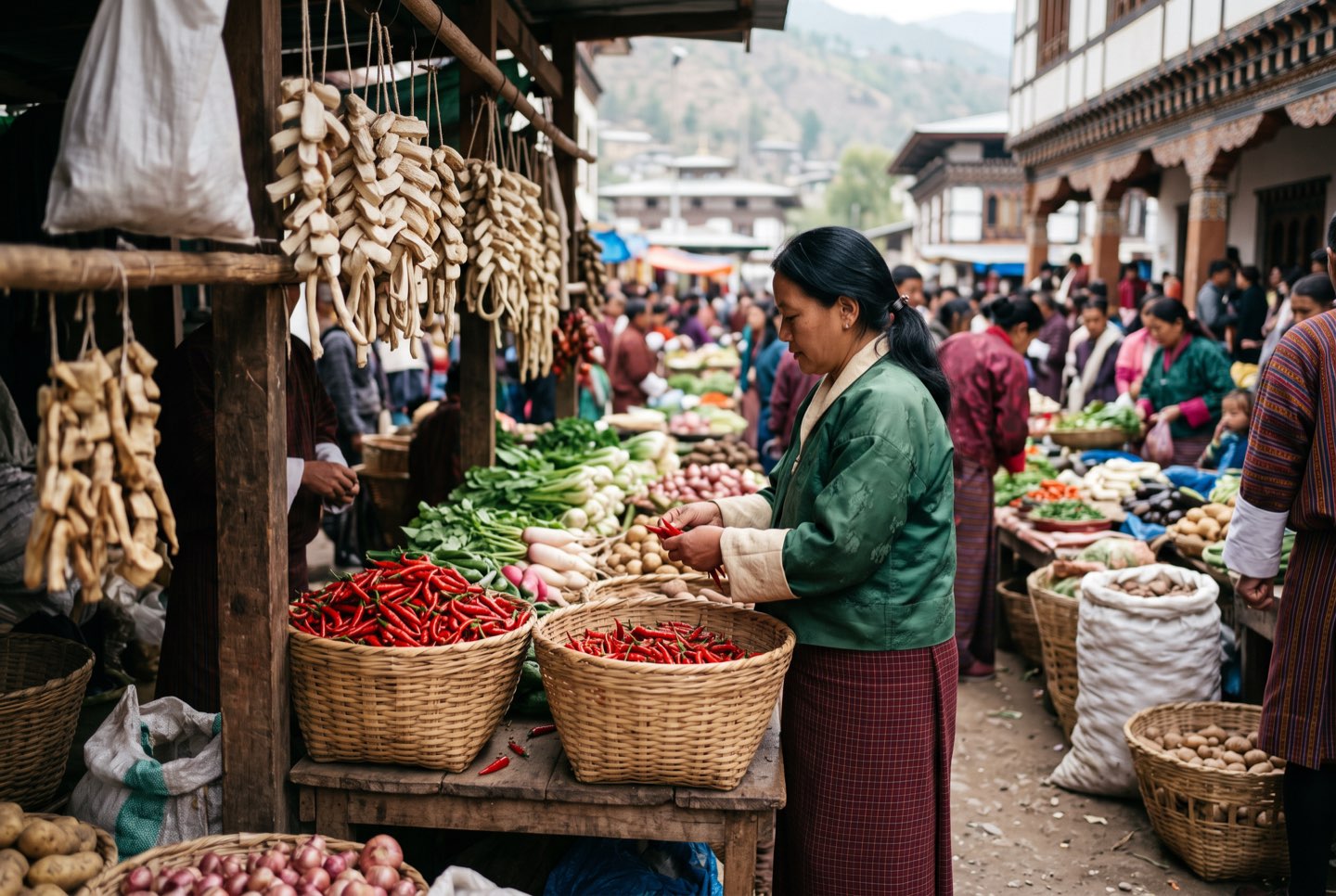 A market vendor in a kira among baskets of red chillies, vegetables and strings of dried cheese, in morning light.
Which walks and viewpoints are worth it?
The easy ones first. The Buddha Dordenma’s hilltop has tranquil walking paths and a wide view of the Thimphu valley, per the Dzongkhag, which makes it a short walk with a real payoff. The clockwise circle around the Memorial Chorten, at morning or evening, is a walk in its own right, with locals doing the same. Tashichho Dzong, on the west bank of the Wang Chhu river, is set among manicured gardens and green hills, which are worth a look before you go in.
Longer hikes climb to monasteries on the ridges above the city. They are lovely, and they are not first-day walks. We put them after you have adjusted, as a half-day of their own, rather than squeezed between sights.
What should you skip, and how should you pace day one?
Skip the checklist. Thimphu has no attraction we would tell you to avoid, but it has a real over-scheduling problem. If time is short, drop a second museum before you drop the chorten circle, and leave shopping until after you have seen the craft school.
Then pace the first day. Thimphu sits at roughly 2,300 m, so your body is still taking notes. Our guide to staying well in Bhutan explains altitude in plain words. The short version is a slow afternoon, plenty of water and an early night. The UK Foreign Office also advises avoiding night-time travel where possible, another reason for a quiet first evening.
Save the hilltops and the long walks for day two. Thimphu will wait; it is not in a hurry.
Frequently asked questions
Are there really no traffic lights?
The UK Foreign Office says there are no traffic lights in Bhutan. You will often read that Thimphu is the only capital in the world without them; we have not checked every capital, so we will stick to what the Foreign Office says.
Do I need a guide to enter the monuments?
Yes. The Department of Tourism’s FAQ says a guide is required to enter monuments and dzongs, and the Foreign Office warns that you may be refused entry otherwise. On our journeys the monument fees are already included, so there is nothing to work out at the gate.
What if I only have half a day?
Take the Buddha Dordenma for the view in the morning, the Memorial Chorten circle after it, and the craft school if time allows. Tashichho Dzong fits a late afternoon if its window suits your day; we would confirm it before promising.
Is Thimphu the place to buy crafts?
It is a good place to see them made, and to buy from the trainees and institutions that make them. Read our guide to what to buy first, because some things cannot leave Bhutan.
Thimphu asks for a day, not a checklist. Walk the chorten circle, look up at the gold, and let the capital set your pace.