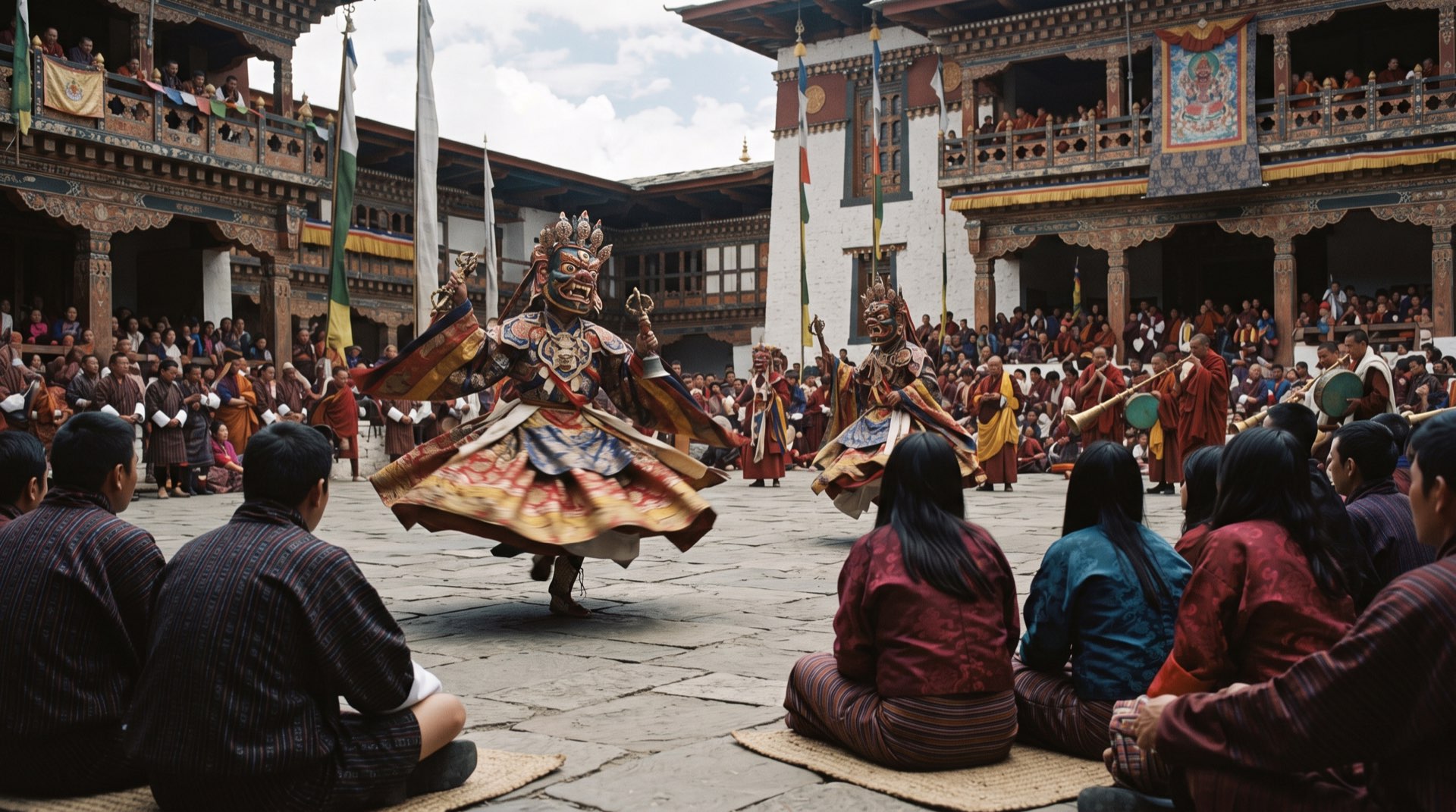
It’s still dark when the courtyard begins to fill. Families arrive in their finest clothes with cushions and flasks tucked under their arms, the air smells of incense and cold stone, and somewhere above you monks are lowering something enormous down a high white wall. By the time the sun clears the ridge, it will be folded away again for another year.
If you’ve been reading about Bhutan’s festivals, you probably have two worries. Which one should I choose? And will I be intruding on something sacred? The second worry is a good sign: it means you’ll be a thoughtful guest. The first, we can help with, from a team that has spent a great many festival mornings in those courtyards.
| At a glance | Detail | Source |
|---|---|---|
| What a tshechu is | A religious festival; the name means “tenth”, for the lunar day sacred to Guru Rinpoche | Department of Tourism |
| Paro Tshechu 2026 | 29 March–2 April, thongdrel on the last day | Tentative festival list, on the Department of Tourism’s website |
| Thimphu Tshechu 2026 | 21–23 September | Tentative festival list, on the Department of Tourism’s website |
| Jambay Lhakhang Drup 2026 | 26–29 October, Bumthang | Tentative festival list, on the Department of Tourism’s website |
| Black-necked Crane Festival | 11 November, Phobjikha | Tentative festival list, on the Department of Tourism’s website |
| 2027 dates | Tentative list published (updated February 2025): Paro Tshechu 18–22 March, Thimphu Tshechu 10–12 October | Tentative festival list, on the Department of Tourism’s website |
| Checked | 30 September 2026 |
What is a tshechu?
A tshechu is a religious festival, and the dances you’ll watch are acts of devotion rather than performances. The word means “tenth”. As the Department of Tourism explains, Guru Rinpoche, whose arrival in the 8th century Bhutan still celebrates, promised to return on the tenth day of each month of the lunar calendar, which makes that day deeply auspicious. Dzongs (the fortress-monasteries at the heart of each valley) and village temples across the country hold their own festivals, each on its own dates.
At the centre of it all is cham, the sacred masked dance. Some dances are slow and stately, some fast and wrathful, and some honour Guru Rinpoche himself. For the families watching, simply being there brings blessings, so people come in their best gho and kira (the national dress for men and women), bring a picnic and stay for the day.
If you’re curious about the ideas behind the masks, our guide to Bhutan’s beliefs, decoded is a gentle place to start.
Should you choose a big festival or an intimate one?
Choose a big dzong festival for spectacle and a village festival for closeness. Both are sacred; they simply feel different.
The big ones, in Paro, Thimphu and Punakha, fill vast dzong courtyards with thousands of people. Punakha’s late-winter festival begins with the Dromchoe, which re-enacts the victory of the pazaps, Bhutan’s traditional warriors, over Tibetan invaders, then flows into its tshechu. BBS reported that more than 3,300 visitors came in 2025, three times the year before, many braving a crowded courtyard. Expect colour, energy and very little elbow room.
The intimate ones happen at village temples, many of them in Bumthang: Jambay Lhakhang Drup, Prakhar, Nalakhar. Then there is the Black-necked Crane Festival at Gangtey Monastery in Phobjikha, a secular, joyful welcome for the cranes, with local children dancing in crane costumes. At festivals like these you may be one of a handful of visitors, sitting among the families rather than behind them. Our guide to Bhutan’s smaller festivals looks further beyond the tshechu.
For a first festival, our advice is one of each, if the calendar allows. Torn between the two biggest? Our guide to Paro Tshechu or Thimphu Tshechu helps you pick.
Which day should you go?
Go for at least two days if you can: a middle day for the dances, and the final dawn for the thongdrel.
A thongdrel is a giant appliqué thangka, a sacred Buddhist image on cloth, which a few dzongs and monasteries unveil once a year. The tentative list marks one for the final morning at Paro, Gangtey, Pemagatshel, Trongsa and Lhuentse. At Paro, BBS describes it being displayed in the early hours and folded before sunrise, with thousands gathering before dawn to receive its blessings.
So yes, it means an alarm set for an hour you may not have seen since your student days. Bring a torch and your warmest layer. Standing in that hushed crowd as the first grey light reaches the scroll is a moment that tends to stay with people.
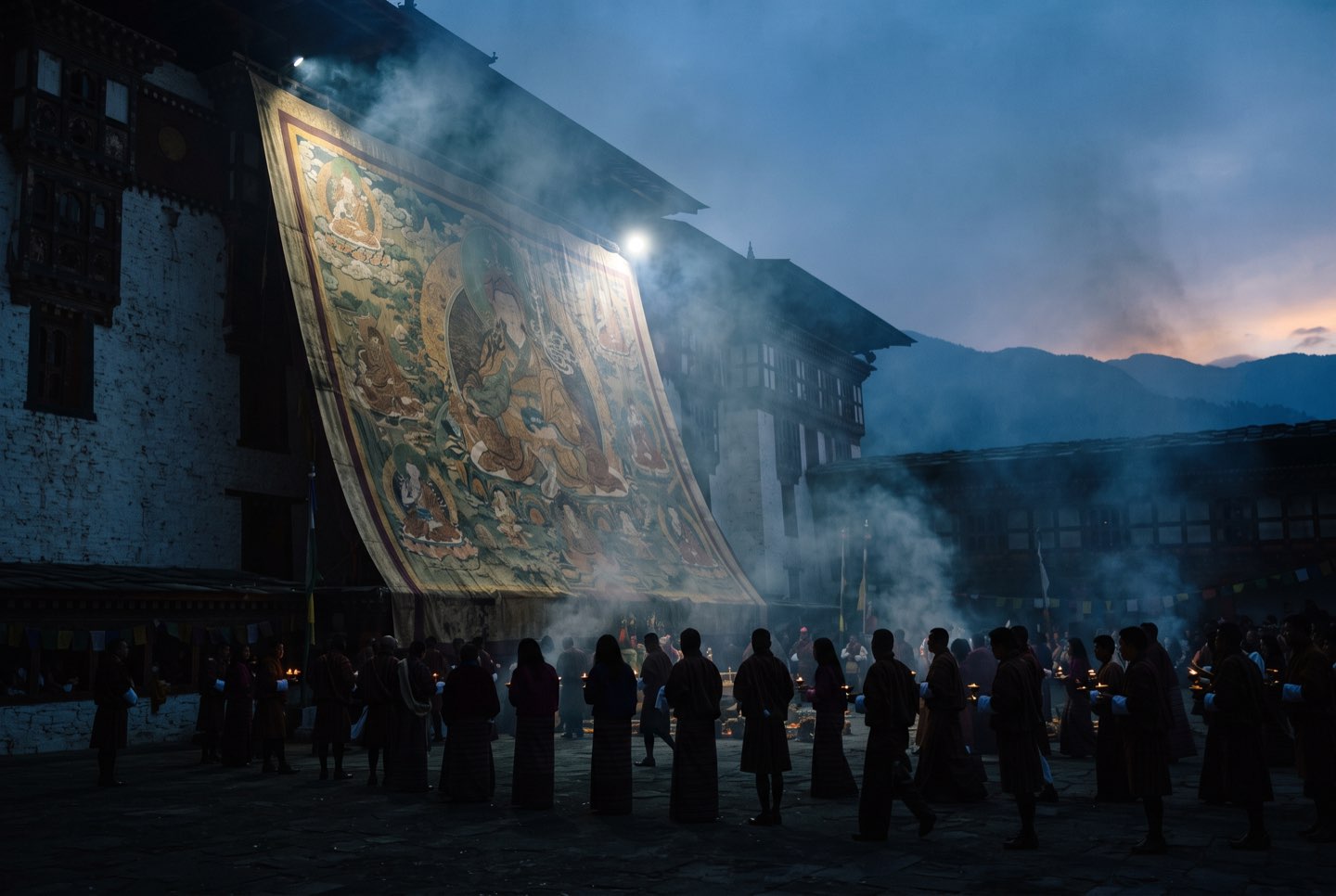 A thongdrel unveiled on the dzong wall before sunrise, incense drifting over the crowd.
The middle days belong to the cham itself: long, absorbing mornings when you can settle in, watch a whole dance unfold and ask your guide what each mask means. In our experience they are a little less crowded than the final day, too.
How do you watch a festival well?
Watch as you would at a family celebration that is also a prayer: dress up a little, sit where the families sit, and let the camera rest often.
Where to sit. Arrive early and settle along the edges of the courtyard or on the steps, never on the open dance ground. Your guide will steer you away from places kept for monks and officials. Bring a cushion: dzong stone is beautiful and unforgiving in equal measure.
What to wear. Smart and modest. The Department of Tourism asks visitors at sacred places to wear long sleeves, cover their legs and remove caps and hats. Many guests enjoy wearing a gho or kira for the day, and your guide can help you dress.
When to lower the camera. The same guidance asks visitors to be mindful when photographing people who are praying or taking part in festivals, and never to stand between worshippers and an altar. Skip the flash and never step onto the dance ground for a shot. Photograph the spectacle, ask before you photograph a person, and during a blessing, simply be there.
Which festival fits which journey, month by month?
Pair the festival with a season you’d enjoy anyway, and the route falls into place. Here is how we match them, using the 2026 dates as a guide to each festival’s season:
- Late February: Punakha Dromchoe and Tshechu (24 February–1 March), in the mild Punakha valley, the warmest corner of the west in winter.
- Late March to April: Paro Tshechu (29 March–2 April) with the Tiger’s Nest and the western valleys, then the Haa Spring Festival (7–9 April 2026), just over the Chele La pass.
- September: Thimphu Tshechu (21–23 September) and Gangtey Tshechu (24–26 September), as the rains ease.
- October: Jakar Tshechu (18–21 October) and Jambay Lhakhang Drup (26–29 October) in Bumthang, a natural fit with our Cranes & the Central Valleys journey.
- November: the Black-necked Crane Festival in Phobjikha on 11 November.
- December: the Druk Wangyel Tshechu at Dochula (13 December) and Trongsa Tshechu (17–21 December).
For the weather and crowds around each of these, see our guide to when to visit Bhutan. And if the cranes are the real draw, read about the cranes of Phobjikha.
What are the festival dates for 2026 and 2027?
The 2026 dates in this guide come from the tentative festival list, last updated in April 2025 and hosted on the Department of Tourism’s website. For 2027 there is a tentative list too, last updated in February 2025. The headline dates, all tentative, are:
| Festival | 2027 dates (tentative) |
|---|---|
| Punakha Dromchoe, then Punakha Tshechu | 13–15 February, then 16–18 February |
| Paro Tshechu | 18–22 March |
| Thimphu Tshechu | 10–12 October |
| Gangtey Tshechu | 13–15 October |
| Jakar Tshechu | 6–9 November |
| Black-necked Crane Festival | 11 November |
| Jambay Lhakhang Drup | 14–17 November |
| Druk Wangyel Tshechu, Dochula | 13 December |
| Trongsa and Lhuentse Tshechus | 5–9 January 2028 |
One planning note. Every festival from September 2027 onwards falls after 31 August 2027, when the current US$100 Sustainable Development Fee window ends, and no later rate has been announced. Our guide to the Sustainable Development Fee explains what is and isn’t confirmed.
Two things are worth knowing about any festival date in Bhutan. First, festivals follow the lunar calendar, so they land on different Western dates every year, and a festival you think of as an April one may fall in March. Second, the list is tentative. We reconfirm dates as your journey approaches and keep a little slack around the days that matter most.
Of this year’s big autumn festivals, Thimphu’s has just passed. Jakar, Jambay Lhakhang Drup, the Crane Festival and December’s festivals at Dochula and Trongsa are still ahead in 2026.
If you’re dreaming of 2027, the tentative list is enough to start planning, and our full guide to Bhutan’s festival dates for 2027 lays it out. Tell us which festival, or simply which season, and we’ll match the window to the right lodges, then reconfirm the dates as they firm up.
Frequently asked questions
Do festival dates change?
Occasionally, even after a list is published, because the dates are tentative. Treat any date as a strong guide rather than a promise, and avoid tying non-refundable plans to a single festival morning.
Do I need tickets?
There’s nothing to book in advance. Visitors may pay a daily entry fee on festival days, as they did at Punakha in 2025, and we confirm what applies to your festival when we plan.
Can I photograph the dances?
Usually, yes, from among the spectators, without flash and without stepping onto the dance ground. Photography isn’t allowed inside temples, and if a particular dance or ritual shouldn’t be photographed, your guide will tell you.
Are festivals very crowded?
The big dzong festivals are, especially on the final morning. Village festivals rarely are. For more on where and when Bhutan gets busy, see Bhutan’s crowds in 2026.
Come as a guest, sit where the families sit, and let the dances do what they have done for centuries.