Somewhere below the Dochula pass you notice you are holding your jacket instead of wearing it. The air through the window has turned soft and green-smelling, the hairpins have loosened, and the hillsides step down in rice terraces. You have come down about 1,900 m from the pass, and the valley floor is warm.
Then the planning question arrives, as it always does. Every list of things to do in Punakha says dzong, bridge, temple, river, and none says whether that adds up to an afternoon or a week. One night, two or three? The answer is shorter than the lists suggest, and it starts with what comes next on your route.
| At a glance | Detail | Source |
|---|---|---|
| Punakha Dzong | Built 1637–38 where the Pho Chhu and Mo Chhu rivers meet; the head of the clergy and his monks winter there | Punakha district administration |
| Altitude | Punakha about 1,200 m; Paro 2,200 m; Dochula pass 3,100 m | Bhutan Luxury Travel, 2026 |
| Coldest night, 2025 | Punakha 3.5 °C, with no nights at or below 0 °C; Paro −6 °C, with 96 such nights | NCHM |
| By road | Thimphu 71 km, 2.5–3 h; Gangtey 78 km, 2.5–3 h; Paro 125 km, 4–4.5 h | Bhutan Luxury Travel, 2026 |
| Rivers | Rafting and kayaking; tougher rapids on the Pho Chhu, a gentler glide on the Mo Chhu | Punakha district administration |
| Spa and massage | Offered in Thimphu, Paro and Punakha | Department of Tourism |
| Punakha festivals, 2027 | Dromchoe 13–15 February, Tshechu 16–18 February (tentative) | Tentative list on the Department of Tourism’s website |
| Checked | 30 September 2026 |
Is Punakha worth visiting, and how many nights?
Yes, and two nights is where we would start. Punakha is where Bhutan softens. After the pine-dark cool of Paro and Thimphu you reach a low, warm valley of rice terraces and orchards, with two rivers and one of the country’s great dzongs at their meeting point. Paro is crisp and cliffside; Punakha is warm and riverside. They are less rivals than a pair.
Why two? The road from Thimphu is 71 km and takes 2.5–3 hours, so the first day is mostly driving. One night buys an evening and a morning. Two buy a whole day with nothing to catch. Both of our western journeys, Rivers, Dzongs & Bliss and The Soul of Western Bhutan, give Punakha two nights. The eleven-day Cranes & the Central Valleys gives it one, because Gangtey is next.
So the real answer depends on what follows and how many days you have; our guide to how many days in Bhutan helps with the second. The lodge changes the answer too, because a riverside villa and a farmhouse suite invite different afternoons. That is the subject of choosing Bhutan’s luxury lodges.
Why is Punakha warmer than Thimphu and Paro?
Because it sits about 1,000 m lower. Punakha lies at around 1,200 m, Paro at 2,200 m, and the National Centre for Hydrology and Meteorology notes that in 2025 the average maximum temperature was highest in the southern lowlands and valley areas and fell towards the high north, a pattern it puts down to elevation and terrain.
The station records show what that feels like. In 2025 Punakha’s station logged no night at or below freezing, and its coldest was 3.5 °C in December. Paro’s logged 96 such nights, with a low of −6 °C, and Thimphu’s Babesa station 77.
The district administration has an older answer. Because of the region’s healthy climate, it says, Punakha is the winter capital of Bhutan, and the head of the clergy and his monks spend the winter in the dzong. If you are travelling in the cold months, that warmth is a reason to come; see our guide to Bhutan in winter.
What is Punakha Dzong, and when is the best hour to visit?
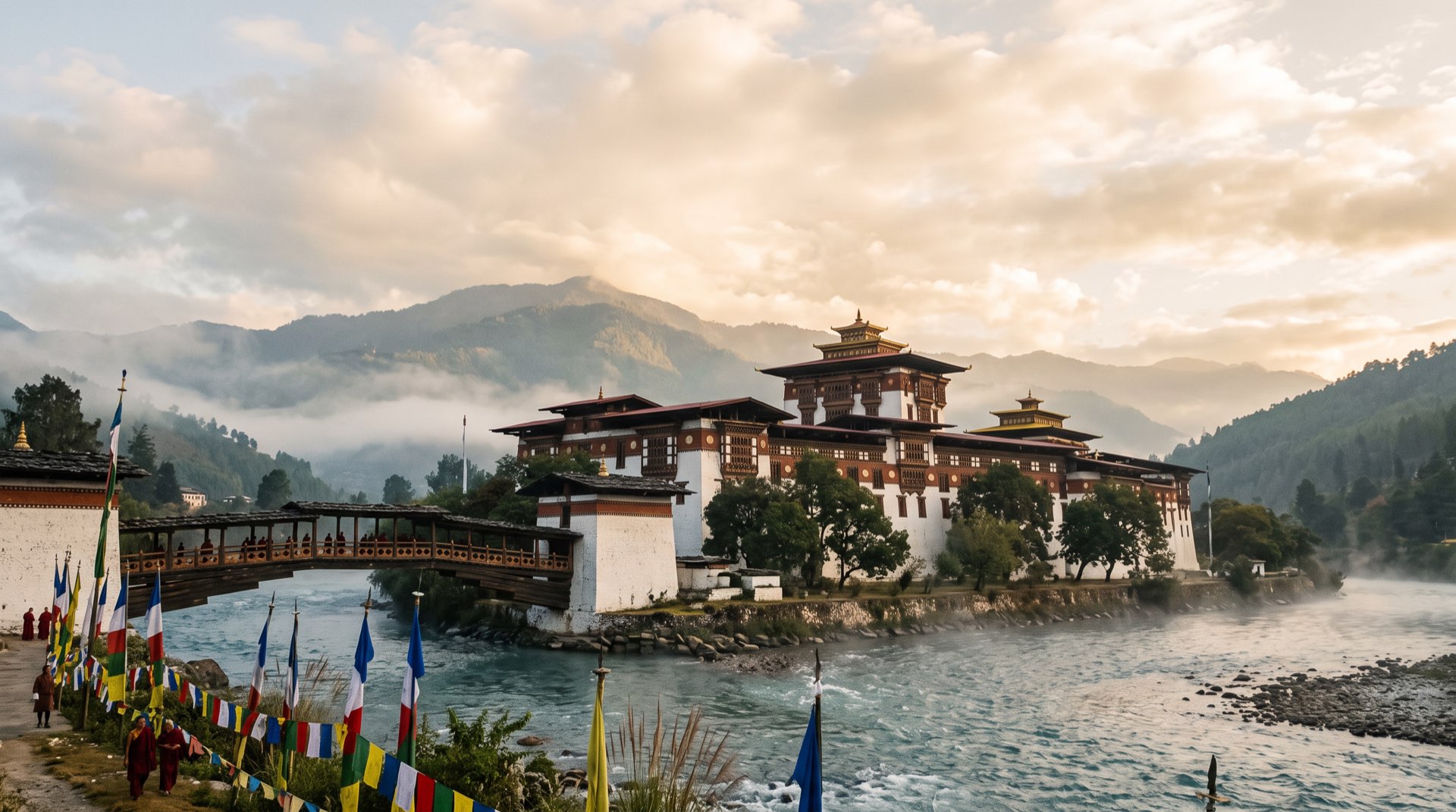
It is a fortress-monastery, built in 1637–38 by Ngawang Namgyal at the meeting of the Pho Chhu (“father”) and Mo Chhu (“mother”) rivers, and it is still a working place. The Punakha district administration calls it the second oldest and second largest dzong in Bhutan and the administrative centre of the district. It houses sacred relics, including the remains of Ngawang Namgyal and of the treasure-revealer Pema Lingpa. In spring, it adds, jacaranda trees around the walls flower mauve.
You approach across the traditional cantilever bridge, which is half the pleasure. If the monks, relics and murals are new to you, our short guide to Buddhism in Bhutan is a good companion.
The best hour is our judgement, not a rule. We like the courtyards soon after they open, while mist lifts off the rivers and before the mid-morning arrivals from the Thimphu road, and we like the walls again late in the day, when the light turns them gold.
The Department of Tourism’s list of museums and monuments, linked from its FAQ and undated, gives the dzong 9 am to 5 pm with no lunch break. We found no fuller visiting rules on an official page, so we won’t print any. It is a monastery and a government office, and the monks live there in winter, so arrangements can differ by day and season. We confirm what is open for your dates.
Which walks are worth it?
Three, all optional and none demanding. Walking in Punakha is mostly about the terraces, so the pleasures are small and green.
The rice terraces. The Punakha day on Rivers, Dzongs & Bliss includes a gentle walk through the terraces, and The Soul of Western Bhutan offers an optional walk through the rice fields to Chimi Lhakhang. The paddies are green through the summer and gold around the autumn harvest, and on a warm day the morning is the time to go.
Chimi Lhakhang. A short path through rice fields leads to the small temple of the Divine Madman, Drukpa Kunley, with painted farmhouses on the way. Read Bhutan’s beliefs, decoded first, and the walls will make sense before you reach them.
Khamsum Yulley Namgyal Chorten. A path from the roadside crosses a bridge over the Mo Chhu, then climbs steeply to a gold-topped chorten (a Buddhist shrine) with views up and down the valley. Go in the cool of the morning, and skip it without guilt if the day is hot.
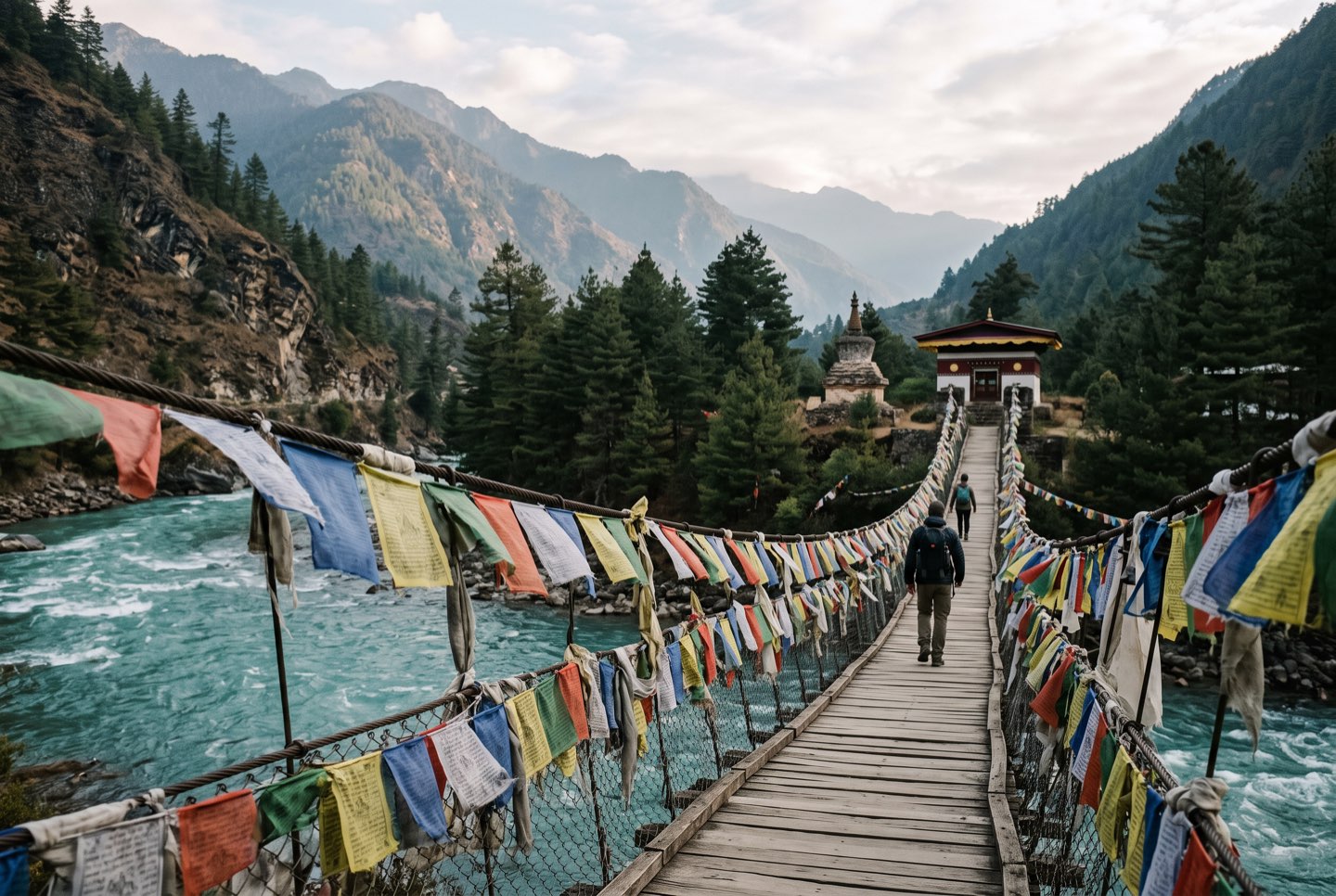 A long suspension bridge draped in prayer flags over a turquoise river, two walkers small in the morning light.
The district’s dzong page also calls the Punakha Suspension Bridge the longest in Bhutan. It is a long walk on planks over moving water, so tell us if heights unsettle you.
What can you do on the river?
Float on it, picnic beside it, or simply watch it. The Punakha district administration lists river rafting and kayaking among its attractions. It describes tougher rapids on the Pho Chhu and a gentle glide on the Mo Chhu, for everyone from thrill-seekers to families and first-timers, past rice fields and villages, with a chance of spotting a rare White-bellied Heron.
Rafting is not part of our published journeys. If you want it, ask, and we will check river conditions and what can be arranged for your dates. The quieter option is on both journeys already: a private riverside picnic beneath the dzong, with the water loud and the walls pale above you.
Cold water asks for warm water afterwards. The Department of Tourism lists spa and massage treatments in Thimphu, Paro and Punakha, and an optional hot-stone bath is on our western journeys. Our guide to Bhutan’s wellness traditions explains the ritual.
Punakha, Wangdue or Gangtey: what is where?
They are neighbouring districts, and people use the names loosely. The Wangdue Phodrang district administration lists Gangtey and Phobjikha among its gewogs (blocks of villages), so the crane valley is in Wangdue, not Punakha, and it names Gangtey Lhakhang and the Black-Necked Crane Festival among its attractions.
So the route runs Thimphu, Punakha, then on to Gangtey, 78 km and 2.5–3 hours away. Phobjikha lies much higher, at around 2,900–3,000 m, and the cranes arrive in late October and leave by mid-February; see the cranes of Phobjikha.
Wangdue has its own festival, in autumn. Its district site says the 2026 Tshechu was set for 19–21 September, and the tentative 2027 list on the Department of Tourism’s website gives 8–10 October.
One, two or three nights? A decision table
Choose by what comes next and what you want the middle day to be. This table draws on how our journeys are built.
| Nights | Choose it when | What you get | What it costs |
|---|---|---|---|
| One | Gangtey and the cranes come next, as on Cranes & the Central Valleys | An evening by the river and a morning in the dzong | Little time for the terraces or a slow lunch |
| Two | Your default; both western journeys use it | A full day: dzong, picnic, terraces, perhaps a hot-stone bath | Little; the long drive to Paro follows |
| Three | You want an empty day, a rafting day or a wellness stay; see also Bhutan for couples | Two full days, one for sights and one for stillness | A night taken from somewhere else |
None of our published journeys uses three nights, but we plan it on request. If you have to protect one thing, protect the second night.
Frequently asked questions
Is Punakha hot?
In summer, yes. NCHM’s 2025 records show Punakha’s station reached 39.5 °C on 26 July and logged 182 days at or above 30 °C, while Paro’s logged five. That is one station in one year, but it fits our preference for spring and autumn here.
Is it worth a day trip from Thimphu?
We would not. The drive takes 2.5–3 hours each way over the Dochula pass, so a day trip spends five to six hours in the car. Sleeping in the valley gives you the light and the quiet the road takes away.
When are the Punakha festivals?
In the tentative 2027 list on the Department of Tourism’s website, the Punakha Dromchoe runs 13–15 February and the Tshechu 16–18 February. The Talo Tshechu at Talo Gonpa, also in Punakha, is on 16–18 March. Lists change, so check Bhutan's festival dates for 2027.
Is Punakha good in the monsoon?
Often, if you like it green and quiet. Clouds drift through the valley, the rice grows tall and the famous sites are calm, though the low valley can feel sticky. Our guide to Bhutan’s green season has more.
Give Punakha the second night. Two rivers, one warm valley, and time enough to notice both.