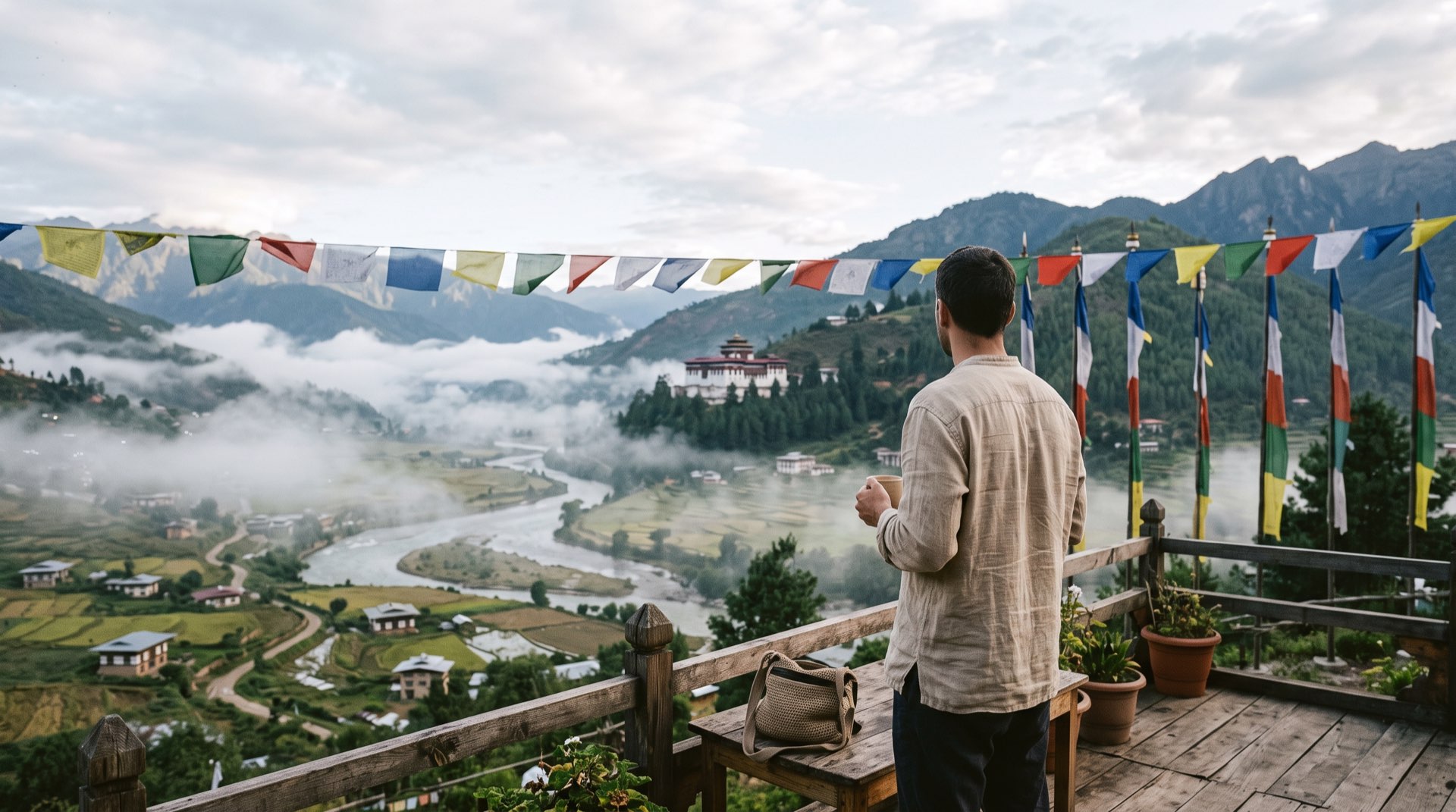
The aircraft door opens and the first thing you notice is the air. It is cool and thin, faintly sweet with pine, and the quiet of the Paro valley reaches you well before your luggage does. Up the valley, a white-walled dzong (a fortress that houses both monks and local government) sits on the hillside as if it had been expecting you.
Most first-time visitors reach that moment after a few weeks of low-level worry. Do I really need a guide? What is this fee everyone mentions? Why are there so few flights? Is it all going to be terribly complicated?
It isn’t, once someone walks you through it. So let’s walk through it: this is how Bhutan actually works in 2026, from our office in Thimphu, where we have been planning first journeys since 2007.
| At a glance | Detail | Source |
|---|---|---|
| Visa | Needed by every visitor except Indian nationals, who need a permit; US$40, reviewed within five working days | Department of Tourism |
| Guide | A licensed guide must accompany you at all times | Department of Tourism |
| Sustainable Development Fee | US$100 per adult per night; US$50 for ages 6–11; nothing for under-6s | Department of Tourism |
| Getting there | Drukair and Bhutan Airlines fly into Paro from Bangkok, Delhi, Kathmandu, Singapore and other regional hubs | Department of Tourism |
| Paro flights | Daylight only, in good visibility | Department of Air Transport |
| Currency | Ngultrum, at par with the Indian rupee | Department of Tourism |
| Checked | 27 September 2026 |
Can you just book a flight and go?
Not quite, but you don’t have to do the hard part yourself. Every visitor except Indian nationals needs a visa before arriving, and the Department of Tourism is clear that visitors must be accompanied by a guide at all times.
The visa itself is straightforward, and our guide to how the Bhutan visa works takes it step by step. You can apply online, or, as the Department of Tourism explains, a tour operator or hotel can apply on your behalf. There is a one-off US$40 application fee, and a complete application is reviewed within five working days. The UK Foreign Office adds one detail worth checking tonight: your passport must be valid for at least six months after the date you plan to leave Bhutan.
When you travel with us, you send your passport details and we handle the rest: visa, fee, guide, driver and permits. The guide rule can sound restrictive from a distance. Up close, it feels more like travelling with a well-read local friend who knows which caretaker keeps the temple key, and which bend in the road has the view.
What is the Sustainable Development Fee, and is it on top?
It is a nightly fee the government asks of visitors, and with us it is already inside your journey price, not added at the end. For most international travellers it is US$100 per adult per night. Children aged 6 to 11 pay US$50, and children under 6 pay nothing, according to the Department of Tourism. The current rate is set until 31 August 2027, and our guide to what has changed for Bhutan travel keeps track of the rest.
The money goes to the national exchequer and on to free healthcare, education, infrastructure and environmental protection. It is one reason a visit here feels like a contribution rather than a transaction.
Three things are worth remembering. It is a government fee, so it is the same whoever you travel with. It is counted by the night. And on our proposals it always has its own line, so you can check our maths. We explain it all, with a worked example, in our guide to Bhutan’s Sustainable Development Fee.
How do you get there?
You fly into Paro, and the flight is part of the adventure. Bhutan’s two national airlines, Drukair and Bhutan Airlines, connect Paro directly with Bangkok, Delhi, Kathmandu, Singapore, Kolkata, Dhaka and other regional cities, so most journeys from Europe, the Americas or Australia connect through one of those hubs.
Paro’s airport sits in a narrow valley among high ridges, and the rules reflect it. According to the Department of Air Transport, flights operate only between sunrise and sunset and in good visibility, and only specially certified pilots may land here. Worth knowing when the wingtip seems to pass close enough to count the chillies drying on a farmhouse roof.
Two practical things follow. Seats are limited, so we secure flights early, alongside your lodges. And because weather can hold a departure, we recommend leaving at least 24 hours between your flight out of Paro and any onward long-haul connection. Our guide to flying into Paro has the details.
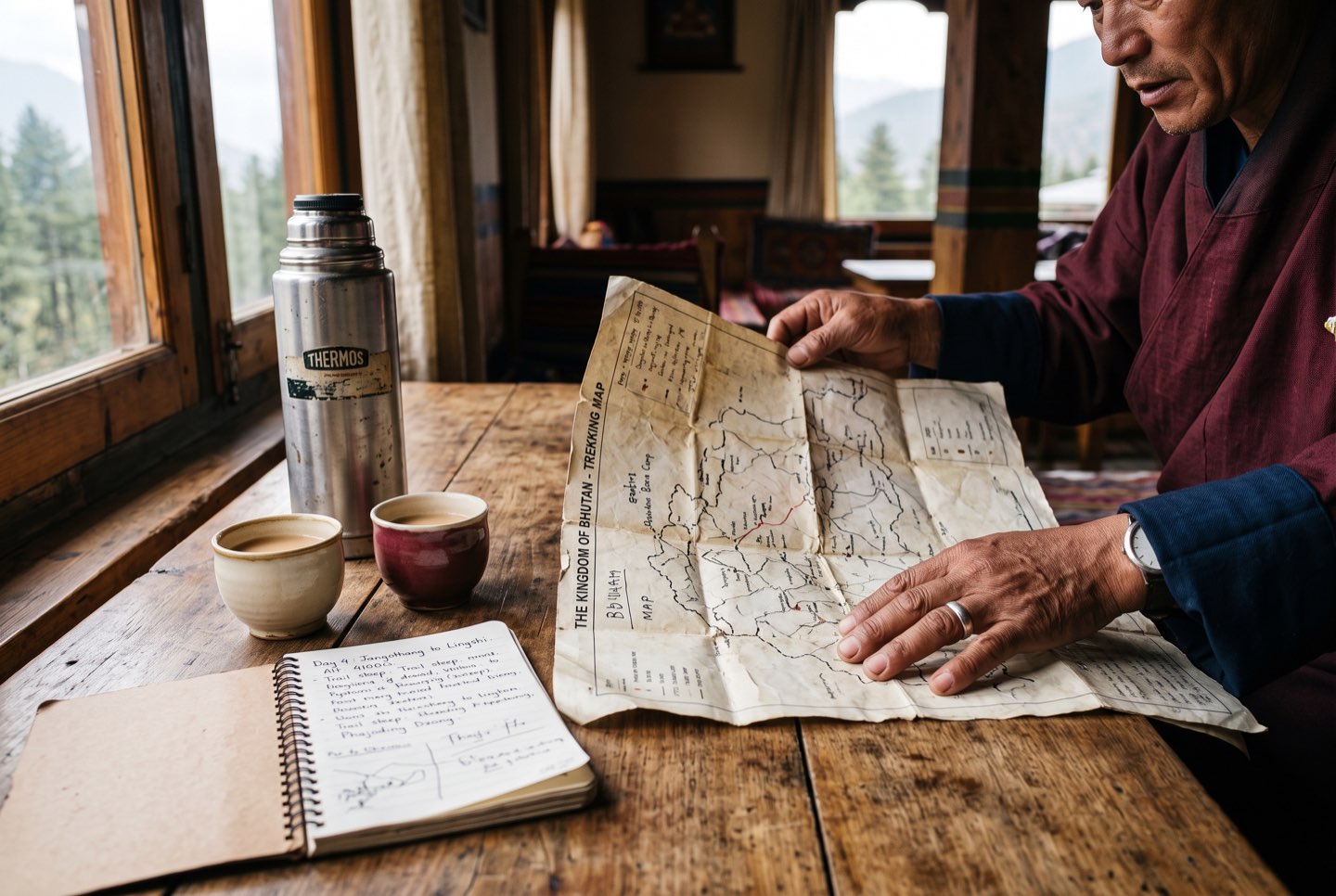 A worn paper map, a thermos and two cups of tea: most first journeys take shape at a table like this.
How many days do you need?
For a first visit, about a week in western Bhutan is the sweet spot, and longer if you want the central valleys. Our shortest private journey, Rivers, Dzongs & Bliss, covers Paro, Thimphu and Punakha in six unhurried days, Tiger’s Nest included. Eight days lets those same valleys breathe, with room for a farmhouse lunch or an afternoon of doing nothing in particular. With eleven, you can follow the road east to Gangtey, where black-necked cranes spend the winter, and on to the old temples of Bumthang.
The limit isn’t distance. Bhutan is small. It’s the roads, which wind around every ridge and fold of the hills: the drive from Punakha to Gangtey is only 78 km, yet it takes the best part of three hours. We would rather you arrive with time for tea than tick off one more valley.
If you’re weighing up the options, our full guide to how many days in Bhutan sets out what each length of journey feels like.
When should you go?
Autumn and spring are the classic seasons, but there is no wrong month, only different ones. October and November bring the clearest skies and a busy calendar of tshechus, the religious festivals with masked dances held in dzong courtyards. March to May adds rhododendron and warmer days; in 2026, the Paro Tshechu fell between 29 March and 2 April.
Winter is cold, clear and quiet, and from late October to mid-February the black-necked cranes return to the Phobjikha valley. The summer monsoon paints everything a deep, glossy green and thins out the visitors, at the price of some cloud and the odd muddy boot.
Popular months fill first. We suggest getting in touch three to six months ahead for autumn, spring, festival dates and the most sought-after lodges, although shorter notice is sometimes possible. Our month-by-month guide to when to visit Bhutan will help you choose, and our Plan Your Journey page has a month explorer if you like to browse.
What will it cost, and why won’t anyone just tell you?
It depends on six things, and that is honestly why no careful operator quotes a single figure: the SDF, your lodges, the season, the length and route of your journey, the size of your party, and your flights. Only the first is fixed by the government. The rest are choices, and small ones add up in both directions.
A journey through a circuit of small luxury lodges in October will look very different from one in December that pairs a lodge with a heritage farmhouse, even if the valleys are the same. A family of five sharing a guide and vehicle spends differently per person from a couple. Flying east instead of driving saves days on the road but adds a fare.
What you can expect from us is clarity: an itemised proposal, so you can see what each choice does, with the visa, SDF, private guide and driver, entrance fees, taxes and 24-hour support already included. For the full picture, read what a luxury Bhutan journey costs.
What should you pack in your head?
Three things: a slower pace, respect for the altitude, and clothes that cover your shoulders and knees.
The pace first. Bhutan rewards the unhurried. The moments people remember tend to arrive between the sights: a butter lamp flickering in a side chapel, a game of archery in a village field, a long lunch that nobody wanted to end.
Altitude next. Our journeys usually run between about 1,200 m in Punakha and 3,100 m at the Dochula pass. The CDC’s travel health guidance notes that altitude illness is mainly a risk for travellers sleeping at about 2,450 m or higher, and suggests only mild exercise and no alcohol for the first 48 hours at altitude. So we pace the first days gently. Our guide to altitude and health in Bhutan has more.
And dress. The Department of Tourism asks visitors to wear long sleeves and cover their legs in temples, remove shoes on entering and take off hats at sacred sites. Pack a light layer and shoes that slip off easily. You will take them off more often than you expect.
Where to go next
Once the shape of the trip is clear, these are the questions people ask us next.
- Whether you need a guide in Bhutan: the 2026 rule explained, and what it means for how you spend your days.
- What has changed for Bhutan travel: what moved in 2026, and what to watch for in 2027.
- How the Bhutan visa works: the application step by step, from passport to approval.
- How safe Bhutan is: solo travellers, women, LGBTQ+ travellers and the real risks, plainly put.
- Money, SIM cards and plugs in Bhutan: the small practical things to sort out before you land.
Frequently asked questions
Do I need a guide everywhere?
Yes. A licensed guide accompanies you throughout, and one is required to enter dzongs and monuments; the rule is set out in full in our piece on whether you need a guide in Bhutan. In our experience, most guests stop thinking of it as a rule by the end of the first day.
Can I travel solo?
Yes, and it works well here. Every journey we plan is private anyway, so travelling alone simply means your guide’s full attention, and the window seat, are yours.
Is Bhutan safe?
Very. The Department of Tourism describes it as a very safe place to visit, even for those travelling alone, with very little crime. The real challenges are natural ones, such as mountain roads, weather and altitude, which is why pace and planning matter more here than money belts. Our fuller guide to how safe Bhutan is goes through the details.
Do I need cash, or can I use cards?
A little of both. Banks and ATMs accept Visa and Mastercard, and cards are widely used in towns and lodges. Cash is still handy for markets, small shops and offerings in temples. We cover money, SIM cards and plugs in Bhutan in a guide of its own.
Bhutan asks a little more of you before you arrive, and gives it all back the moment you step off the plane.