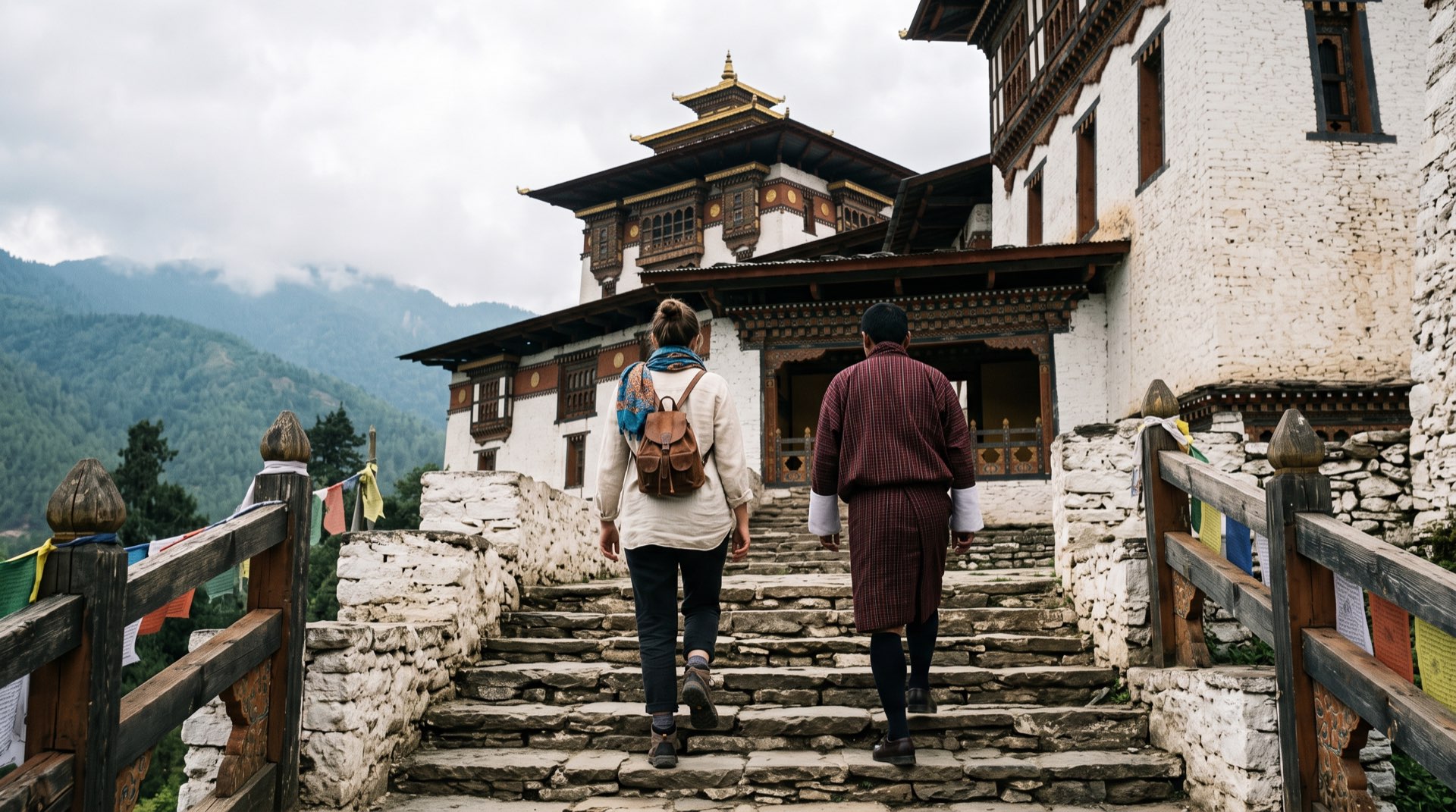
The wooden stairs up into Punakha Dzong are steep, and below you two rivers meet in a rush of green water. Halfway up, most first-time visitors slow down, and it isn’t only the gradient. A small worry has arrived. Are my sleeves long enough? Is the camera allowed in there? And did I just walk the wrong way round that chorten, the little whitewashed stupa by the gate?
Take a breath. Bhutan’s etiquette for visitors is short, kind and easy to learn, and nobody expects you to arrive knowing it. Most of it comes down to the manners you would bring to any place of worship, plus a few local habits that are a pleasure to pick up.
The whole list fits comfortably on this page.
| At a glance | Detail | Source |
|---|---|---|
| Dress | Long sleeves and covered legs at temples and other sacred sites | Department of Tourism |
| Hats and shoes | Hats off at sacred sites; shoes off when you enter a temple | Department of Tourism |
| Photos inside temples | Not allowed | Department of Tourism |
| Photos of people | Always ask first | Department of Tourism |
| Drones | Operations allowed only for government organisations; unapproved drones are seized on arrival | Bhutan Civil Aviation Authority |
| Around chortens | Walk clockwise | Thimphu Dzongkhag Administration |
| Checked | 27 September 2026 |
What is the golden rule?
Treat every dzong, Bhutan’s fortress-monasteries, as a place of worship and a working office at the same time, because that is exactly what it is. Paro’s Rinpung Dzong, for example, is home to the district’s monastic body and to the government offices of Paro, according to the Paro Dzongkhag Administration. The monk crossing the courtyard is on his way to prayers; the official behind him is on her way to a meeting.
So the rule is simple: covered, quiet and unhurried. Keep your voice low, give way on narrow stairs, and never stand between someone praying and the altar. The Department of Tourism asks visitors not to obstruct people’s right to practise their faith in peace, which is about the kindest way we’ve ever seen a rule written.
Everything else in this guide is detail. If you’d like to understand what you’re actually looking at in those courtyards, start with our introduction to Bhutan’s living culture.
What should you wear to a dzong or temple?
Long sleeves and covered legs. That is the official guidance from the Department of Tourism for temples and sacred sites, and since dzongs have temples inside them, it applies there too. Take off caps and hats as you enter, and when you meet elders.
In practice, loose trousers or a long skirt and a shirt with sleeves do the job beautifully. We suggest layers, because temples can be cool inside even on a warm day, and a light shawl or scarf is useful for the same reason. Aim for tidy rather than formal: think of dressing to meet a friend’s grandparents.
Then think about your feet. You will take your shoes off at every temple door and put them back on afterwards, many times in a single day. Shoes that slip on and off easily are your friend. Lace-up boots with double knots are a lesson in patience… and the queue behind you learns it too.
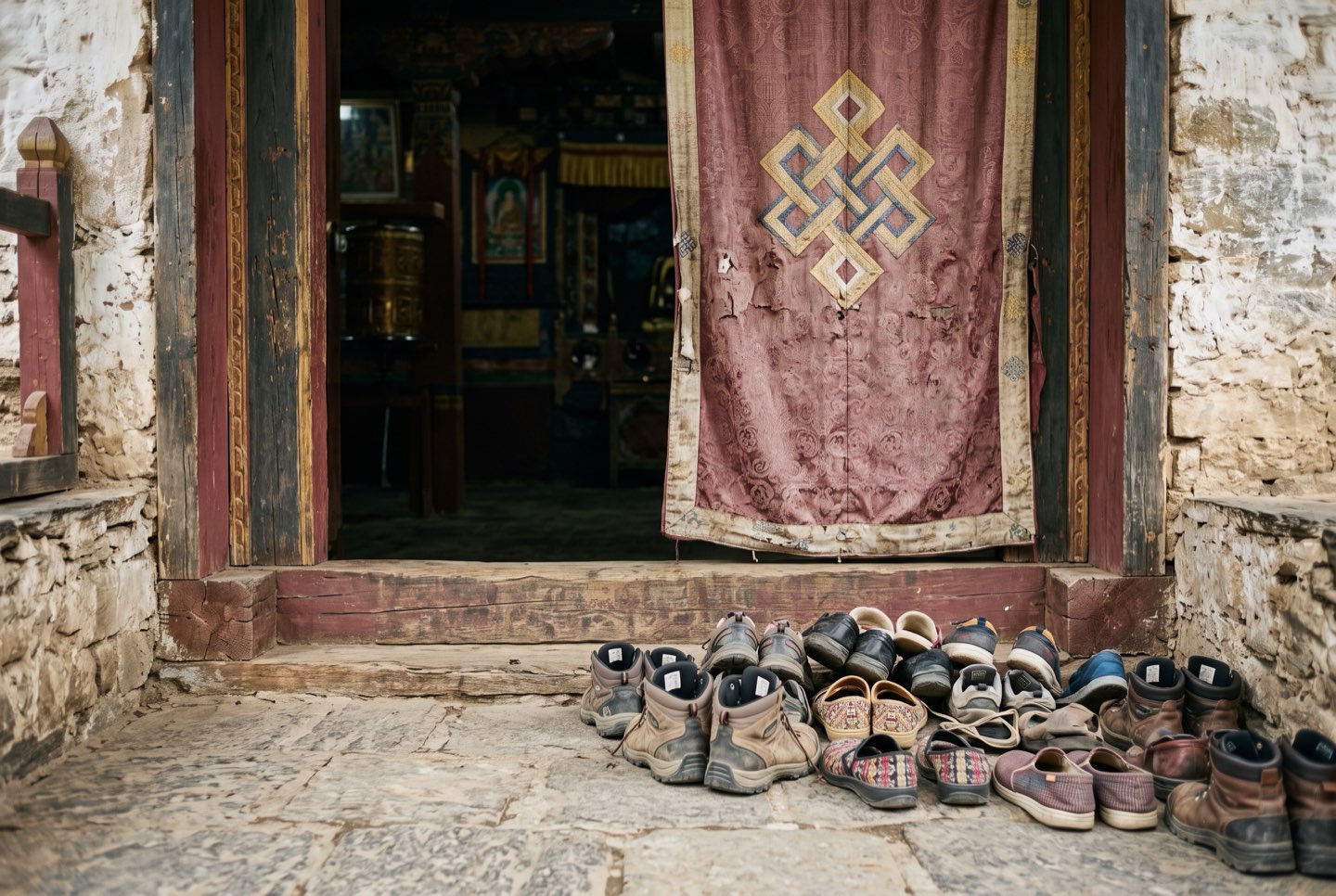 Shoes left in a neat row outside a temple doorway, beneath a faded red curtain embroidered with an auspicious symbol.
Where can you take photos?
Courtyards and exteriors, usually yes; inside temples and shrine rooms, no. The Department of Tourism asks visitors to refrain from taking photos inside sacred sites, and that includes the smallest chapel with the most tempting painting. At some places, including the Tiger’s Nest, phones and cameras are left at the entrance altogether. Our guide to the Tiger’s Nest hike explains how that works.
In the open courtyards of most dzongs you can photograph the architecture, the carved windows and the light on the walls. Rules can vary from place to place, and even from day to day when a ceremony is under way, so follow your guide’s lead.
People are different from buildings. The same guidance asks you to respect privacy and always ask before you photograph someone. That goes for monks, for elders spinning prayer wheels, and for children who have spotted your camera long before you spotted them. A smile and a raised camera, with a pause for the answer, is enough. If the answer is no, that’s the answer.
Can you fly a drone in Bhutan?
No. According to the Bhutan Civil Aviation Authority, drone operations are permitted only for government organisations, under the country’s 2017 regulation for unmanned aircraft. No agency or individual may bring a drone into Bhutan without prior approval, and one that arrives without it is seized at the point of entry.
Even approved operators need extra clearances, including from the Ministry of Home Affairs for heritage sites and from the army for no-fly zones. That tells you how carefully the country guards the air above its dzongs.
So leave it at home, however good the footage would be. If photography matters to you, tell us early and we’ll plan your days around viewpoints and the best light instead. The consolation is real: the view from the ground here is very good, and it never needs charging.
Which small courtesies make a difference?
Walking clockwise is the big one. Around chortens, temples and prayer wheels, go the way everyone else goes, keeping the sacred place on your right. The Thimphu Dzongkhag Administration describes locals and visitors circling the Memorial Chorten clockwise and spinning its prayer wheels, and you’re welcome to join them. If the prayer wheels are there, give them a turn as you pass.
Inside a temple, the Department of Tourism asks visitors not to touch religious objects or paintings, and not to sit on the thrones kept for lamas, the senior religious teachers. If you find yourself sitting on the floor with a monk, an elder or a host, sit cross-legged. Keep quiet; a temple is a place of prayer first and a sight second.
Bhutanese homes have their own gentle habits too. People usually take their shoes off before going in, so follow your host.
None of this needs to be perfect. What people notice is that you’re trying.
Should you wear a gho or kira?
Only if you would like to. Nobody expects it, and a visitor in modest clothes is properly dressed for any dzong in the country.
That said, many guests enjoy wearing the national dress for a festival day or a special visit, and Bhutanese weavers sell their fabrics through shops in Thimphu, Paro and Punakha, according to the Department of Tourism. The gho for men is a knee-length robe belted at the waist; the kira for women is a long woven skirt worn with a short jacket. Tying a gho properly takes a second pair of hands the first few times. Your guide will help, and will try very hard not to laugh.
One thing we’d leave to the Bhutanese is the ceremonial scarf. Men wear a kabney and women a rachu when they visit a dzong, and the colour signals rank, from white for ordinary citizens up to saffron for the King. It isn’t something to borrow for a photograph.
Which words earn a smile?
Two will carry you a long way, and the Department of Tourism teaches both: kuzu zangpo la, which means hello and works at any time of day, and kadrin chey la, which means thank you.
The little la on the end matters. It is the polite part, a mark of respect Bhutanese add to all sorts of sentences. Say it to a monk, a shopkeeper or the person who has just poured your butter tea, and watch what happens.
Your pronunciation will not be perfect, and that is fine. In our experience the effort is noticed far more than the accent, and your guide will happily coach you in the car between valleys.
Frequently asked questions
Can I wear shorts?
Not to dzongs or temples. On a trail or around your lodge they’re fine, but many walks end at a temple, so carry light trousers or a long wrap skirt to change into.
Can I take photos at festivals?
Yes, in the courtyard, as long as you stay at the edges, never step into the dance ground and don’t block anyone’s view. Watch for moments when people are praying and lower the camera then. Our guide to Bhutan’s festivals helps you choose one.
Is it rude to wear a gho?
No. In our experience it is received warmly, as a compliment to the culture. Wear it properly, belt and all, rather than as a costume for one picture.
Do I remove my shoes?
Yes, before entering any temple or shrine room. In dzong courtyards you keep them on, and a row of shoes by a doorway is your cue.
Dress for respect, walk clockwise, ask before the photo. Everything else, Bhutan will teach you kindly as you go.