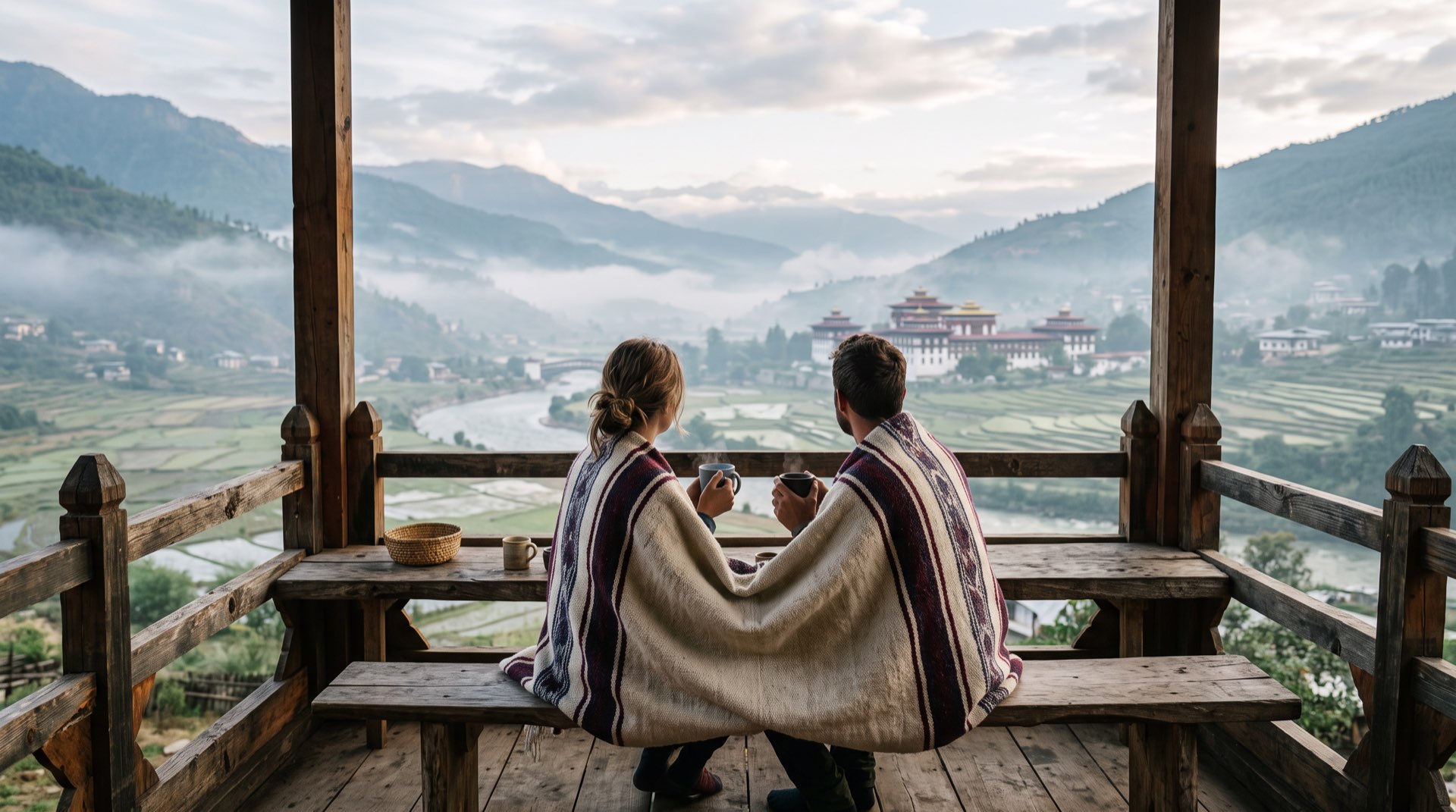
The tea has gone lukewarm and neither of you has noticed. Below the terrace, mist is lifting off the river in slow sheets, a dog is barking at nothing, and somewhere a prayer wheel keeps time. Nobody has spoken for ten minutes, and it is the best conversation of the trip.
That is the Bhutan we would like you to picture, because the brochure version worries people. A guide beside you at all times. Temples, rules, hairpin roads. Is that a honeymoon, or a very well-run school trip? It can be either, and the difference lies mostly in how the days are built. So here is how we build them for two: what is fixed, what is ours to shape, and where we simply do not know.
| At a glance | Detail | Source |
|---|---|---|
| Guide | A guide must accompany you at all times in Bhutan | Department of Tourism |
| Safety | Described as very safe, even for people travelling alone | Department of Tourism |
| Sustainable Development Fee | US$100 per adult per night; children 6 to under 12 pay US$50, under 6 pay none | Department of Tourism |
| Wellness | Massage and spa in Thimphu, Paro and Punakha; hot-stone baths at hotels and homestays; yoga in Thimphu | Department of Tourism |
| Smallest lodges | Amankora Punakha and Amankora Gangtey have eight suites each | Aman |
| Winter warmth | In 2025 Paro’s overnight low reached 0 °C or below on 96 days; Punakha’s on none | NCHM |
| Our advice | Two or more nights in most valleys | Bhutan Luxury Travel, 2026 |
| Checked | 30 September 2026 |
Is Bhutan good for a honeymoon?
Yes, if what you want is time together rather than a scene. Bhutan has no beach, very little nightlife and no shortage of stairs. It has quiet valleys, warm river light, small lodges and days with room in them. That is our judgement, and we should say so plainly: few official sources write about “romance”, so the facts in this guide are logistics and the feelings are ours.
The logistics do help. The Department of Tourism calls Bhutan very safe, even for people travelling alone, with little crime. You cannot hire a self-drive car, so someone else handles the hairpin bends while you look at the view. And nothing about the country rewards rushing, which suits two people who have just spent months planning a wedding or a big anniversary and would like, for once, to do nothing efficiently.
Our case for slow luxury in Bhutan explains why fewer moves and longer stays matter even more when there are two of you.
What does a day for two really look like?
Like one good thing, done properly, with space on either side. Our model is the Punakha day on The Soul of Western Bhutan. After a slow breakfast you spend the morning in the courtyards of Punakha Dzong, built in 1637–38 where the Pho Chhu and Mo Chhu rivers meet, according to the Punakha district administration. Lunch is a private picnic by the river beneath the dzong walls. The afternoon is yours: an optional short hike to Khamsum Yulley Chorten, or a hot-stone bath.
The bath is worth planning around. The Department of Tourism’s wellness page notes that hot-stone baths are offered at local hotels and homestays, and that massage and spa treatments are found in Thimphu, Paro and Punakha. It also observes that long car journeys and challenging climbs make relaxing worthwhile, which is a polite way of saying your legs will thank you. Our guide to Bhutan’s wellness traditions explains what to expect.
Then dinner, and an early night. Evenings here are quiet, and that is rather the point.
How do you get privacy with a guide and driver?
By designing it, not by expecting it. The guide rule has no loophole: the Department of Tourism says a guide must accompany you at all times. What you can shape is distance, timing and who does the talking. Here is our checklist for two.
- Ask for two or more nights in most valleys. Fewer moves means fewer hours in a car with a third person.
- Put the famous sites at the quiet hours. Early morning and late afternoon give you courtyards with room in them; our note on Bhutan’s crowds in 2026 has the hour-by-hour detail.
- Choose small lodges. Fewer suites means fewer strangers at breakfast.
- Ask for a private picnic or dinner. Our journeys already include some, and we can ask what else is possible.
- Agree the guide’s role beforehand. Explain first, then step back on the walk. Tell us how much company you want, and ask us how far the day can be shaped around it.
- Leave afternoons open. Privacy is mostly unscheduled time.
How your guide works around your lodge is a conversation we have with you before you arrive, so ask us.
Which months suit couples?
Every month can work; each one gives you a different kind of togetherness. This is our chooser, drawn from our season guides.
- October and November: the clearest skies and the most company. Small lodges fill first, so plan early.
- December to February: cold, calm and quiet. Base yourselves in Punakha, which in 2025 had no days at or below 0 °C at its weather station, while Paro had 96, according to the national weather service.
- March to May: blossom and festivals, with a haze that softens the far peaks and crowds around the big festival weeks.
- June to September: green, wet and quiet. Rain slows the roads, so keep afternoons loose and lunches long.
If a date is fixed by a wedding, we work around it. If you can choose, our guide to when to visit Bhutan goes month by month.
Which valleys and lodges suit romance?
Punakha first, then whatever you have time for. It is lower and warmer than Paro or Thimphu, at about 1,200 m, and the district administration calls it the winter capital of Bhutan. Our guide to Punakha and Wangdue covers the valley in depth.
Paro adds the Tiger’s Nest, a five- to six-hour return walk that some couples treat as a shared challenge. Thimphu is the city night. Gangtey, in the crane valley, is small and remote, and Amankora’s Gangtey lodge has eight suites, according to Aman. Amankora Punakha is an eight-suite lodge in a 300-year-old farmhouse near the dzong.
The Soul of Western Bhutan uses COMO Uma Punakha, which we describe as an intimate lodge on a hill above the Mo Chhu river. For a fuller comparison, read our guide to choosing Bhutan’s luxury lodges. Which lodge suits your occasion, on your dates, is a question for us.
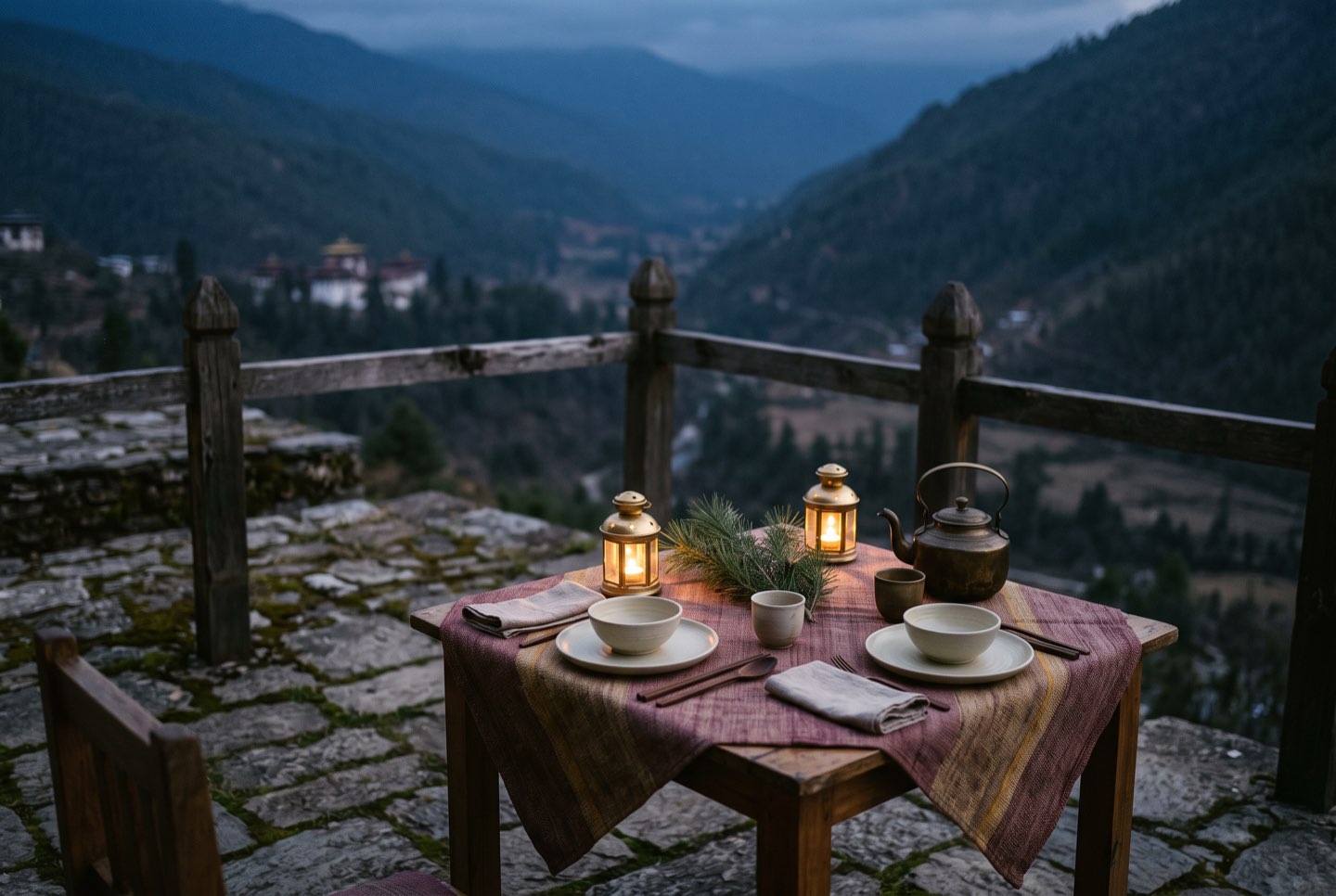 A table for two on a stone terrace at dusk, with small lanterns and a brass teapot, the valley going blue beyond.
How do you mark an anniversary or milestone birthday?
With one thing chosen on purpose, not a programme of surprises. From what our journeys already do, here are the ingredients we would combine:
- A private riverside picnic beneath Punakha Dzong, which is part of the Soul journey.
- A privately arranged dinner in Paro, which is how that journey ends.
- The Tiger’s Nest morning, for a milestone you would like to earn. A horse may help for part of the ascent, never the descent.
- A hot-stone bath, the evening after a big walk.
- One extra night, which is often the best gift of all.
Lodges can have occasion offers of their own, so tell us the date and what it marks and we will ask what each can do. Ceremonies, blessings and weddings are absent from this guide on purpose. Official sources on them are thin, and we would rather say so than guess. If that is what you have in mind, ask us directly.
What should couples avoid?
The usual mistakes are all about too much. Avoid five valleys in eight days; the roads are slow, and our guide to how many days in Bhutan shows why. Avoid the Tiger’s Nest on the day you land. Avoid choosing a lodge from a single photograph, because the valley matters more than the pillow.
Avoid booking late for October, when the smallest lodges go first. Avoid expecting nightlife; a good dinner and a clear sky are the entertainment. And avoid assuming the guide can be waived. It cannot, so make friends with the idea early, and tell us the kind of company you like, so we can talk it through well before you arrive.
Frequently asked questions
Is Bhutan too spiritual for a honeymoon?
No. Faith is visible everywhere, in prayer flags, shrines and monks, but nobody asks you to do more than be courteous. Our guide to dzong and temple etiquette covers the courtesy.
How many days for a honeymoon?
Eight is where we start, which gives you the western valleys and an open day. Add two or three more if you want rest days or the crane valley.
Can we have a private dinner?
Yes. The Soul of Western Bhutan ends with a privately arranged dinner, and Rivers, Dzongs & Bliss lists private dining. What is possible on other nights depends on the lodge and your dates, so ask us.
Can we celebrate a milestone birthday with family?
Yes. The Department of Tourism sets the Sustainable Development Fee at US$50 for children aged 6 to under 12, and none under 6. Our guide to multi-generation journeys in Bhutan shows how the days change.
Come for each other, and let the valley do the rest.