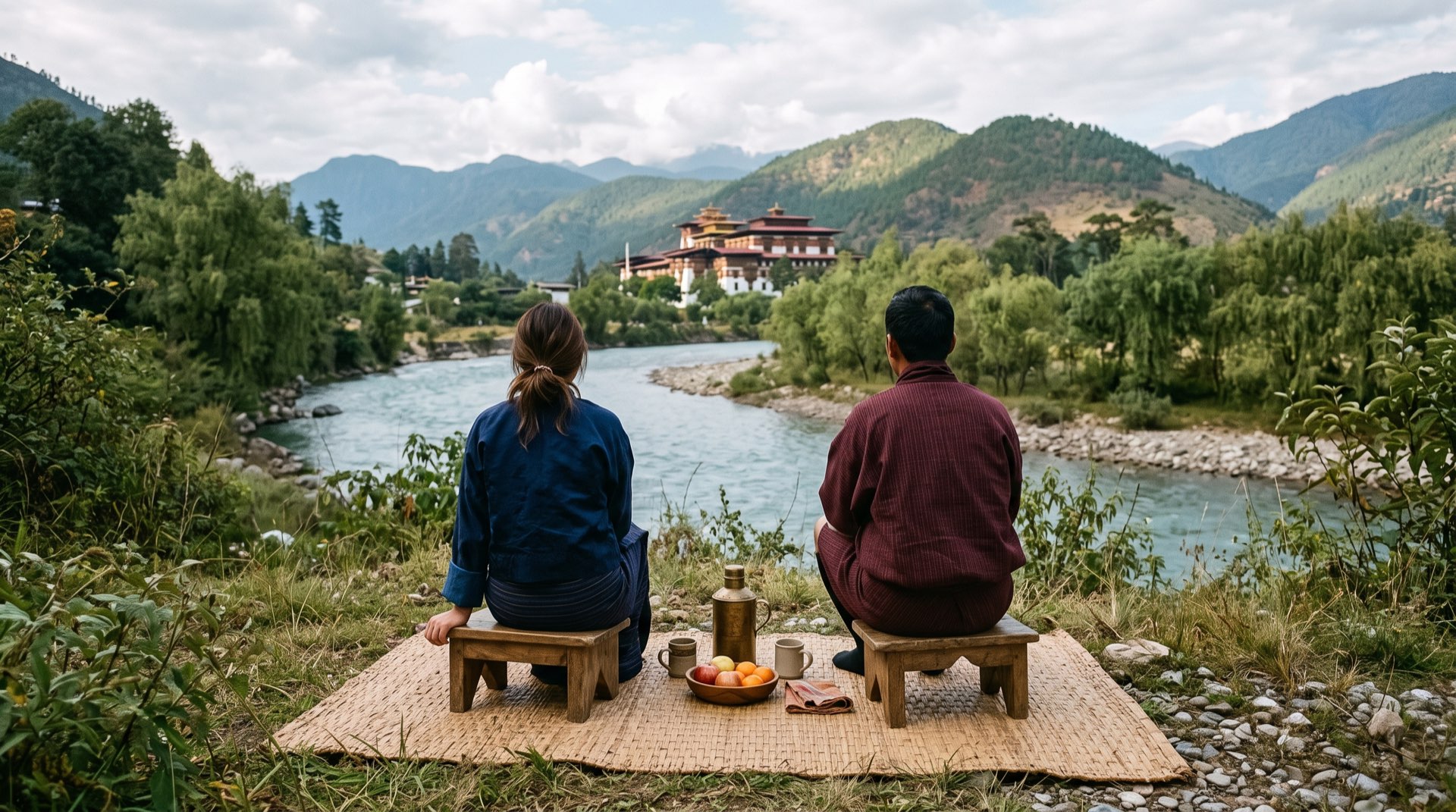
The flask of tea comes out first, then the fruit, then a blanket that someone has folded with rather more care than a riverbank strictly needs. The Mo Chhu rushes past, cold and green. Across the water, the whitewashed walls of Punakha Dzong glow in the afternoon light, and the prayer flags by the bridge lift and settle in the breeze. Nobody is checking the time.
We mention this moment because it is usually when the worry fades. You have come a long way, and a small voice asks whether slowing down means missing out. It’s a question we hear often, and our answer never changes: in Bhutan, doing less is how you see more.
| At a glance | Detail | Source |
|---|---|---|
| Your guide | Every visitor must be accompanied by a guide; on our journeys, yours travels with you alone | Department of Tourism |
| Getting around | No self-drive car hire; you travel with a private driver | Department of Tourism |
| Pace | Two or more nights in most valleys | Bhutan Luxury Travel, 2026 |
| Longest drive on our western loop | Punakha to Paro, about 4–4.5 hours, with stops | Bhutan Luxury Travel, 2026 |
| Journey lengths | 6, 8 and 11 days as starting points, each reshaped around you | Bhutan Luxury Travel, 2026 |
| Checked | 27 September 2026 |
Why is time the real luxury in Bhutan?
Because it’s the one thing most holidays run short of, and Bhutan is set up to give it back. The country measures its progress through Gross National Happiness, and one of the nine domains behind that measure, according to the GNH Centre Bhutan, is time use. A nation that pays attention to how people spend their hours is a very good place to spend yours slowly.
Tourism follows the same thinking. Every visitor pays a nightly Sustainable Development Fee, and the Department of Tourism explains that, alongside healthcare, education and conservation, it helps the country keep offering guests a tranquil, intimate experience. Fewer visitors mean quieter courtyards, emptier trails and guides with time to talk.
So we plan around that. Fewer moves, longer stays, and days with room to breathe. The luxury isn’t the marble in the bathroom, though you may well find some. It’s the empty afternoon, the second pot of tea, the conversation that wanders off course and turns into the part of the day you remember.
What does “unhurried” look like on a real day?
It looks like one big thing, done properly, with space on either side. Take the Punakha day on The Soul of Western Bhutan, our eight-day journey.
After a slow breakfast, you cross the traditional cantilever bridge to Punakha Dzong, a dzong being a fortress that houses both monks and government offices. It was built in 1637–38 where the Pho Chhu and Mo Chhu rivers meet, and its name means the palace of great happiness, as the Punakha district administration records. You spend real time in its courtyards rather than a quick lap. Lunch is a private picnic by the river. The afternoon belongs to you: a gentle walk through the rice terraces, a hot-stone bath, or a book and a window seat at the lodge.
That’s it. One dzong, one picnic, one choice. It sounds modest on paper. In practice it is often the day people describe first when they get home. If Punakha catches your imagination, our guide to Punakha and Wangdue shows how many nights it deserves.
Mornings start early only when the light or a walk calls for it. We would rather you arrive at a monastery curious than exhausted.
Who sets the pace on a private journey?
You do. Every journey we plan is private: your own guide, your own driver, and a plan that bends around you. Bhutan requires every visitor to be accompanied by a guide, and there is no self-drive car hire, so the real question is whether your guide is shared with a busload. On our journeys, never.
That changes the shape of a day. If a farmer waves you in for tea, there is time to say yes. If the light over the Dochula pass is perfect, the car stops. If your knees vote against the last flight of temple steps, nobody minds.
Your guide is also your interpreter of small things: why you walk clockwise around a chorten, a Buddhist shrine; what the colours of the prayer flags stand for; when to lower your voice. Private travel isn’t about keeping Bhutan at arm’s length. It’s about having someone beside you who opens doors.
And your driver? Bhutan’s mountain roads twist and climb, so you won’t be setting any speed records. You will, however, know every good place to stop for the view.
Which moments stay with people?
Rarely the ones in the itinerary’s headline. The Tiger’s Nest is unforgettable, of course, and our honest guide to the Tiger’s Nest hike will help you enjoy it. But the moments we see people light up for tend to be smaller.
Coffee among the prayer flags at Dochula, where 108 chortens crown the ridge and, on a clear morning, the eastern Himalaya lines the horizon. A quiet hour with a thangka painter, an artist of Buddhist scroll paintings, as a face appears one fine brushstroke at a time. Tea in a farmhouse kitchen, sitting cross-legged near the stove, with suja, the salty butter tea that first-timers find either deeply comforting or deeply confusing.
And the hot-stone bath. Bhutan’s own tourism website lists hot-stone bathing among the ways to soothe the spirit here, and after a day in the mountains a wooden tub warmed by fire-heated stones does exactly that. We explore the ritual, and more, in our guide to Bhutan’s wellness traditions.
Where do the lodges fit in?
They are part of the journey, not a pause from it. The lodges we use most, from Amankora and Six Senses to COMO Uma and Pemako, each have their own character, and a good one makes staying in on a rainy afternoon feel like a genuine plan.
This is where slow travel quietly pays off. We plan two or more nights in most valleys, so you unpack once, learn which chair catches the morning sun, and wake up already there. A long lunch at the lodge becomes a choice rather than a gap in the schedule.
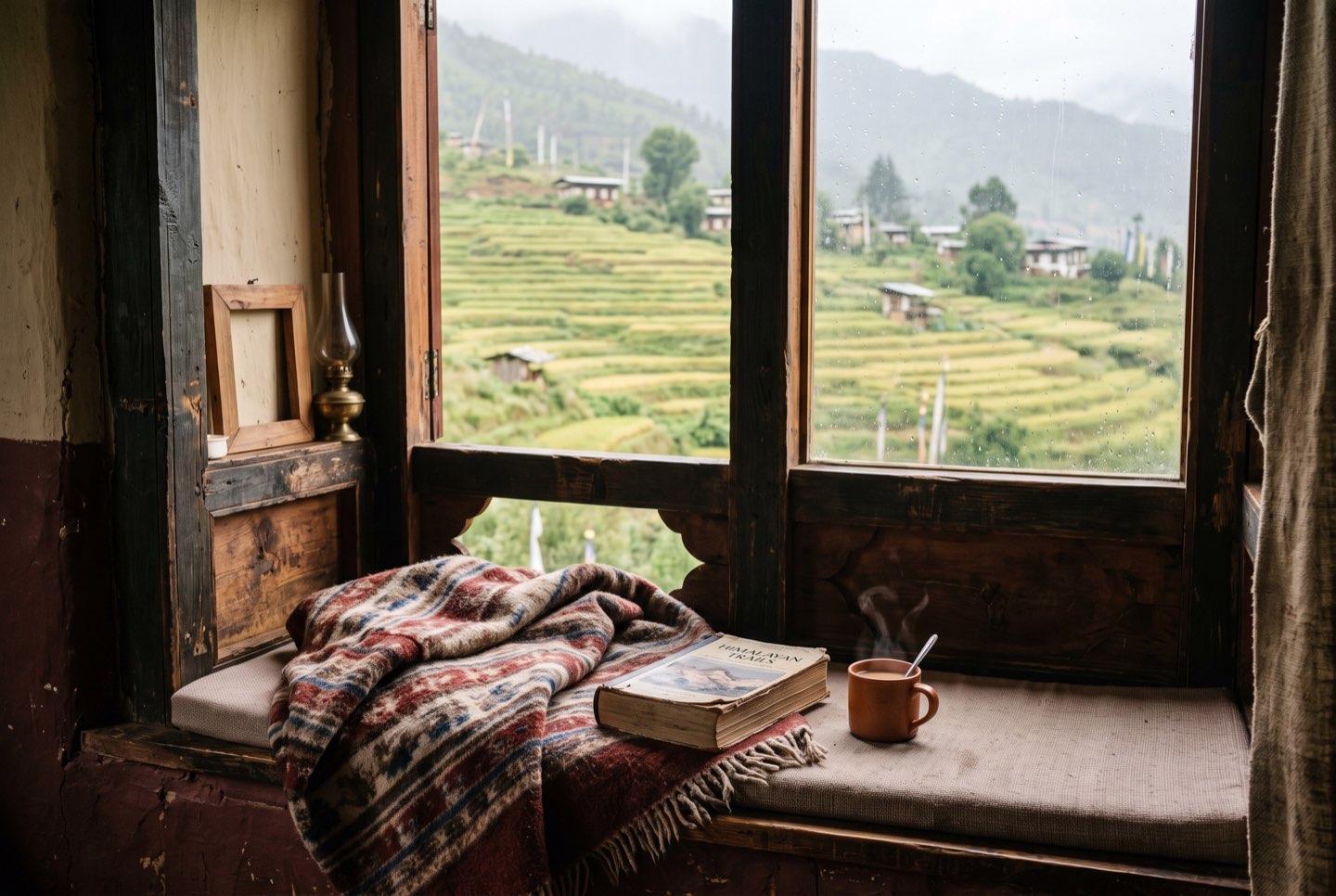 A window seat, a wool throw and a cup of tea, while soft rain falls on the terraced fields.
Different lodges suit different travellers, and mixing brands valley by valley often works better than staying loyal to one. Our guide to choosing Bhutan’s luxury lodges walks through each valley in turn, from Paro’s pine forests to the crane valley of Phobjikha.
How many days do you need?
More than you think, and fewer than you fear. Our shortest journey, Rivers, Dzongs & Bliss, gives western Bhutan six unhurried days. The Soul of Western Bhutan takes eight, and Cranes & the Central Valleys reaches the crane valley and Bumthang in eleven.
The real question isn’t how many sights, but how many nights in each valley. Mountain roads reward patience, so every move between valleys takes a good part of the day. Add a valley and you add a drive; add a night and you add a whole day of actually living somewhere. When in doubt, we suggest the extra night.
We go through the trade-offs in our guide to how many days in Bhutan, including what fits into a first visit and what is worth saving for the next one. And if Bhutan is only one stop in a longer trip, read about combining Bhutan with Nepal, Sikkim or Bangkok.
Who is slow luxury for (and who isn’t it for)?
It’s for travellers who would rather feel a place than photograph all of it. Couples who want time together, not a timetable (our guide to Bhutan for couples has more). First-timers who want to understand what they are looking at. Families too: multi-generation journeys in Bhutan work well at this pace, because grandparents and grandchildren tire at different times and nobody needs to be hurried. Older travellers find the pace kind as well; our guide to Bhutan for older travellers covers stairs, altitude and long drives.
It isn’t for everyone, and we would rather say so now. If you want to see every dzong in the country in a week, Bhutan’s roads will politely overrule you. If you need nightlife or a packed schedule to feel you are getting your money’s worth, the silences may feel long. If you are weighing Bhutan against other places for a slow trip, we set out Bhutan versus Nepal or Japan side by side.
Slow doesn’t mean idle, either. The Tiger’s Nest is a proper half-day hike, the passes are cold at dawn, and some temple stairs are steep. We simply space the effort out, with rest in between.
Not sure where you fit? Tell our journey finder how you would like to feel, and it will suggest where to begin.
Where to go next
If one of the ideas above caught your eye, these guides pick it up.
- Combining Bhutan with Nepal, Sikkim or Bangkok: a route planner for adding a second country, and the buffer days it needs.
- Bhutan for couples: a honeymoon or anniversary, romance taken slowly.
- Bhutan versus Nepal or Japan: how the three compare, and a simple way to choose.
- Bhutan for older travellers: stairs, altitude and drives, said plainly.
- Punakha and Wangdue: what to do in the warm valley and how many nights it deserves.
Frequently asked questions
Is everything private?
Your guide, driver, vehicle and plan are yours alone. Lodges, dzongs and monasteries have other visitors, of course, but we time visits for quieter hours where we can, and meals like a riverside picnic or a farmhouse lunch are arranged just for you.
Can I change the plan on the day?
Usually, yes. Skipping a temple for a longer lunch, or swapping a walk for a hot-stone bath, is a conversation with your guide, not a crisis. Bigger changes, such as adding a night somewhere, depend on lodge availability, so we check before we promise.
Is it suitable for first-timers?
Very. A slower pace gives you time to take in the customs, the food and the altitude without feeling overwhelmed. Most first visits focus on the west, where Paro, Thimphu and Punakha offer plenty to fill a week at an easy pace.
What does ‘tailor-made’ actually mean?
It means our journeys are starting points, not packages. We ask how you like to walk, eat, rest and explore, then reshape the route, the lodges and each day around your answers, before you arrive and while you are here.
Bhutan doesn’t reward the fastest traveller. It rewards the one who stays for another cup of tea.