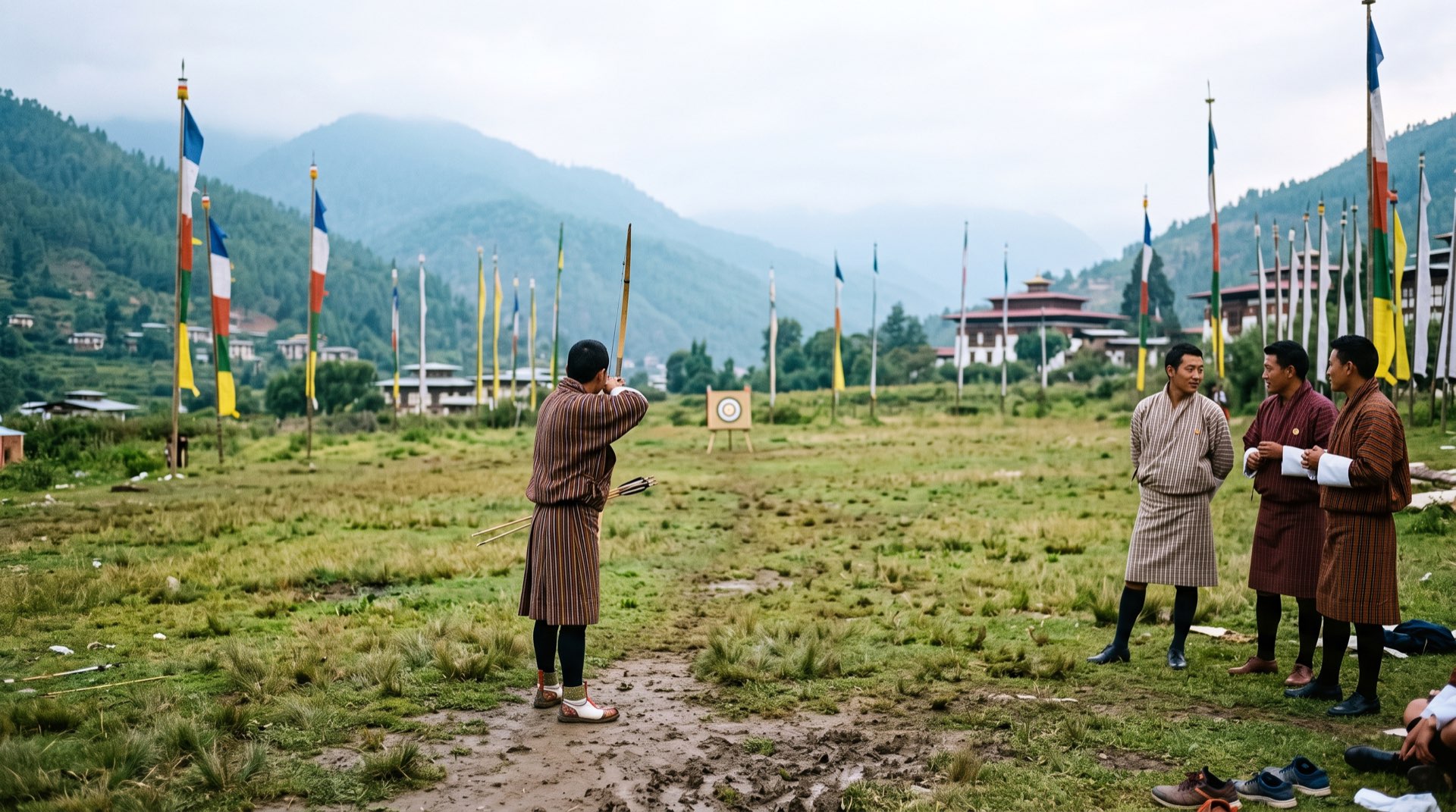
Late afternoon on a village field, and an arrow is somewhere in the air. It has a long way to go: the target is a small painted board at the far end of the range, and the archers stand in their gho, the knee-length robe men wear, waiting to hear it land. When it hits, the team breaks into song and a few dance steps. The other side looks studiously unimpressed. Nobody checks a phone, and nobody seems in a hurry to go home.
You may have read that Bhutan is “the happiest country in the world”, and quietly suspected it was a slogan. That suspicion is half right. The headline is too simple. The idea behind it is Bhutan’s own, and it is far more interesting.
We live with GNH every day in Thimphu, so let us show you the idea behind the headline.
| At a glance | Detail | Source |
|---|---|---|
| Four pillars | Good governance; sustainable socio-economic development; preservation and promotion of culture; environmental conservation | GNH Centre Bhutan |
| How it’s measured | 33 indicators across nine domains, from 11,052 face-to-face interviews | Centre for Bhutan & GNH Studies |
| GNH Index 2022 | 0.781 on a scale of 0 to 1, up from 0.743 in 2010 | Centre for Bhutan & GNH Studies |
| Forest cover | At least 60% of the land, “for all time” (Article 5) | Constitution of Bhutan |
| Carbon | Net sink of about 5.6 million tonnes of CO₂ (2015 inventory) | Second NDC, UNFCCC |
| Checked | 27 September 2026 |
What is Gross National Happiness, in one paragraph?
It is a way of judging a country’s progress by more than its income. The idea took shape in the 1970s under the Fourth King, Jigme Singye Wangchuck, who questioned whether economic growth alone could deliver wellbeing. The GNH Centre Bhutan describes four pillars: good governance, sustainable socio-economic development, the preservation and promotion of culture, and environmental conservation.
Those pillars are broken down into nine domains that the country actually measures: psychological wellbeing, health, education, time use, cultural diversity and resilience, good governance, community vitality, ecological diversity and resilience, and living standards.
The wording in the Constitution of Bhutan is careful, and worth reading twice. Article 9 says the state shall “strive to promote those conditions that will enable the pursuit of Gross National Happiness”. Conditions, not a feeling. Pursuit, not a guarantee.
So GNH isn’t a mood ring for the nation. It’s a compass for policy: a set of questions meant to shape what gets built, protected and paid for.
Why are forests written into the constitution?
Because Bhutan decided its forests were too important to leave to any single government. Article 5 of the constitution requires that at least 60 per cent of the country’s land remain under forest cover “for all time”, and Bhutan’s own climate submission to the UN puts actual cover at around 71 per cent.
Those forests do real work. According to Bhutan’s Second Nationally Determined Contribution to the UN climate convention, the country emitted about 3.8 million tonnes of CO₂ equivalent in 2015, while its forests absorbed about 9.4 million tonnes, leaving a net sink of roughly 5.6 million tonnes. Clean hydropower helps keep emissions low.
Bhutan has pledged to stay carbon neutral, meaning its emissions must never exceed what its forests and sinks absorb. That is a promise the country has to keep renewing as it grows, not a trophy on a shelf.
You feel it from the car window. Leave Thimphu for the high passes and the valleys beyond, and the forest comes right down to the road: blue pine, oak, rhododendron, moss on everything, the air cold and resinous. It’s a landscape a law is quietly looking after.
Are healthcare and education really free?
Yes, for Bhutanese citizens, by law. The constitution commits the state to free access to basic public health services “in both modern and traditional medicines”, and to free education for every child of school-going age up to tenth standard, with higher education open to all on merit.
That small phrase about traditional medicine is worth noticing. Bhutan’s own healing traditions are part of what the state provides, alongside modern medicine, rather than something on the fringe.
Free, though, doesn’t mean easy. Keeping schools and clinics staffed in a mountainous country is hard, and it is getting harder. BBS reported in May 2025 that, according to a World Bank report, 69.5 per cent of civil service resignations the previous year came from the education and health sectors. Teachers and nurses are part of the migration story we come to below.
For visitors, the practical point is simple. These are public services for citizens, funded in part by the country’s visitors, which is one reason tourism here works the way it does.
Where will you feel GNH on an ordinary Tuesday?
In the pace, mostly. Nobody announces GNH on a Tuesday, but you notice it in small things once you start looking.
Archery, or da, is the national sport, and a match between neighbouring villages can take up a whole afternoon, with songs and good-natured heckling between shots. In Thimphu, the National Memorial Chorten, built in 1974 in memory of the Third King, draws older residents every day. They walk slow clockwise circuits, turning the big prayer wheels and catching up with friends as they go.
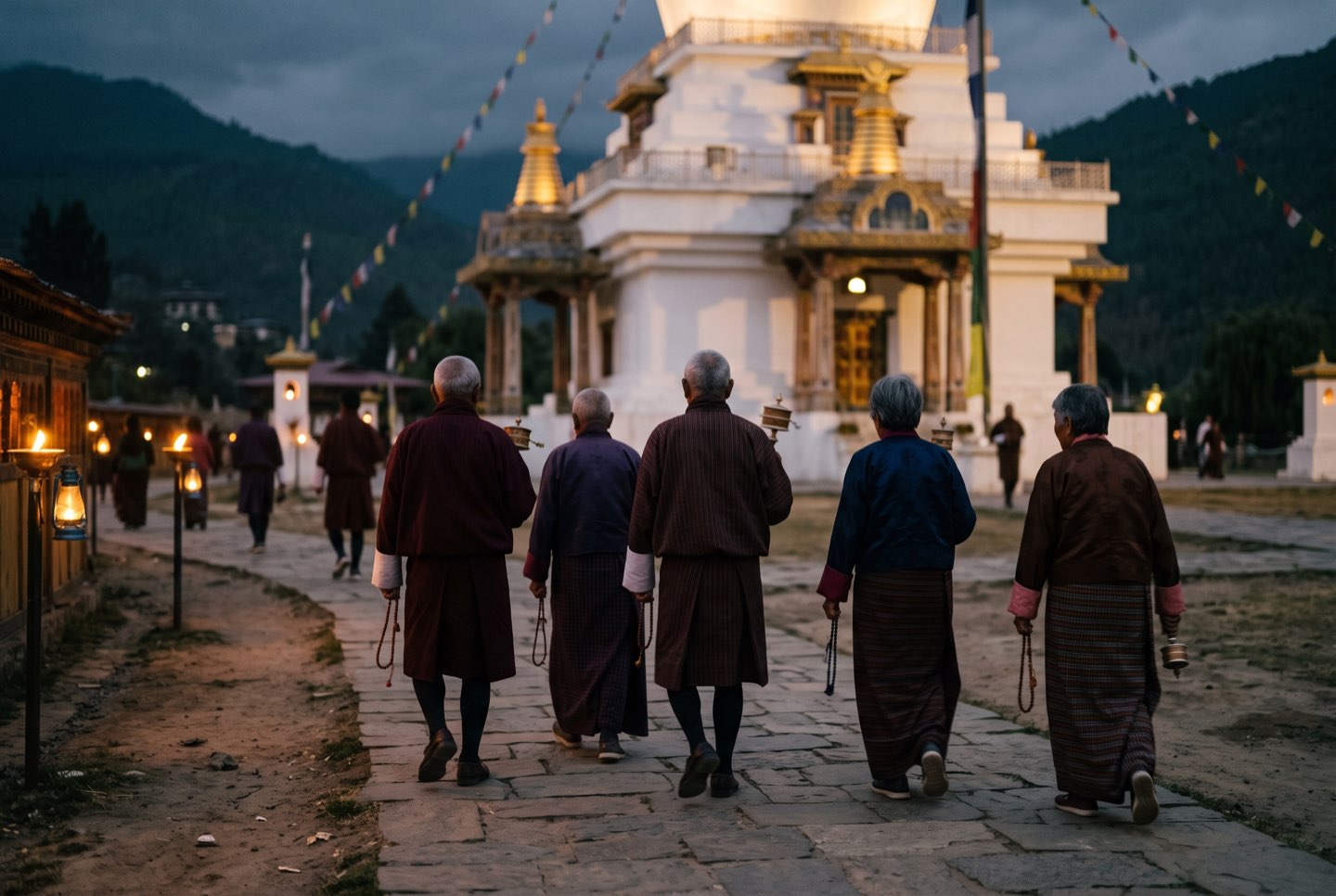 Evening circuits around the National Memorial Chorten in Thimphu, as the lamps come on.
Then there’s time itself. Time use is one of the nine domains, and the 2022 GNH report counts people as having enough sleep only if they get at least eight hours, and a healthy working day as no more than eight. We find this the most persuasive policy idea we have ever read.
For you, it shows up as an absence of rush, and it’s one of the easiest ways into Bhutan’s living culture. Sit a little longer. The day will wait.
Where does tourism fit in?
Tourism is meant to pay its way without wearing the country out. That is the thinking behind Bhutan’s Sustainable Development Fee, the nightly fee visitors pay on top of their journey.
According to the Department of Tourism, the fee goes into the government’s consolidated account, like other taxes and levies. Once running costs such as salaries are covered, the remaining revenue funds development work: building schools, providing free healthcare, training young people, maintaining forests and wildlife, supplying clean drinking water and renovating the historic dzongs, the great fortress-monasteries. It isn’t a ring-fenced fund, then, but it is a real contribution to the conditions GNH is about.
The other half is how tourism is done on the ground. We work with local guides, producers, artisans and family-run businesses, and keep every group small. In the villages of Adha and Rukha, profits from guest visits helped build hygienic toilets and kitchens. You can read more about how we give back.
Is everyone in Bhutan happy?
No, and GNH has never claimed they are. Bhutan’s own survey is refreshingly blunt about it. In the 2022 GNH report, the Centre for Bhutan & GNH Studies counted 48.1 per cent of people aged 15 and over as “deeply” or “extensively” happy, meaning they had enough in at least two-thirds of the weighted indicators. Another 45.5 per cent were narrowly happy, and 6.4 per cent were unhappy.
The trends are mixed, too. Wellbeing in rural areas has risen strongly since 2010, while the share of happy people in towns fell between 2015 and 2022. And many young, educated Bhutanese are leaving: according to BBS, the World Bank found that the number leaving for Australia roughly doubled between 2020 and 2024, with limited private-sector jobs, low wages and slow career growth among the reasons.
We find this honesty reassuring rather than disappointing. A country that publishes figures like these is using GNH as a working tool, not a postcard. What you’ll meet isn’t a nation of permanent smiles, but one that keeps asking, out loud, whether its choices are making life better.
How can you travel in the spirit of GNH?
Slowly, respectfully and with curiosity. That’s really all it asks of you.
- Stay longer in fewer places. It’s gentler on you and on the valleys, and it’s the heart of slow luxury in Bhutan.
- Say yes to the unplanned. An archery match, a village festival, a cup of tea in a farmhouse kitchen.
- Dress for the dzong. Long sleeves and covered legs in temples and fortresses, and walk clockwise around chortens and prayer wheels.
- Spend close to the source. Buy weaving and crafts from the people who make them, and eat where local families eat.
- Ask questions. Your guide grew up with GNH. Ask what it means to them, and you’ll get a personal answer rather than a brochure one.
Frequently asked questions
Is Bhutan the happiest country?
Not in any measured sense, and that isn’t what GNH is for. It’s a yardstick for judging development, not a league table, and by its own demanding standard the country counts just under half of its people as happy.
How is GNH measured?
Through a national face-to-face survey run by the Centre for Bhutan & GNH Studies, most recently in 2022, alongside earlier rounds in 2010 and 2015. Each person is scored on 33 indicators, from sleep and literacy to family and safety, and the results are combined into a single index between 0 and 1.
Is Bhutan really carbon negative?
On the government’s own figures, yes. In 2015 its forests absorbed about 5.6 million tonnes more CO₂ than the country emitted, and it has committed to remain carbon neutral.
How does tourism support GNH?
Directly, through the fee each visitor pays into the national budget. Indirectly, through where your money goes each day: to guides, drivers, farmhouse kitchens, weavers and village families.
GNH won’t hand you happiness at the airport. But give Bhutan a slow week, and you may start measuring your own days a little differently.