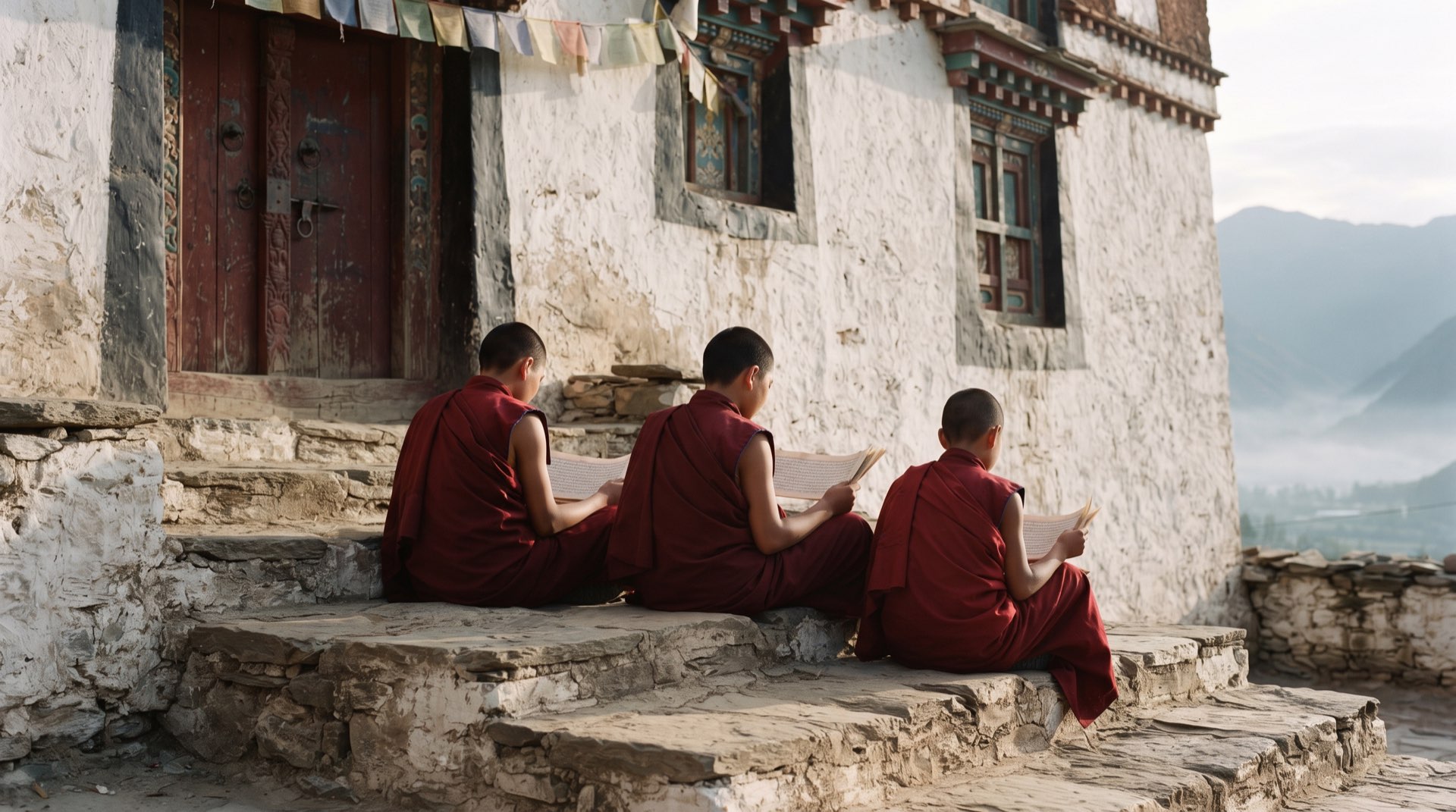
A drum is being struck somewhere above you, slowly, and juniper smoke drifts down the wooden stairs. Across the courtyard a line of maroon robes crosses the flagstones without hurry. Behind them a man in a gho, the knee-length robe Bhutanese men wear, hurries the other way with a folder under his arm. You have been in Bhutan for two days, and you have just realised that you cannot tell a novice from a lama, or a temple from a monastery, or whether the fortress around you is an office or a place of prayer. (It is both.)
That is a perfectly good place to be standing. Bhutan’s Buddhism is lived so plainly that nobody thinks to explain it. So we will: who is who, which building is which, and where the monks are through the year, so you can go back to watching with a little more at your elbow.
| At a glance | Detail | Source |
|---|---|---|
| Constitution, Article 3 | Buddhism is Bhutan’s “spiritual heritage”; the Druk Gyalpo is protector of all religions; religious institutions stay above politics | Constitution of Bhutan |
| Monastic school | Monks and nuns follow the Kagyu school; the Drukpa Kagyu sect was introduced by Phojo Drugom Zhigpo | Department of Tourism |
| Je Khenpo | Appointed by the Druk Gyalpo on the recommendation of the Five Lopons; chairs the Dratshang Lhentshog | Constitution of Bhutan |
| Monk body’s year | Six winter months in Punakha; back at Tashichho Dzong in Thimphu on the first day of the fourth Bhutanese month | BBS, 2013 report |
| District monk bodies | Each dzongkhag has a rabdey that performs ceremonies, preserves teachings and assists at state religious functions | Dratshang Lhentshog |
| Checked | 30 September 2026 |
What kind of Buddhism is practised in Bhutan?
Vajrayana Buddhism of Tibetan origin, with a monastic tradition in the Kagyu school. The Department of Tourism says a majority of Bhutanese follow the Vajrayana or Mahayana branch, which began in Tibet, and that monks and nuns follow the Kagyu school. It tells the arrival in layers. Guru Rinpoche, the eighth-century tantric master, first introduced Buddhism; Phojo Drugom Zhigpo introduced the Drukpa Kagyu sect; and the Zhabdrung, Ngawang Namgyal, the leader who unified the country and arrived from Tibet in 1616 by the Department’s dating, brought several schools that flourished under his rule. That is the Department’s account, and it simplifies: it also says Guru Rinpoche propagated the Nyingma school, and Nyingma is very much alive, since the Wangdue Phodrang district page calls Gangtey Goenpa, above the Phobjikha valley, an important Nyingma monastery. “Kagyu” is the Department’s word for the monks’ and nuns’ tradition, not the only school you will meet. Our short history of Bhutan puts those names on a timeline.
You will sometimes read that Buddhism is Bhutan’s “state religion”. The Constitution’s own word, in Article 3, is “spiritual heritage”, which it says promotes peace, non-violence, compassion and tolerance. The same article makes the King the protector of all religions in Bhutan. For the everyday texture around all this, Bhutan’s living culture is the place to start.
Who is who: the King, the Je Khenpo and the monk body?
The King protects, the Je Khenpo leads the monks, and the Constitution keeps the roles apart. The Druk Gyalpo, the King, is head of state. The Je Khenpo is the head of the monk body, and the Druk Gyalpo appoints him, on the recommendation of the Five Lopons, the senior masters of the Zhung Dratshang, or Central Monastic Body. The Je Khenpo in turn appoints the Five Lopons, on the recommendation of the Dratshang Lhentshog, the council he chairs. When you hear “His Holiness” in this context, it means him.
Then comes the rule. Religious institutions and personalities, the Constitution says, must promote the country’s spiritual heritage while ensuring that religion remains separate from politics, and they shall remain above politics. The State, for its part, keeps funding the Zhung Dratshang and the district monk bodies (more on those in a moment).
What is the difference between a dzong, a lhakhang, a goemba and a chorten?
Purpose, mostly, and what you do at the door. The Department of Tourism describes temples and monasteries as built in the dzong style, and chortens as white stupas with a square base under a dome. The Constitution itself lists “Dzongs, Lhakhangs, Goendeys” as separate kinds of heritage for the State to protect.
| Word | What it is | How to spot it |
|---|---|---|
| Dzong | A fortress that is also a monastery and a district office | Angled whitewashed walls, one fortified door, a central tower (utse) and a red band near the top |
| Lhakhang | A temple | The dzong layout and style: whitewashed walls, sloping roofs |
| Goemba | A monastery: temples plus the community around them | Resembles a dzong in design and painted murals |
| Chorten | A stupa, not a room | White, square base, domed top |
Spelling is still a moving target, so maps also say goenpa and gonpa: one word, not three buildings. In a dzong you spend most of your time in the courtyards, and only the temples inside ask you to remove your shoes; at a lhakhang, the door is where that starts. A chorten you never enter. You walk round it, clockwise.
Where does the monk body live through the year?
In Thimphu for the summer and Punakha for the winter, a rhythm older than the country’s roads. BBS reports that the Je Khenpo and the monks of the Zhung Dratshang spend six winter months in Punakha, then return to their summer residence in Tashichho Dzong on the first day of the fourth Bhutanese month, a tradition it says the Zhabdrung instituted in the 17th century. Its report is from 2013, but the custom, it notes, is annual. The return is a procession: in that report thousands of people lined the highway to offer prayers and receive blessings from the Je Khenpo and the sacred relics, the nangtens, travelling with the monks, and in keeping with tradition the party rested overnight at Simtokha.
The fourth month follows the moon, so the date shifts every year. Punakha’s February and March festivals fall in the middle of the winter stay; our guide to Bhutan’s festivals lists them. We cannot promise a procession for your dates, but we can check where the monk body will be. Both Thimphu and Punakha are stops on The Soul of Western Bhutan, an easy route for following the monks.
What do monks, nuns and gomchens actually do?
Mostly they pray on behalf of other people. The Department of Tourism describes monks and nuns of the Kagyu school praying for all living beings to be freed from suffering, and that is the work behind the rest. Each district also has a monk body called a rabdey, which, the Dratshang Lhentshog’s own page says, performs religious ceremonies, preserves Buddhist teachings and assists at state religious functions. At a tshechu, the great annual festival, the religious music and chanting you hear include the monastic body’s.
Gomchens, the lay monks you may hear about, are different again. We explain them below.
You may see figures for how many monks and nuns Bhutan has. We haven’t found an official count, so we print none.
What should you do when you enter a temple?
Less than you fear. Wear long sleeves and cover your legs, take off your hat, and leave your shoes at the door with everyone else’s. Inside, keep your voice low and your hands to yourself: no touching paintings or sacred objects, no sitting on a lama’s throne, no photographs. Then follow the room. Walk clockwise, sit cross-legged if you are invited to sit on the floor, and never stand between someone praying and the altar. Our guide to dzong and temple etiquette has the full list, with the Department of Tourism’s wording.
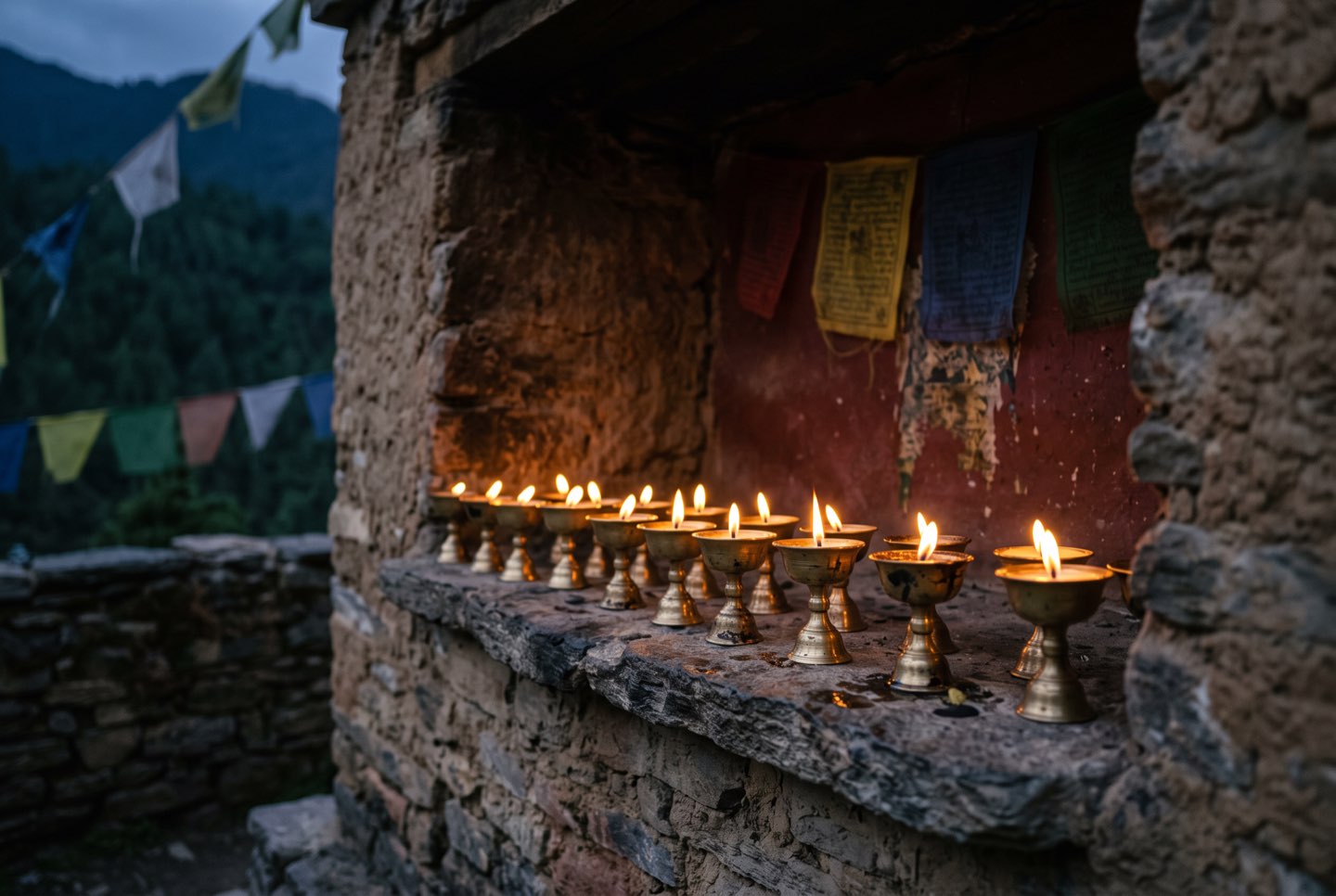 A row of butter lamps burning in a stone alcove at a chorten at dusk.
The rest is watching. Bhutanese Buddhists believe that acts of devotion, from a lap of a chorten to a prayer wheel turned, gather merit, and you will see people fit in a few circuits on the way to somewhere else. Nobody counts yours. For the stranger sights around a temple, from painted walls to masked dances, read Bhutan’s beliefs, decoded.
Can visitors receive a blessing?
Yes, if you would like one. Bhutanese Buddhists believe a blessing from a lama, a monk or a sacred object brings protection and merit, and it is offered, not booked. What it looks like depends on the temple and the person giving it. At Chimi Lhakhang in Punakha, for example, pilgrims receive a tap on the head with a sacred object. The crowds along the highway for the Je Khenpo show how sought-after a blessing is, and how ordinary.
Tell your guide that you would like to receive one. They will speak to the monk, show you what to do and tell you what, if anything, is appropriate to offer on the day. Then accept it quietly, the way the people around you do. You do not have to share the belief to receive the blessing respectfully; you only have to take it as it is meant.
Frequently asked questions
Who is the Je Khenpo?
The head of Bhutan’s monk body. The Constitution asks for a learned and respected monk, ordained in accordance with the Druk-lu, with the nine qualities of a spiritual master. You will hear him called His Holiness, and you will read about him whenever the monk body makes its seasonal move.
What is a gomchen?
A lay monk, meaning a practitioner who is not a celibate monastic. The Wangdue Phodrang district page describes the gomchen who help maintain Gangtey Goenpa, above the Phobjikha valley, as lay monks, “not necessarily celibate”. Our Cranes & the Central Valleys journey spends a full day in the valley below.
Can women become monastics?
Yes. The Department of Tourism speaks of monks and nuns alike following the Kagyu school, and in June 2022 the Je Khenpo conferred gelongma vows on nuns at Ramthangka in Paro, an ordination BBS called the first of its kind, organised by the Bhutan Nuns Foundation with the Central Monastic Body.
Can I speak to a monk?
Often, through your guide, but not always: monks may be studying, praying or busy with a ceremony. Wait to be introduced, keep questions kind and curious, and ask before any photograph. A monk is a person, not a backdrop.
Come curious, leave your shoes at the door, and let the people around you show you how the day is done.