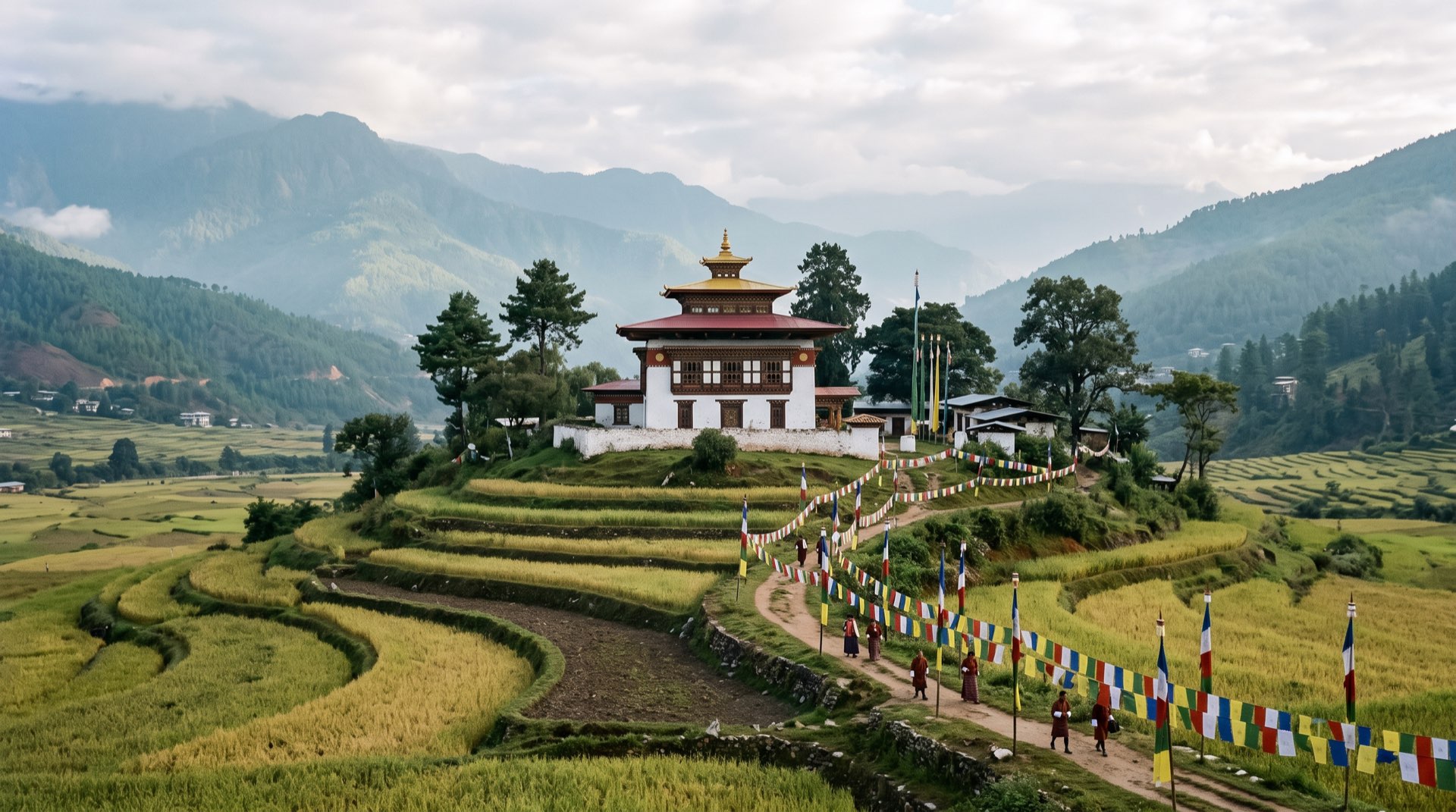
The path to Chimi Lhakhang (lhakhang means temple) runs through rice and mustard fields, under strings of prayer flags, past a village of whitewashed houses. You notice the paintings on the walls at about the same moment as everyone else in your group. There is a pause. Somebody coughs. Somebody else becomes very interested in a cow.
Yes, those are phalluses, painted large and bright beside the doors. And no, nobody here is embarrassed except, briefly, you.
It’s a natural moment, and the worry behind it is a kind one: you don’t want to laugh at something sacred, or look foolish for not understanding it. So here is what these symbols mean, who put them there, and the other beliefs you’ll meet on the way, from a team that has grown up around them.
| At a glance | Detail | Source |
|---|---|---|
| Painted phallus | Believed to protect against evil spirits, gossip and the “evil eye”, and to bless fertility | Department of Culture |
| Drukpa Kunley | The “Divine Madman” (1455–1529), who blessed the site of Chimi Lhakhang | Punakha Dzongkhag Administration |
| Chimi Lhakhang | Built in 1499 by Ngawang Choegyel, the 14th Drukpa hierarch | Punakha Dzongkhag Administration |
| Masked dances (cham) | Sacred dances of peaceful and wrathful deities, a source of blessing for those who watch | UNESCO |
| Atsara | The red-masked festival clown, whose wooden phallus stands for fertility and protection | Department of Culture |
| Astrology | Monks advise on names, wedding dates and good days to begin things | Department of Tourism |
| Checked | 27 September 2026 |
Why is there a phallus on that farmhouse (and why are only you giggling)?
Because Bhutanese believe it protects the household. According to the Department of Culture, the phallus is seen as a powerful talisman against evil spirits, gossip and the “evil eye”, which is why it is often painted near the entrance of a house. It is also a symbol of fertility, believed to bless families with healthy children, prosperity and good harvests.
The paintings are bold and colourful on purpose. The same source explains that their humour and playfulness are thought to disarm negative forces. In other words, the humour is aimed at evil spirits, not at passers-by.
Most importantly, the Department of Culture describes the symbol as viewed with respect and reverence rather than embarrassment. For the family inside, it is no more remarkable than a lucky horseshoe over a door might be to you.
So the giggle is almost universal among first-time visitors, entirely forgivable, and usually a solo performance. Let it pass, then look again. You are looking at a blessing for the people who live there.
Who was Drukpa Kunley, the Divine Madman?
He was a Tibetan saint, Drukpa Kunley (1455–1529), revered in Bhutan for teaching Buddhism in famously unorthodox ways. The Department of Culture describes how he used humour, poetry and deliberately shocking behaviour to convey spiritual truths and to challenge social norms and hypocrisy. The widespread use of the phallus symbol in Bhutan is largely attributed to him.
That is the key to understanding him. The outrageousness had a purpose: to shake people out of hypocrisy and towards the heart of the teaching. A saint who makes you laugh, then makes you think, is harder to forget than one who only lectures.
Tradition gives him a heroic side too. According to the Punakha Dzongkhag Administration, he subdued a demon of the Dochu La pass with what tradition calls his magic thunderbolt of wisdom, and trapped it in a rock near where a chorten (a stupa) now stands, beside Chimi Lhakhang.
Bhutanese tell many stories about him, and some of them are genuinely funny, which is rather the point. Our guides tell them far better than we can write them.
What happens at Chimi Lhakhang, the fertility temple?
Chimi Lhakhang is a small temple on a round hillock in the Punakha valley, where pilgrims come to be blessed, particularly women hoping for children. It was built in 1499 by Ngawang Choegyel, the 14th head of the Drukpa school of Buddhism, after Drukpa Kunley had blessed the site and built a chorten there, according to the Punakha Dzongkhag Administration.
From the village of Sopsokha, a walk of about 20 minutes follows a path through mustard and rice fields, lined with prayer flags. The same source notes that every house in the village has phalluses painted on its outside walls, so by the time you reach the temple, the surprise has usually worn off.
Inside, the temple keeps the original wooden phallus that Drukpa Kunley brought from Tibet, with a silver handle. It is used to bless pilgrims with a tap on the head. Many who make the walk are hoping for a child, and the atmosphere is gentle and sincere.
Chimi Lhakhang is an easy optional walk on our six-day Rivers, Dzongs & Bliss journey. Go slowly, and let the fields do some of the talking.
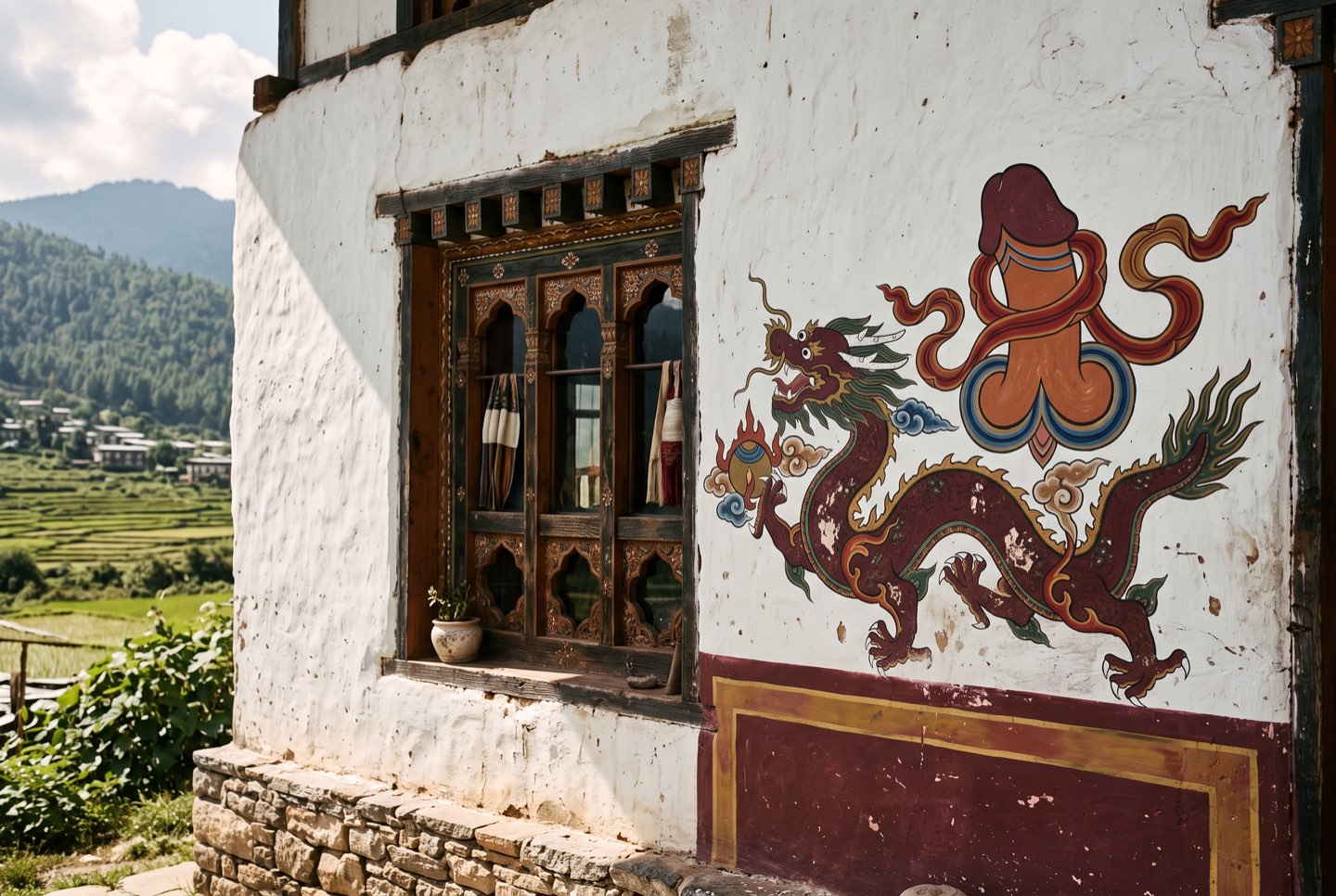 A whitewashed farmhouse wall painted with protective symbols, a winged phallus beside a dragon, under a carved wooden window.
What do the masked cham dances mean?
They are sacred dances, not shows, and Bhutanese believe that simply watching them brings blessings.
UNESCO recognised one of them, the Drametse Ngacham or mask dance of the drums from eastern Bhutan, as intangible cultural heritage in 2008. Its UNESCO listing describes a dance performed in honour of Padmasambhava, better known in Bhutan as Guru Rinpoche, the eighth-century master whom tradition credits with bringing Buddhism here. It has a calm, contemplative part for the peaceful deities and a rapid, athletic part in which the dancers embody wrathful ones. For the audience, it says, the dance is a source of spiritual empowerment.
That word “wrathful” can unsettle visitors, so it helps to know the tradition behind it. The Department of Culture describes Mahakala, a protector who often appears in cham, as the fierce and wrathful form of the Bodhisattva of Compassion. In other words, the fiercest face in the courtyard is there to protect.
Cham are the centrepiece of the tshechus, the great annual religious festivals held in dzong and temple courtyards across the country. Our calendar of Bhutan’s festivals will help you choose one.
Who is the atsara, the festival’s sacred clown?
The atsara is the masked joker who wanders through the dances and the crowd, and he is a beloved part of the sacred festival, not an interruption to it. The Department of Culture describes his red wooden mask with its big nose and expressive eyes, and the wooden phallus he carries to tease the audience. In his hands, it stands for fertility, protection and the driving away of evil spirits.
The atsaras crack jokes and poke fun at social, political and even religious matters. That can look like mischief in the middle of solemn ritual, and it is meant to. According to the same source, the atsara represents a wisdom that goes beyond conventional appearances, reminding everyone not to take life too seriously. The Department of Culture calls this “crazy wisdom”, and it is easy to hear an echo of Drukpa Kunley in it.
If an atsara singles you out, you have been chosen, not insulted. Laugh along. Everyone around you is already laughing, and not at you… well, mostly not at you.
Why do astrology and auspicious days matter so much?
Because many Bhutanese still consult an astrologer, usually a monk, before important decisions. The Department of Tourism explains that readings guide when to marry, when to set off on a journey, when to move house or change jobs, and that astrologers name newborn children and advise on good and bad days. Training to become an astrologer can take up to fifteen years.
You may feel this even as a visitor. Festival dates follow the lunar calendar, and the day chosen to start a building, a business or a long drive may have been checked first.
Would you like a reading yourself? The same article notes that most astrologers welcome an interested foreign visitor, and you don’t need to be a Buddhist. It suggests Pangri Zampa, a monastery near Thimphu, as a fine place to ask. Take it in the spirit it’s offered, and you may find it more moving than you expect.
How should you respond respectfully?
With curiosity rather than embarrassment. Look, listen, and ask your guide what you’re seeing. In our experience, a question about these symbols is always welcome when it is asked kindly, and it often leads to the best conversation of the day.
What does cause hurt is treating the sacred as a prop. Don’t pose for joke photographs with the paintings, with carved phalluses or with ritual objects. In temples, don’t touch religious objects or paintings, and keep your voice low. At festivals, stay at the edge of the dance ground and let people pray without a lens in their face. Our guide to dzong and temple etiquette covers the practical side.
And remember the bigger picture. These beliefs sit inside Bhutan’s living culture, alongside prayer flags, chortens and quiet daily devotion. The painted walls are one colourful thread, not the whole cloth.
Frequently asked questions
Is it respectful to photograph the paintings?
Yes, taken respectfully from the road or path. A farmhouse is someone’s home, so ask if the family is around, and photograph the painting as the art and blessing it is.
Can visitors be blessed at Chimi Lhakhang?
Yes, if you would like to be. Tell your guide, who will speak to the monk and show you what to do, then accept the blessing quietly, as the pilgrims around you do.
Are the dances religious or performance?
Religious first. The Department of Culture describes cham as having the power to purify the land and bless the spectators, even though the courtyard around them feels like a joyful family day out.
What do the masks represent?
Deities, both peaceful and wrathful, and animals real and mythical. In the Drametse dance, UNESCO notes, the dancers wear wooden masks with the features of real and mythical animals.
Come curious, laugh when the atsara says so, and let Bhutan show you that the sacred and the joyful can share one courtyard.