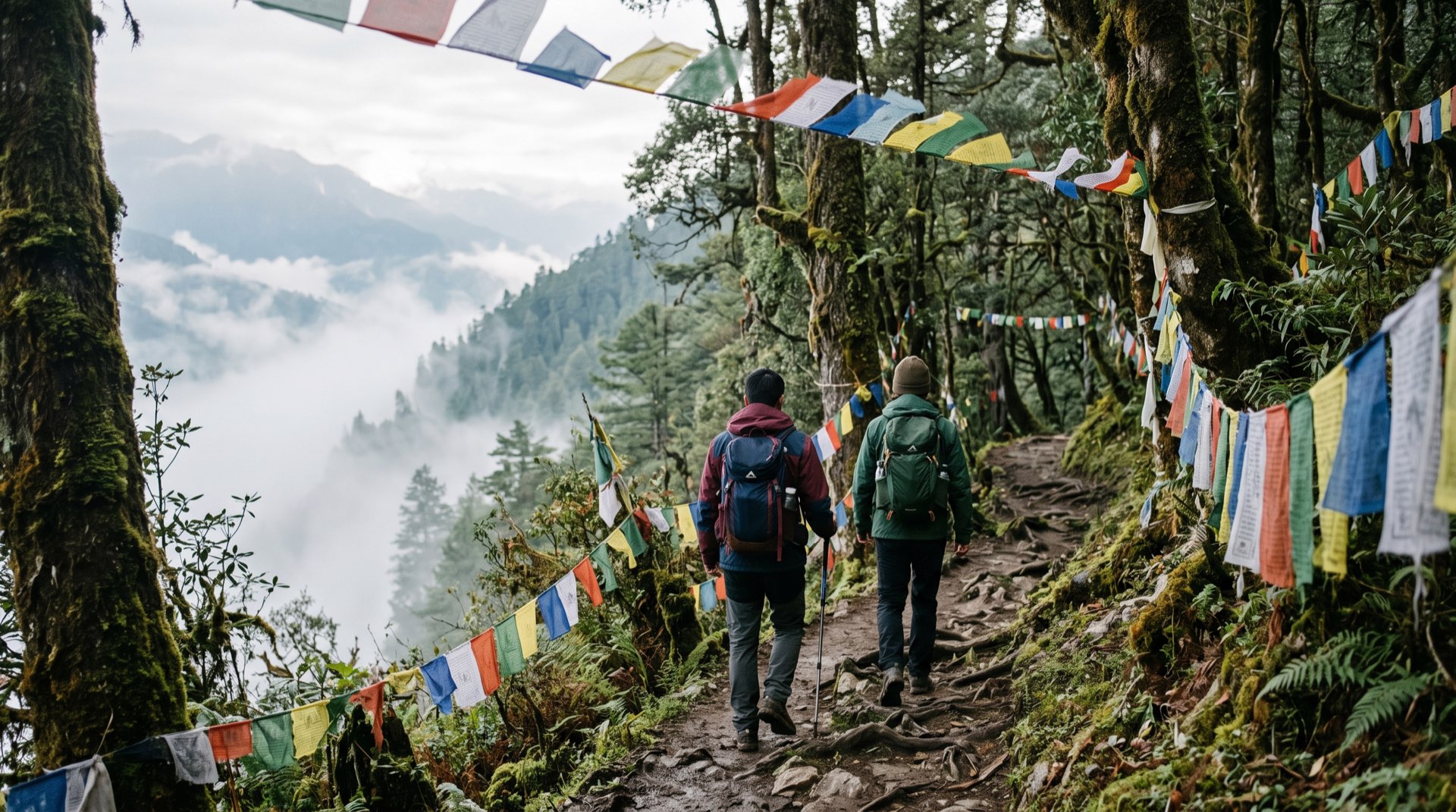
The first thing you notice is the quiet. Then small sounds fill it in: a water-driven prayer wheel turning in a stream, a dog barking two farms away, your own boots on pine needles. Somewhere below, someone is burning juniper, and the smoke drifts up the hillside with a sweet, sharp smell you will remember for years.
This is Bhutan on foot. Yet the question we hear most, often in a slightly worried voice, is whether you are fit enough for it. Will you hold everyone up? Is it all steep?
We walk these trails in every season, and we can promise you this: there is a walk here for every pair of legs. Yours included.
| At a glance | Detail | Source |
|---|---|---|
| Easy valley walks | Gangtey nature hike about 1 hour; Bumthang cultural hike about 2 hours | Department of Tourism |
| Temple hikes | Tango Monastery about 2 hours; Dochula to Lungchutse Lhakhang 2–3 hours | Department of Tourism |
| Tiger’s Nest | 5–6 hours return, to about 3,120 m, roughly 900 m above the Paro valley | Department of Tourism; Department of Culture |
| Trans Bhutan Trail | 403 km from Haa to Trashigang, walkable in shorter sections | BBS |
| Multi-day treks | From 3 days to more than 3 weeks; most run in spring and autumn | Department of Tourism |
| Altitude | Altitude illness is mainly a risk when sleeping at about 2,450 m or higher | CDC |
| Checked | 27 September 2026 |
Why is walking such a good way to see Bhutan?
Because so much of Bhutan’s beauty sits just beyond the road. Temples perch on ridges, and the views that make people fall quiet usually wait at the end of a path, not a car park.
Walking also sets the right speed. On foot you notice things: prayer flags faded from blue to white, red chillies drying on a farmhouse roof, the moment the forest turns from pine to oak. You reach a monastery warm, a little out of breath and ready to sit still, which is exactly the right mood to go in.
And walking is how you meet Bhutan’s wild side. Almost 42% of the country is covered by national parks, wildlife sanctuaries and a nature reserve, according to the Department of Tourism. You are unlikely to meet a tiger on a morning stroll, which most people find perfectly acceptable, but birds and wildflowers are constant company. In winter, walks in Phobjikha come with the cranes of Phobjikha overhead. For everything else that flies, flowers or hides in the forest, read a naturalist’s Bhutan.
What are the easy walks in Bhutan?
Valley walks of an hour or two, mostly level or gently rolling, that anyone who walks at home can enjoy. They are the backbone of most of our journeys.
In Punakha, a path runs through rice fields to Chimi Lhakhang, a small temple (lhakhang) on a low rise above the valley. In Phobjikha, the Gangtey nature hike takes about an hour across the open valley, according to the Department of Tourism’s list of day hikes, which puts the Bumthang cultural hike at about two hours.
Bumthang is walking country: temples, farmhouses and buckwheat fields, in valleys wide enough to wander. Our guide to going beyond western Bhutan explains why the long drive east is worth it.
One honest note. Easy isn’t the same as sea level. Phobjikha lies at around 3,000 m, so even a level walk there can leave you breathing harder than you expect. Walk at conversation pace, stop for the views, and let the valley do the work.
Which temple hikes are a step up?
Half-day walks that climb, usually to a temple or monastery, and ask for a few hours of steady effort. If you walk hills at home for a couple of hours, you will be fine on most of them.
Around Thimphu, the Department of Tourism lists the walk to Tango Monastery at about two hours, and the forest path from Changangkha to Buddha Point at 1.5 to 2 hours. The hike from the Dochula pass to Lungchutse Lhakhang takes two to three hours. Near Punakha, a shorter climb crosses a suspension bridge and rises through rice fields to Khamsum Yulley Namgyal Chorten, a temple built as a chorten (a Buddhist stupa).
Then there is the one everybody asks about. The Tiger’s Nest hike takes about 5–6 hours return. The monastery sits at about 3,120 m, roughly 900 m above the Paro valley floor, as Bhutan’s Department of Culture records. It is steady rather than technical, and a horse can sometimes carry you part of the way up, never down.
Can you walk the Trans Bhutan Trail in a day or two?
Yes. You don’t need to walk all 403 km to feel its history under your boots. The trail is broken into shorter sections, and a morning or a couple of days on it is a lovely way to link valleys on foot.
For centuries this path was how Bhutan travelled. The Trans Bhutan Trail, the not-for-profit enterprise behind its restoration, describes a 403 km route from Haa in the west to Trashigang in the east. Pilgrims walked it, and so did the garps, legendary runners who carried messages between the dzongs (fortress-monasteries). Restoration began in 2018 and rebuilt 18 bridges and more than 10,000 steps.
What makes it special is the texture: old stone steps under moss, chortens at the edge of fields, long stretches out of earshot of any road. We choose sections to match the day’s energy and have the car waiting at the far end. The highest point is between 3,900 and 4,000 m, though many sections sit far lower.
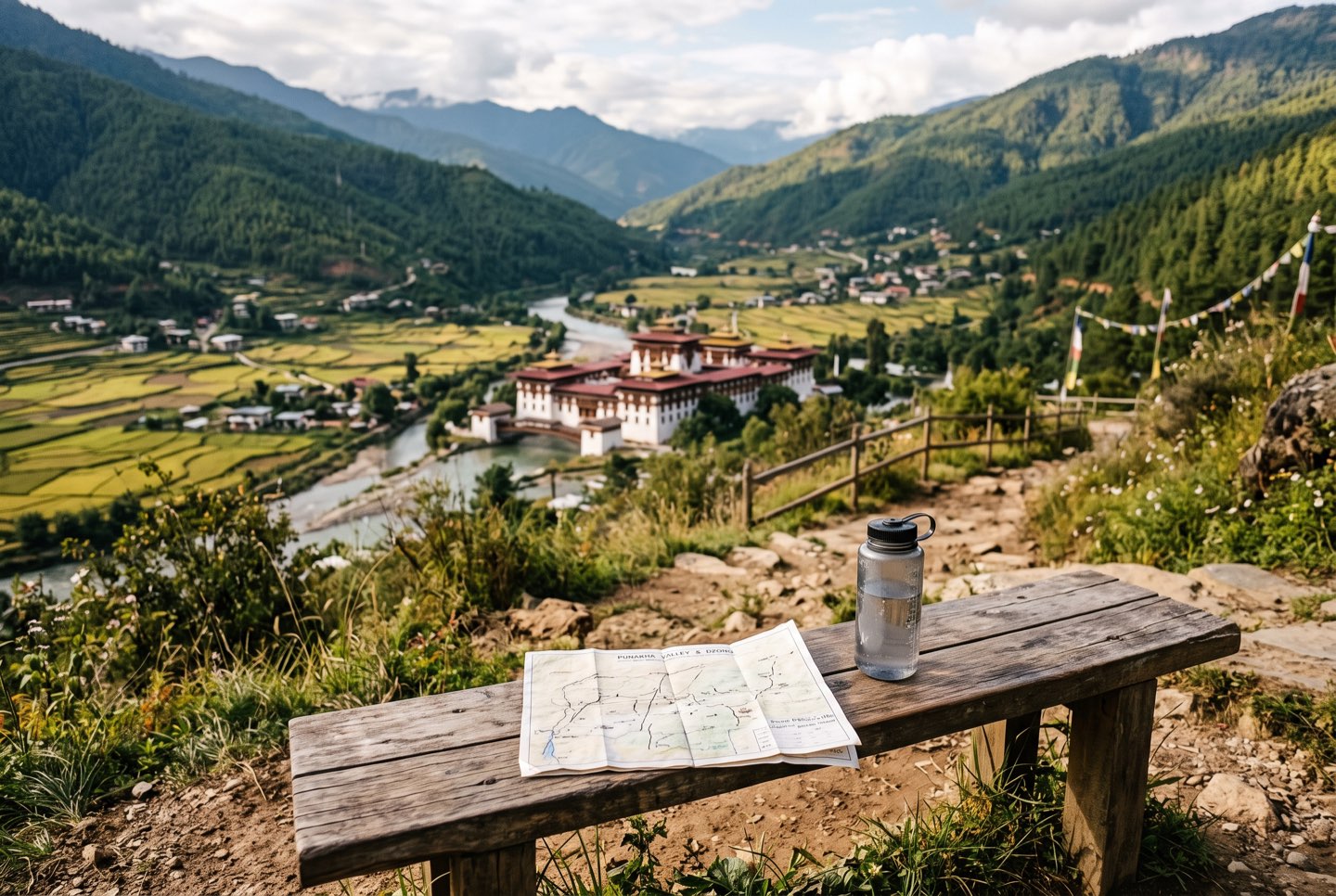 A trail bench above the Punakha valley, map folded and water bottle ready for the afternoon.
What are Bhutan’s proper treks really like?
Wonderful, and genuinely demanding. A trek means days or weeks on foot, sleeping in tents with a crew, far from roads and lodges. It suits fit walkers who are happy with cold nights and high camps, and it deserves an honest conversation before you commit.
The Department of Tourism lists treks from three days to four weeks. The Druk Path runs for about a week; the Jomolhari trek takes around ten days; the Snowman, which the Department calls Bhutan’s toughest, lasts more than 20 days, climbs higher than 5,000 m and crosses 13 passes. For a first taste of trekking, start with one of the three- or four-day routes, not the Snowman.
Altitude is the real test. The CDC advises that once above 3,000 m, you should raise your sleeping altitude by no more than 500 m a day. Good trek itineraries are built around exactly that, which is why they take the time they do.
Our guides and trek crews are trained in first aid and trekking medicine, and there are few finer moments than warm soup at camp beneath Jomolhari after a long day. Still, we would rather you arrive at camp smiling than merely arriving.
How do we pace walking days?
Gently at first, harder later, and always around you. We don’t put a big climb on the day you land, or on your first day at a new altitude.
The usual shape is easy valley walks in the first days, while your body adjusts, then the temple hikes, with the Tiger’s Nest towards the end of the journey. A few nights in Bhutan first make any climb more pleasant; our guide to altitude and health in Bhutan explains why.
On the day itself we start early, when the air is cool and the trails are quiet. Your guide walks at your pace, not the other way round, and the car can meet you at the end, so many walks only go one way. Water and snacks come with us, and on longer days we can plan a picnic with a view.
If the weather turns, we swap days around. The mountains keep their own timetable, so we keep ours in pencil. Not sure where you fit? Try our journey finder.
What should you wear on the trail?
Layers, and something for both sun and rain. Bhutan’s weather can change within an hour, and a single trail can take you from a warm valley to a cold, windy ridge.
- Layers: a breathable base, a warm fleece or light down jacket, and a waterproof shell you can stuff in a daypack.
- Sun: a hat, sunglasses and sunscreen. The sun is strong at altitude, even when the air is cold.
- Poles: a pair of walking poles makes descents far kinder to knees. They are not a sign of weakness, just a sign that you have walked down a Bhutanese hill before.
- Temple wear: many walks end at a temple, so pack long sleeves and trousers or a long skirt. Our guide to dzong and temple etiquette has the details.
Spring and autumn are the classic walking seasons; winter brings clear, cold mornings, and the monsoon brings mud and green. Our guide to when to visit Bhutan goes month by month.
Frequently asked questions
Do I need to be fit?
For valley walks, no: if you walk for an hour at home, you will enjoy them. The Tiger’s Nest asks for reasonable fitness, and multi-day treks for genuine fitness. Tell us honestly where you are and we will plan from there.
Can I walk without doing a trek?
Absolutely. Most walking on our journeys happens by day, with a lodge and dinner waiting each night: all of the mountain air, none of the tent.
Are there toilets on the trails?
Sometimes. Busier trails may have simple toilets at the start or at a café along the way; quieter paths have none, so we plan a stop before setting off. On treks, the crew sets up a toilet tent at camp.
What footwear do I need?
Comfortable walking shoes with a grippy sole are enough for valley walks. For the Tiger’s Nest steps or a trek, choose light boots with ankle support, and wear them in at home before you fly.
Bhutan reveals itself at walking pace. Bring comfortable shoes and a little curiosity, and we’ll find the path that fits.