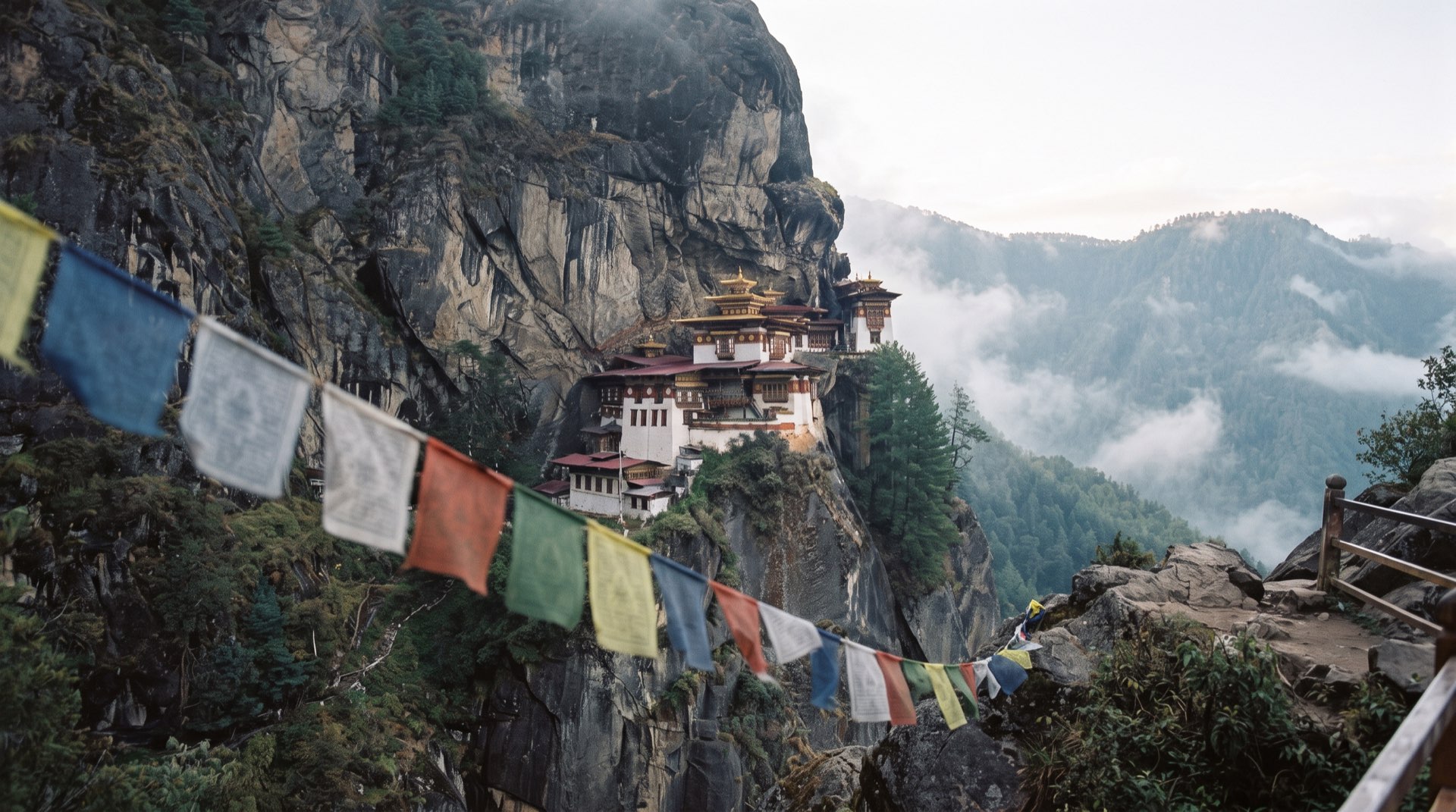
Let’s start with a confession. We have watched grown adults well up at the Tiger’s Nest. Sometimes it’s the view. Sometimes it’s the steps. And sometimes, honestly, it’s both at once.
You round a bend in the blue-pine forest, the prayer flags snap in the wind, and there it is: a white-walled monastery pinned to a granite cliff, looking as if someone glued it there for a bet. It is probably the picture that made you want to come to Bhutan in the first place. So the question isn’t whether it’s worth it. It is. The question is how to do it well, and whether all of it is for you.
Here is our honest answer, from the people who walk this trail with guests every season.
| At a glance | Detail | Source |
|---|---|---|
| Monastery altitude | About 3,120 m, roughly 900 m above the Paro valley floor | Department of Culture |
| Built | 1692, by Tenzin Rabgye, the fourth Druk Desi | Department of Culture |
| Return walk | About 5–6 hours, with many steps | Bhutan Luxury Travel, 2026 |
| Horses | Part of the ascent only, never the descent, conditions and welfare permitting | Bhutan Luxury Travel, 2026 |
| Inside | Shoes and hats off, long sleeves and covered legs, no photos | Department of Tourism |
| Checked | 27 September 2026 |
How hard is the Tiger’s Nest hike, really?
It is a steady uphill half-day walk, not a technical climb. You need no ropes, no special gear and no mountaineering past, just decent shoes and a willingness to keep putting one foot in front of the other.
The numbers explain the effort. The monastery sits at about 3,120 m, roughly 900 m above the valley floor, according to Bhutan’s Department of Culture. Paro itself lies at around 2,200 m, so the air is already thinner than most people are used to, and it thins a little more with every switchback. The full return walk takes about 5–6 hours, including time at the monastery and a tea stop.
The hardest part surprises people. It isn’t the long forest path. It’s the final stretch of stone steps, which drops down to a waterfall and a small bridge, then climbs back up to the monastery gate. On the way down your knees get a vote. On the way up, your lungs do.
A five-question self-test
Answer these honestly. Nobody is watching.
- Can you walk uphill on a rough, dusty path for about two hours, with short breaks?
- How do your knees feel about steps? Not in theory. On a Tuesday, after breakfast.
- Will you have spent a few nights in Bhutan before the climb, so your body has adjusted to the altitude? (Our guide to altitude and health in Bhutan explains why this matters.)
- Are you comfortable on a path cut into the side of a cliff, with a long view down?
- Would you still enjoy the day if you stopped halfway, with the whole monastery in front of you?
Five yeses: you’re ready. Wobbling on one or two? Then plan for a horse on part of the way up, a slower pace and more stops. Hesitating on question four? Talk to us first. And if question five made you smile, you already understand the Tiger’s Nest better than most people who race to the top.
What does the route look like?
Think of the walk in three parts, each with its own character.
The forest, up to the cafeteria. From the small car park at Ramthangkha, the path zigzags up through blue pine and oak, strung with prayer flags. It is the longest section and the most even. At a comfortable pace it takes around an hour to an hour and a half to reach the cafeteria viewpoint, where the monastery appears across the gorge for the first time.
The upper trail, to the viewpoint opposite. Beyond the cafeteria the path keeps climbing until you stand almost level with the monastery, close enough to see the gold roofs and the prayer flags on the cliff. This is the spot for your photographs, and the spot where many people fall quiet.
The steps. From the viewpoint, stone stairs lead down to the waterfall and the bridge, then back up the other side to the gate. It is shorter than the forest path but it takes the most effort. Take it slowly and use the handrails where there are any. There is no prize for arriving first.
For more gentle ideas across the country, see our guide to walking in Bhutan.
Can you ride a horse up the Tiger’s Nest?
Sometimes, for part of the way up, and never on the way down. Horses may be available on the lower trail, depending on the weather, the state of the path and the horses themselves. When the ground is wet or the animals need rest, we walk.
Going downhill is harder on a horse’s legs and less stable for a rider, so everyone walks down, always. The upper trail and all of the steps are on foot too, whoever you are.
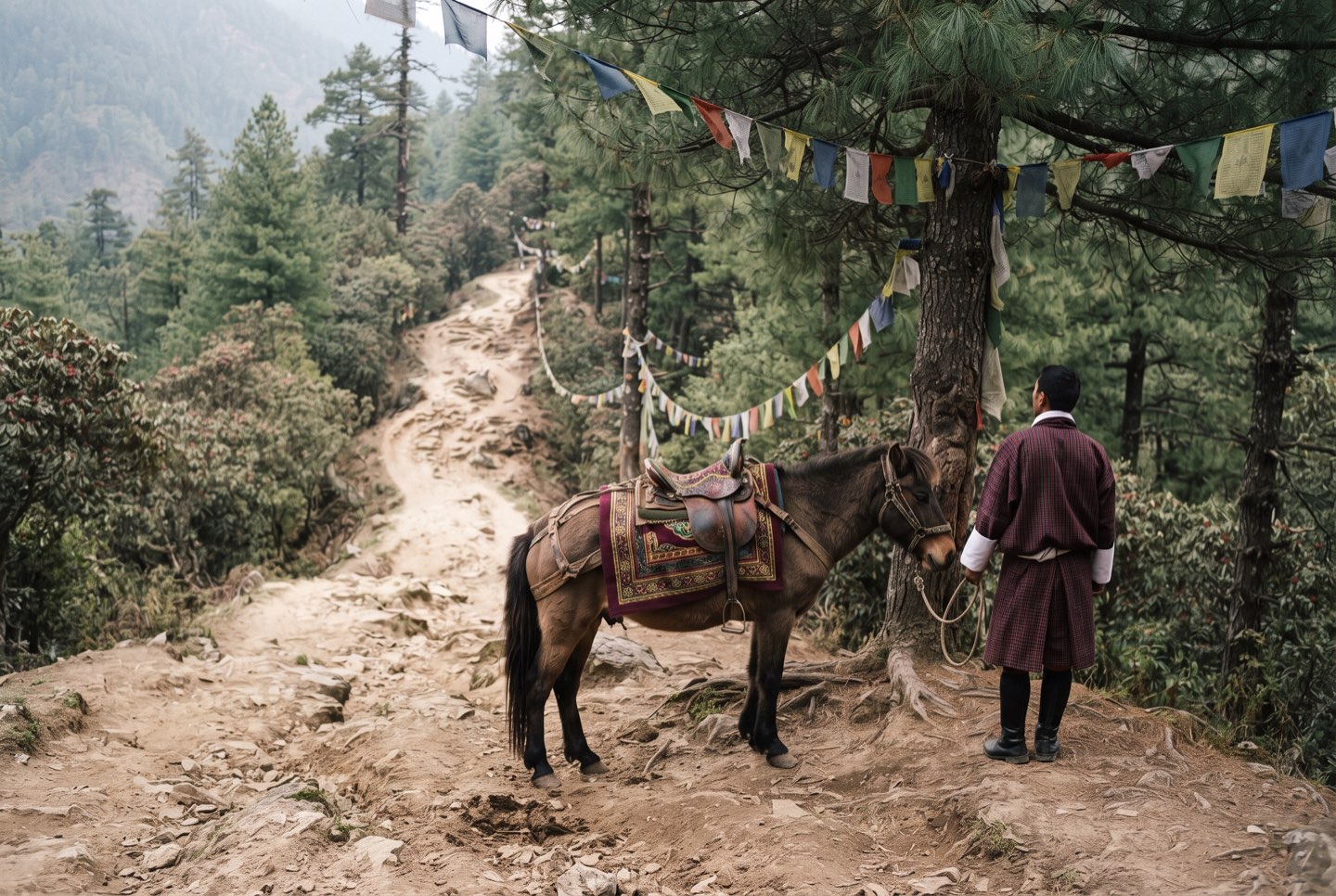 The lower trail, where a horse can take you part of the way up.
A horse is a good choice if your knees are the weak link or you want to save energy for the steps. It isn’t a shortcut for the whole climb, and we would rather tell you now than halfway up.
When should you start, and in which season?
Early. The car park at the trailhead is small. Bhutan’s national broadcaster BBS reported in May 2026 that it holds only around 15 vehicles, and that traffic backs up along the narrow road in both the morning and the afternoon. We aim to be walking soon after breakfast, so you climb in the cool air, meet fewer people on the steps and have time at the monastery before its midday pause.
Timing within your journey matters just as much. We place the climb towards the end of a trip, after several nights in Bhutan. The CDC’s travel health guidance notes that the risk of altitude illness applies mainly to travellers sleeping at about 2,450 m or higher. You sleep lower than that in Paro and only visit 3,120 m for a few hours, so the climb feels hard rather than harmful. Still, a few days of adjustment make it far more enjoyable.
As for seasons: autumn and spring bring clear skies and comfortable temperatures. Winter mornings are cold but crisp and quiet. In the monsoon months the path can be muddy and the cliff may vanish into cloud, which is either a disappointment or the most atmospheric morning of your trip, depending on the minute. Our guide to when to visit Bhutan goes through the year month by month.
What is it like inside the monastery?
Quiet, dim and fragrant with butter lamps. The monastery is a cluster of small temples built around caves in the rock, and it is still a living place of prayer, not a museum.
The story explains why it is here at all. According to the Department of Culture, Guru Rinpoche flew to this cliff on the back of a tigress, believed to be a form of his consort Yeshe Tsogyal, and meditated in a cave to subdue the local spirits. Taktsang means “Tiger’s Lair”. The monastery you visit today was built around those caves in 1692 by Tenzin Rabgye, the fourth Druk Desi.
At the entrance you leave bags, phones and cameras behind. The Department of Tourism asks visitors to wear long sleeves, cover their legs, remove shoes and hats, and refrain from taking photographs inside sacred sites. Your guide will show you what to do as you go, and explain the paintings in each chapel. If you’re curious about the customs before you arrive, read our guide to dzong and temple etiquette.
What if you don’t go all the way?
That is a real choice, and plenty of our guests make it. The cafeteria viewpoint gives you the whole cliff, a cup of tea and a very good excuse. From there you see the monastery as most photographs show it, and you keep your knees happy for the rest of the journey.
Nobody who stops there has ever told us they missed out… although a few did come back the next year and climb the rest.
If you do stop early, the day isn’t over. We can take you on to a quieter temple in the valley, a farmhouse lunch or simply a long, well-earned lunch in Paro. Our guide to day hikes in Bhutan has other walks to choose from, valley by valley. The point of the Tiger’s Nest is how it makes you feel, not how many steps you counted.
Frequently asked questions
How many steps are there?
Several hundred, between the viewpoint and the monastery gate, first down and then up. Counts vary, mostly because people lose track somewhere around the waterfall.
Can children do the Tiger’s Nest hike?
Yes, many families do. Children who are used to walking often bound ahead of their parents. For younger ones we set shorter goals, like the cafeteria viewpoint, and plan more stops and snacks along the way.
Can I take photos inside?
No. Photography isn’t allowed inside the monastery, and phones and cameras stay at the entrance. The best photographs are taken from the viewpoint across the gorge anyway, especially in the soft light of the morning.
Is there food on the way?
Yes. The cafeteria at the halfway viewpoint serves tea and simple meals. We also carry water and snacks for you, and many guests save a proper lunch for the valley afterwards.
The Tiger’s Nest rewards the unhurried. Come ready to walk, stop when you like, and let the cliff do the rest.