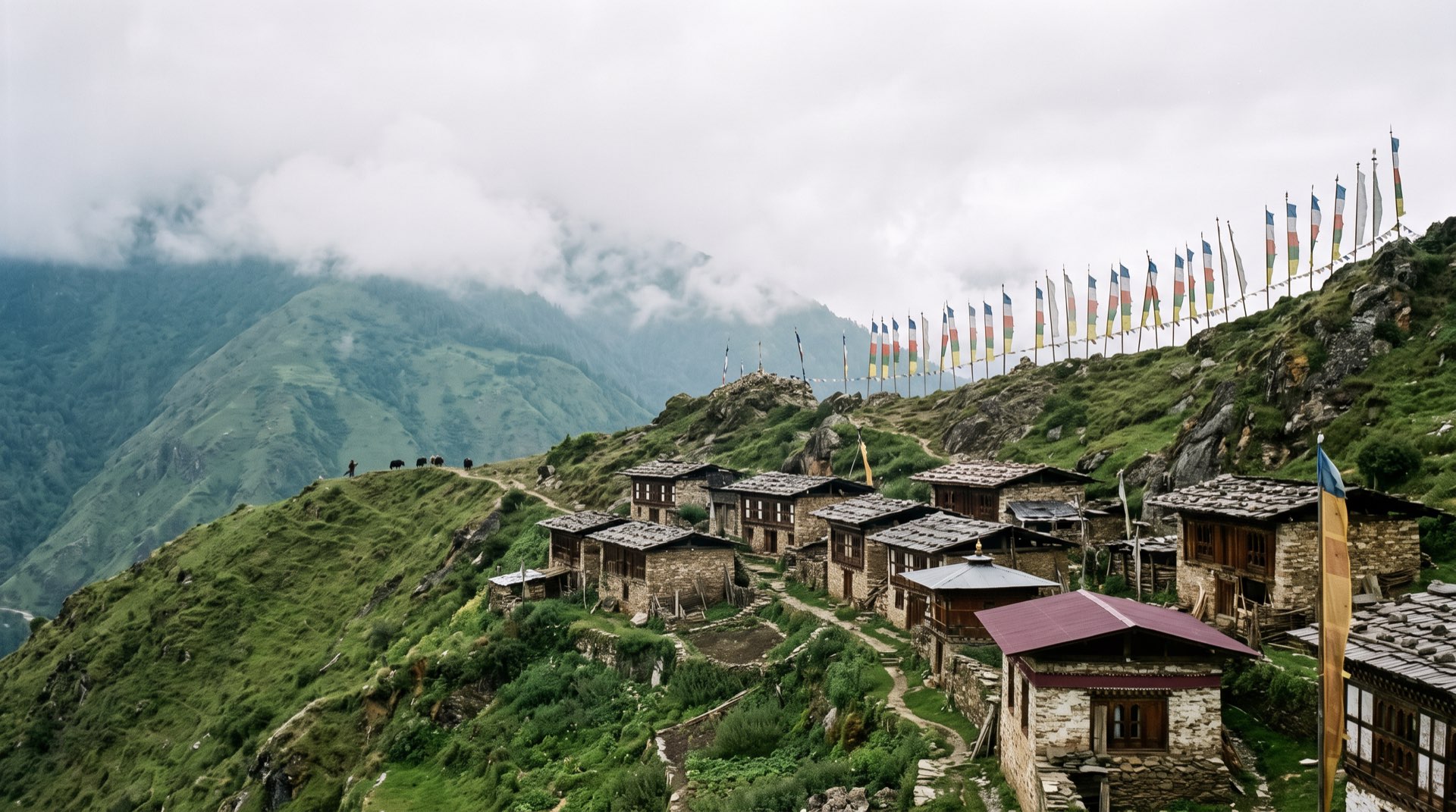
The cloud lifts for a minute, and there it is: a scatter of stone houses stepped down a steep green slope, woodsmoke leaning sideways in the wind, prayer flags snapping on the ridge above. The air smells of wet grass and cold. Nothing moves except the smoke and, a long way off, a small figure with a herd.
You came partly for the yeti, admit it. Perhaps you also wonder whether a place with such a famous legend can be anything but a novelty, and whether it is worth days of travel to find out.
We think it is, and not for the reason on the postcards. Let’s take the monster first, then the people, the walk and the roads.
| At a glance | Detail | Source |
|---|---|---|
| Yeti (migoi) | No scientific evidence. A 2017 study of nine purported yeti samples from the Himalayas and Tibetan Plateau found eight Asian bears and one dog | University at Buffalo |
| Sanctuary | Established 2003, in Trashigang in the far east | Dept of Forests and Park Services |
| Area (sources differ) | 740.6 km² (forest department; Bhutan for Life gives the same) against 650 km² (Department of Tourism) | Dept of Forests and Park Services, Department of Tourism |
| People (sources differ) | About 5,000 semi-nomadic Brokpa (forest department); Bhutan for Life says about 4,000 | Dept of Forests and Park Services |
| Merak Sakteng trek | 7 days, medium, 1,500–4,100 m; listed months March–May and September–November | Department of Tourism |
| By road | Almost four hours from Rangjung to Sakteng in December 2023, the last 17.5 km rough | BBS |
| Great Yeti Quest | Three-day festival in Sakteng, reported 9 May 2026 | BBS |
| Our first trek | March 2009, on foot from Rangjung | Bhutan Luxury Travel, 2026 |
| Checked | 30 September 2026 |
Is there a yeti in Bhutan?
Not that anyone has shown. There is no scientific evidence for it, though the story is old and the people of Sakteng tell it with relish. In Bhutan the creature is called the migoi, and it turns up in the tales of the eastern highlands far more often than in any field report.
Science has looked at yeti evidence elsewhere in the Himalayas. A 2017 study led by a University at Buffalo biologist analysed nine purported yeti specimens (bone, tooth, skin, hair and droppings) from museums and private collections in the Himalayas and on the Tibetan Plateau. One was a dog. The other eight were Asian bears. The lead researcher said the findings strongly suggest that the biological underpinnings of the yeti legend lie in local bears. A caveat: the university’s summary doesn’t say the samples came from Bhutan, so it can’t settle anything about Sakteng itself. It shows what tends to happen when a mystery hair meets a laboratory.
Does that spoil it? Not for us. A legend needs no specimen to shape a place. It gives a valley its stories, a festival its name and a walker a reason to look twice at every shadow between the rhododendrons. For the animals that are documented, see wildlife in Bhutan.
What is Sakteng Wildlife Sanctuary?
A protected area of eastern forest and rhododendron country, set up in 2003 on the border with India’s Arunachal Pradesh. Its managers, the Department of Forests and Park Services, describe eight forest types climbing from warm broadleaf forest at about 1,500 m to alpine meadow at 4,500 m, with 41 rhododendron species, three of them endemic. The department calls it a paradise of rhododendrons, and in spring you can see why.
How big is it? That depends whom you ask. The forest department gives 740.6 km², with a core zone of 146.08 km², and Bhutan for Life uses the same figure. The Department of Tourism lists 650 km². We use 740.6 and flag the gap. The department also says it officially manages 937.62 km² to serve the whole of Merak and Sakteng gewogs (a gewog is a group of villages).
Our guide to a naturalist’s Bhutan covers the rhododendrons and the blue poppy, which the Department of Tourism says grows here.
Who are the Brokpa people?
The Brokpa are the semi-nomadic herders of Merak and Sakteng, and BBS calls their culture unique. Semi-nomadic means moving with the herds through the seasons. The forest department counts about 5,000 Brokpa across its jurisdiction and says almost 83% of them depend on livestock; Bhutan for Life gives about 4,000 and names yaks, sheep and dzo, the yak–cow hybrids, as the herds. Either way, this is a small community in a big landscape.
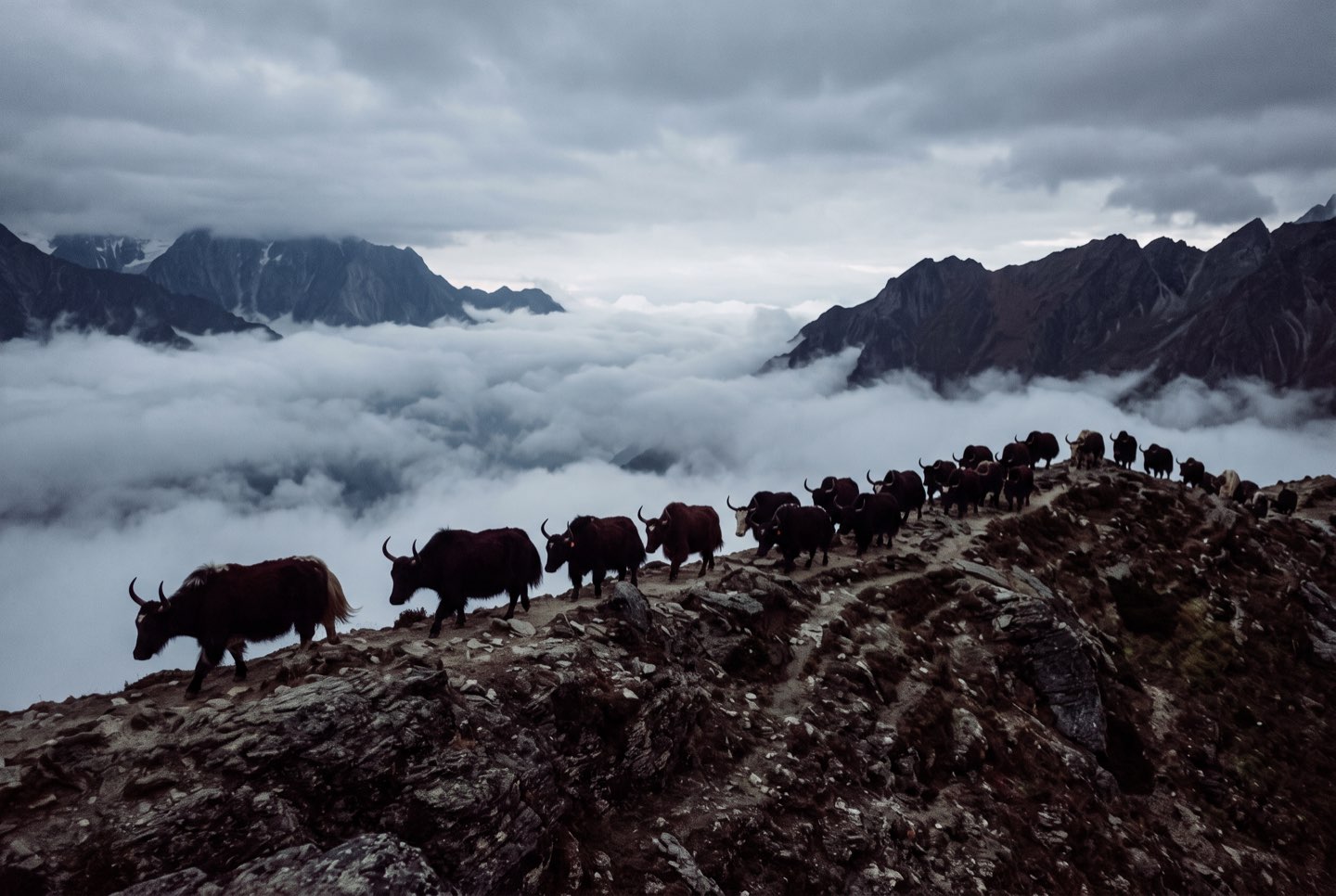 A herd of yaks on a high ridge against low cloud, in cold light.
Tourism here is young. At the Great Yeti Quest, BBS reported, residents performed the programme, and food stalls and exhibition spaces were set up inside or beside traditional Brokpa houses, so visitors met the architecture and the hospitality together. One of the stated aims of the festival is to create new sources of income for residents, which is a fair way to think about your own visit.
Manners matter more the smaller the village. Ask before you photograph anyone; our guide to dzong and temple etiquette explains how, and the same courtesy applies at a farmhouse door.
What is the Merak–Sakteng trek like?
Long, varied and demanding. The Department of Tourism’s trek list gives the Merak Sakteng trek seven days at medium difficulty, between 1,500 m and 4,100 m, with March to May and September to November as the listed months. The forest department adds that the heaviest rain falls from June to August, which explains why the listed months skip the summer.
“Medium” on an official scale is not the same as “gentle”. The lowest and highest points of the route are 2,600 m apart in height, so expect real climbs and long descents, and remember that the air at 4,100 m is thinner than in Paro. Our guide to altitude and health in Bhutan explains what to prepare, and your own doctor should have the last word.
What you get for the effort is walking through yak pastures and high forest between two villages, with a crew looking after you. We led our first Merak–Sakteng trek in March 2009 and design treks on request, rather than selling a fixed one. To see how this one compares, read Bhutan's treks compared; for gentler options, try walking in Bhutan.
How do you reach the villages now that roads have come?
By road from Rangjung, in almost four hours at the last count, on a route that was still being improved. BBS reported in December 2023 that the drive to Sakteng took that long, with the last 17.5 km from Sonadrang rough and bumpy, and that blacktopping would save more than an hour. Conditions may have changed since, so we check before we plan.
Rangjung lies in Trashigang, which you reach by long road days from Bumthang or a short flight into Yonphula; beyond western Bhutan sets out both. In March 2009 the roads had not arrived, and our group, the first British trekking group officially allowed into Merak and Sakteng, began on foot from Rangjung with special government approval.
The road has changed the approach, not the destination. You can now visit Sakteng without trekking, which is a perfectly good choice. We still love arriving by foot, when a hillside slowly turns into a village.
What is the Great Yeti Quest festival?
A three-day community festival in Sakteng that celebrates the yeti legend, promotes eco-tourism and keeps Brokpa culture in view. BBS reported on 9 May 2026 that it had opened the day before, with songs, dances and stories of the mythical yeti. More than 1,000 people, including international tourists, came on the opening day, and Sakteng Dungkhag (the sub-district administration) organised it with support from the Department of Tourism.
The BBS report doesn’t say whether the festival will return, or when, and we don’t yet know either. If it matters to your dates, ask us before you plan around it. It sits outside the big annual tshechus, and Bhutan's smaller festivals explores more like it. Go as a guest, not an audience: the residents perform, cook and host, and you are there to watch, taste and be welcomed.
Who is this journey for?
Walkers with a week or more, curious travellers who prefer a village to a viewpoint, and anyone who has already seen the western valleys. It is less suited to a first, short trip, to long vehicle days that you dread or to a spa every night, because simpler lodging comes with the distance.
Our Cranes & the Central Valleys journey reaches Bumthang; Merak and Sakteng lie further east, and we design that extension with you around the season and your legs. Tell us what drew you, the walk, the people or the legend, and we’ll shape the days around it.
Frequently asked questions
Has anyone seen a yeti?
People tell stories of one, and a festival now celebrates them, but no scientific study has confirmed an animal and nobody can promise you a sighting. What you can count on is a good story, well told.
Was Sakteng created to protect the yeti?
You will see it written. We found no government source for it: the forest department’s introduction describes a sanctuary for the Eastern Himalayan ecosystem and its cultural heritage, and doesn’t mention the yeti. We found no official listing of the migoi as endangered either, so we treat both as unverified.
Can I visit without trekking?
Yes for Sakteng, where a road now arrives, so a visit needs no trekking; we check the position at Merak before we plan. Lodging in the far east is simple, and we tell you plainly what to expect before you decide.
When is the best time to go?
Spring if you want the rhododendrons, autumn if you prefer settled weather; both fall inside the Department of Tourism’s listed months. Neither promises clear skies at 4,100 m, so we keep a little slack in the plan.
Sakteng does not need a yeti to be worth the road. Come for the ridgelines, the welcome and the pleasure of a legend nobody has to prove.