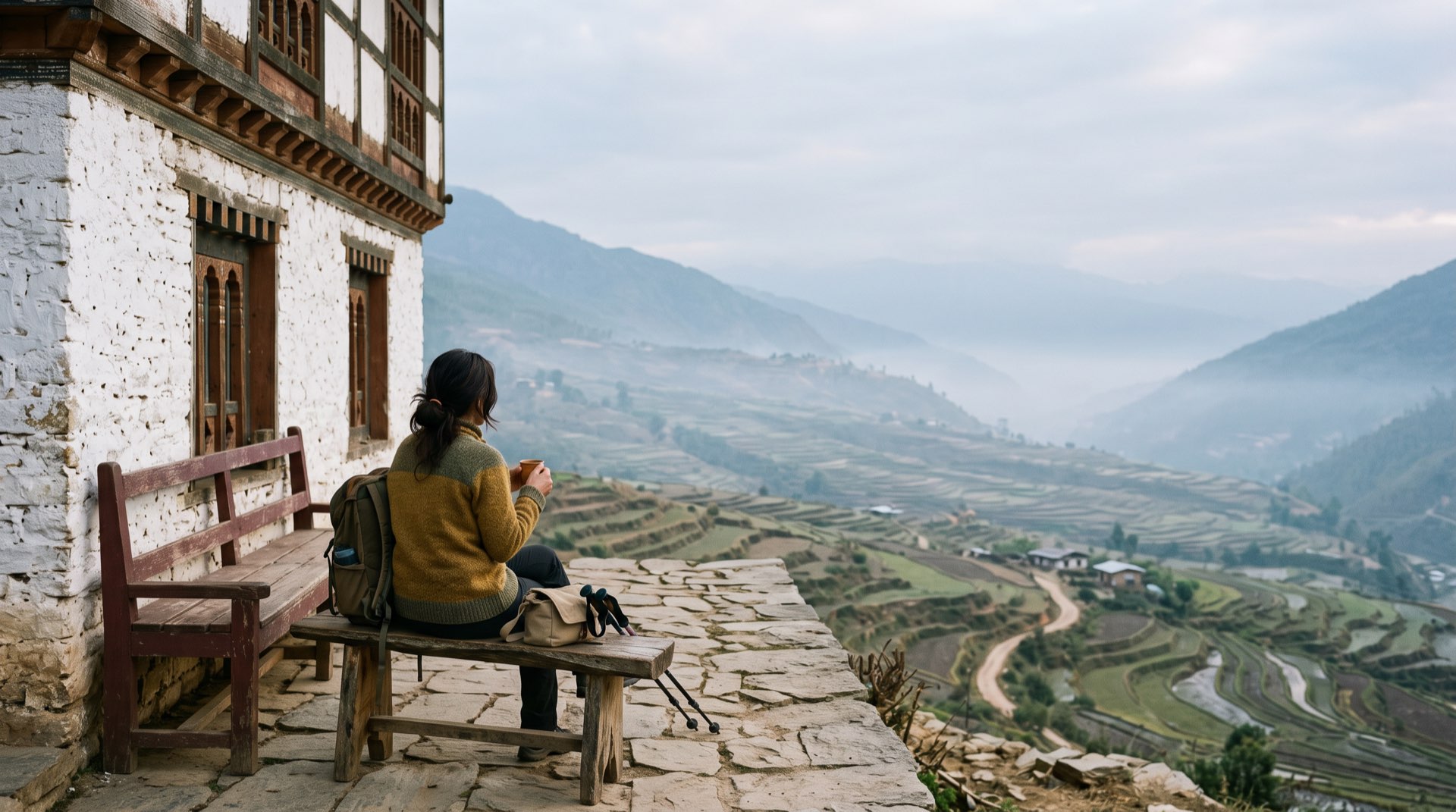
It is late, the flights are booked, and the search bar is open: is Bhutan safe? The answers run from a shrug to a small novel.
Here is what a first evening in Thimphu is more likely to hold. Cold air off the river. Juniper smoke from somebody’s stove. A dog barking at nothing on a far hillside. The worries that keep people awake at home (crime, scams, strangers) are, by every official source we found, the small ones here. The ones worth your attention are quieter: mountain roads, monsoon landslides, a bite from an unfamiliar dog.
So let’s put the risks in order, with a source beside each — and say plainly where the sources go quiet.
| At a glance | Detail | Source |
|---|---|---|
| Tourism authority’s view | A very safe place to visit, even if you are travelling alone | Department of Tourism |
| Crime | Low across Bhutan; take the same precautions as at home | UK Foreign Office |
| Roads | One of the biggest causes of injury and death; avoid night travel if possible | UK Foreign Office |
| Rabies | Rabid dogs are sometimes found; about 72,000 dogs sterilised by June 2026 | CDC, BBS |
| Same-sex activity | Decriminalised in 2020–21 (the Foreign Office says 2020); same-sex marriage not recognised | UK Foreign Office |
| Emergency numbers | 110 fire, 112 ambulance, 113 police | Department of Tourism |
| Checked | 30 September 2026 |
Is Bhutan safe for tourists?
Yes, and the two official sources that speak to crime agree. The Department of Tourism describes Bhutan as a very safe place to visit, even alone, with very little crime experienced by locals or visitors. The UK Foreign Office says crime levels are low and asks only for the precautions you would take at home, such as keeping a copy of your passport photo page and visa apart from the originals.
“Safe” is not “risk-free”, and neither source claims otherwise. The Foreign Office notes there is no recent history of terrorism in Bhutan, then adds that attacks cannot be ruled out. Sensible, if not exactly poetry.
One thing changes the picture for solo visitors. The Department of Tourism says a guide must accompany you at all times, so “alone” in Bhutan means without a travelling companion, not without company. Our post on whether you need a guide in Bhutan explains the rule.
What are the real risks, ranked?
Roads first, then weather, altitude and dogs, with crime near the bottom. The order is our judgment, not an official ranking; every row has its source.
| # | Risk | What to know | Source |
|---|---|---|---|
| 1 | Mountain roads | Accidents are one of the biggest causes of injury and death; use seatbelts, avoid night travel if possible | UK Foreign Office |
| 2 | Monsoon landslides and floods | Can cut some roads for days; June to September rains can affect transport | UK Foreign Office, Department of Tourism |
| 3 | Altitude | Mostly a matter of pace; our published journeys run from 1,200 m at Punakha to passes of 3,100–3,400 m | Bhutan Luxury Travel, 2026 |
| 4 | Stray dogs and rabies | Keep your distance; wash any bite and see a doctor at once | Department of Tourism, CDC |
| 5 | Earthquakes and wildfire | Parts of Bhutan lie on active fault zones; wildfire risk is high in central and southern areas | UK Foreign Office |
| 6 | Crime | Low; the same precautions as at home | UK Foreign Office |
What about the roads and the weather?
They deserve your respect, and they are the part you can least manage alone. The Foreign Office says car and motorbike accidents are one of the biggest causes of injury and death, advises avoiding night travel where possible and notes that Bhutan has no traffic lights. (That sounds alarming, though we have never once been stuck at a red one.)
The numbers, from The Bhutanese quoting the Royal Bhutan Police: 1,118 motor-vehicle accidents in 2024, up from 780 in 2022, with 96 deaths in 2024. Losing control of the vehicle and drink-driving were the leading causes. These are national figures for every road user, so they describe the roads, not your trip.
What we can do is plan around them: a private vehicle with a professional driver, road days that finish in daylight, and slack in the schedule. The Department of Tourism notes that the monsoon, June to September, can affect transport and services, and the Foreign Office adds that weather regularly affects flights. Our look at Bhutan’s green season shows what that means day to day.
Are the stray dogs a problem, and what about rabies?
Mostly a matter of manners, with one serious footnote. The Department of Tourism says you may meet stray dogs in some areas, that they normally keep their distance, and that you should do the same, especially with children, and neither feed nor pat them. The CDC adds that rabid dogs are sometimes found in Bhutan and that rabies vaccine may only be available in larger suburban or urban medical facilities. If you are bitten or scratched, it advises washing the wound with soap and clean water and seeing a doctor straight away.
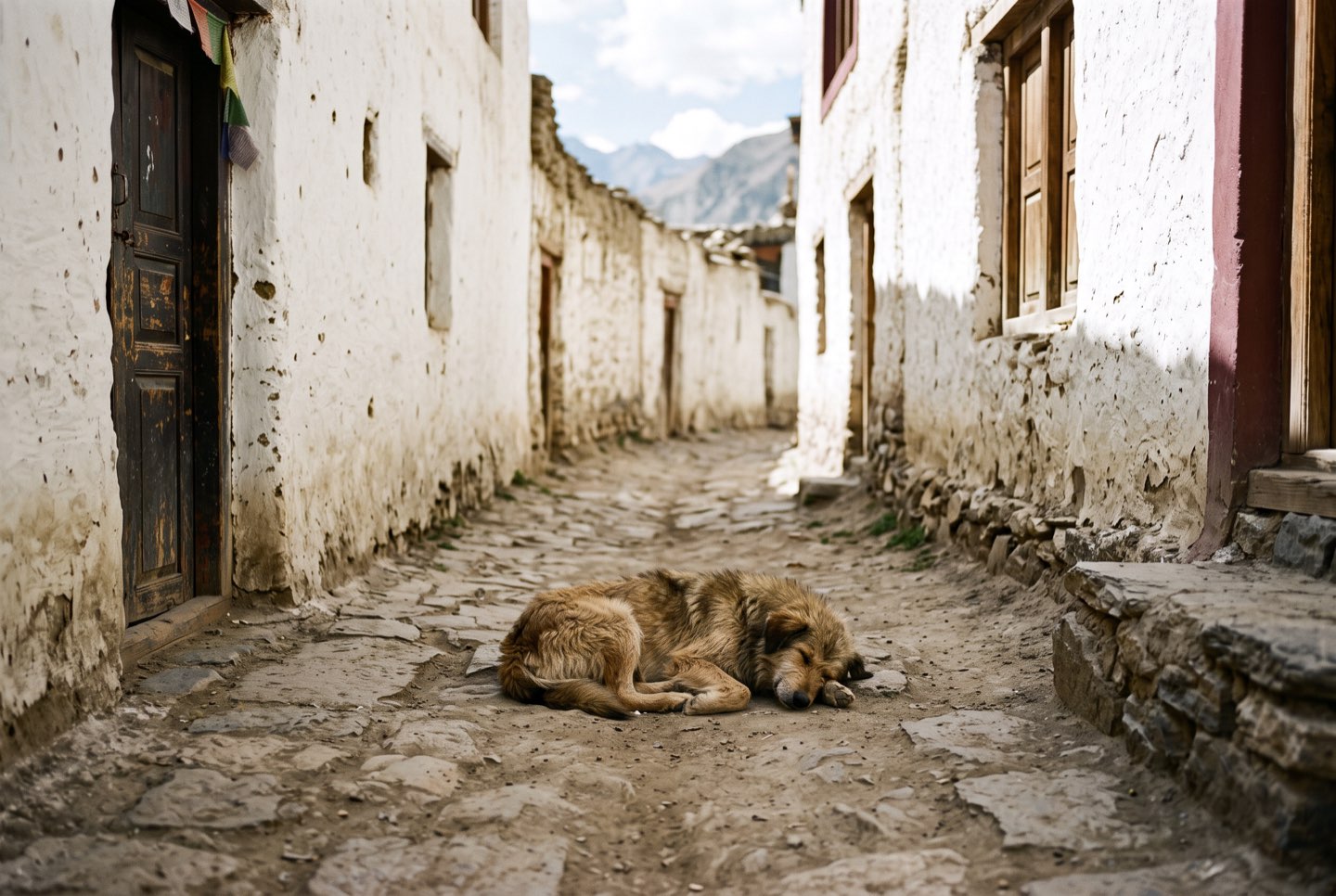 A village dog asleep in the middle of a quiet lane at midday.
The trend is good. In September 2026 the national broadcaster BBS reported that Bhutan has been recognised for eliminating dog-mediated human rabies as a public health problem, with around 72,000 dogs sterilised as of June and a goal of zero human cases by 2030. The risk is not spread evenly, though: in December 2023 The Bhutanese reported that all nine dzongkhags (districts) along the border were high-risk for outbreaks. Give strays room, skip the petting, and tell your guide about any bite or scratch straight away.
Is Bhutan safe for women and solo travellers?
For solo travellers, yes, and the tourism authority says so directly. For women specifically, the official pages we read say nothing, so here is what we can say, and where we are only giving our view.
What the sources say: the Department of Tourism’s line about travelling alone, above, and the Foreign Office’s finding of low crime. The Foreign Office’s Bhutan advice has no section on women travellers. That is neither a warning nor a special assurance; it is silence, and we would rather name it than fill it.
What we can add is how our journeys work. They are private, so your guide and driver are yours for the day and you set the pace.
Our view, and it is only that: tell us what would help you feel at ease, whether that is a certain pace, more company or less, and we will plan around it. We would rather hear about a small worry in March than have it travel with you in May.
What should LGBTQ+ travellers know?
Same-sex activity is no longer a crime, though the law stops short of recognising same-sex marriage or transgender people. According to the UK Foreign Office, same-sex sexual activity was decriminalised in Bhutan in 2020, and there are no censorship laws restricting the discussion or promotion of LGBT+ topics. Other reports date the change a little later: Parliament voted in December 2020, and the amended law came into force on 17 February 2021. Same-sex marriages are not recognised, and there is no legal recognition of transgender individuals, so both points are worth knowing before you book.
That is one government’s reading, written for British travellers, so check your own government’s advice too. And the pages say nothing about how any one person will be treated, so we will not guess on behalf of everyone you might meet.
Our view: because every journey with us is private, who you are and who you travel with is your business. Tell us as much or as little as you like. If the legal points above affect you, ask us before you book and we will talk it through.
What should you do before you go?
A short list, mostly dull, which is what you want from safety advice.
- See a travel clinic. The CDC advises seeing a doctor at least a month before you go. It recommends hepatitis A vaccination for unvaccinated travellers and typhoid for most, and suggests asking whether rabies vaccination before travel suits you.
- Buy insurance that covers evacuation. It stopped being mandatory on 23 April 2024, but the Department of Tourism strongly recommends it. Our guide to altitude and health in Bhutan says what to check.
- Skip freshwater swimming. The CDC notes leptospirosis is found in Bhutan and advises against swimming in lakes, ponds or rivers. Lovely to look at; leave them at that. If you plan to hike, our guide to walking in Bhutan covers the rest.
- Read your own government’s advice, on the day you book and again before you fly. The Foreign Office’s Bhutan page was last updated in December 2025 when we checked.
If this is your first trip, planning your first trip to Bhutan puts the rest in order.
Frequently asked questions
Do I need a rabies vaccine?
That is a decision for you and a travel clinic. The CDC says it depends on whether your activities raise your exposure to animals and whether you might struggle to reach prompt treatment. Tell the clinic where you plan to walk.
Who do I call in an emergency?
Dial 112 for an ambulance, 110 for fire or 113 for police, the numbers the Department of Tourism gives. For a tourism problem, its line is +975 17661974 (2300 within Bhutan). Your guide is your first call, and our team is on call around the clock.
Is anything banned that I might not expect?
Yes. Tourists generally cannot bring drones, and a permit is needed in advance. The Foreign Office says drug sentences run from a minimum of three years to life, that mountaineering is banned (trekking is allowed) and that littering is illegal anywhere. Tobacco is legal, but smoking near religious sites can cause offence.
Is Bhutan safe for children?
The official pages add one caution for families: the Department of Tourism asks you to keep children away from stray dogs. The Foreign Office advises a well-maintained vehicle with seatbelts. Ask us about child seats before you book, and we will confirm what is possible for your dates.
Bhutan asks for the care you would give any mountain country, and repays it with a great deal of calm.