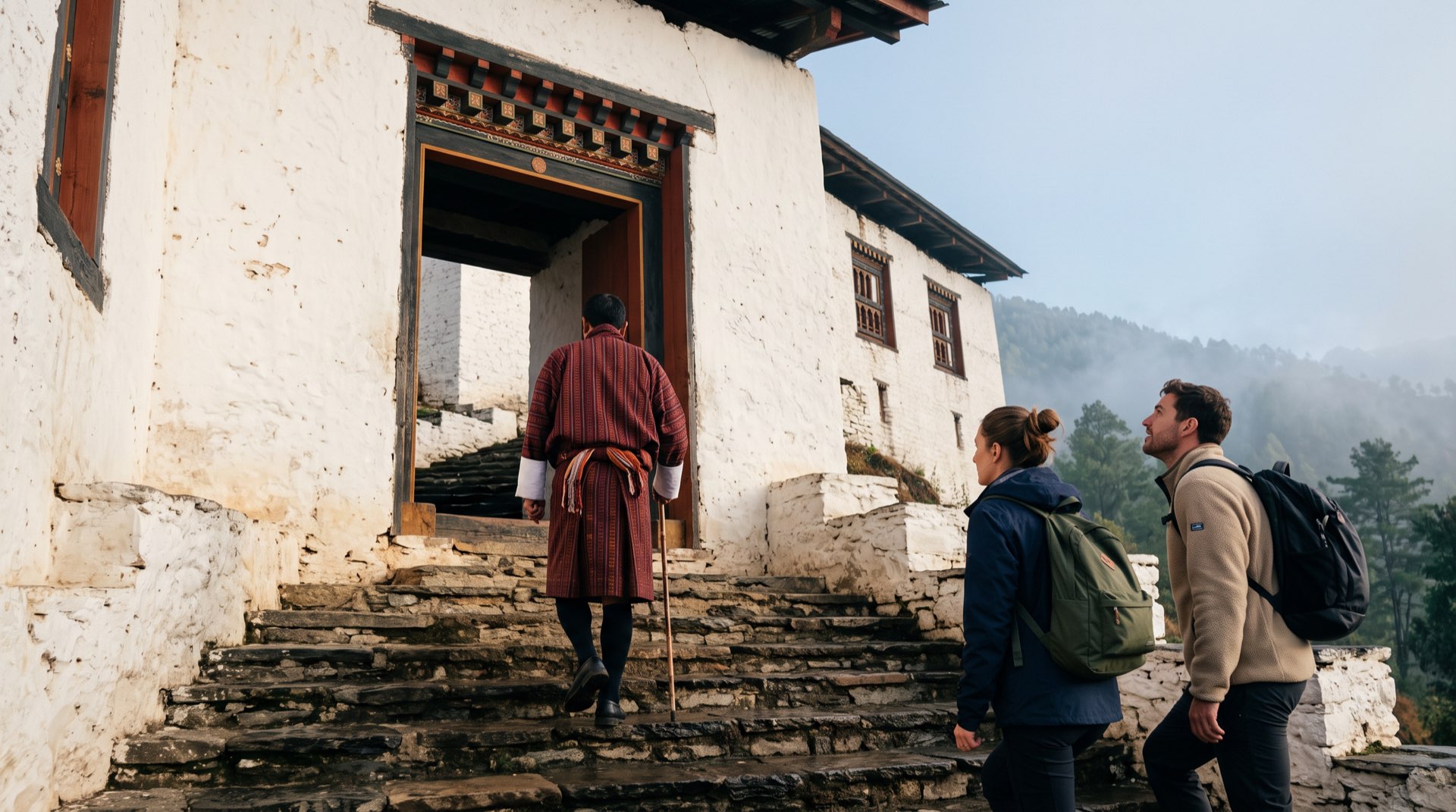
The first evening in Paro has a way of getting into your head. Your bags are in the room, the air smells faintly of woodsmoke and pine, a prayer wheel is turning somewhere below the window, and every instinct you own says: go for a walk. Just to the end of the lane. Just to see.
Then the seven browser tabs you opened last night start murmuring. One says a guide is compulsory. Another hints that you can wander about by yourself. It is a fair thing to be muddled about, and the Department of Tourism restated the rule this April for that very reason.
We are a tour company, so you are entitled to raise an eyebrow at our advice. That is why this guide quotes the documents rather than us, and says plainly where they go quiet.
| At a glance | Detail | Source |
|---|---|---|
| The rule | A licensed guide at all times, including at monuments and from Paro airport to other dzongkhags (districts); a licensed trekking guide for treks | Department of Tourism notification, 8 April 2026 |
| Where it comes from | Tourism Rules and Regulations 2024: Rule 20 (guide mandatory), Rule 15 (tourist arranges stay, guide, transport) | Tourism Rules and Regulations 2024 |
| Booking | Every part of the trip can be booked independently since 23 September 2022 | Department of Tourism FAQs |
| Driving | No self-drive vehicle can be hired; rentals come with a driver | Department of Tourism |
| Guide supply | 3,495 registered guides as of August 2026 | Department of Tourism bulletin |
| Not settled by any text we read | A stroll alone from your hotel; what “first designated check point” means | Rules 2024, Rule 20 |
| Checked | 30 September 2026 |
Do you need a guide in Bhutan? The short answer
Yes. The Department of Tourism (DoT) says visitors must be accompanied by a licensed guide at all times, in its FAQs and, more formally, in a notification dated 8 April 2026. The UK Foreign Office puts it in travel-advice English: use tour guides when visiting places of interest, or you may be refused entry.
If that conjures a chaperone with a clipboard, the rulebook paints a different picture. Its first two duties for a licensed guide are to explain the places, history and customs in front of you, and to look after your safety (Rule 124 of the Tourism Rules and Regulations 2024, or TRR). A guide is also required to enter dzongs and monuments. Our guide to dzong and temple etiquette covers what happens once you step inside.
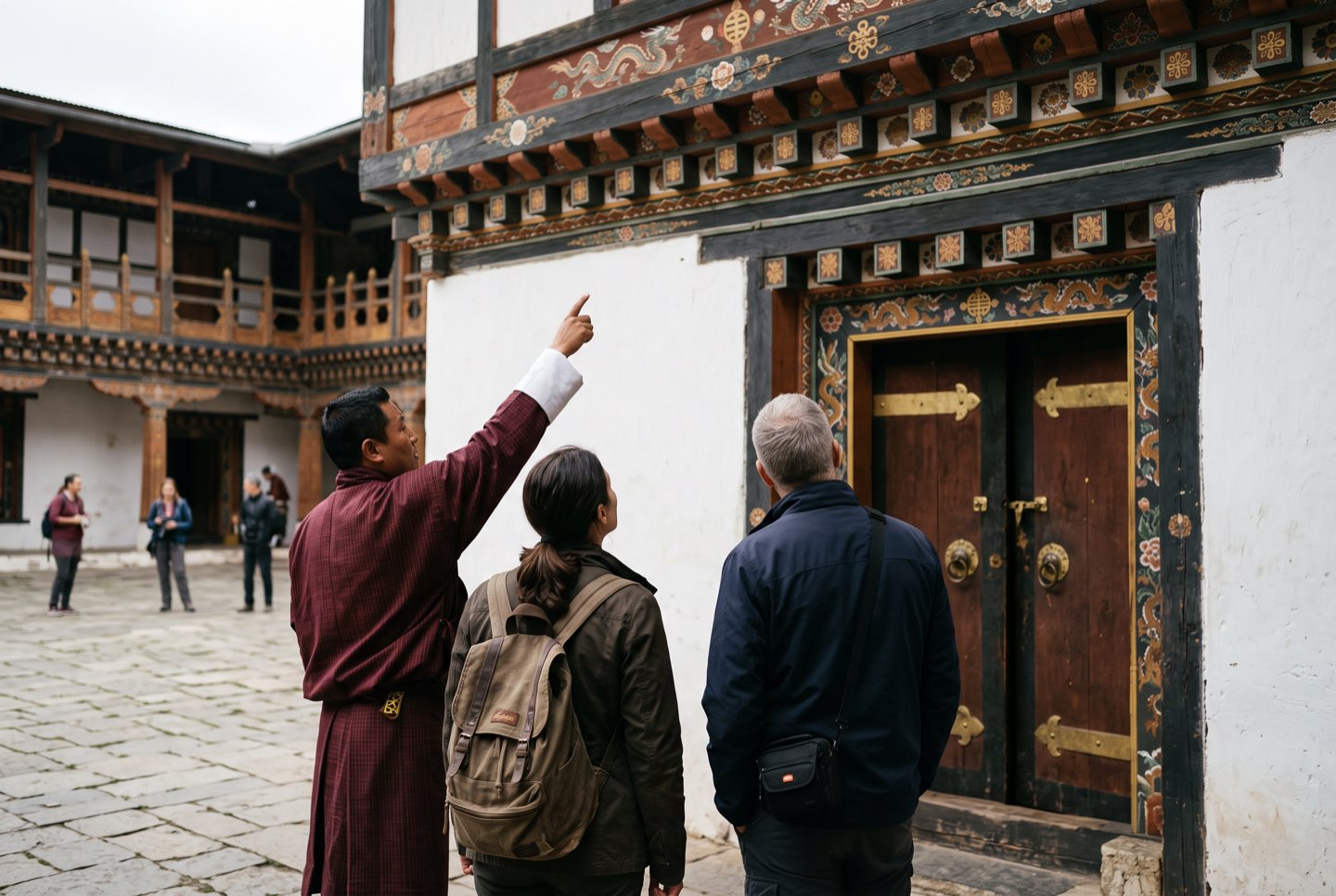 A guide’s hand picks out the painted cornice above a courtyard door.
What do the official documents actually say?
Three texts matter. In the TRR, Rule 15 says a tourist shall arrange accommodation, a tour guide and transport, including airport pick-up. Rule 20 says a guide is mandatory for all tours “except until the first designated check point”.
The second is the DoT notification of 8 April 2026. It recites that rule, notes that a guide is highly recommended even in the exempt stretch, then says all guests must be accompanied by a licensed guide at all times. The third is the FAQ page, which says so in one sentence.
Here is the awkward part, and we would rather show it than hide it. The TRR do not define “first designated check point”. They define a different phrase, “designated point”, as an area within border towns notified by the Ministry of Home Affairs. Whether the two mean the same thing, the documents do not say, so we plan no journey around that exception.
What can you still arrange yourself?
Quite a lot. Since Bhutan reopened on 23 September 2022, the DoT says visitors can book every part of the journey independently. Rule 15 makes that your job: your stay, your guide, your transport. Accommodation must be DoT-certified (Rule 16), and the DoT publishes lists of certified guides and providers. You can even apply for your own visa online; how the Bhutan visa works walks through it.
What you cannot do is hire a self-drive car. The DoT is plain about it: hire a vehicle and driver from a rental company or a tourism provider.
The documents do not fit together neatly for a fully do-it-yourself trip. Rule 28 says tour and sightseeing services “shall only be provided by the tour operator”, and the text does not spell out how that sits beside Rule 15. If you plan without an operator, ask the DoT’s free host team before you commit money. If you are still weighing options, our guide to planning your first trip to Bhutan lays them side by side.
What did the April 2026 notification change?
On paper, nothing. It is a reminder, and it says why it was needed: the DoT had noticed “various interpretations” of the guide rule for travel between dzongkhags, particularly along the Paro to Thimphu route. So it restated the position. Guests must be accompanied by a licensed guide at all times, at monument sites and from Paro airport to other dzongkhags alike, and treks need a licensed trekking guide.
It asks for “strict compliance” and says breaches will be handled under the TRR. Schedule 2 lists a fine for failing to arrange a guide; where a provider arranged the guide, the provider pays.
The practical effect is that the stretch of road behind those interpretations is now spelled out in writing. The notification also asks people to rely on bhutan.travel rather than “unreliable online sources”, a fair warning to any blog, ours included. For the wider 2026 picture, see what has changed for Bhutan travel.
Can you walk around town alone, or hire a car and drive?
Driving: no. Walking: no document we could read answers it, so here is what we can and cannot say.
Driving has a clear answer. No self-drive vehicle can be hired, and cars come with a driver. Anyone bringing their own vehicle over a land border needs a guide too: the UK Foreign Office says you must hire one to travel with you, and Rule 26 of the TRR requires a licensed Bhutanese guide.
Walking is the murky one. The DoT’s wording is “at all times”, and the notification names monuments and the road from Paro, but no text we read mentions a stroll from the lodge to a café, either way. So we will not tell you it is allowed, or that it is forbidden, because we cannot show you the line. What we can say is that a licensed guide is with you on our journeys, and that how free hours work at each lodge is something to settle with us before you fly.
One DoT line has nothing to do with paperwork: do not venture into the wild without an accredited guide, since wild predators, though rarely met, are not unheard of even a short hike from a city.
Do trekkers need a separate guide?
Yes: a licensed trekking guide, not simply a good guide with strong knees. The notification says so, and the TRR fill in the detail. Rule 13 opens restricted areas identified as trekking routes only when a trekking guide is with you. Rule 50 makes the tour operator arrange a licensed trekking guide, with the necessary permit, for every trek. Rule 52 requires one trekking guide for every seven tourists and keeps groups to designated trails and campsites.
Anyone aged 18 or under may trek only with a parent or guardian, or with their written permission (Rule 51). Mountaineering is another matter: the UK Foreign Office notes it is banned in Bhutan.
None of our published journeys is a trek. We design treks and walking extensions on request, so tell us what you have in mind. Our guides to walking in Bhutan and Bhutan's treks compared are the places to start.
Will you ever have time to yourself?
Yes, and the rulebook is on your side. A guide in Bhutan is a licensed professional with a written code of conduct, not a shadow. Rule 125 tells guides to respect the itinerary and travel plan of the tourist, to keep personal views on politics and religion to themselves, and to decline commissions from shops. The DoT’s August 2026 bulletin counts 3,495 registered guides.
The lever is the itinerary, because the guide must respect it. Build a morning with nothing in it. Ask for the long lunch. Tell us the hour you want empty and we will build the day around it. On The Soul of Western Bhutan, one dedicated licensed guide travels with you between Paro, Thimphu and Punakha, and the pace, empty hours included, is yours to set.
The rules require your guide to respect your plan. No rule requires you to enjoy it, but we have hopes.
Frequently asked questions
How can I tell a guide is licensed?
Rule 125 requires guides to display their licence or other identification on duty, and the DoT keeps a list of certified guides you can check before you book. Licences run for one year (Rule 100), so it is fair to ask for a current one.
Can I choose a guide who speaks my language?
Yes. Guides can specialise in languages, the specialisation appears on the DoT portal, and Rule 115 says a tourist shall choose a guide whose language they are comfortable with. Name your language at the planning stage.
Does one guide cover a whole convoy?
No. Rule 22 requires one guide per vehicle, motorbikes excepted, and another for any vehicle carrying more than 12 tourists. A family in one car shares one guide; two cars need two. A 29 September 2023 DoT notice, still on its announcements page, temporarily allows up to 22 tourists per guide “until further notice”; the texts do not say how that sits beside Rule 22, so tell us your party size.
Do I need a guide if I cross by road from India?
Yes: the DoT’s FAQ says guides are mandatory for visitors entering by land and travelling beyond the border towns. A DoT notification dated 11 September 2026 (listed on its announcements page on 14 September) says guides arranged in advance at Phuentsholing register 48 hours before travel, and the Tourism Information Office there also connects walk-in tourists with certified guides. Ask us which border suits your route.
The rule says someone must walk beside you. Much of the pleasure is in who that turns out to be.