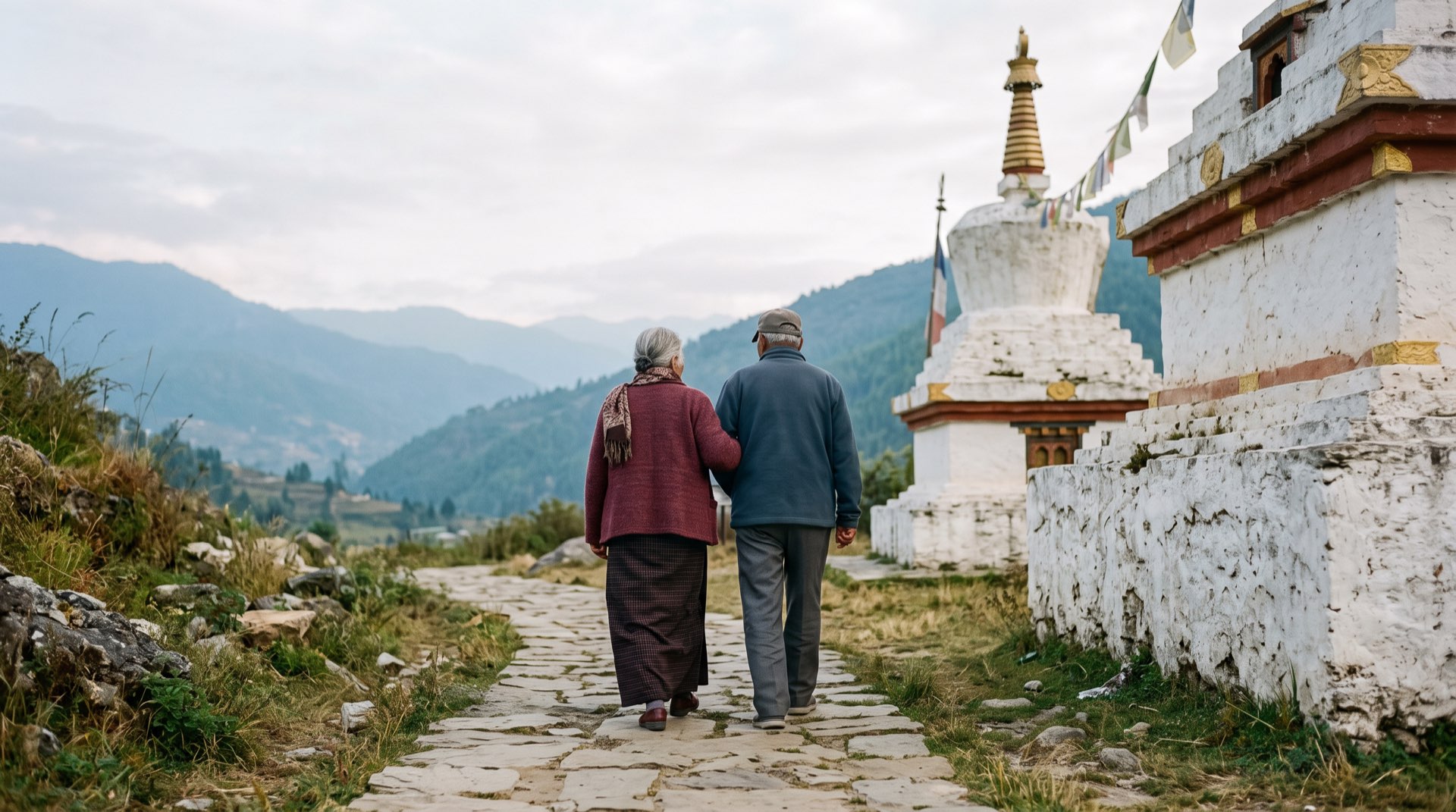
The doorway is lower than you expected, and the wooden threshold rises like a step. Beyond it, a steep timber staircase climbs into the dark, warm with butter-lamp smoke. Your shoes are already in your hand, and a question that has followed you halfway round the world catches up: can I really do this?
If you are travelling in your seventies, or around a new hip, or with someone who needs more support than most brochures admit, it is a fair question and it deserves a straight answer. Bhutan is not step-free. It can still be one of the kindest places to travel slowly, if the journey is built around you.
Here is the map, drawn from what we know and marked plainly where we don’t.
| At a glance | Detail | Source |
|---|---|---|
| Step-free? | No. Steep stairs, raised thresholds and uneven courtyards are normal at dzongs and temples | Our judgement, not an official rating (Bhutan Luxury Travel, 2026) |
| The country’s own view | In July 2026 the national broadcaster reported that most infrastructure is not disability-friendly | BBS |
| Hospitals | One hospital, in Thimphu, offers surgery and emergency treatment; elsewhere, basic care | UK Foreign Office |
| Insurance | Not mandatory since 23 April 2024, strongly recommended | Department of Tourism |
| Altitude | Risk applies to sleeping at about 2,450 m or higher, and sometimes lower; people over 50 have slightly less risk | CDC |
| Tiger’s Nest horses | Pre-booking required for all guests since 2 April 2023 | Department of Tourism |
| Checked | 30 September 2026 |
Is Bhutan suitable for older travellers?
Often yes, when the journey is built around your pace, and much less so when it is built around a checklist. Three things matter more than your birthday: how many steps you can manage in a day, how long you can sit in a car, and whether you have a condition that needs specialist care close by.
Some of Bhutan works in your favour. A guide must accompany every visitor at all times, the Department of Tourism says, and on our journeys yours is private, with your own driver and a vehicle that stops when you ask. We rate The Soul of Western Bhutan as easy to moderate.
Some of it works against you: stairs, thin air, winding roads, and hospitals that grow simpler beyond Thimphu. None of that is a reason to stay home; all of it is a reason to plan. If the whole family is coming, see our guide to multi-generation journeys in Bhutan.
Is Bhutan wheelchair accessible?
Not in the way most wheelchair users would need, and we would rather tell you now than at the temple door.
The national broadcaster BBS reported in July 2026 that most of the country’s infrastructure is not disability-friendly, and described a Thimphu workshop where planners, engineers and architects were learning to audit facilities for accessibility. It concerned daily life for Bhutanese people, not tourism, but it is the country describing itself.
What follows is our own judgement, not an official rating. Dzongs and temples were built for defence and devotion, not ramps: expect raised timber thresholds, uneven courtyards and stairs closer to ladders. If you use a wheelchair all day, many great interiors will be out of reach. If you walk short distances, or use a stick, far more is open.
We don’t publish a list of accessible sites, because we won’t guess. Tell us exactly what you need, and we check each site and lodge for your dates, and say plainly if a day wouldn’t work.
Which sights need stairs, and which don’t?
The stairs cluster in dzongs, temples and the Tiger’s Nest; most of the rest is gentle.
| Stop | What it asks of you | Our read |
|---|---|---|
| Dochula pass, about 3,100 m | A roadside stop for coffee among 108 chortens (Buddhist shrines) | Little walking; cool, thin air |
| Thimphu sights | Sightseeing by vehicle with gentle walking | Gentle |
| Punakha valley | Dzong courtyards, a riverside picnic, rice-terrace paths | Gentle, apart from the steep wooden stairs into the dzong |
| Chimi Lhakhang | An optional walk through rice fields to a small temple | Gentle, on a field path |
| Khamsum Yulley Chorten | An optional short hike | A steep climb after a bridge crossing; skip it without guilt |
| Tiger’s Nest | 5–6 hours return, several hundred stone steps | The hardest day, and always optional |
Shoes come off at every temple door, as our guide to dzong and temple etiquette explains, so slip-ons and socks you like beat smart boots. Bring the stick or poles you already trust, and let your guide say which stairs repay the effort. Skipping one is a good way to see a temple: the courtyard, the light and the tea are still yours.
How do altitude and long drives affect you?
For most older travellers, the roads tire more than the altitude. The CDC puts the risk on travellers going up to a sleeping altitude of about 2,450 m or higher (and sometimes lower), says people over 50 have slightly less risk, and says fitness makes no difference. It adds that day trips ending back on lower ground are much less stressful than sleeping high.
That suits Bhutan. On our routes you sleep at about 2,300 m in Thimphu, which sits close to that line, then 1,200 m in Punakha and 2,200 m in Paro, and visit Dochula (3,100 m) and the Tiger’s Nest (3,120 m) for a few hours. Our guide to altitude and health in Bhutan has the detail.
The exception is a heart or lung condition. The CDC advises travellers with coronary artery disease, chronic lung disease or obstructive sleep apnoea, even when well controlled, to see a doctor who knows high-altitude medicine before they go.
Then the drives: 1–1.5 hours from Paro to Thimphu, 2.5–3 hours on to Punakha, and 4–4.5 hours from Punakha back to Paro. The vehicle is private, so we stop for a stretch or tea whenever you ask, and give the longest drive a day with little else in it.
What is medical care like, and what insurance do you need?
Good in Thimphu, basic elsewhere, and limited for anything complex. The UK Foreign Office says one hospital, the Jigme Dorji Wangchuck National Referral Hospital in Thimphu, can provide surgery and emergency treatment, while hospitals outside the capital generally give only basic care. Complex treatment means evacuation to India or Thailand. English is widely spoken, and doctors are likely to speak some. In an emergency, call 112 for an ambulance.
That is why insurance matters more for an older traveller than any packing list. It has not been mandatory since 23 April 2024, but the Department of Tourism strongly recommends it, and the Foreign Office advises cover for treatment abroad, emergency helicopter evacuation and repatriation.
The Foreign Office notes that the legal status of some medicines differs between countries, so carry a printed list of yours in their original packaging. Your guide is with you every day, and our team is on call around the clock. For the wider picture, see how safe Bhutan is.
Can a horse help at the Tiger’s Nest?
For part of the way up, yes; for the steps and the whole descent, no. The monastery sits at about 3,120 m, roughly 900 m above the valley floor, according to the Department of Culture. A horse saves your legs, not the last stretch.
One rule is official. The Department of Tourism’s announcement says that from 2 April 2023 every guest must pre-book horse riding for the Taktsang trail, under a requirement from Paro district; without a booking, guests wait their turn, decided by the on-site team. The notice doesn’t say how far up the horses go. In our experience it is part of the ascent, never the descent, and only when the path and the horses’ welfare allow.
So tell us before you travel if you might want one, so it can be booked ahead. Riding needs balance and the ability to mount and dismount, so mention your hips and knees. Our guide to the Tiger’s Nest hike has a five-question self-test, and the cafeteria viewpoint halfway up shows the whole monastery, with tea.
How should the journey be paced?
Slowly, with fewer moves and a rest after every big day. These are our rules of thumb, not official guidance.
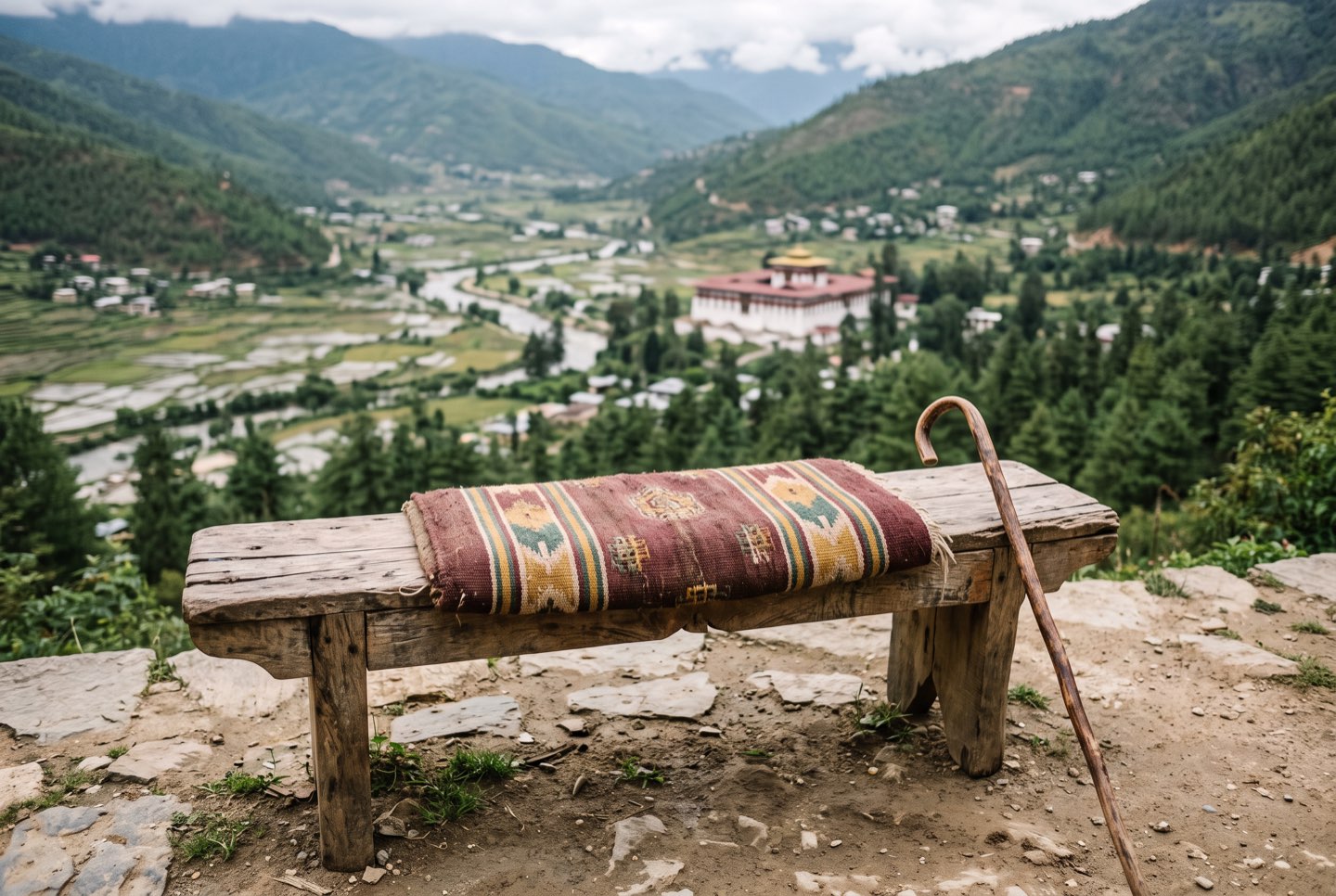 A wooden bench with a wool cushion at a Paro viewpoint, a walking stick resting against it.
- One big thing a day, early, then an empty afternoon.
- Two nights or more in each valley, so you unpack once.
- The Tiger’s Nest late in the trip, after several nights in the country, ideally with an extra night in Paro so you climb fresh.
- Eight days where six would be brisk. The Soul of Western Bhutan gives the long Punakha-to-Paro drive a day of its own. Our guide to how many days in Bhutan explains the trade-offs.
- A day in hand before any onward flight. Paro flights operate only in daylight and good visibility, so we suggest at least 24 hours.
Then tell us your good hours. Some people are bright until noon and gone by three; some are the reverse.
Frequently asked questions
Can I visit with a walking frame?
For part of the trip, yes; for a lot of it, no. Frames struggle with raised thresholds and steep stairs, so many temple interiors would be out of reach, while views from the road stay open. Tell us how far you walk, and we’ll say which days would work.
Do lodges have lifts or ground-floor rooms?
We can’t say in general, because it depends on the lodge, the suite and the year, and we won’t guess. Ask us, and we check for the lodges we would propose for your dates: a step-free route, a shower with a seat, a suite near the dining room.
Can I skip the Tiger’s Nest?
Yes. It is optional on both of our western journeys, and Paro has its own dzong and National Museum to fill the day. Nothing else on those journeys asks as much of your legs.
What should I ask my insurer?
Whether existing conditions are accepted in writing, whether walking to 3,120 m is covered, whether your age changes the terms, and whether evacuation from remote areas is included. Read the wording itself before booking anything you can’t cancel.
Bhutan won’t flatten its stairs for you, but it will happily slow down to match yours.