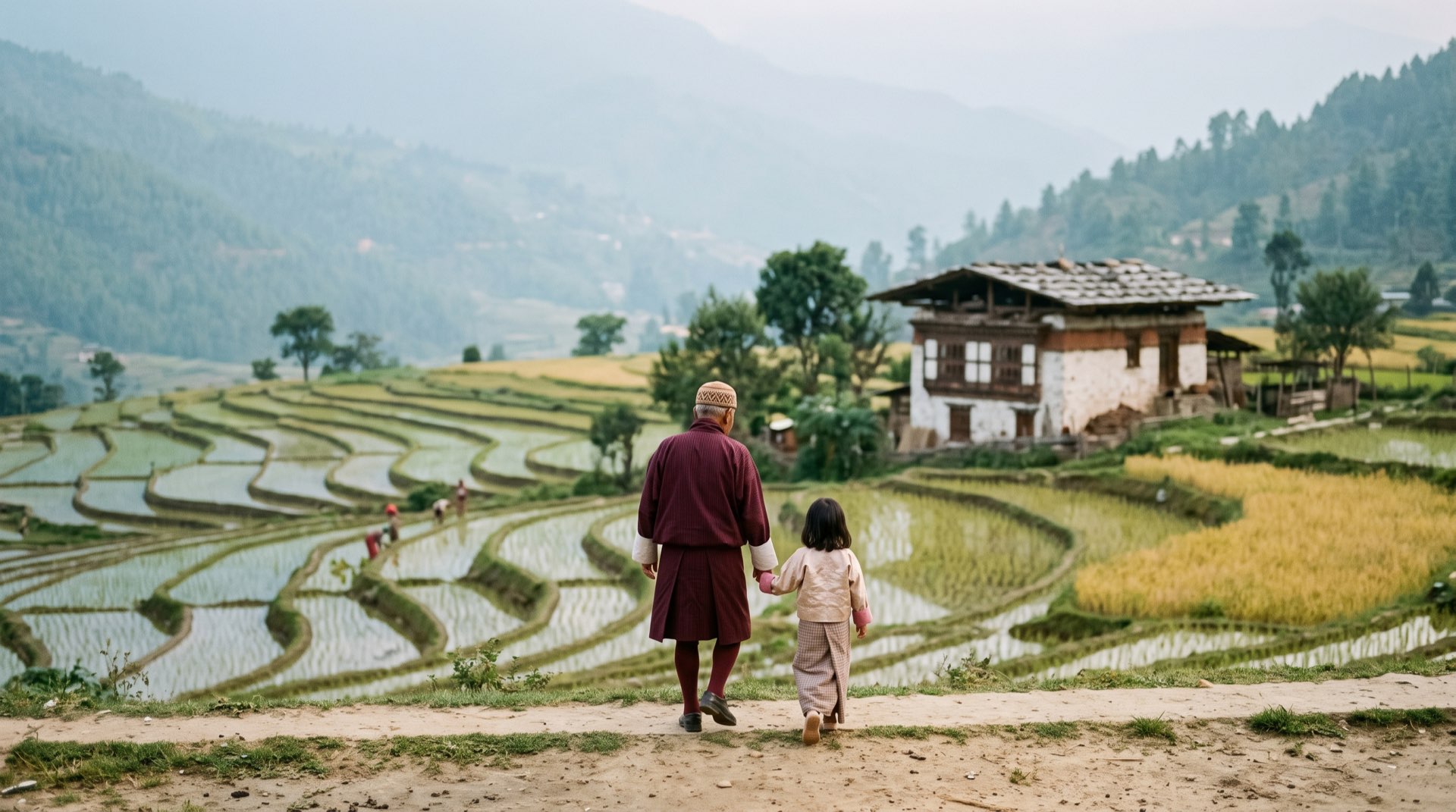
The path beside the rice terraces is flat, which is exactly why we chose it. Up ahead, a small hand has found a bigger one, and the two of them are walking at precisely the same speed: slowly, stopping to inspect every interesting stone. Behind them, the rest of the family has quietly given up pretending to be in a hurry.
If you are planning Bhutan for three generations, you probably arrived here with a list of worries. Will your parents manage the steps and the altitude? Will the children last through a morning of temples? Will anyone enjoy the drives? All reasonable, and all solvable. What follows is the pacing we use to make a family journey work for everyone, from the grandparent who wants a bench with a view to the teenager who wants a phone signal.
| At a glance | Detail | Source |
|---|---|---|
| SDF for children | Under 6: none. From 6 until they turn 12: US$50 a night, half the adult rate of US$100 | Department of Tourism |
| Altitude | Children are as susceptible as adults; risk applies mainly from a sleeping altitude of about 2,450 m | CDC |
| Healthcare | Surgery and emergency care at the national referral hospital in Thimphu; generally basic care elsewhere | UK FCDO |
| Longest drive on our western loop | Punakha to Paro, about 4–4.5 hours, with stops | Bhutan Luxury Travel, 2026 |
| Step-heavy sites | Tiger’s Nest (several hundred steps; horse for part of the ascent only); steep dzong and temple stairs | Bhutan Luxury Travel, 2026 |
| Checked | 27 September 2026 |
Can grandparents and grandchildren both love Bhutan?
Yes, and often for the same reasons. Bhutan is a country of small, vivid things: prayer wheels you can spin as you walk past, butter lamps flickering in a dim temple, red chillies drying on farmhouse roofs, prayer flags snapping on a ridge. A seven-year-old and a seventy-year-old notice them at the same pace, which is rarely true at home.
It is also a place where the day is naturally paced for families. Nobody rushes you through a temple, lunch is a proper sit-down affair, and the drives, while slow, pass through villages and forests worth looking at.
The honest catch is that the two ends of your family want different things from a day and have different amounts of energy to spend. Grandparents may want a quiet courtyard and a long conversation; children want to climb, spin and throw. Plan for both, and Bhutan gives each of them plenty. The rest of this guide is about how, and if you’d like the thinking behind our unhurried style, start with slow luxury in Bhutan.
What is the honest physical picture?
Gentle in some ways, demanding in others. Altitude comes first. The CDC notes that children are as susceptible to altitude illness as adults, that fitness doesn’t change the risk, and that very young children may show it as loss of appetite, irritability or pallor rather than a headache. The passes and the crane valley sit high: Six Senses puts Gangtey at about 3,000 m. Our guide to altitude and health in Bhutan explains what to watch for.
Then the steps. Temple and dzong stairs can be steep, and the Tiger’s Nest has several hundred stone steps near the top. A horse can carry a rider on part of the ascent only, conditions and the horses’ welfare permitting, and everyone walks down.
Healthcare is worth knowing about if a grandparent has a medical condition. The UK government says the national referral hospital in Thimphu can provide surgery and emergency treatment, while hospitals elsewhere generally offer basic care, and complex cases may need evacuation to India or Thailand. Travel insurance isn’t mandatory in Bhutan, but the Department of Tourism strongly recommends it, and so do we.
Which pacing rules do we use?
A handful of simple ones, and we stick to them.
Two or more nights in each valley. Fewer packing mornings, more time to settle, and a lodge that starts to feel like home.
One big thing a day. A dzong in the morning, lunch, then a free afternoon. Children run off their energy; grandparents rest their legs.
Steep things on fresh mornings. Temple stairs and the Tiger’s Nest go early, and only after a few nights in the country.
Climb gradually. Punakha, at around 1,200 m, is a warm, gentle place to settle. Higher valleys come later in the journey.
Break up the drives. Mountain roads are slow, and the monsoon, from June to September, can affect transport, the Department of Tourism notes. We stop for tea at the passes, for a farmhouse lunch, and for anyone who needs a moment. If someone in the family is prone to car sickness, bring whatever usually helps.
For a first family visit, a short western loop such as Rivers, Dzongs & Bliss keeps the drives modest and the days easy.
What do children love?
Archery, animals and anything they can spin. Archery, or da, is Bhutan’s national sport, and at COMO Uma Paro archery lessons are among the complimentary activities. Even small children can hold a bamboo bow with a little help; hitting the target is optional, and so, frankly, is hitting the ground in front of it.
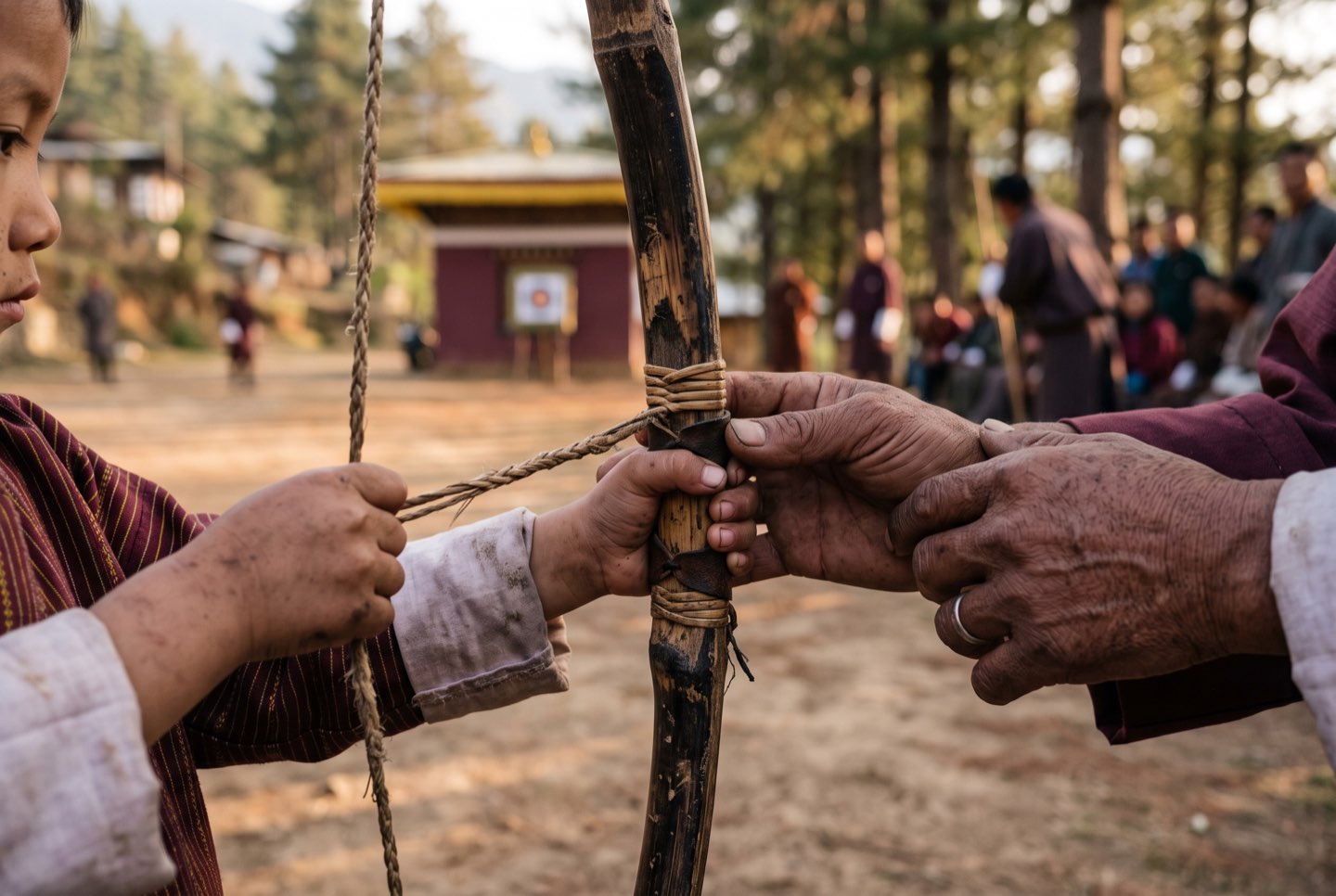 Small hands on a bamboo bow, steadied by a grown-up’s, in the late light of an archery field.
Prayer wheels are another favourite. Your guide will show them how to turn each one clockwise as they walk past, and most children quickly appoint themselves in charge of every wheel in the building. Butter lamp lighting, farmhouse kitchens and the masked dances of a festival hold their attention too.
The Tiger’s Nest can work for children who are used to walking; they often bound ahead of their parents. For younger ones, we set a nearer goal, such as the cafeteria viewpoint halfway up. Our guide to the Tiger’s Nest hike has an honest self-test for the whole family.
One gentle warning: stray dogs. The Department of Tourism asks visitors to keep their distance, especially with children, which is easier said than done with a dog-loving eight-year-old.
What do grandparents love?
Time, mostly. Time to sit in the courtyard of Punakha Dzong and watch the light move across it. Time with a thangka painter, an artist of Buddhist scroll paintings, while a figure takes shape brushstroke by brushstroke. Time to ask a guide about faith, family and farming, and to hear the answer properly.
Many grandparents also love the warmth of the Punakha valley, a hot-stone bath at the end of the day, and coffee among the prayer flags at the Dochula pass, where 108 chortens, or Buddhist shrines, crown the ridge.
The key is permission to skip. If the family is climbing to the Tiger’s Nest, a grandparent can have a slow morning at the lodge, visit a quieter temple in the valley, and meet everyone for lunch with a full set of stories to trade. Nobody needs to prove anything.
We plan the drives around them too, with a window seat and stops before anyone has to ask.
What do children pay (the SDF)?
Less than adults, and the youngest pay nothing. The Sustainable Development Fee is a nightly levy paid by visitors. According to the Department of Tourism, adults pay US$100 a night, children from 6 until they turn 12 pay US$50, and children under 6 pay no SDF at all. Somewhere, a six-year-old is being told this is the price of growing up.
Monument entrance fees follow a similar logic: the same official page says children under 18 pay half, and children aged five and below go free.
On our journeys, the visa, the SDF and monument entrance fees are included, so there is nothing extra to pay at the gate. Our guide to Bhutan’s Sustainable Development Fee explains what the fee funds and why it exists.
How do you choose lodges for families?
Look for space, an easy first transfer and something to do on a rainy afternoon. Six Senses Punakha has two- and three-bedroom villas, the largest sleeping up to twelve, which lets three generations share a front door without sharing a bathroom.
COMO Uma Paro is about ten minutes from the airport, a small mercy after a long flight with tired children, and its COMO Shambhala facilities include an indoor pool for the day the weather turns.
Size matters too. Some lodges are very small, with just eight suites, so a large family can fill a good share of the rooms. That is a reason to book early, not to avoid them. Our guide to choosing Bhutan’s luxury lodges walks through each valley, and we are happy to suggest pairings that suit your particular mix of ages.
Frequently asked questions
What’s the minimum age?
Bhutan’s own fee rules make provision for children under six, so even babies can come. In practice, the question is how a child copes with winding roads and a new routine, and for toddlers we plan shorter drives and more time at the lodge.
Is it wheelchair friendly?
Only partly, and we would rather tell you now. Many dzongs and temples have raised wooden thresholds, uneven courtyards and stairs that are closer to ladders, so some sites are out of reach. Tell us exactly what you need, and we will check each site and lodge room before we plan.
Are there family rooms?
Yes, in several lodges. Six Senses Gangtey and Six Senses Bumthang each have a two-bedroom villa, and elsewhere we ask for neighbouring suites so everyone stays close.
Can we split up for part of a day?
Yes. Every visitor in Bhutan must be accompanied by a guide, so for two separate outings we add a second guide and vehicle. It is a common pattern on the Tiger’s Nest day: the climbers leave early, and the rest of the family meets them for lunch.
Three generations, one unhurried pace. Bhutan has a way of making everyone the same age for a while.