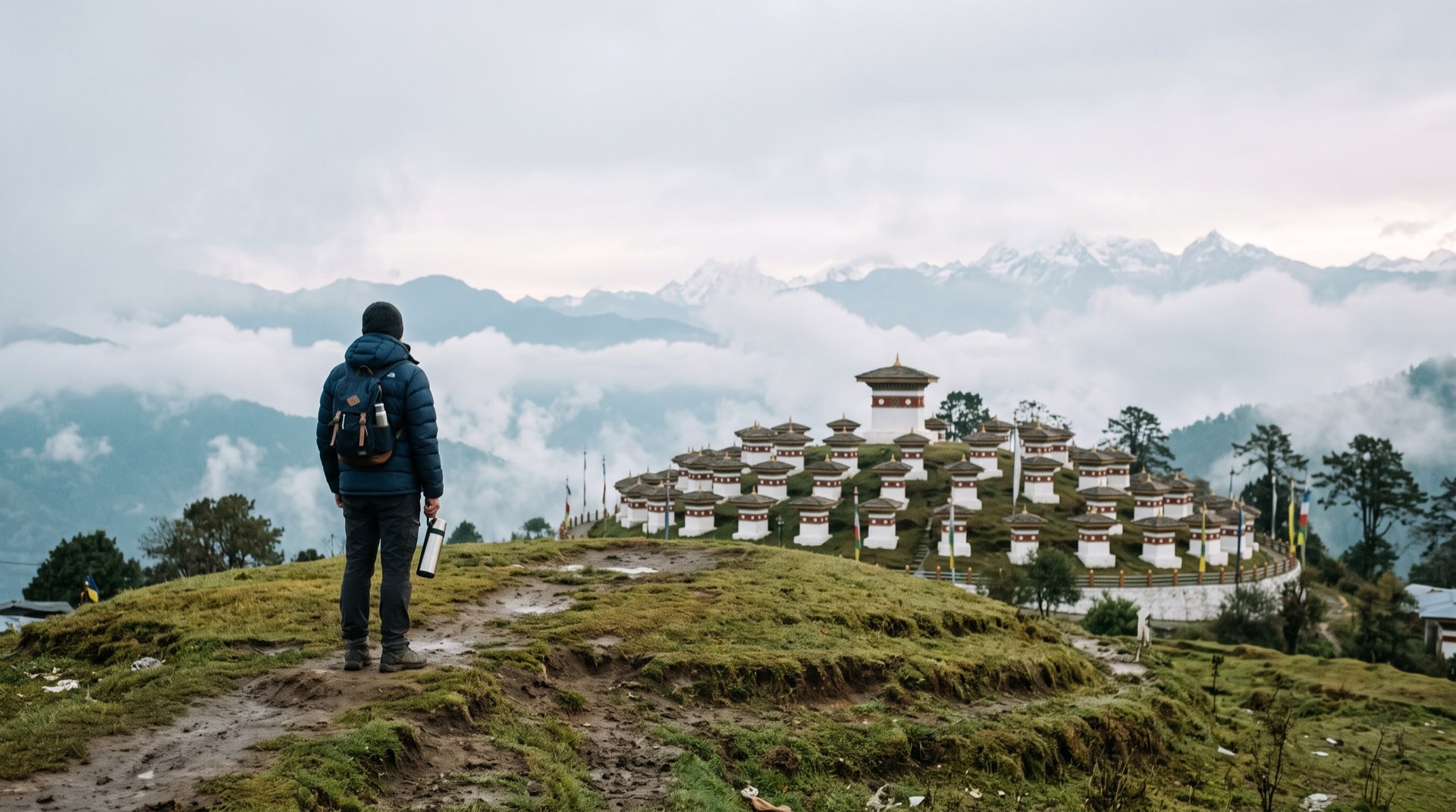
The first sign is usually the stairs. You climb to your room on your first evening in Thimphu, reach the top, and find yourself breathing as if you had jogged there. Nothing is wrong. The air up here simply carries less oxygen than the air at home, and your body is taking notes.
For many travellers, that is the whole story. But if you’re planning a trip with a parent in their seventies, a heart that needs watching, or simply a healthy respect for your own limits, you want more than a cheerful “you’ll be fine”. You want the real altitudes, the honest risks and a plan.
That is what this guide is for. It isn’t medical advice, and it doesn’t replace your doctor. It is what we would tell a friend over a cup of tea in Thimphu.
| At a glance | Detail | Source |
|---|---|---|
| Most journeys | Between about 1,200 m (Punakha) and 3,100 m (Dochula pass); the road east to Bumthang crosses passes of about 3,400 m | Bhutan Luxury Travel, 2026 |
| Highest point on a classic western route | The Tiger’s Nest, about 3,120 m, for a few hours | Department of Culture |
| When altitude illness becomes a risk | Mainly when sleeping at about 2,450 m or higher | CDC |
| Travel insurance | Not mandatory since 23 April 2024, but strongly recommended | Department of Tourism |
| What it should cover | Medical treatment, emergency helicopter evacuation and repatriation | UK Foreign Office |
| Hospital care | Surgery and emergency treatment at the national referral hospital in Thimphu; basic care elsewhere | UK Foreign Office |
| In an emergency | Call 112 for an ambulance | UK Foreign Office |
| Checked | 27 September 2026 |
How high does a typical journey go?
Lower than many people expect, with a few high moments. Most nights on a classic route are spent between about 1,200 m and 3,000 m, and the highest points are places you visit rather than places you sleep.
| Stop | Roughly | What you do there |
|---|---|---|
| Punakha | 1,100–1,300 m | Sleep in the warm, low valley |
| Paro | 2,200 m | Land, sleep, walk |
| Thimphu | 2,250–2,650 m | Sleep, explore the capital |
| Phobjikha | 2,900–3,000 m | Sleep in the crane valley |
| Dochula pass | 3,100 m | Stop for tea and the view |
| Tiger’s Nest | 3,120 m | A half-day hike |
| Passes on the road east | 3,400 m | Drive over, stop for the view |
Thimphu spreads across its valley between 2,248 m and 2,648 m, according to Thimphu Thromde, the city authority (thromde means municipality), so where your hotel sits makes a small difference. Phobjikha, the high wetland valley where black-necked cranes spend the winter, is the highest place many journeys stay overnight. Dochula, the pass crowned with 108 chortens (Buddhist stupas), is higher still, but you stop there for tea and the view, then drive down into the warmth of Punakha.
Figures vary by a few dozen metres between sources; these are the round numbers we plan with. If this is your first visit, our guide to planning your first trip to Bhutan puts them into the wider picture.
Will you feel the altitude?
Perhaps a little, and usually in small ways: shorter breath on stairs, a lighter sleep the first night, a mild headache that fades. That is your body adjusting, and it’s normal.
The CDC notes that altitude illness is mainly a risk for travellers sleeping at about 2,450 m or higher. Paro sits below that line and Thimphu straddles it. Phobjikha sits above it, which is one reason it usually comes after a few nights lower down, not on day one.
The NHS lists the classic signs of altitude sickness as headache, loss of appetite, feeling sick, tiredness, dizziness and difficulty sleeping. Its advice is simple: go up gradually, drink enough water and avoid alcohol. It also advises against flying straight to high altitude, and Paro, at about 2,200 m, lands you below the 2,500 m mark the NHS uses. (Our guide to flying into Paro covers the landing itself.) We would add one thing: the welcome drink will keep until the second evening.
If symptoms get worse rather than better, say so straight away. Going lower is what the CDC advises when that happens, and in Bhutan a lower valley is usually a drive away, not an expedition.
What about the Tiger’s Nest?
For most reasonably active travellers it is very doable, because you climb to 3,120 m for a few hours and then come back down to sleep in Paro. The altitude matters less than the effort.
That effort is real. The monastery sits roughly 900 m above the valley floor, the return walk takes about 5–6 hours, and the last stretch is several hundred stone steps, down and then up again. Stairs at this height humble everyone, including those of us who live here.
Think twice, and speak to your doctor first, if you have a heart or lung condition, or knees that dread steps. A horse can carry you part of the way up (never down), and the cafeteria viewpoint halfway is a perfectly good summit, with the whole cliff in front of you.
We place the climb towards the end of a journey, after several nights in Bhutan, so your body has had time to settle. Our full guide to the Tiger’s Nest hike includes a five-question self-test to help you decide how far to go.
What should you pack for health and comfort?
Your own medicines first, then a few small comforts for mountain roads and mountain sun. Bring enough of any regular medication for the whole trip plus a few spare days, in original packaging, with a copy of the prescription. The UK Foreign Office points out that the legal status of some medicines differs between countries, so check anything unusual before you fly.
Bhutan’s roads follow rivers and ridgelines, and they bend constantly. Drives are measured in hours rather than distance, and your vehicle is private, so you can stop whenever you like: for a stretch, a photograph, or simply a still horizon.
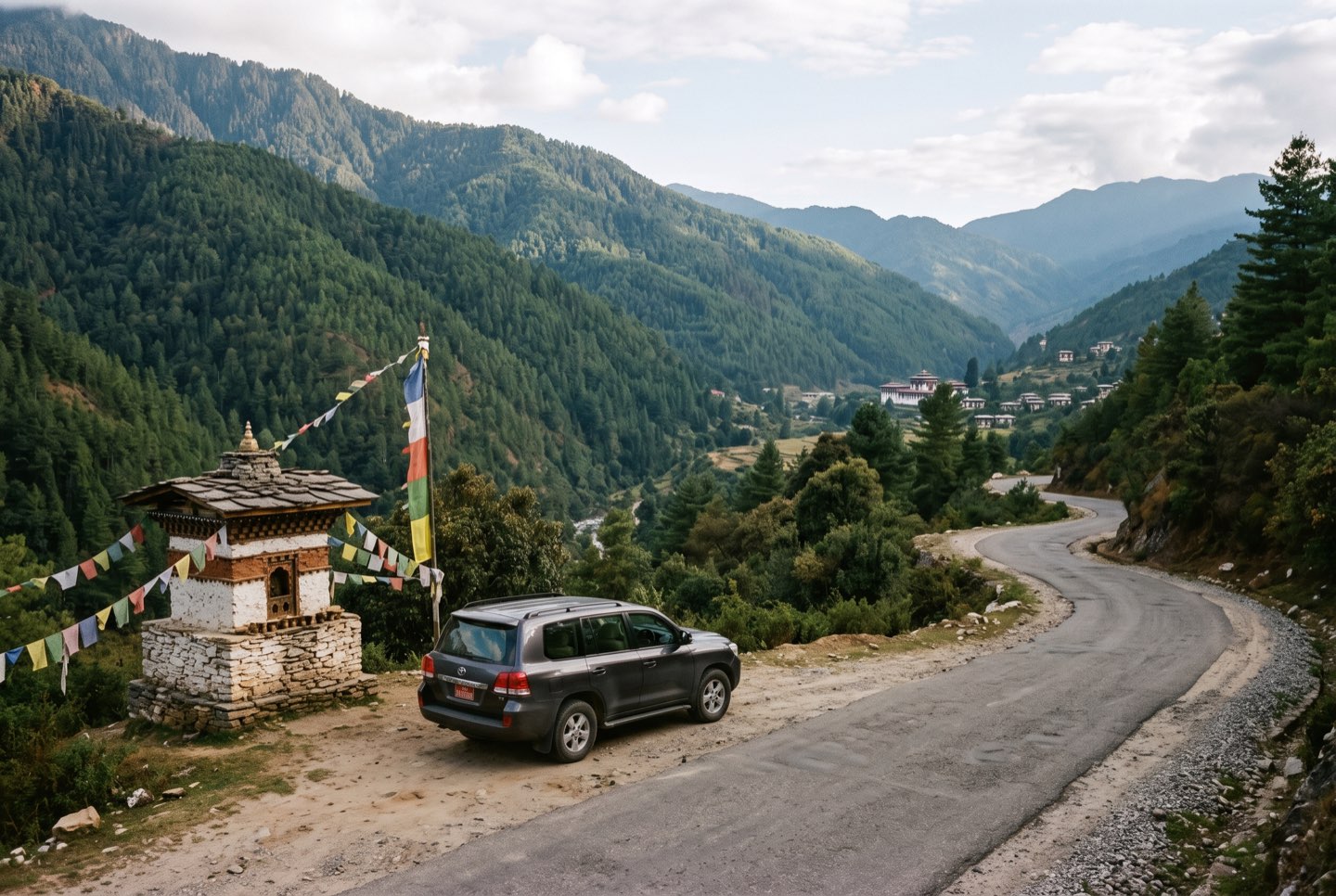 A pause at a roadside viewpoint, prayer flags above a winding mountain road.
The rest is simple. Pack lip balm and a high-factor sunscreen, because the sun at altitude is stronger than it feels. Add a warm layer for early mornings and high passes, and a refillable bottle; bottled water is included on every journey with us.
What is medical care like in Bhutan?
Good in Thimphu, basic elsewhere, and limited for anything complex. According to the UK Foreign Office, the Jigme Dorji Wangchuck National Referral Hospital in Thimphu can provide surgery and emergency treatment, while hospitals outside the capital generally offer basic healthcare. For more complex treatment, it says you would need evacuation to India or Thailand.
That sounds stark, but it is simply the reality of a small mountain kingdom, and it is the main reason we talk about insurance so directly. In an emergency, the number to call is 112 for an ambulance.
You won’t be navigating any of this alone. Your private guide is with you every day, and our team offers support around the clock while you are in the country.
One request from us: if you feel unwell, tell your guide early. It’s the one moment in Bhutan when we’d ask you not to be polite.
What should your travel insurance cover?
Medical treatment, emergency helicopter evacuation and repatriation, at the very least. Insurance hasn’t been mandatory for visitors since 23 April 2024, but Bhutan’s Department of Tourism still strongly recommends it, and the UK Foreign Office advises cover for exactly those three things.
Before you buy, check:
- Evacuation: helicopter and air ambulance to a hospital outside Bhutan.
- Existing conditions: declared to the insurer and accepted in writing.
- Altitude: any limit on walking height, and whether 3,120 m for the Tiger’s Nest sits inside it.
- Age: any upper age limits or changed terms for older travellers.
- Delays: cover for held flights and missed connections, because mountain weather keeps its own timetable.
Read the policy wording itself, not just the summary, and do it before you travel. One quiet evening with the small print buys a great deal of calm.
Can you travel with a health condition, or at any age?
Very often, yes, with a conversation with your doctor first and a route shaped around you. The CDC advises that people with conditions such as coronary artery disease, chronic lung disease or obstructive sleep apnoea see a doctor familiar with high-altitude medicine before they travel. Take your draft itinerary, with the altitudes above, to that appointment.
Then tell us what your doctor said. Because every journey is private, we can plan lower nights, shorter walking days and longer lunches, or swap a night in Phobjikha for an extra one in Punakha. Age on its own is rarely the question; pace is.
If three generations are coming together, our guide to multi-generation journeys in Bhutan looks at pacing a trip so that every generation enjoys it.
Frequently asked questions
Do I need altitude medication?
That is a question for your doctor rather than for us. The CDC notes that acetazolamide, a prescription medicine, can speed acclimatisation, and the NHS suggests speaking to a GP or travel clinic if you have had altitude sickness before.
Are the roads bad for motion sickness?
They wind a lot, so if you’re prone to it, plan ahead. Sit in the front, keep your eyes on the horizon, eat lightly before long drives, and ask your pharmacist about remedies before you leave home.
Is the tap water safe?
We suggest you don’t drink it untreated. Stick to bottled, filtered or boiled water, and use it for brushing your teeth too if your stomach is sensitive.
Which vaccinations should I ask my doctor about?
The CDC lists hepatitis A and typhoid for most travellers to Bhutan, alongside routine vaccines such as measles, and suggests others, like rabies or Japanese encephalitis, depending on your plans. The UK Foreign Office recommends checking at least eight weeks before you travel.
Travel at the pace your body likes, and Bhutan will meet you there.