The first sound of a trek morning is a zip. Then come boots on frosted grass, a kettle muttering in the cook tent, and a mug of tea appearing at your tent door before you have quite decided to be awake. Your breath makes small clouds. The ridge above camp is still in shadow.
That is the picture most people carry into their planning, and it is a good one. The worry arrives about a minute later. Which trek? The names all sound magnificent, the lengths run from three days to more than three weeks, and every website sounds very sure of itself. Is “medium” medium for a marathon runner, or medium for you?
We have gathered the Department of Tourism’s own trek list in one place and added the rules we plan by. It is a way to choose well. The mountain still gets the last word.
| At a glance | Detail | Source |
|---|---|---|
| Treks on the official list | 19, graded easy, medium or hard, from 3 to 28 days | Department of Tourism |
| Toughest | The Snowman: 20+ days, above 5,000 m, 13 passes | Department of Tourism |
| Guide | A licensed trekking guide is mandatory for trekking tours | DoT notification, 8 April 2026 |
| Altitude rule | Above 3,000 m, raise your sleeping altitude by no more than 500 m a night (advice the CDC relays); fitness does not lower the risk | CDC |
| Months | Shown here as “months listed by the Department of Tourism” | Department of Tourism |
| Rain | June to September brings about 73% of the year’s rainfall | NCHM |
| Checked | 30 September 2026 |
What are Bhutan’s main treks, side by side?
The Department of Tourism lists 19 treks, from 3 to 28 days, and grades each one easy, medium or hard. Here are ten that show the range, with the Department’s own figures.
| Trek | Days | Grade | Elevation (m) | Months listed |
|---|---|---|---|---|
| Gangtey Trek | 4 | Easy | 2,250–3,120 | Apr–May, Sep–Nov |
| Bumthang Owl Trek | 3 | Easy | 2,250–4,000 | Mar–Jun, Nov–Dec |
| Nabji Korphu Trek | 6 | Easy | 1,000–1,500 | Jan–Apr, Oct–Dec |
| Dagala Thousand Lakes | 6 | Medium | 2,250–4,270 | Apr–Jun, Sep–Oct |
| Druk Path Trek | 7 | Medium | 2,400–4,200 | Mar–Jun, Sep–Nov |
| Merak Sakteng Trek | 7 | Medium | 1,500–4,100 | Mar–May, Sep–Nov |
| Jomolhari Loop | 7 | Medium | 2,500–5,000 | May–Jun, Sep–Nov |
| Jomolhari Trek | 10 | Medium | 2,500–5,000 | Sep–Nov |
| Jomolhari Laya Gasa | 13 | Hard | 2,250–5,005 | May–Jun, Sep–Nov |
| Snowman Trek I | 26 | Hard | 2,850–5,320 | Jul–Oct |
Read the elevation column as the lowest and highest point of the route, not the height of your camps. Read the months as “months listed by the Department of Tourism”. The list is a little surprising in places: it gives the Punakha Winter Trek and the Samtengang Winter Trek no winter months at all. Treat the table as the start of a conversation, not a calendar.
Which Bhutan trek suits a first-timer?
An easy trek of three to six days, chosen by its highest point rather than its name. On the Department’s list that points to the Gangtey Trek (4 days, top of 3,120 m) or Nabji Korphu (6 days, never above 1,500 m). The Bumthang Owl Trek is also graded easy, yet its top is 4,000 m, so the grade cannot be describing the altitude. If altitude is your main worry, trust the elevation column over the grade.
The usual second step is a week: the Druk Path (7 days, medium, 2,400–4,200 m), or Merak Sakteng (7 days, medium, 1,500–4,100 m) if you want villages more than passes. Jomolhari, with a 5,000 m top on the table, is best saved until you have slept high before and liked it.
Our rule of thumb is highest point first, then days, then scenery, which will look after itself. The Tiger’s Nest hike is a fair rehearsal for climbing for hours, though not for a cold night in a tent. If you would like walking without the tent, start with walking in Bhutan.
How high do they go, and why does sleeping altitude matter?
Because the CDC measures risk by where you sleep, not where you walk. It says any unacclimatised traveller going to a sleeping altitude of 2,450 m or higher is at risk of altitude illness. Once above 3,000 m, it relays the Wilderness Medical Society’s advice to ascend no more than 500 m a night in sleeping altitude, and to allow an extra night to acclimatise for every 1,000 m of gain. Then comes the line worth reading twice: training and physical fitness do not affect the risk.
So the marathon runner and the weekend walker face the same odds, and what protects both is time. On the Department’s table, 12 of the 19 treks reach 4,000 m or more, and five reach 5,000 m. The table gives each route’s lowest and highest points, not its camps, which is why a trek company should hand you a day-by-day list of sleeping altitudes before you pay a deposit. Our guide to altitude and health in Bhutan covers the rest, including insurance. None of this is medical advice; your doctor is the right person to ask.
When is the best season for trekking?
Spring and autumn, judging by the table: most treks are listed for March to June and September to November. Those are months listed by the Department of Tourism, not the limit of what an operator can run, and operators often quote wider windows. When a company’s window is wider than the table’s, ask what its crew does when a pass closes.
The Snowman is the exception. Snowman Trek I is listed for July to October and Trek II for June to October, which is largely the wet season. Bhutan’s National Centre for Hydrology and Meteorology puts 73% of the country’s rain in the summer monsoon, June to September. That is worth a question to anyone selling you the trek. For the year month by month, see when to visit Bhutan.
What is the Snowman Trek really like, and who is it not for?
Long, cold, remote and serious. The Department of Tourism calls it the toughest trek Bhutan has to offer: more than 20 days, above 5,000 m, 13 passes. In its table Snowman Trek I runs 26 days and Snowman Trek II 28, both between 2,850 m and 5,320 m.
It is not for you yet if you have never slept high and enjoyed it, or if you cannot set aside a month with a few spare days for weather. It needs a doctor’s conversation first if you have a heart or lung condition, sleep apnoea or sickle cell trait, the conditions the CDC asks people to discuss with an altitude-aware physician. And it is not for anyone who needs a hot shower every evening, which is a perfectly reasonable thing to need.
The Snowman is a goal you can grow into: the Druk Path first, then Jomolhari, then a long conversation with us.
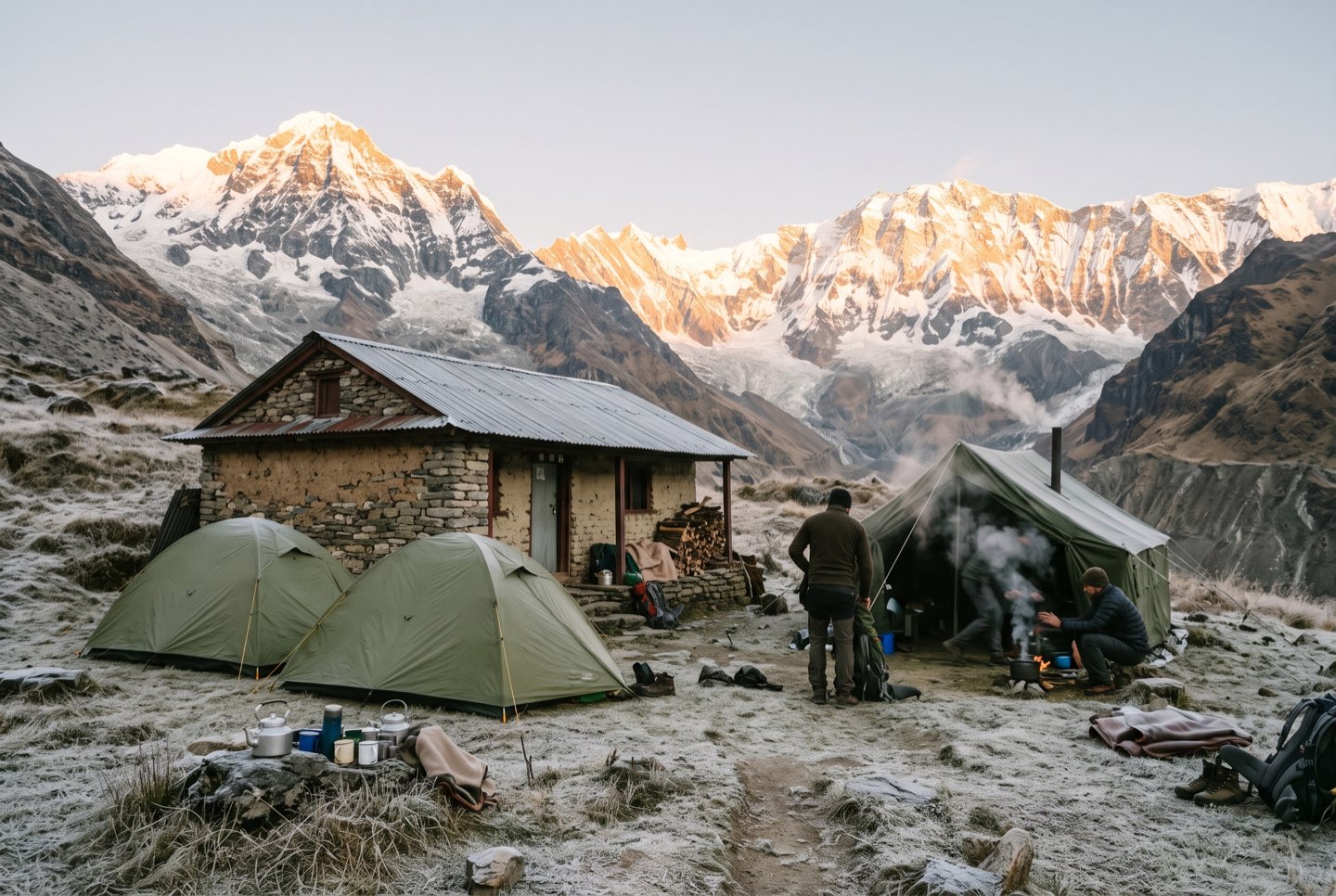 Two dome tents beside a stone hut at dawn, frost on the grass and steam rising from the cook tent.
Do you need a guide for a trek?
Yes, and it must be a licensed trekking guide. The Department of Tourism’s FAQs say all treks must be undertaken with an accredited tour operator or guide. Its notification of 8 April 2026 goes further: tourists must be accompanied by a licensed guide at all times, and a licensed trekking guide is mandatory for trekking tours.
That settles solo trekking before anyone has to argue about it. There is no solo option to plan around, however short or gentle the route. In practice the guide is also the person who reads the weather, the pace and your face at 4,000 m, which is much of what safety means up there. Our fuller answer on whether you need a guide in Bhutan covers the rule for the rest of the country.
What should you ask any trek operator?
Ask for the sleeping altitudes, the rest days, the evacuation plan and the guide’s licence, and ask for them in writing. A good operator will enjoy the questions.
- Sleeping altitudes: where do we sleep each night, and how far up is each move?
- Rest days: where are they, and can one move to the day my body asks for it?
- Licence and training: is the guide a licensed trekking guide, and what first-aid and altitude training does the team hold?
- Going down: who decides, how fast can someone descend, how does the crew communicate, and does my insurance cover it?
- Weather: what changes if it snows or a pass is closed on my dates?
Ask us the same. We design treks and walking extensions on request instead of selling a fixed route, and our first Merak–Sakteng trek dates from March 2009, a story we tell in our guide to going beyond western Bhutan.
Frequently asked questions
Is being fit enough to avoid altitude sickness?
No. The CDC states that training and physical fitness do not affect risk. What helps is an itinerary that climbs slowly and builds in rest.
Is there a trek with lodge stays instead of camping?
The Department’s table does not say where each trek sleeps, so we can’t answer from it. A lodge-based alternative is easy to describe: day walks from a comfortable base, such as a section of the Trans Bhutan Trail or the walks in our guide to day hikes in Bhutan.
Can I trek in winter?
Only a little, and low. The Department lists a single trek for January and February, Nabji Korphu, which stays between 1,000 m and 1,500 m. Winter is the dry season, with only 1% of the year’s rain according to the NCHM, but dry is not the same as warm.
How many days is the Druk Path?
Seven, on the Department’s list. If someone offers you fewer, ask which nights were dropped and whether the sleeping altitudes changed with them.
Pick the trek your lungs will thank you for, not the one your photograph album has been waiting for.