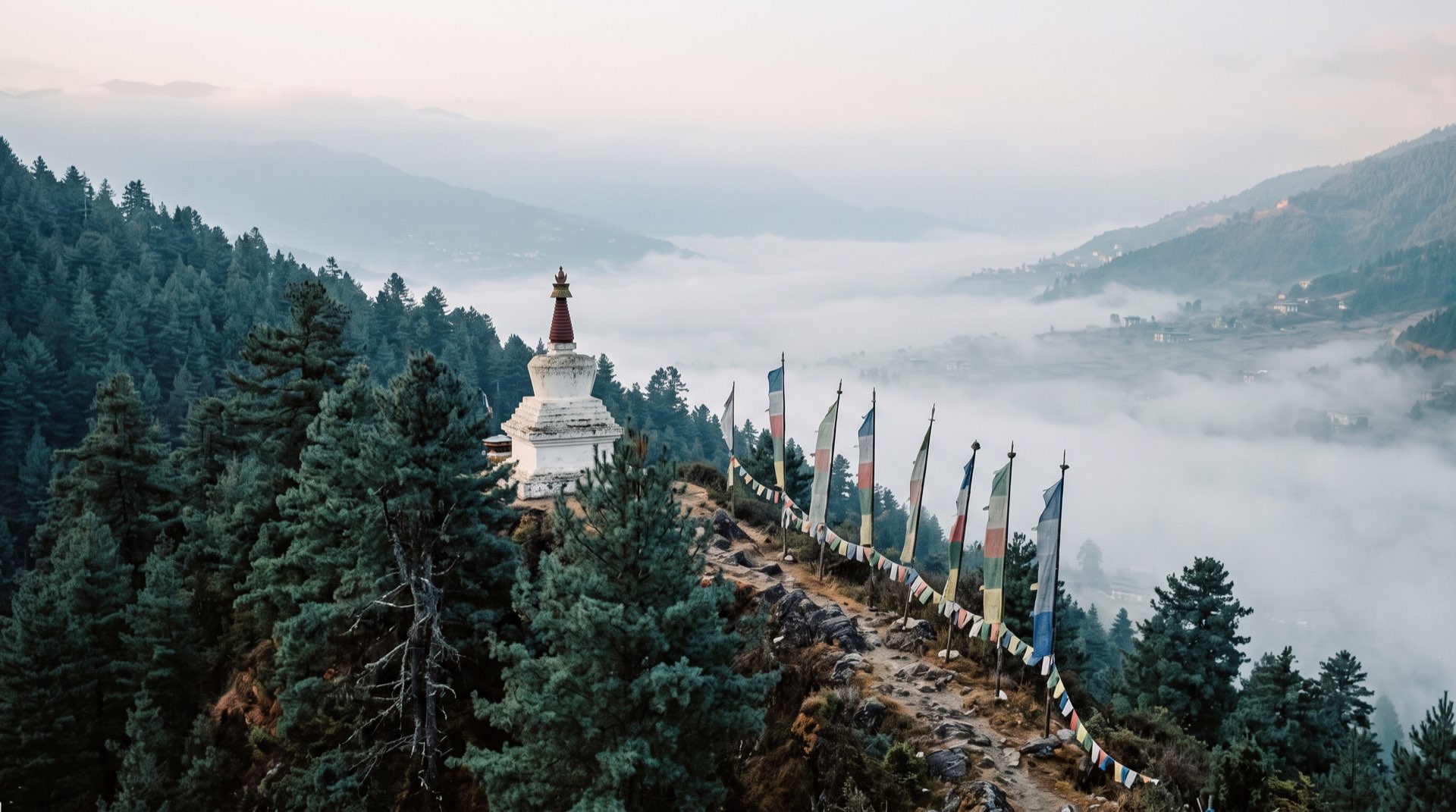
On a school-day morning in Bhutan, the roads fill with children in gho and kira, the national dress, walking in twos and threes with their bags bouncing behind them. Later in the day you might pass a rural clinic, a freshly surfaced mountain road, or an old dzong (a fortress-monastery) whose woodwork is being carefully restored. Part of what pays for all of that is a line on your travel bill.
That line tends to cause a small wobble. Is the fee on top? Do the children pay? Why does every website seem to say something slightly different?
Here is the Sustainable Development Fee, or SDF, set out plainly, with official sources and a worked example you can borrow for your own trip. The short version is reassuring. The longer version is rather interesting.
| At a glance | Detail | Source |
|---|---|---|
| Adult rate | US$100 per person per night | Department of Tourism |
| Children | Ages 6–11: US$50 per night. Under 6: nothing | Department of Tourism |
| Regional rates | India: Nu. 1,200 per person per night. Bangladesh: US$15 (or Nu. 1,200) for the first 15,000 guests each year | Department of Tourism |
| Rate valid | 1 September 2023 to 31 August 2027 | Department of Tourism |
| After August 2027 | No rate announced yet | BBS, September 2026 |
| Refunds | Nights not spent in Bhutan are refunded, minus bank charges | Department of Tourism |
| On our journeys | Included, and shown on its own line in your proposal | Bhutan Luxury Travel, 2026 |
| Checked | 28 September 2026 |
What is the SDF, in one sentence?
It is a nightly fee that Bhutan asks of visitors to fund the country’s long-term development, and it is separate from what you pay for lodges, guides and transport. For most international travellers in 2026, that means US$100 per adult per night.
The fee is set by the government, not by hotels or tour operators, so it is the same whoever you travel with. It used to be higher. From 1 September 2023, the Department of Tourism halved the prevailing rate of US$200 to US$100 and fixed it there until 31 August 2027. When the cut was announced, BBS reported that the aim was to bring visitor numbers back to pre-pandemic levels by 2027.
You pay it in advance, together with the visa. The Department of Tourism’s own visa steps end with paying for the visa application and the SDF, and a tour operator can do all of it on your behalf. With us, that is exactly what happens.
Who pays less?
Children, visitors from India and, up to a yearly limit, visitors from Bangladesh. Children who have not yet turned 6 pay no SDF at all, and children from 6 until they turn 12 pay half, US$50 a night, according to the Department of Tourism. From their twelfth birthday they pay the adult rate, which makes twelve a milestone in more ways than one.
Indian nationals pay a separate rate in ngultrum, currently Nu. 1,200 per person per night, on showing a valid Indian passport or voter ID card. Bangladeshi nationals have a concession of their own: the first 15,000 Bangladeshi guests each year pay US$15 (or Nu. 1,200) per person per night, again according to the Department of Tourism. The scheme began in June 2024 and is set to run until 2027; once a year’s 15,000 places are taken, the standard rate applies. There is also a 24-hour SDF waiver for visitors staying in Bhutan’s southern border towns, which matters only if you are crossing by road rather than flying into Paro.
Otherwise, the rate is refreshingly flat. It is the same in festival week as in a quiet January, and the SDF is the one line on a Bhutan proposal that is identical for a farmhouse stay and a suite with a view of the Himalaya. We find that rather democratic.
Where does the money actually go?
Into the national exchequer, and from there into the country you are travelling through. The Department of Tourism’s own explainer on the SDF lists building schools, providing free healthcare, skilling young people, maintaining forests and wildlife, providing fresh drinking water and renovating historic dzongs. Its FAQ adds training for the tourism and hospitality industry and better infrastructure.
The same explainer is also candid about something many articles leave out: part of the SDF supports the government’s recurrent spending, including salaries and interest on loans. We would rather you heard that from us than discovered it later. A country still has to pay its teachers.
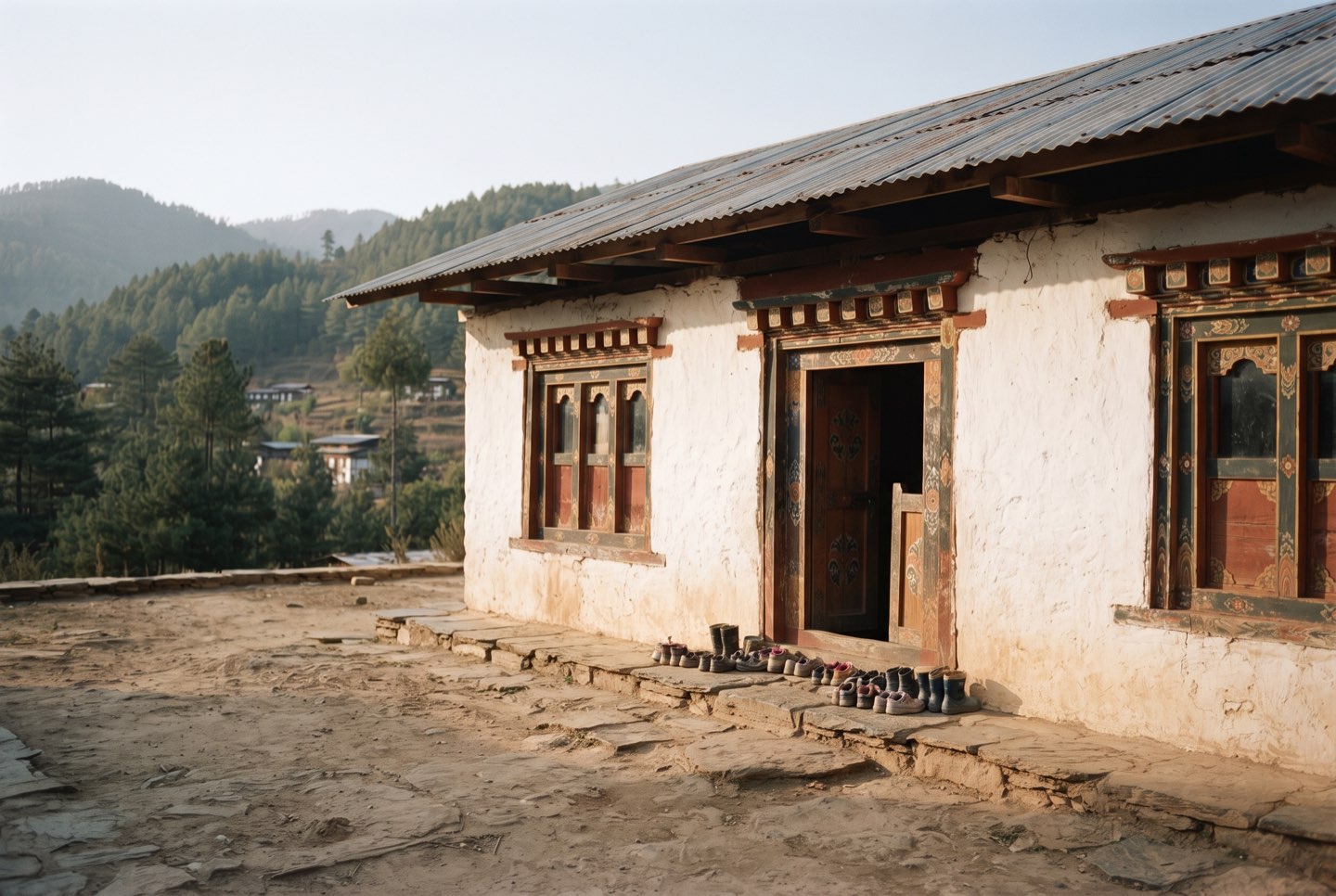 A village school on a sunny morning, and a neat row of small shoes waiting at the door.
This is a country whose constitution requires at least 60 per cent of its land to remain under forest, and which measures progress through Gross National Happiness rather than growth alone. The Department of Tourism describes the SDF as a way of paying it forward: your nights help make sure the next traveller finds Bhutan as good as you did, or better.
Is the SDF included in a Bhutan Luxury Travel journey?
Yes, always. The SDF for your confirmed travel dates is included in every journey we plan, together with your visa, and it appears on its own line in your proposal. That way you can see exactly what goes to the government and what goes into your journey.
We confirm the current rate when we quote, and we pay it for you as part of the visa application, so there is one less international payment for you to make and one less form to fill in.
Why give it its own line? Because it is a fixed government fee that no operator can discount, and because we think you should be able to check our maths. If an offer anywhere seems to make the SDF disappear, it is worth a second look. Someone still has to pay it, for every night.
For the full picture of how a journey is priced, and why no careful operator publishes a single figure, see our guide to what a luxury Bhutan journey costs.
Does the fee really make your trip better?
We think it does, though the argument is more interesting in 2026 than it used to be. The case for it is simple. A fee on every night keeps Bhutan from chasing volume, pays for the forests and dzongs you came to see, and sets a tone: this is a place that asks something of its visitors instead of selling itself cheaply. You notice it in small ways, like a monastery courtyard where the loudest sound is a prayer wheel creaking, or a mountain road with more cows on it than cars.
The complication is that Bhutan also wants more visitors than it has had. The 2023 halving was itself a response to that, and the conversation hasn’t stopped. Hoteliers in the east, where visitors are fewer, have asked for the fee to be waived in their region, and the industry is pressing for clarity on what comes after 2027.
None of this changes the fee on your trip. It simply means that the SDF is a principle Bhutan holds firmly while still debating the details in public, which, when you think about it, is how a principle ought to work.
How do you do the maths for your trip?
Multiply nights by people, using the right rate for each person. It is nights that count, not days, so a journey of eight days and seven nights carries seven nights of SDF, whatever time your flight leaves.
Here is a worked example for a family of four on that seven-night journey:
- Two adults: 2 × 7 nights × US$100 = US$1,400
- One child aged 9: 7 nights × US$50 = US$350
- One child aged 4: no SDF
- Total SDF: US$1,750, plus the one-off US$40 visa fee for each traveller
If the nine-year-old had already turned twelve, the SDF would be US$2,100. If the same two adults came on their own, it would be US$1,400.
That is the whole of the government’s share. Everything else in a proposal, from lodges to guides to that picnic above the river, depends on the choices you make. If you are just getting started, our guide to planning your first trip to Bhutan puts the SDF in context alongside visas, flights and timing.
What might change after August 2027?
Nobody knows yet, and anyone who tells you otherwise is guessing. The US$100 rate runs until 31 August 2027. As of 27 September 2026, BBS reports that no rate has been announced for the period after that. The tourism industry has asked the government for a decision with plenty of notice, and a 2026 regulatory review has recommended a more flexible system, with possible discounts for less-visited destinations.
If you are planning a journey for late 2027 or beyond, we will tell you plainly what is confirmed and what isn’t when we quote, and we will let you know as soon as the government announces anything. Our guide to what has changed for Bhutan travel covers the wider picture.
What seems unlikely to change is the idea behind it: Bhutan wants its visitors to leave something behind besides footprints.
Frequently asked questions
Is the SDF charged for the night you leave?
No. The fee is charged for the nights you spend in Bhutan, so your departure day doesn’t count. And since flights from Paro only operate in daylight, you won’t be leaving late at night anyway.
Do infants pay?
No. Babies and children who have not yet turned 6 pay no SDF at all. They still need their own visa, which we arrange together with yours.
Can the SDF change after I book?
For travel up to 31 August 2027, the rate has been set by the government until then. For later dates no rate has been announced, and we will show you clearly what is and isn’t confirmed before you commit.
What happens to the SDF if my flight is cancelled?
The Department of Tourism says the SDF is refunded by the Department of Immigration for cancelled or shortened trips, minus any bank charges. If weather holds you in Bhutan for an extra night, we deal with the formalities with you on the ground.
Every night you spend here leaves a little behind: in a classroom, a forest, a dzong’s freshly painted woodwork. That seems a fair exchange to us.